Property Title Due Diligence in Costa Rica: A Step-by-Step Guide for Foreign Buyers
Property title due diligence in Costa Rica before buying land or a home. What to check, who to hire, and the common problems that surface when buyers skip the process.


Title due diligence in Costa Rica is not optional and it is not a formality. The National Registry is a public registry system that is generally reliable, but the reliability of the system does not mean that every property in it is clean, clear, and exactly as the seller represents it. Liens, encumbrances, boundary disputes, easement conflicts, environmental restrictions, and the distinction between titled and concession land near beaches are all things the registry contains information about and that a proper due diligence process will surface before they become the buyer's problem.
The buyers who skip due diligence to save a few thousand dollars occasionally get lucky. More often they are the case studies that Costa Rica real estate lawyers use to explain why due diligence matters.
In this article
The National Registry and how it worksStep 1: Title searchStep 2: Titled vs concessionStep 3: Boundary verificationStep 4: Liens and encumbrancesStep 5: Environmental restrictionsStep 6: Uso de suelo and zoningStep 7: Water accessStep 8: Road access and easementsWhat commonly goes wrongFAQThe National Registry and How It Works
Costa Rica's National Registry (Registro Nacional) is the central repository for property records, corporate information, and other legal registrations. Real property is registered by folio real number, a unique identifier that links to all recorded information about the property: current owner, boundary description, area, registered liens, mortgages, encumbrances, and annotations.
The registry is public and searchable. Your lawyer will pull the full registry entry for any property you are considering and read it against what the seller has represented. The registry entry is the authoritative source on the legal status of the property as recorded. What it does not tell you is everything that might affect the property that has not been recorded, which is why the due diligence process involves multiple complementary checks rather than just the registry search.

Step 1: Title Search
The title search reviews the chain of ownership for the property going back a minimum of ten years, and often further. The purpose is to verify that each transfer was properly executed, that the seller at each stage had clear title to convey, and that there are no gaps or irregularities in the ownership history that could give rise to a future claim.
Your lawyer will verify that the current seller's name on the registry matches who you are contracting with, which sounds obvious but is a step that catches discrepancies in corporate structures, name changes, and properties held through entities that have not been properly maintained. Properties held through a sociedad anónima require verification that the SA is current, properly registered, and that the person signing on its behalf has the legal authority to do so.
The title search also reviews all annotations currently on the registry entry. An annotation can be anything: a pending lawsuit, a voluntary lien, a third-party claim. Annotations that are not cleared before closing transfer with the property and become the buyer's issue.
Step 2: Titled Versus Concession Land
This is the most consequential distinction in Costa Rica real estate, particularly for properties near the coast. Titled land is registered in the National Registry with a full fee-simple ownership right that can be held by any person or entity, including foreigners. Concession land, governed by the Maritime Zone Law, covers most of the land within 200 meters of the high-tide line on Costa Rica's beaches and cannot be directly owned by foreigners or by corporations with foreign majority ownership.
The distinction is not always obvious from a physical inspection or a casual description. Some beachfront properties are titled. Some land that appears to be well back from the beach is in the Maritime Zone because of how the high-tide line runs. Your lawyer must verify the land classification against the Maritime Zone maps maintained by INDER and the relevant municipality before you can assess what you are actually buying and whether you can legally own it in the structure you intend to use.
Purchasing concession land without understanding the legal structure required to hold it is one of the more common and expensive mistakes foreign buyers make. Concession rights can be held by foreigners through qualifying legal structures, but this requires specific advice and compliance that is distinct from a straightforward titled land purchase.
Step 3: Boundary Verification
The registry entry for a property includes a reference to its plano catastrado, the cadastral survey registered with the Catastro Nacional. Your lawyer will obtain a copy of the registered plano and a licensed topographer will verify, through a physical survey of the property, that the boundary markers on the ground match the registered plano and that the area of the property matches what is represented.
Boundary discrepancies are common, particularly in older rural properties and in areas where the original surveys were done with less precision than modern GPS-based methods allow. A discrepancy between the registered plano and the actual ground boundaries is not always a disqualifying problem but it is something that must be identified, understood, and resolved before closing. Sometimes this means the registry entry needs to be updated to reflect the actual boundaries. Sometimes it reveals an encroachment problem with a neighbor. Sometimes it reveals that the property is smaller than represented.
The topographic survey that a licensed topographer produces for this verification is distinct from the engineering topographic survey commissioned for construction purposes, though both are often needed for a buildable lot purchase.
Step 4: Liens and Encumbrances
A mortgage or lien on a property in Costa Rica is registered in the National Registry and appears in the property's registry entry. The title search will identify any registered mortgages, voluntary liens, and legal annotations, including the amounts and the beneficiaries. Costa Rica law provides that registered liens follow the property rather than the owner, which means a lien that is not cleared at closing becomes the buyer's obligation regardless of what the seller represented.
Clearing liens at closing is standard practice, where the purchase proceeds are used to discharge any registered mortgages or liens at the time of transfer. Your lawyer manages this process. The key is that the existence of liens must be known before the purchase price is agreed and before any funds change hands, because the cleared-lien property is a different purchase than the same property with a $300,000 mortgage attached.
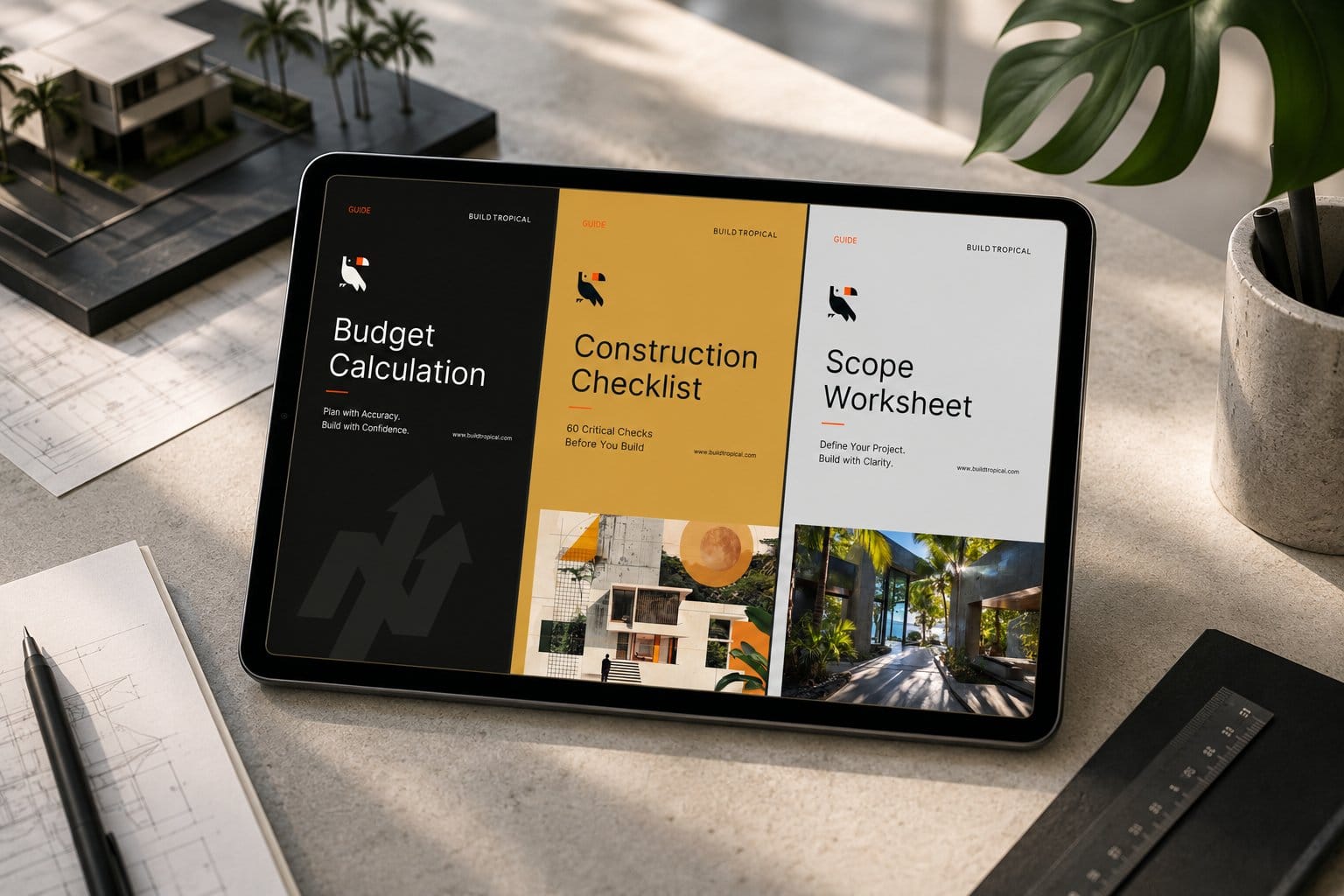
Most budget blowouts in Costa Rica are locked in long before anyone pours concrete — in the scope you never defined and the number you never pressure-tested. Build Ready is the 70-point checklist, scope worksheet and budget model I use to get that on paper before a client talks to land agents, architects or contractors.
See what is inside Build Ready →Step 5: Environmental Restrictions
Costa Rica has active environmental protection legislation. Several categories of land carry restrictions that significantly limit or prohibit construction. Properties within a certain distance of a forest, within a protected area boundary, within a wetland zone, or within a riverine protection zone may have construction restrictions that are not obvious from a physical inspection and are not always disclosed by sellers.
The environmental due diligence check involves reviewing the property against SINAC maps, INDER records, municipal zoning maps, and where relevant, the SETENA environmental management database. A property that appears to be a clean residential lot may be in a restricted zone that prohibits or significantly limits the construction you intended. This check is particularly important for rural properties, hillside lots near forest, and any property near water.
Step 6: Uso de Suelo and Zoning
The uso de suelo, or land use certificate, confirms that the municipal zoning for the property permits the intended use. Residential construction on land zoned for agriculture, commercial use on land zoned residential, or any construction on land zoned for conservation or protection, requires municipal approval that may or may not be obtainable.
The uso de suelo is also required as part of the building permit package. Confirming it before purchase rather than after ensures that your intended construction is actually permitted on the land you are buying. The alternative, discovering after purchase that the zoning does not permit your project, is an expensive problem.
Step 7: Water Access
Water access confirmation is a due diligence step that is frequently omitted and frequently consequential. The check involves confirming with the relevant water authority, either AyA or the local ASADA, that a water connection is available for the specific property and that the system has capacity to serve it. A written letter confirming availability is the document that matters. Verbal assurances from the seller or agent are not a substitute.
For properties outside established water service areas, a hydrogeological assessment of well viability before purchase is the relevant check. We have covered this in detail in our guide to water availability and building in Costa Rica.
Step 8: Road Access and Easements
Confirm that the property has legal road access, not just physical access. A property that is currently accessed via a road across a neighbor's land without a registered easement is vulnerable to losing that access if the neighbor's ownership changes or the relationship deteriorates. Legal road access means an easement registered in the National Registry or a public road boundary.
Also check for any easements that cross the property, which would affect what can be built and where. Power line easements, water line easements, and drainage easements are all common and can significantly affect the usable area of a property.
What Commonly Goes Wrong
The patterns that appear most often in problematic Costa Rica property transactions cluster around a few predictable failures: buyers purchasing without a lawyer and missing registered liens or annotations, buyers relying on the seller's description of the land type without independently verifying titled versus concession classification, buyers purchasing without boundary verification and discovering a significant discrepancy after the fact, and buyers not checking environmental restrictions on rural or coastal lots.
The common thread is the belief that the physical property and the seller's representation are a sufficient basis for a purchase decision. They are not. The registry entry, the boundary survey, the land classification, and the environmental status are separate inquiries that each have the potential to surface material information.
For more on the legal and practical aspects of property ownership in Costa Rica, see our guides to buying land in Costa Rica, beachfront property, and whether foreigners can build in Costa Rica.
Frequently Asked Questions About Property Due Diligence in Costa Rica
What is a title search in Costa Rica and do I need one?
A title search reviews the National Registry entry for a property, verifying the chain of ownership, identifying registered liens and encumbrances, and checking for annotations or claims. It is conducted by a Costa Rican lawyer and is an essential step before any property purchase. Without it, you cannot know the legal status of the property you are buying.
What is the difference between titled and concession land in Costa Rica?
Titled land is registered with full fee-simple ownership rights in the National Registry, open to any buyer including foreigners. Concession land is within the Maritime Zone, governed by a separate law that restricts direct ownership to Costa Rican citizens and qualifying corporations. The distinction is critical for coastal properties and must be verified through your lawyer before purchase.
How long does property due diligence take in Costa Rica?
A complete due diligence process for a residential property typically takes two to four weeks depending on the complexity of the property, the response time of the relevant agencies (water authority, municipality), and whether any issues surface that require further investigation. Rushed due diligence to meet an artificial deadline is a risk not worth taking.
What does property due diligence cost in Costa Rica?
Lawyer fees for a standard residential purchase title search and due diligence run $1,500 to $3,000. A licensed topographer for boundary verification adds $800 to $2,500 depending on the property size and terrain. Environmental and zoning checks may add additional fees. Total due diligence costs of $2,000 to $5,000 are common for a standard residential purchase.
What happens if a lien is found on a property in Costa Rica?
A registered lien on a property can be cleared at closing using purchase proceeds, similar to how a mortgage is discharged in a North American property transaction. The purchase contract should specify that the sale is conditioned on delivery of clear title at closing. Your lawyer manages the lien discharge process and confirms with the registry that the annotation has been removed before the transfer is completed.

James Caldwell is a real estate investor and writer based on the Pacific coast of Costa Rica. He spent fifteen years in commercial real estate in Canada before shifting his focus to the Costa Rica market. He writes for Build Tropical about the numbers behind property decisions, the ones that hold up and the ones that do not.