Home Builders in Costa Rica: How to Find the Right One and What to Expect
Finding a home builder in Costa Rica as a foreign buyer. How the market works, what to look for, how design-build firms differ from independent contractors, and what the process looks like.

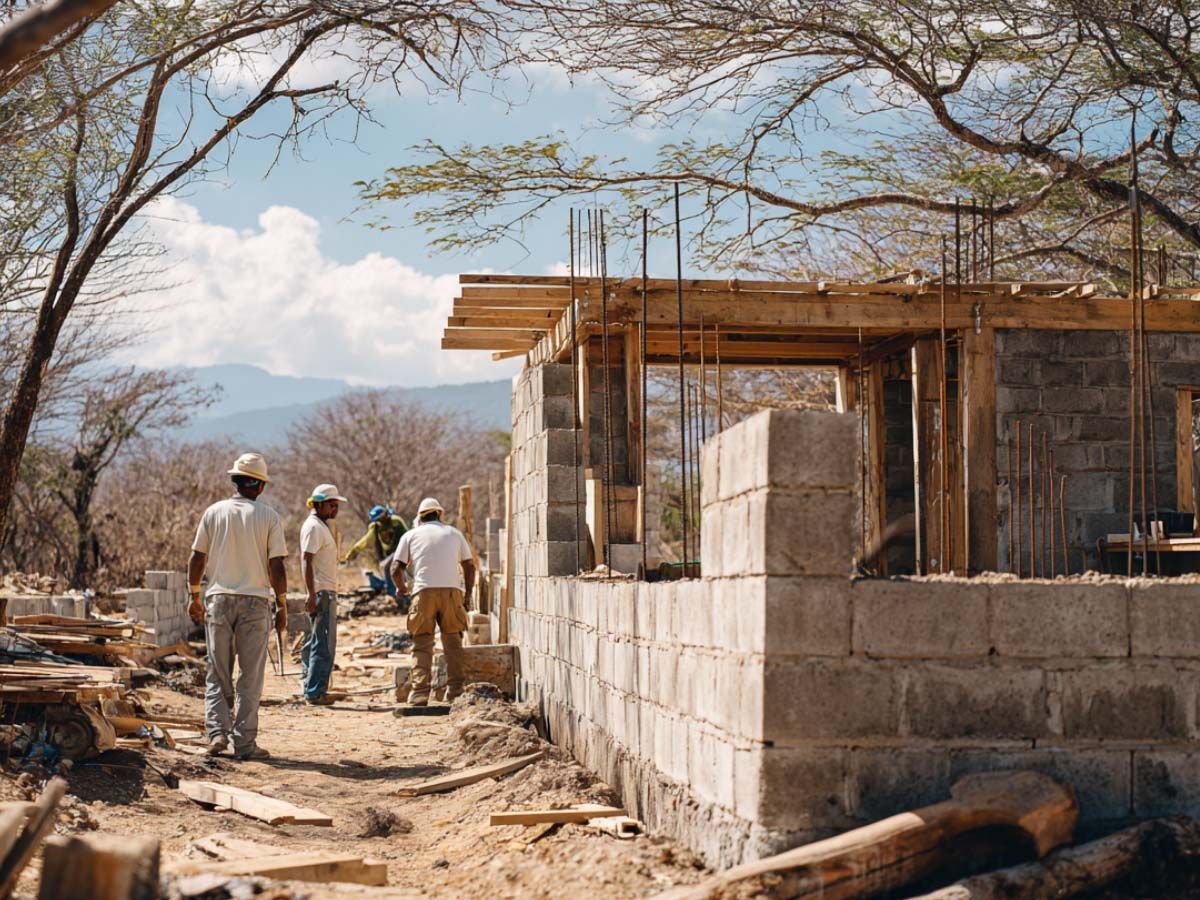
The Costa Rica construction market does not work the way most foreign buyers expect. There is no licensing system for general contractors the way North America and Europe have. There is no single platform where verified, insured, bonded builders are listed with ratings and track records. What there is instead is a fragmented market of independent contractors, small construction firms, and a handful of larger design-build operations, ranging in quality from excellent to very poor, with no reliable external signal that tells you which is which from a distance.
This is not a reason to be afraid of building in Costa Rica. It is a reason to approach the contractor selection process carefully, with the right questions and the right framework for evaluating answers.
In this article
How the construction market worksTypes of builders in Costa RicaWhy you need an architect separate from your contractorHow to find candidatesEvaluating a builderWhat to expect from the processRegional availabilityFAQHow the Construction Market Works
Costa Rica has no government licensing body for general contractors equivalent to a state contractor's license in the US. The CFIA licenses architects and engineers, whose stamps are required on any permitted project, but there is no analogous credential for general contractors. A contractor can legally offer construction services without any formal credential beyond business registration.
This means the vetting burden falls entirely on the client. The market does have internal reputation mechanisms. Contractors who do good work get referrals. Contractors who do poor work or mismanage client funds get known within the expat community, which is small enough that word travels. But these mechanisms are informal and slow, and a foreign buyer arriving new to the market does not have access to them without effort.
The formal quality signal in a Costa Rica construction project is the architect and structural engineer. Their stamps on the plans are the professional credentialing layer that the contractor system lacks. A well-designed project with a competent architect providing construction supervision is more reliably well-built than a project where the contractor operates without design oversight. This is the structural reason we recommend that foreign buyers start with the architect rather than the contractor.

Types of Builders in Costa Rica
The residential construction market divides roughly into three tiers. The first is the independent maestro de obras, a skilled construction foreman who manages a small crew and takes on projects in the $50,000 to $200,000 range, typically smaller homes, renovations, or accessory structures. The best maestros are exceptionally skilled and often represent the most cost-effective way to build a simple project. The risk is that a maestro typically has limited administrative capacity, no contract infrastructure, and may not have experience managing the coordination requirements of a complex project.
The second tier is small to mid-size contractor firms with a principal contractor overseeing multiple crews and projects simultaneously. These firms can handle standard residential projects from $150,000 to $600,000 and have more administrative structure than an independent maestro. The principal contractor may or may not be actively present on your specific site, which is the key question to investigate.
The third tier is established larger contractors who build at significant scale and do so continuously. These firms are worth understanding separately because the constant flow of projects changes what they can offer. A contractor who has ten or more active projects per year can afford to employ a better structural engineer, a more experienced maestro de obras, and senior site staff who stay with the company rather than drifting between employers. The continuity of their workforce is itself a quality signal. Because they are always building, their best people have reason to stay. They have also absorbed the permit and coordination experience that comes from building repeatedly in the same markets. For larger or more complex projects, a well-established contractor at this scale can offer meaningful operational depth that a smaller firm cannot match.
Why You Need an Architect Separate from Your Contractor
The question of whether to use a design-build firm — a single company that handles both architecture and construction — is worth addressing directly, because it gets presented to foreign buyers as a convenient option. In our experience it can turn out very badly, and we do not recommend it.
The reason is structural. When the architect and the contractor are the same entity, there is no independent professional whose job is to verify that what gets built matches what was designed. The oversight role that an architect provides in a well-run project, reviewing work on site, calling out deficiencies, rejecting substandard execution, is eliminated when both parties report to the same management. The client has no one working specifically on their behalf in the field.
This matters less on simple projects where the scope is clear and the margins for error are small. It matters significantly on complex builds, hillside sites, custom homes, or anything involving imported systems or non-standard finishes. These are precisely the projects that most foreign buyers are undertaking.
The correct structure is an architect engaged separately, with a clear construction supervision scope in their contract, and a contractor engaged separately on the basis of drawings that the architect has produced. The architect then reviews the contractor's work throughout the build. This arrangement takes more coordination but provides genuine independent quality control. It is the standard we work from.
How to Find Builder Candidates
Referrals from the local expat community are the most reliable starting point. Talk to people who have built recently in the area where you are building and ask specifically about who built their house and whether they would hire them again. The Costa Rica expat Facebook groups and local community forums are imperfect but useful sources of recent first-hand experience.
Your architect, once engaged, will typically have working relationships with contractors they have collaborated with before and whose work they can vouch for from direct experience. An architect's contractor referral is more reliable than a cold search because it comes with professional accountability on both sides.
For larger contractors, their track record in the specific region where you are building is the starting point. A contractor who has delivered ten or more projects in Guanacaste has absorbed the local permit process, the contractor networks, and the site conditions in a way that a firm operating there occasionally has not. Ask for project references specifically in your geography, not just their best projects wherever those happened to be.
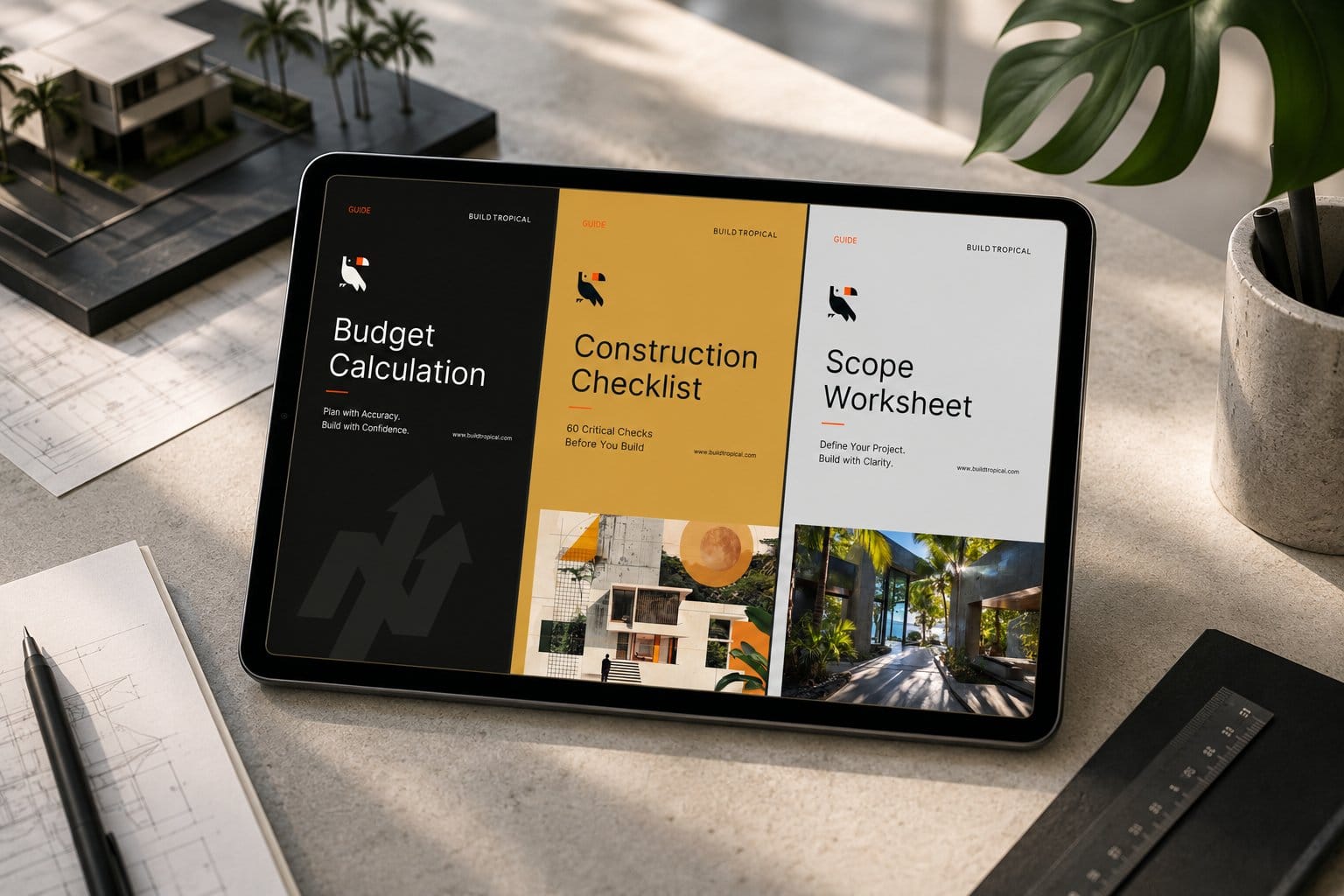
Most budget blowouts in Costa Rica are locked in long before anyone pours concrete — in the scope you never defined and the number you never pressure-tested. Build Ready is the 70-point checklist, scope worksheet and budget model I use to get that on paper before a client talks to land agents, architects or contractors.
See what is inside Build Ready →Evaluating a Builder
Ask for a portfolio of completed residential projects in the region where you are building, specifically projects comparable in size and type to yours. Visit at least one completed project in person. Photographs are useful but insufficient. A site visit shows you finish quality, detailing, and how the building has aged in the specific climate conditions of the area.
Request three references from projects completed in the past two years and call them. Ask the same four questions you would ask of any contractor: did the project finish on schedule, did the final cost match the quote, how were problems handled, and would you hire them again.
Ask who will be present on site daily during your project. The maestro de obras who runs the day-to-day construction is often more consequential for quality than the principal contractor, who may be managing several projects simultaneously. Ask to meet the maestro.
Ask specifically about experience working with foreign clients who are not on site regularly. This is a distinct skill set from managing a local client who visits daily. A contractor who has done this well for other foreign buyers will have communication systems, reporting protocols, and decision-making structures in place. A contractor who has not will be learning at your expense.
What to Expect From the Process
A well-run residential construction project in Costa Rica, from the signing of the construction contract to handover of the finished building, runs 10 to 16 months for a standard home. Foundation to structure is typically 2 to 3 months. Structure to rough-in is 2 to 3 months. Finishes and systems, which is where the most schedule slippage typically occurs, is 4 to 6 months. Complex designs, hillside sites, or projects with significant imported materials extend the timeline.
Payment terms should be milestone-based. Standard advance payments of 10 to 15 percent at contract signing, with subsequent payments tied to inspectable progress stages: foundation complete, structural frame complete, roof complete, rough-in complete, finishes complete. Each payment should follow a site inspection or photo documentation that confirms the milestone has been reached.
Regional Availability
Labor markets and contractor availability vary significantly by region. Guanacaste and the northern Pacific coast have the deepest construction labor pool, with established networks of contractors and subcontractors serving the concentration of foreign buyer activity in Tamarindo, Flamingo, and the Papagayo corridor.
The Southern Pacific, including Uvita and Dominical, has a smaller local construction workforce. Projects in the Southern Pacific often face longer lead times for material delivery and more limited contractor options at the mid to upper quality level. This does not make building there impossible but it does mean the preparation and planning phase needs to account for a different logistics environment.
The Nicoya Peninsula, including Santa Teresa and Nosara, has grown its construction workforce substantially as the market has developed. Experienced contractors working regularly in these markets exist, but the pool is shallower than in Guanacaste and travel costs for materials and specialized trades from the mainland add to project costs.
For more on the construction process, see our guide to hiring a contractor in Costa Rica, our construction timeline overview, and our guide to questions to ask your contractor before signing.
Frequently Asked Questions About Home Builders in Costa Rica
Do home builders in Costa Rica need to be licensed?
There is no government licensing system for general contractors in Costa Rica. CFIA registration is required for architects and engineers whose stamps appear on permitted drawings, but general contractors have no equivalent credential. This makes client-side due diligence, including portfolio review and reference checks, the primary quality assurance mechanism.
What is the difference between a contractor and a design-build firm in Costa Rica?
A contractor builds from designs produced by an architect who is engaged separately by the client. A design-build firm provides both architectural design and construction management under one contract. We do not recommend the design-build structure because it removes the independent oversight that a separately engaged architect provides — there is no one working specifically on the client's behalf to verify that construction matches the design and meets quality standards. The correct structure is an architect engaged separately, with a construction supervision scope, and a contractor working from that architect's drawings.
How much does it cost to build a home in Costa Rica?
Construction costs in Costa Rica run $1,200 to $2,500 per square meter depending on region, finish level, construction method, and site conditions. See our complete cost of building guide for a full breakdown by region and finish level.
How long does it take to build a house in Costa Rica?
A standard residential project runs 10 to 16 months from construction contract signing to handover. This does not include the design phase (2 to 4 months) or the permit process (3 to 6 months after design completion). From the decision to build to keys in hand, 18 to 24 months is a realistic expectation for a mid-size residential project.
How do I find a good home builder in Costa Rica as a foreigner?
Start with referrals from the local expat community and from your architect once engaged. Request a portfolio of completed projects comparable to yours, visit at least one in person, and call two to three past client references. Ask specifically about experience managing projects for foreign clients who are not on site regularly. The contractor's track record with remote client management is as important as their construction quality.
Carolina Vargas is a general contractor based in Guanacaste, Costa Rica. She has built residential and hospitality projects on the Pacific coast for over twelve years. She writes for Build Tropical about the realities of construction from the contractor's side of the table.