Gated Communities in Costa Rica: Costs, Rules, and Who They Actually Suit
Gated communities in Costa Rica offer security and amenities but come with HOA fees, restrictions, and trade-offs worth understanding before buying. An investor's honest assessment.

Gated communities are the most common structure through which foreign buyers in Costa Rica encounter the residential real estate market, particularly at the upper end. The concept is familiar, the sales process is well-organized, and the promise of security, amenities, and a managed community appeals to buyers who are making a major decision from abroad and want to reduce uncertainty. What is less clearly communicated in most sales processes is what life inside a condominium regime actually looks like, what the ongoing costs are, and what constraints come with the property that would not exist on an independent lot.
This is my honest look at what gated communities in Costa Rica actually offer, what they cost, and who they genuinely suit.
In this article
How gated communities work in Costa RicaWhat HOA fees actually coverSecurity and infrastructure benefitsThe restrictions that matterRental rules in gated communitiesResale liquidityWho gated communities suitWho they do not suitFAQHow Gated Communities Work in Costa Rica
A gated community or residential condominium in Costa Rica is established under a condominium regime registered with the National Registry. Each owner holds an individual titled interest in their lot or unit plus a proportional interest in the common areas. The homeowners association manages the common infrastructure, security, and amenity maintenance, funded by monthly dues assessed against each property owner.
The condominium regime's rules are established in the constitutive deed and internal regulations, which are registered documents that bind all current and future owners. These are not suggestions. They are legal obligations that run with the property. Before purchasing in any gated community, your lawyer should review the constitutive deed and regulations in full, because what those documents say about rental activity, construction modifications, pet policies, and use restrictions determines much of what you can and cannot do with the property.

What HOA Fees Actually Cover
Monthly HOA fees in Costa Rica gated communities range from around $200 per month in smaller or less amenity-rich developments to $1,500 per month in large resort-style communities with extensive common infrastructure. The typical range for established communities in places like Guanacaste or Escazu is $300 to $700 per month.
What those fees cover varies by community. Security and gatehouse staffing is the baseline. Roads, drainage, common area landscaping, and lighting maintenance is standard. Communities with swimming pools, tennis courts, gyms, or beach clubs add management costs for those facilities. Some larger communities employ full-time maintenance staff, groundskeeping crews, and administrative personnel.
The things HOA fees typically do not cover are utility connections to individual properties, individual property maintenance, and capital reserves at some smaller developments that have not properly funded their long-term maintenance reserves. Before buying, ask for two to three years of HOA financial statements and ask specifically whether there are any special assessments, which are one-time additional charges beyond the monthly fee, currently in discussion or recently paid. A development with a large deferred maintenance liability and an underfunded reserve is a financial risk that should be priced into the acquisition.
Security and Infrastructure Benefits
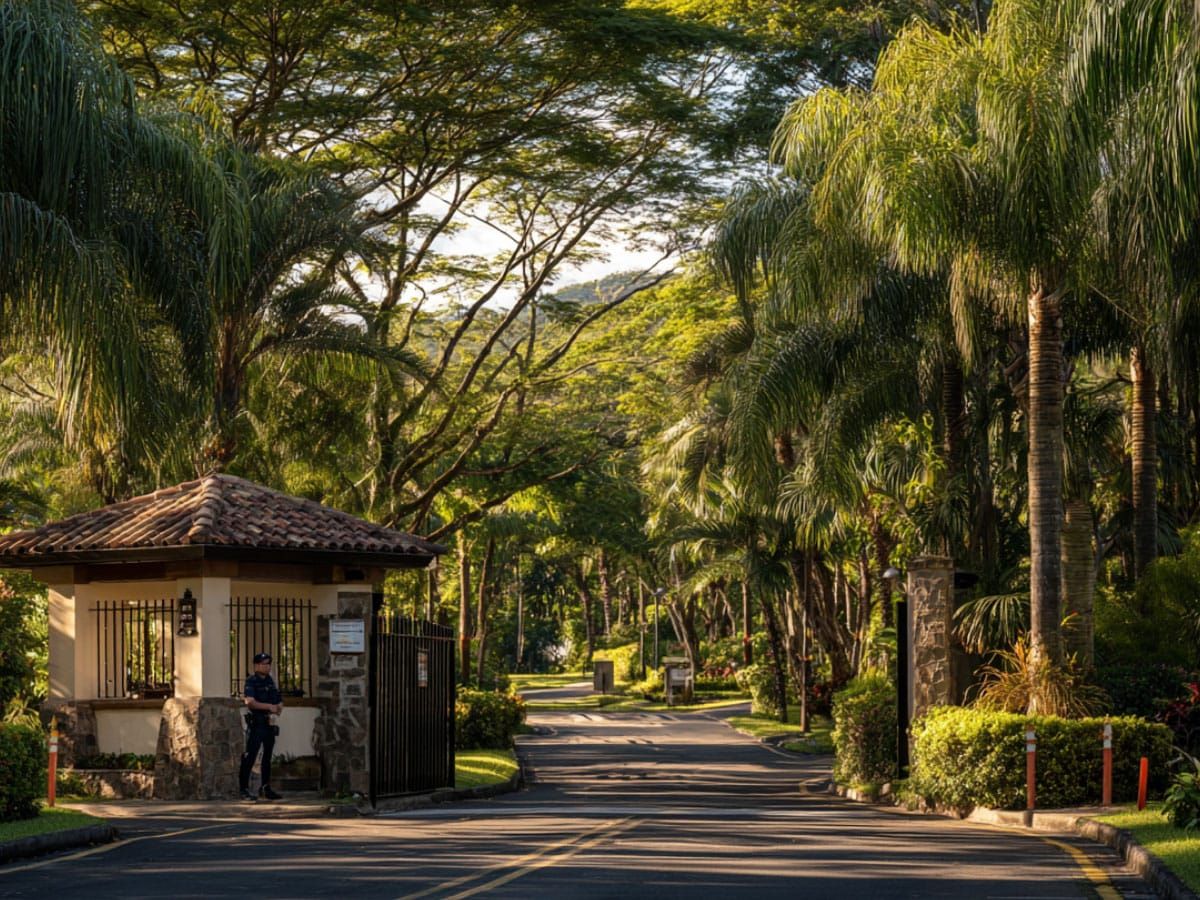
The genuine advantages of a gated community for a foreign buyer, particularly one who is not in the country full-time, are real. A staffed security gate with access control significantly reduces the casual crime risk that unguarded properties in the same area would face. The knowledge that your property is in a managed environment, with neighbors and staff who will notice if something is wrong, is valuable when you are managing from another country.
That said, the quality of security and infrastructure varies enormously across Costa Rica gated communities — far more than the label implies. At one end, there are communities in the Southern Pacific, particularly around Uvita, that are genuinely well-executed: remote, beautiful, fully paved, with professional security and real communal infrastructure. One development worth noting is ESM, where the developer has invested properly in the communal build-out — five communal areas, paved roads, covered structures — a reasonable example of what a serious gated community in an emerging region can look like when the developer follows through. At the other end of the spectrum, there are early-stage developments in areas like Nosara and the Esperanza corridor where the gate exists but roads are unpaved, infrastructure is thin, and the community is still largely a concept rather than a reality. Neither the name nor the price point tells you reliably which one you are looking at. Visit and verify.
The infrastructure benefit is also meaningful where it genuinely exists. Roads within a well-run condominium are typically better maintained than public roads in rural coastal areas. Common area lighting, perimeter walls or fencing, and in larger communities CCTV coverage provide a security layer that an independent property owner in the same area would need to fund independently.
For a vacation home or investment property managed from abroad, the peace of mind that comes from a managed community has a real monetary value, even if it is hard to quantify precisely.
The Restrictions That Matter
The restrictions in a condominium regime that most commonly affect foreign buyers fall into several categories. Design and modification restrictions typically require HOA approval for any exterior changes, additions, or modifications to the property. How strict those restrictions are varies significantly by community and by region. Some established resort communities impose tight aesthetic controls — approved palettes, matching materials, setback rules — that leave little room for design individuality. Others, particularly newer or smaller developments, are considerably more flexible and allow owners to build what they want within basic site parameters. If architectural freedom matters to you, the internal regulations on design approval are worth reading carefully before purchase, not after.
Use restrictions vary widely. Some communities restrict commercial activity including Airbnb rentals, either limiting rental periods, requiring registration, or prohibiting short-term rental entirely. This is not always disclosed clearly in the sales process and it is one of the most consequential restrictions for buyers who are planning an investment property or want flexibility to rent when they are not using the home.
Pet restrictions, vehicle restrictions, noise restrictions, and landscaping requirements are more minor but can affect daily quality of life in ways that buyers from North America, where HOA restrictions exist but are often less enforced, do not fully anticipate.
Most budget blowouts in Costa Rica are locked in long before anyone pours concrete — in the scope you never defined and the number you never pressure-tested. Build Ready is the 70-point checklist, scope worksheet and budget model I use to get that on paper before a client talks to land agents, architects or contractors.
See what is inside Build Ready →Rental Rules in Gated Communities
This is where buyers with investment intentions most commonly encounter surprises. Rental activity within a condominium regime is subject to the community's internal regulations, not just national law. Some communities in Costa Rica actively welcome short-term rental and provide management infrastructure to support it. Others restrict rental to periods of 30 days or longer to maintain a residential rather than hotel character. Others prohibit short-term rental entirely.
The rental rules, their enforceability, and how actively they are enforced vary significantly. Before purchasing a property in a gated community with any rental intention, read the specific rental clauses in the internal regulations with your lawyer. Do not rely on verbal assurances from the sales agent that rentals are fine. Get the specific regulatory text and verify that what you intend to do is explicitly permitted.
Resale Liquidity
Properties in established gated communities tend to have better resale liquidity than comparable independent properties in the same market. The structure is familiar to international buyers, the title is clean and well-defined, and the managed environment appeals to the same buyer profile that bought the property originally. In markets like Guanacaste where the primary buyer is foreign, community properties often sell faster and with fewer complications than independent lots or homes on public roads with less infrastructure.
The trade-off is that a property's value is partially tied to the health of the HOA and the quality of the community's management. A well-managed community with funded reserves, professional administration, and responsive maintenance holds its value. A community with chronic HOA funding problems, deferred maintenance, or conflict among owners does not.
Who Gated Communities Suit
Gated communities suit foreign buyers who are not in the country full-time and who value the peace of mind that comes from a managed environment. Buyers who want a straightforward purchase with clear infrastructure, no uncertainty about road access or utility connections, and a resale market that is familiar to other international buyers. Buyers who are investing in a property that will be rented through a community management program and who want the operational simplicity of a managed rental structure.
They suit buyers who are less interested in design flexibility and more interested in the security of a known product.
Who They Do Not Suit
Gated communities are less well-suited to buyers who want maximum flexibility in how they use and modify their property. Independent-minded buyers who will find HOA restrictions frustrating rather than reassuring. Buyers who want to build something architecturally distinctive, because the design controls in most communities will limit how far from the approved aesthetic they can go. And buyers who are doing the return calculation carefully, because the HOA fee is a fixed cost against rental income that can meaningfully reduce the net yield compared to an equivalent independent property.
For more on the broader land and property market, see our guides to buying land in Costa Rica and property titles and due diligence in Costa Rica.
Frequently Asked Questions About Gated Communities in Costa Rica
How much are HOA fees in Costa Rica gated communities?
Monthly HOA fees range from approximately $200 to $1,500 depending on the development, its amenities, and the size of the community. The typical range for established Guanacaste or Central Valley communities is $300 to $700 per month. Before buying, review two to three years of HOA financial statements and confirm whether any special assessments are pending.
Can I rent my property on Airbnb if it is in a gated community in Costa Rica?
It depends entirely on the community's internal regulations. Some communities explicitly permit short-term rental. Others restrict rental to 30-day minimums or prohibit it altogether. This must be verified by reviewing the specific regulatory text with a lawyer before purchasing, not by relying on verbal assurances from the sales agent.
What is a condominium regime in Costa Rica?
A condominium regime is a registered legal structure established under the Ley Reguladora de la Propiedad en Condominio that governs properties within a gated or managed community. It gives the homeowners association legal authority to assess dues, enforce use restrictions, and manage common areas. The rules are registered documents that bind all current and future owners.
Are gated communities safer in Costa Rica?
Generally yes, compared to unguarded independent properties in the same area. A staffed security gate with access control, perimeter fencing, and common area monitoring reduces casual crime risk meaningfully. However, security quality varies significantly between communities — from professional security firms with 24-hour coverage and fully paved infrastructure to early-stage developments where the gate is the only feature that qualifies as security. Evaluate the actual setup during a visit, ask about road conditions, communal infrastructure, and HOA financial health rather than relying on the sales presentation.
Do gated communities in Costa Rica hold their value?
Properties in well-managed gated communities with funded HOA reserves and professional administration generally hold their value and offer better resale liquidity than comparable independent properties. Properties in communities with chronic funding problems, deferred maintenance, or management conflicts carry more risk. Due diligence on the HOA's financial health is as important as due diligence on the property itself.

James Caldwell is a real estate investor and writer based on the Pacific coast of Costa Rica. He spent fifteen years in commercial real estate in Canada before shifting his focus to the Costa Rica market. He writes for Build Tropical about the numbers behind property decisions, the ones that hold up and the ones that do not.