The Hidden Cost of Paradise: Why Construction in Costa Rica Breaks People
The costs that break Costa Rica builds aren't the ones people budget for. An architect's honest breakdown of import taxes, design changes, and the real price of building remotely.
The cost of building in Costa Rica surprises almost everyone. Not because they did not budget — most people who get far enough to break ground have thought about money. It surprises them because the numbers they budgeted against were wrong before they started. They were working from an incomplete picture, and the items missing from that picture tend to arrive not as polite line items but as emergencies mid construction, when the project is already committed and the leverage is gone.
I am going to describe the costs that actually break builds. Not the obvious ones — material costs, contractor fees, basic site work. The ones that come later, the ones that compound, and the one that is almost entirely within the client's control to avoid.
In this article
The import tax realityThe distance premiumDesign changes: the most expensive mistakeProfessional fees that get forgottenWhat the site itself costsThe emotional costHow to go in with eyes openFAQ
The Import Tax Reality
Costa Rica manufactures a fraction of what goes into a modern home. Electrical components, plumbing fixtures, cabinetry hardware, specialty glazing, roofing membranes, insulation systems, kitchen appliances — most of this comes in from the US, Europe, or elsewhere in Latin America. And most of it carries an import duty, a value-added tax of 13 percent, and logistics costs that together add between 30 and 60 percent to the price of the item before it reaches the job site.
The practical consequence: a kitchen appliance package that costs $12,000 in the US costs $16,000 to $19,000 landed in Costa Rica, depending on what is in it and how it was shipped. A skylight system designed for a roof detail costs three times what the same product would cost installed in Florida. Specialty windows — large format, high-performance glazing — are significantly more expensive here than in North American markets, and the lead times can be 8 to 14 weeks from the point of order.
The solution is not to refuse to use imported materials. It is to know which items on your finishes schedule carry the import premium and to cost them correctly from the start. I build the import cost into every specification document I produce. Contractors who do not are not necessarily being dishonest — they may be quoting what the item costs at source, which is what they know. The landed cost is what matters.

The Distance Premium
Most people who build in Costa Rica do not live in Costa Rica while they build. They are in the US, Canada, or Europe, managing a construction project in another country over video calls, WhatsApp messages, and periodic site visits. That distance has a cost that never appears in a construction quote.
The first category is site visit costs. For a client doing a serious 12 month build, I typically expect six to ten trips to the site — foundation inspection, framing review, rough-in walkthrough, finishes selection, punch list, and handover, plus the unexpected ones that arise when a decision needs to be made in person. At $800 to $1,400 per round trip from a US city plus accommodation and ground transport, that is $8,000 to $20,000 in travel that most initial budgets do not include.
The second category is time. Managing a construction project remotely is a part-time job that most clients do not fully account for until they are in it. Reading drawings, responding to contractor questions, reviewing invoices, making decisions on material substitutions, resolving disputes — these tasks accumulate.
The third category is what happens when no one is watching. This is not a claim that Costa Rican contractors are dishonest. It is a structural observation about construction in any country: work quality, material substitutions, and schedule adherence all respond to supervision. A project with an on site owner or a trusted local project manager moves differently than one where the owner appears every six weeks. If you cannot be present and cannot hire someone to be present on your behalf, that gap in oversight has a cost that materializes in the punch list or, worse, after handover.
Design Changes: The Most Expensive Mistake
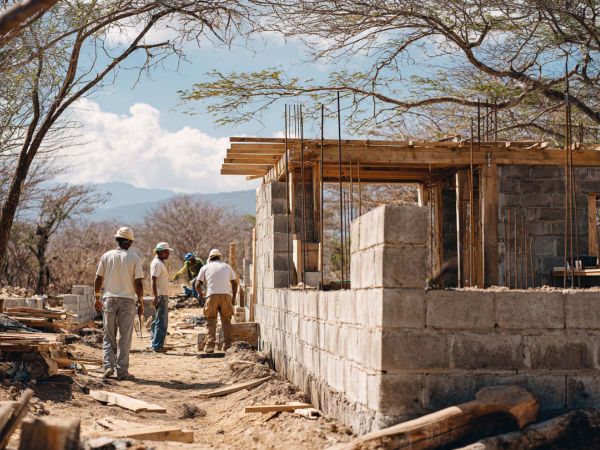
This is the cost I have seen break more projects than any other, and it is the one most within the client's control. In a concrete block or concrete frame structure, changing something mid construction is not a matter of redrawing a line. Concrete sets. Columns are poured. Block walls are laid. A window that moves 60 centimeters to the left after the lintels are in requires cutting block, relocating structural steel, repouring, and replastering. The direct material and labor cost of that change might be $800. The schedule impact is two to three days minimum. On a project with ten such changes, the cumulative cost in money and schedule can exceed $20,000 and add four to six weeks to the build.
The structural reason for this is worth understanding. In wood frame construction — what most North American clients are familiar with from watching renovation shows — walls can be moved, openings can be cut, and the structure can be modified with relatively minor effort. Concrete and block cannot. The design decisions made on paper in a concrete building are essentially permanent once construction starts.
The right response is to decide everything before construction starts. Every opening position, every room dimension, every ceiling height, every electrical outlet, every light fixture location, every plumbing rough-in. This is not an unreasonable demand — it is what construction documents are for. The problem is that not all architects treat the design phase as genuinely non-negotiable before breaking ground. Some will accept a rough brief, start producing construction drawings, and allow clients to keep refining during construction because it keeps the client engaged and the project moving. That approach transfers the cost of incomplete design decisions onto the construction budget, where they are 10 to 20 times more expensive to resolve.
The architect you want for a Costa Rica build is one who will not break ground until every decision is made. Who treats the design phase as a complete and closed process before construction begins. Who has enough professional confidence to tell a client "we are not starting until this is resolved" and mean it. That quality is not universal among architects here, and it is worth asking directly in your first conversation: what is your policy on design changes after construction begins? The answer tells you a great deal about how your project will run.
The Professional Fees That Get Forgotten
A construction permit in Costa Rica requires a structural engineer's stamp on the structural plans and calculations, an architect's CFIA registration on the architectural drawings, and sign-off from various other technical professionals depending on the project and location. These are required by law, and any contractor who tells you he can start without them is building illegally or has obtained the permits through channels you do not want to know about.
The costs: a topographic survey on a complex or sloped lot runs $800 to $2,500. A soil study, which is required on many sites and strongly recommended on all of them, runs $1,500 to $3,500 depending on the number of borings and the laboratory analysis required. CFIA registration fees for the architectural and structural plans are calculated on the project value and typically run $3,000 to $8,000 for a mid sized residential build. Environmental permits through SETENA, required on sites above a certain development threshold, add $1,500 to $10,000 depending on the complexity and the municipality.
None of these appear in a contractor's construction quote. They are the client's responsibility to organize and fund, typically before construction starts. Add them up on a mid size residential project and you are looking at $8,000 to $20,000 in pre construction costs that are not optional and frequently not in the client's initial budget.
What the Site Itself Costs
Site conditions revealed after purchase are one of the most reliable sources of construction budget surprises. A lot that looks flat from the road has a back corner that drops three meters and requires a retaining wall. A lot with a well symbol on the survey has a well that requires rehabilitation before it can supply the volume a residence needs. A hillside lot with a stunning view has a rock shelf at 1.2 meters that changes the foundation system entirely.
The solution is a comprehensive pre purchase site study. Topographic survey, soil study, water access verification, utility connection assessment. On a lot that checks out cleanly, this costs $3,000 to $6,000 and gives you a complete picture of what you are buying. On a lot that reveals problems, it saves you from buying a construction problem that your budget is not designed to absorb. I have had clients skip this step to save money before purchase and spend $40,000 on foundation surprises in the first two months of construction. The math is not close.
The Emotional Cost
I do not usually include this in a construction article, but it belongs in an honest accounting of what building in Costa Rica costs. Managing a complex project in another country, in a different regulatory system, with a contractor team you interact with primarily over video, while spending more money than you have spent on almost anything — this is stressful. It is stressful for people who are prepared for it. It is genuinely damaging for people who were not.
I have watched capable, intelligent people make poor decisions mid project because they were anxious about the build and did not have a trusted advisor on the ground to stabilize their judgment. The emotional cost is real and it is proportional to how unprepared you were for the realities described above.
How to Go In With Your Eyes Open
The preparation that actually works is front-loaded. Budget the professional fees before any contractor is hired. Commission the site studies before you finalize the purchase. Choose an architect who will not break ground until the design is complete. Hire a local project manager if you cannot be on site regularly, or appoint your architect to that role from the start. And cost every imported item at its landed price, not its source price.
The clients I have seen build well here are not the ones who had the easiest projects — there are no easy projects. They are the ones who treated the preparation phase as the most important part of the process and who found professionals they trusted enough to take seriously. The alternative is making expensive decisions under pressure, which is where most of the cost overruns described above actually originate.
For a full breakdown of construction costs in Costa Rica, see our cost of building guide. For the construction timeline and permitting process, see our building permits guide. For a vetted list of architecture firms that work with foreign clients, see our guide to the best architects in Costa Rica.
Frequently Asked Questions About Hidden Construction Costs in Costa Rica
What are the most common hidden costs in a Costa Rica construction project?
Import taxes on specialty materials, pre construction professional fees (topographic survey, soil study, CFIA registration), site conditions revealed after purchase, and mid construction design changes in concrete structures. Remote management costs — travel, time, local project management — are also consistently underestimated. Together these can add 15 to 30 percent to initial budget estimates that omit them.
How much do import taxes add to building materials in Costa Rica?
Most imported building products carry a combination of import duty plus Costa Rica's 13 percent IVA plus logistics and handling costs. The total landed premium over source price typically runs 30 to 60 percent depending on the product and country of origin. Specialty items — large-format windows, high-performance roofing membranes, kitchen appliances — should be costed at their landed price, not their US or European retail price.
Why are design changes so expensive in Costa Rica construction?
Costa Rica builds primarily in concrete block and reinforced concrete frame. Unlike wood frame construction, concrete cannot be easily modified once it sets. A window moved 60 centimeters after the lintel is poured requires cutting block, relocating structural steel, and replastering — work that costs 10 to 20 times more than the same decision made on paper. The solution is completing every design decision before construction starts.
What professional fees should I budget for before construction starts?
Topographic survey ($800 to $2,500), soil study ($1,500 to $3,500), CFIA architectural and structural registration fees ($3,000 to $8,000 depending on project value), and environmental permits where required ($1,500 to $10,000). These are mandatory costs that precede the permit submission and typically do not appear in contractor construction quotes.
How do I avoid mid construction design changes in Costa Rica?
Work with an architect who treats the design phase as a closed process before construction begins — someone who will not submit permit documents until every decision is finalized and who maintains that position when clients want to continue refining during construction. Complete the design, produce the full construction document set, review it thoroughly, and only then break ground. Every decision made on paper costs a fraction of the same decision made in concrete.

Matt Usher is an architect based in Costa Rica. He designs and builds residential and hospitality projects across the country and writes for Build Tropical about tropical construction, design, and the realities of building in the tropics.