Building Materials in Costa Rica: What's Available, What It Costs, and What Lasts
Every client asks about materials. The conversation is always the same: yes, you can get almost anything in Costa Rica. But whether you should is a different question.

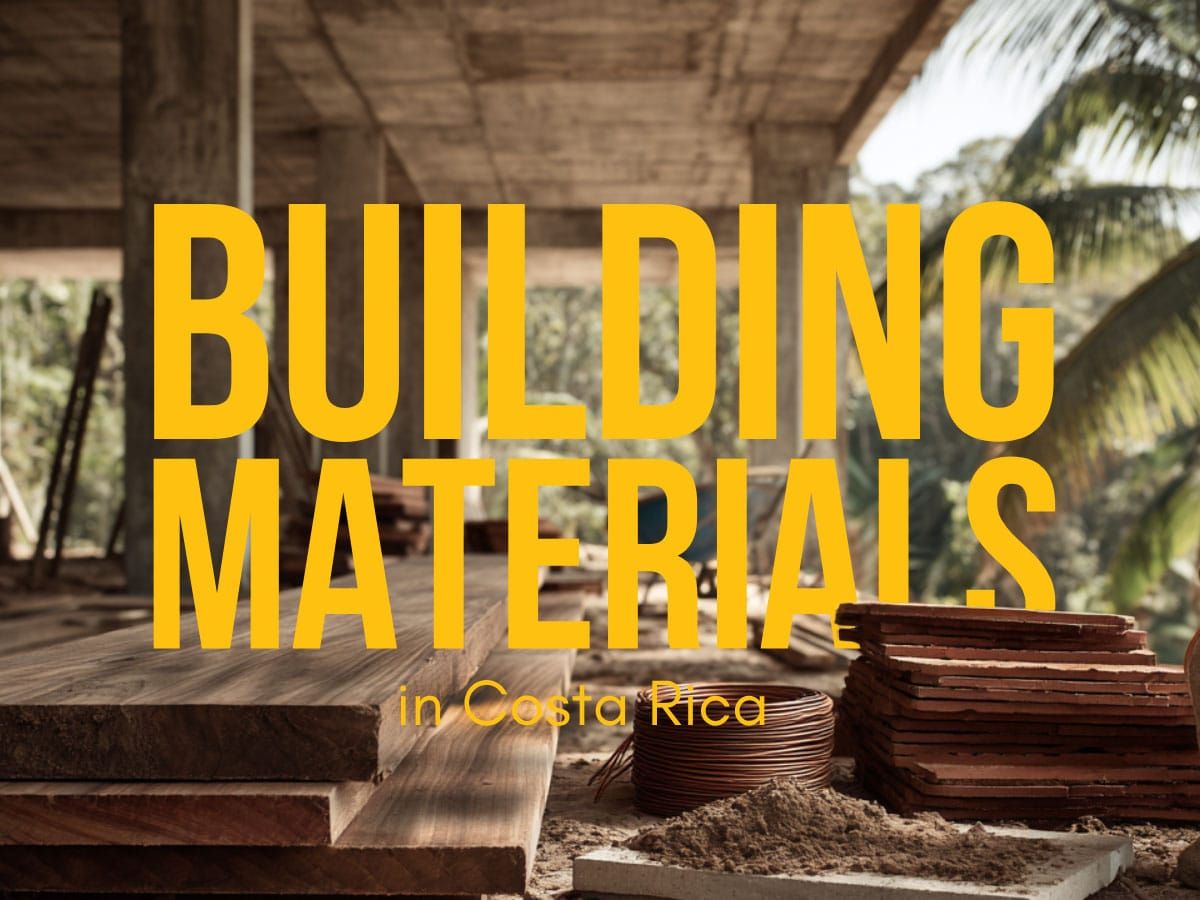
Every client I work with asks about materials at some point. Usually it starts with something they saw online — a floor tile from Italy, a window system from Germany, a specific brand of fixture they had in their last home. The conversation that follows is always the same: yes, you can get almost anything in Costa Rica. But whether you should is a different question, and what it will cost and how long it will take to arrive is a third one.
I have been sourcing building materials in Guanacaste for twelve years. I know what is available locally, what has to be ordered from San José, what has to be imported, and — most importantly — what survives the climate and what does not. This guide is the version of that conversation I wish every client could hear before they start specifying finishes.
In This Guide
- What's available locally
- What gets imported
- Cost comparison
- Materials that survive the tropics
- Materials that fail
- Sourcing strategy
- The import tax reality
- FAQ
What Building Materials Are Available Locally in Costa Rica
Costa Rica has a mature construction supply chain for standard building materials. You will not have trouble sourcing the following anywhere in the country. For the construction method that best leverages locally available materials, see our best construction method guide.
Structural Materials
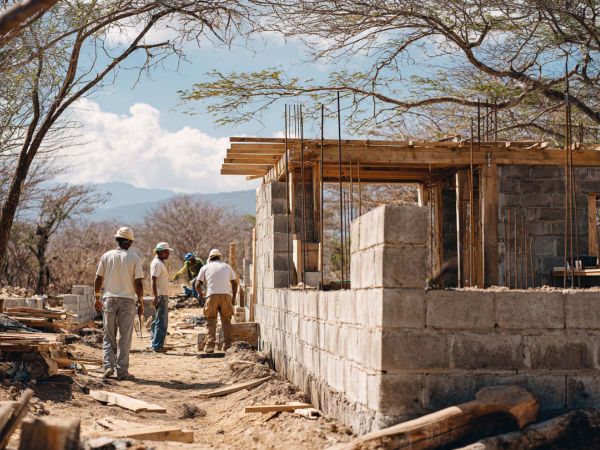
Concrete block — the backbone of traditional Costa Rican construction — is manufactured locally and widely available. Rebar in standard diameters (No. 3 through No. 6) is produced domestically and stocked at every major hardware supplier. Portland cement from local producers like Holcim is available in every town with a ferretería. Ready-mix concrete is available in the Central Valley and major coastal areas, though delivery to remote sites may require coordination.
Steel framing — both light-gauge galvanized studs and structural steel — is increasingly available from local manufacturers and importers. The quality has improved significantly in the past five years as steel frame construction has gained market share. For a detailed comparison of steel versus concrete block, see our guide on steel frame construction in Costa Rica.
Standard Finishes
Ceramic and porcelain floor tile is available in a wide range of qualities and prices from local suppliers. EPA (the large hardware chain), Construplaza, and smaller ferreterías stock domestic and imported options. Standard bathroom fixtures, electrical outlets and panels, PVC plumbing, and basic hardware are all locally sourced.
Paint from local brands (Sur, Lanco) and international brands with local distribution (Sherwin-Williams) is readily available. Standard interior and exterior paints cover the range most projects need.
What Is Less Available Locally
Where the supply chain thins is in the upper tier of finishes and specialty items. Large-format porcelain slabs (for countertops or feature walls), high-end European fixtures, specific North American appliance brands, custom window systems, and imported hardwood flooring are either not stocked locally or available only through specialty importers in San José.
In Guanacaste, the selection is thinner than in the Central Valley. San José has showrooms, importers, and specialty suppliers that simply do not exist on the coast. On my projects, roughly 60 to 70 percent of materials are sourced locally in Guanacaste. The remaining 30 to 40 percent — finish items, specialty hardware, specific fixtures — comes from San José suppliers or direct import.

What Building Materials Get Imported to Costa Rica
Anything beyond standard construction materials may need to be imported. Common imported items on mid-to-high-end residential projects include:
Kitchen appliances from US or European brands — Sub-Zero, Wolf, Bosch, KitchenAid. These are available through authorized distributors in San José but at prices 30 to 50 percent above US retail.
Window and door systems — high-performance aluminum or PGT impact windows. Local manufacturers produce adequate aluminum windows, but clients who want specific thermal, acoustic, or hurricane-rated performance often import.
Specialty tile — large-format porcelain, natural stone, handmade ceramic. Costa Rica has good basic tile, but if you want a specific Italian or Spanish product, it ships by container.
Bathroom fixtures from specific brands — Kohler, Duravit, Hansgrohe. Basic versions may be stocked in San José. Premium models are ordered by the distributor and take 6 to 12 weeks.
Exterior hardware — stainless steel railings, marine-grade handles, custom metalwork. The local market has limited options in marine-grade stainless. Specialty items get ordered from US suppliers.
The Import Tax Reality
Costa Rica's import duties on building materials are significant and frequently surprise clients who budgeted based on US prices.
Import taxes vary by product category but typically add 15 to 30 percent on top of the CIF (cost, insurance, freight) value. Add IVA (the value-added tax) at 13 percent on the post-duty total. The combined effect: a product that costs $1,000 in the US can cost $1,400 to $1,600 by the time it clears customs and arrives at the job site.
Freight adds another layer. Shipping a container from Miami to Puerto Limón or Puerto Caldera takes 5 to 10 days. Customs clearance takes another 3 to 10 business days depending on the product and the paperwork. Inland transport from the port to the job site adds another day and another cost. Total lead time from US order to job-site delivery: 4 to 8 weeks minimum, often longer.
The practical advice: import only what you cannot source locally at acceptable quality. Every imported item adds cost, time, and complexity. If a locally available material meets the performance requirement — even if it is not the exact brand you had at home — use it. You will save money, you will save time, and you will be able to get a replacement quickly if something fails.
Materials That Survive the Costa Rica Climate
The tropical climate is the ultimate materials test. Salt air on the coast, UV radiation everywhere, humidity that never drops below 60 percent in the rainy season, 2,500 millimeters of annual rainfall on the Pacific coast, and insects that eat untreated wood from the inside out. What you choose determines whether your home looks good at ten years or starts deteriorating at three.
What Works
Concrete block and poured concrete — inert, durable, insect-proof, and proven over decades. The standard structural system for good reason.
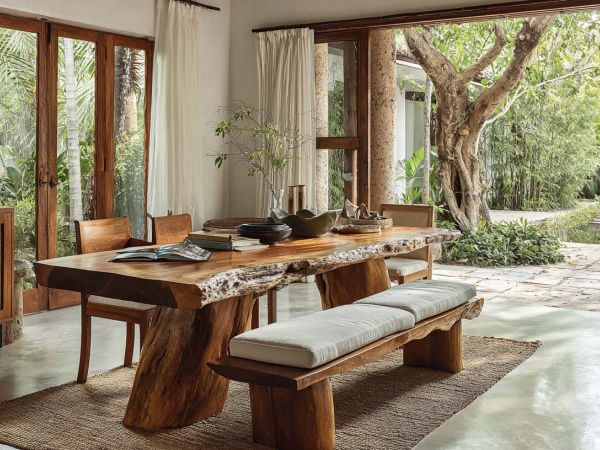
Tropical hardwoods — teak, guanacaste, cenízaro, cristóbal. These species have natural resistance to moisture, UV, and insects. They are more expensive than softwoods but last decades with proper maintenance. I use teak for exterior decking and guanacaste for ceiling beams on most of my projects.
Porcelain tile — dense, non-porous, and moisture-resistant. The best floor material for tropical construction. It does not swell, it does not mold, it cleans easily, and it holds up under heavy foot traffic in a rental property.
Stainless steel hardware — grade 304 for inland applications, grade 316 for coastal. Hinges, handles, railings, fasteners, and any hardware exposed to the elements must be stainless on the coast. Anything less will corrode.
Anodized aluminum windows and doors — resistant to salt air corrosion. Standard aluminum corrodes on the coast. Anodized or powder-coated aluminum lasts.
Standing seam metal roofing — galvalume (aluminum-zinc coated steel) in a light color. Reflects solar radiation, sheds water efficiently, lasts 25 to 40 years with minimal maintenance.
What Fails
MDF and particle board — swells and disintegrates in humidity. Never use in Costa Rica, even for interior applications. I do not allow it on any of my projects.
Untreated softwood — pine, spruce, or other temperate-climate lumber. Rots in months. Attracts termites. Does not belong in tropical construction.
Standard paint without UV protection — fades and peels within 12 to 18 months on sun-exposed surfaces. Exterior paint in Costa Rica must be formulated for UV resistance.
Cheap bathroom fixtures — the $40 faucet from the ferretería that pits and discolors within a year. The $15 towel bar that corrodes and falls off the wall. In humid, salty environments, cheap chrome-plated fixtures fail fast. Spend more here. For the full breakdown of how material choices affect construction costs, see our cost of building guide.
Most budget blowouts in Costa Rica are locked in long before anyone pours concrete — in the scope you never defined and the number you never pressure-tested. Build Ready is the 70-point checklist, scope worksheet and budget model I use to get that on paper before a client talks to land agents, architects or contractors.
See what is inside Build Ready →How I Source Materials on My Projects
On a typical residential project in Guanacaste, my procurement process works in three tiers.
Tier 1 — Local. Concrete, block, rebar, cement, sand, gravel, basic plumbing and electrical, standard tile, interior paint, basic hardware. Sourced from ferreterías and construction suppliers in Liberia, Santa Cruz, and Nicoya. Available within days. This covers 60 to 70 percent of the material budget.
Tier 2 — San José. Mid-range to high-end tile selections, kitchen and bathroom fixtures above basic level, specialty electrical (dimmers, smart home components), specific paint brands, doors and windows from manufacturers like Extralum. Ordered and delivered to site in 1 to 3 weeks. This covers 20 to 25 percent of the budget.
Tier 3 — Import. Specific appliances, premium fixtures, specialty hardware, custom items the client requires. Ordered through importers or direct from US suppliers. Lead time 6 to 12 weeks. This covers 5 to 15 percent of the budget — and often 30 percent of the procurement headache.
The most common mistake clients make with materials is starting at Tier 3. They arrive with a Pinterest board full of products that do not exist in Costa Rica and have to be imported at double the cost with two months of lead time. My advice: start with what is available locally. Walk the showrooms. See the tile options, the fixture options, the wood options. You will be surprised by how much quality is available without importing anything. Then import only the items where nothing local meets the requirement.
For more on how to hire a contractor who manages procurement effectively, see our guide on hiring a contractor in Costa Rica.
Frequently Asked Questions About Building Materials in Costa Rica
Are building materials expensive in Costa Rica?
Standard construction materials — concrete block, rebar, cement — are competitively priced and comparable to or slightly below US costs. Imported finishes, fixtures, and specialty materials cost 30 to 60 percent more than US retail due to import duties (15 to 30 percent) plus IVA (13 percent) plus freight. The total material cost for a mid-range home runs roughly 40 to 50 percent of the total construction budget.
Can I bring building materials from the US to Costa Rica?
Yes, but the import taxes and logistics typically make it uneconomical for standard materials. It can make sense for specific high-value items — a particular appliance, a custom window system, specialty hardware — where the item is unavailable locally and the import duty is offset by the price difference. Budget 4 to 8 weeks for shipping and customs clearance.
What is the best flooring for a house in Costa Rica?
Porcelain tile. It is moisture-resistant, UV-stable, durable under heavy foot traffic, easy to clean, and available locally in a wide range of styles and price points. For exterior applications, textured porcelain with a non-slip rating is the standard. For those who want the look of wood, wood-look porcelain tile is a practical alternative to actual hardwood flooring, which requires significantly more maintenance in tropical humidity. I will be honest — most architects I know, myself included, are not fans of wood imitations. Real wood has a warmth and character that a printed tile cannot replicate, and from a design perspective there is something dishonest about a material pretending to be something it is not. But from a contractor's perspective, I recommend it constantly because it performs better, costs less to maintain, and my clients are happy with it ten years later. That is the trade-off.
What wood should I use for construction in Costa Rica?
Tropical hardwoods: teak for decking and exterior applications, guanacaste and cenízaro for structural beams and ceiling work, cristóbal for high-wear applications. These species have natural resistance to moisture, insects, and UV degradation. Avoid temperate-climate softwoods (pine, spruce) — they rot and attract termites in tropical conditions. All exterior wood should be treated and sealed, with reapplication every one to two years.
How long does it take to get imported materials to a job site in Costa Rica?
Standard timeline is 6 to 12 weeks from US order to job-site delivery: 5 to 10 days ocean freight, 3 to 10 business days customs clearance, 1 to 3 days inland transport. Custom or made-to-order items can take longer. Order imported materials early in the project timeline — during the design phase, not during construction. Late material arrivals are one of the most common causes of construction delays.
---

Carolina is a general contractor based in Guanacaste, Costa Rica. She has built residential and hospitality projects on the Pacific coast for over twelve years. She writes for Build Tropical about the realities of construction from the contractor's side of the table.