
Tropical House Design in Costa Rica: What Works, What Doesn't, and Why It Matters
Good tropical design is not a style. It is a set of decisions about orientation, ventilation, shading, and materials that determine whether your house works with the climate or fights it every day.
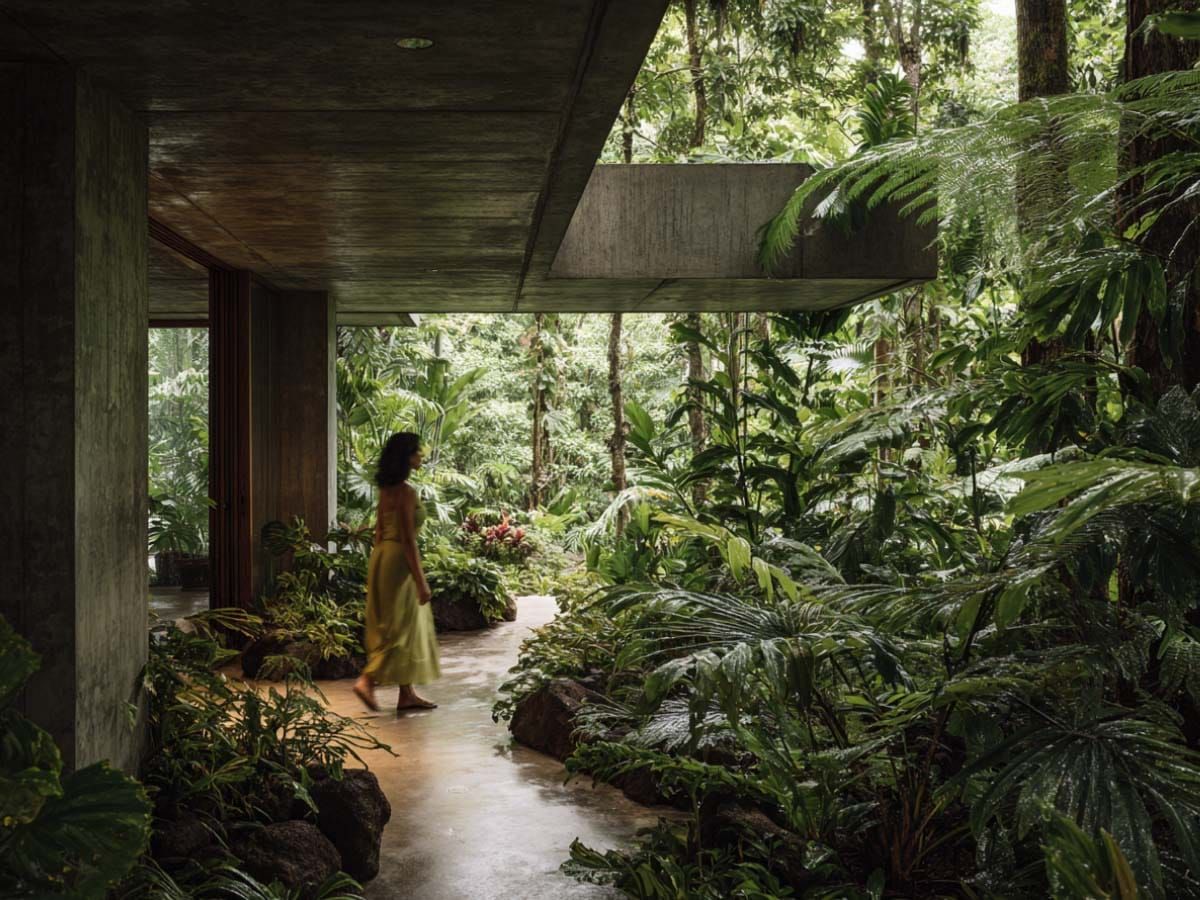
A few years ago I was asked to evaluate a house on the Pacific coast. Beautiful home. Clean modern lines, dramatic glass walls, a flat roof with a dark membrane finish. It looked like it belonged in a design magazine, and it probably had — the original architect had a strong portfolio of international work. The owner was considering selling after two years. His electricity bill was running $800 a month because the house could not function without air conditioning at full capacity, around the clock. The west-facing glass wall turned the living room into a greenhouse every afternoon. The flat dark roof absorbed heat all day and radiated it into the bedrooms all night. There were no operable windows on the windward side, so even when the temperature dropped in the evening, there was no way to flush the hot air out.
The design ignored every principle of tropical architecture. It was built for a photograph, not for a climate.
Good tropical design is not a style. It is a set of decisions — about orientation, ventilation, shading, and materials — that determine whether your house works with the Costa Rican climate or fights it every day. Get those decisions right and you have a house that stays comfortable with the windows open, runs an electricity bill under $200 a month, and ages gracefully in salt air and UV radiation. Get them wrong and you have a beautiful box that costs a fortune to cool and deteriorates faster than it should.
In This Guide
- Why tropical design is a performance standard
- Orientation
- Roof overhangs
- Cross-ventilation
- Materials
- Indoor-outdoor living
- Common design mistakes
- What good design looks like after five years
- FAQ
Why Tropical Design Is Not a Style — It Is a Performance Standard
Most people think of tropical architecture as an aesthetic: wood ceilings, open walls, natural materials, thatched roofs. Those are design choices, and some of them are good ones. But they are not what makes a tropical house work.
Tropical design is a performance standard. It is about how the building manages heat, humidity, rain, and UV radiation — the four forces that define the Costa Rican climate. A concrete block house with correct orientation, generous overhangs, and well-placed openings will outperform a beautiful open-air pavilion that faces the wrong direction. The beautiful pavilion looks tropical. The concrete box performs tropically. The distinction matters because one of them will be comfortable in ten years and the other will have mold problems and a failing roof.
The decisions that determine performance are made early — in the first weeks of design, when the architect studies the site, chooses the building's orientation, and lays out the floor plan relative to sun and wind. By the time you are choosing tile colors, the thermal performance of the house is already locked in. This is why the architect you hire matters more than most clients realize, and why those early design conversations are worth far more than the fee suggests. For more on how to evaluate architects and what the fees actually cover, see our guide on architect fees in Costa Rica.
Building Orientation — The Most Important Design Decision in the Tropics
If I could give a client only one piece of advice about tropical house design, it would be this: orient the long axis of the house east-west.
This accomplishes two things simultaneously. It minimizes the wall area exposed to the afternoon western sun, which is the primary source of heat gain in any tropical building. And it positions the largest wall faces to the north and south, where exposure is manageable with moderate overhangs and where the prevailing trade winds can enter and exit the building through opposed openings.
The afternoon sun in Costa Rica — roughly 1:00 to 5:00 PM — is brutal. A west-facing glass wall with no shading device can raise interior temperatures by 8 to 12 degrees above ambient in the space of an hour. I have measured this. No amount of air conditioning can compete economically with that heat load over the life of the building. The correct response is not more AC — it is less glass on the west face, deeper overhangs, and external shading devices that block the low-angle afternoon sun.
The prevailing winds on the Pacific coast come from the northeast during the dry season and from the west during the rainy season. The architect's job is to study the specific wind patterns on your site and position the house so that the primary living spaces capture the breeze. Sometimes this aligns with the best view. Sometimes it does not. When it does not, the architect earns their fee by solving for both — a house that breathes well and frames the landscape.
Roof Overhangs — Your First Line of Defense Against the Climate
Costa Rica receives 1,500 to 4,000 millimeters of rain per year depending on the location and the coast. That rain is driven by wind, and it hits walls, windows, and doors with force. Without adequate overhangs, water infiltrates window openings, stains exterior finishes, and drives moisture into wall assemblies where it feeds mold and degrades materials.
The minimum overhang I design is 1 meter on all sides. On the west and south faces — where rain and sun exposure are greatest — I push to 1.5 to 2 meters. This dimension is not arbitrary. It is calculated based on the angle of the sun at different times of year and the typical wind-driven rain trajectory.
A deep overhang does more than keep rain off the walls. It shades the glass and wall surfaces below it, reducing heat gain. It creates a transitional zone between inside and outside — a covered area where you can leave a window open during a rainstorm without flooding the floor. It protects exterior finishes from UV degradation, extending the life of paint, wood, and sealants by years.
Houses without adequate overhangs are easy to spot after two or three years. Water staining on the walls below windows. Mold in the corners of rooms. Peeling paint. Swollen wood trim. Premature failure of exterior sealants. These are not material defects — they are design defects. The materials are doing exactly what materials do when you expose them to 2,500 millimeters of annual rainfall without protection.

How to Cool a House in Costa Rica Without Air Conditioning
Cross-ventilation is the oldest and most effective cooling strategy in the tropics, and it costs nothing to operate. The principle is simple: create openings on opposite sides of a space so that wind enters on the windward side, moves through the room, and exits on the leeward side. The air movement creates a perceived cooling effect of 3 to 5 degrees even without reducing the actual air temperature.
For cross-ventilation to work, the floor plan must allow it. This means open plans where air can move freely between rooms. It means avoiding interior corridors that block airflow. It means placing bedrooms where they can have windows on two walls, not just one. It means using interior doors with louvered panels or transom windows that allow air to pass through even when the door is closed for privacy.
Clerestory windows — high windows near the roofline — are one of the most effective tools in tropical design. Hot air rises. A clerestory window at the peak of a vaulted ceiling allows the hottest air to exit the building passively, pulling cooler air in through lower openings. This stack effect runs 24 hours a day without electricity or mechanical systems.
The houses I design that use these strategies consistently run electricity bills of $100 to $200 per month for a 150 to 250 square meter home. The houses I have evaluated that lack cross-ventilation and rely entirely on AC run $400 to $800 per month. Over ten years, that difference is $24,000 to $72,000 — more than the cost of getting the design right in the first place.
Materials That Survive the Costa Rican Climate (And Materials That Do Not)
Material selection in the tropics is not about aesthetics. It is about durability under conditions that destroy cheap materials fast. Salt air on the coast accelerates corrosion. UV radiation degrades plastics, paints, and sealants. Humidity drives moisture into porous materials. Insects eat untreated wood. If you choose materials based on how they look in a catalog rather than how they perform in the climate, you will be replacing them in three to five years.
What works: concrete block and steel frame construction for the structure — both are proven over decades in Costa Rica. Hardwoods like teak, guanacaste, and cenízaro for exterior applications — they resist moisture, UV, and insects. Porcelain tile for floors and wet areas — durable, moisture-resistant, and easy to maintain. Stainless steel hardware for anything exterior — hinges, handles, railings, fasteners. Anodized aluminum for window and door frames — it does not corrode in salt air the way standard aluminum or galvanized steel does.
What fails: galvanized steel near the coast corrodes within two to three years. Standard bathroom fixtures pit and discolor within a year in coastal humidity. MDF and particle board swell, warp, and disintegrate in humidity — never use them in Costa Rica, even for interior applications. Cheap paint without UV protection fades and peels within eighteen months. Standard wood stain lasts about a year before it needs reapplication.
The cost difference between durable and cheap materials is typically 20 to 40 percent at the time of installation. The cost difference over ten years — including replacements, labor to remove and reinstall, and the operational downtime — is enormous. For a full breakdown of construction costs including material choices, see our cost of building guide.
Most budget blowouts in Costa Rica are locked in long before anyone pours concrete — in the scope you never defined and the number you never pressure-tested. Build Ready is the 70-point checklist, scope worksheet and budget model I use to get that on paper before a client talks to land agents, architects or contractors.
See what is inside Build Ready →Indoor-Outdoor Living — The Design Move That Defines Tropical Architecture
In Costa Rica, the covered outdoor terrace is not an amenity. It is the primary living space. The interior is for sleeping, cooking, and storing things. Everything else — dining, socializing, reading, working, watching the rain — happens outside under a roof.
This is not a lifestyle preference. It is a climate response. In a tropical climate, outdoor spaces with shade and airflow are more comfortable than enclosed interior rooms for most of the day. A well-designed covered terrace with a ceiling fan, a dining table, and comfortable seating is the most-used space in every Costa Rica house I have designed or visited.
The architectural tools for indoor-outdoor living are straightforward: large sliding or folding door systems that open an entire wall to the terrace, creating a single continuous space. Covered terraces with finished floors, ceiling fans, and built-in lighting — treated as rooms, not afterthoughts. Outdoor kitchens or wet bars that allow cooking and entertaining without going inside.
The cost of covered outdoor space runs roughly $800 to $1,200 per square meter — significantly less than enclosed interior space at $1,800 to $2,200. The impact on livability is disproportionate. A 30-square-meter covered terrace adds more to the daily experience of a house than a 30-square-meter fourth bedroom that rarely gets used.
The Tropical Design Mistakes I See Most Often
Every mistake on this list traces back to the same root cause: applying temperate-climate design thinking to a tropical site. What works in Portland or Toronto does not work in Guanacaste.
West-facing glass walls with no external shading. This is the most common and most expensive mistake. Floor-to-ceiling glass facing west looks dramatic in renderings. In reality, it turns the living room into an oven every afternoon from October through April and requires massive AC capacity to compensate.
Dark-colored roofs. A dark roof membrane or dark metal roof absorbs significantly more solar radiation than a light-colored one. The temperature difference on the roof surface can exceed 30 degrees between a white and a dark roof on a sunny afternoon. That heat conducts through the roof assembly and radiates into the rooms below. There is no good reason to use a dark roof in Costa Rica.
No overhangs. I have seen new houses — expensive ones — with flush roof edges and no overhang. Water runs directly down the walls. Within two years, the exterior paint is failing and moisture is penetrating the wall assembly. The architect was designing for a photo, not for 2,500 millimeters of annual rainfall.
Interior-only kitchens. In the tropics, cooking generates heat and humidity. A kitchen that opens to outdoor space allows that heat and moisture to dissipate naturally. A closed kitchen requires mechanical ventilation and contributes to the overall cooling load of the house.
Flat roofs in a high-rainfall climate. Flat roofs can work in Costa Rica with proper engineering — but they require meticulous waterproofing, regular maintenance, and drainage systems that never clog. In practice, flat roofs in Costa Rica develop leaks more frequently than pitched roofs. A sloped roof with generous overhangs is simpler, more durable, and better at shedding the volume of water this climate produces.
Hallways. A hallway is a wall that blocks airflow and a floor area that produces no usable space. Every linear meter of hallway in a tropical house is a meter of dead air that cannot be ventilated and cannot be lived in. Open plans with rooms that flow into each other are not just aesthetically appealing in the tropics — they are functionally superior because they allow air to move.
What Good Tropical Design Looks Like After Five Years
Portfolio photos tell you what a house looked like on the day it was finished. I am more interested in what it looks like five years later.
When I evaluate a house, I look for specific things. No water staining on the exterior walls — this means the overhangs are working. No mold in bathrooms or closets — this means the ventilation strategy is working. Comfortable with the windows open on a typical afternoon — this means the orientation and cross-ventilation are working. Exterior materials in good condition — no corroded hardware, no peeling paint, no rotting wood — this means the material selection was appropriate for the climate. An electricity bill under $200 per month for a 150 to 250 square meter house — this means the passive cooling strategy is working and the house is not dependent on mechanical systems to be livable.
These are the metrics that matter. Not how the house photographs with a drone. Not what award it won. Whether the people living in it are comfortable, whether the building is aging well, and whether the operating costs are reasonable. That is what good tropical design delivers.
For more on the permit and inspection process that ensures construction quality, see our guide on building permits in Costa Rica (coming soon).
Frequently Asked Questions About Tropical House Design in Costa Rica
What is tropical modern architecture?
Tropical modern is a design approach that combines contemporary aesthetics — clean lines, open plans, minimalist detailing — with climate-responsive strategies like passive cooling, deep overhangs, and indoor-outdoor living. In Costa Rica, it typically means concrete and steel structures with large openings, covered terraces, and natural materials like wood and stone used strategically. The "tropical" part is the performance. The "modern" part is the aesthetic.
How do you keep a house cool in Costa Rica without AC?
Orient the house to capture prevailing trade winds. Place operable windows on opposite walls for cross-ventilation. Use deep roof overhangs to shade walls and glass from direct sun. Minimize west-facing glazing. Use light-colored roofing. Install ceiling fans. Add clerestory windows to let hot air escape passively. A well-designed house in most Costa Rica locations can be comfortable without air conditioning for 8 to 10 months of the year.
What is the best roof design for a tropical climate?
A pitched roof with generous overhangs — minimum 1 meter on all sides, 1.5 to 2 meters on west and south faces. Light-colored metal roofing reflects solar radiation better than dark membranes or tiles. Vented roof assemblies (with soffit and ridge ventilation) allow trapped heat to escape. Pitched roofs also handle the high rainfall volumes better than flat roofs and require less maintenance.
What materials last longest in Costa Rica's climate?
Concrete block and steel frame for structure. Teak and other tropical hardwoods for exterior wood applications. Porcelain tile for floors. Stainless steel for all exterior hardware. Anodized aluminum for window and door frames. These materials are proven over decades in Costa Rica's combination of heat, humidity, salt air, UV radiation, and heavy rainfall.
How much does it cost to design a tropical home in Costa Rica?
Architecture fees in Costa Rica are regulated by the CFIA at a minimum of 9 to 12 percent of construction cost for standard projects, and 13 to 15 percent for complex or high-end builds. On a $350,000 mid-range project, expect $32,000 to $42,000 in total professional fees covering design, engineering, and construction inspection. The design itself — the decisions about orientation, ventilation, materials, and spatial planning — is where the fee earns its value.
---

Matt is an architect based in Costa Rica who designs and builds residential and hospitality projects. He writes about construction, design, and the realities of building in the tropics at Build Tropical.