Hidden Costs of Building in Costa Rica: What the Per-Square-Meter Number Doesn't Include
Every decision made in the design phase costs nothing beyond the design fee. Every decision deferred to construction costs the decision itself plus the disruption and rework.
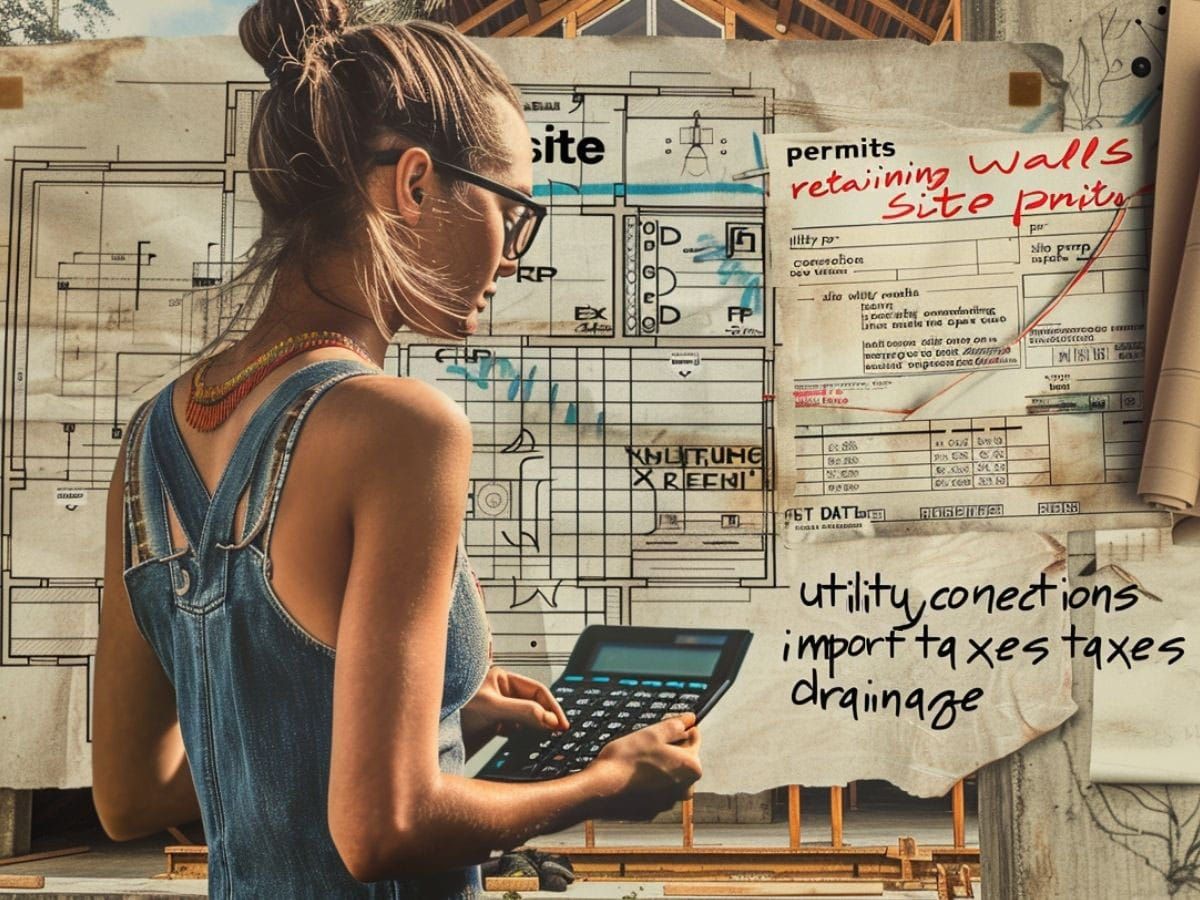
Every client I work with asks the same first question: what does it cost per square meter to build? And every client, without exception, is surprised by what that number does not include. The per-square-meter price covers the house. It does not cover the road to the house, the water connection, the electricity pole, the retaining wall on the slope, the septic system, the landscaping, the gate, or the twenty finishing decisions that somehow add up to more than anyone budgeted.
I have watched clients plan a $350,000 build and spend $450,000. Not because the construction went over budget. Because the construction was never the whole budget. This article, written with input from Carolina Vargas (our general contractor contributor), covers every cost category that the per-square-meter number leaves out. Read it before you set your budget, not after.
Hidden Building Costs in Costa Rica: The Full Picture
Infrastructure (driveway, water, electricity, septic, retaining walls) typically adds 15 to 25 percent on top of the house construction cost. Change orders during construction are the single biggest budget killer and are almost entirely preventable with a thorough design process. Finishing touches (landscaping, gate, furnishing, technology, closet systems, curtains) collectively add 10 to 15 percent. Pre-construction costs (soil studies, surveys, legal, permits) add 3 to 5 percent. On a $350,000 construction budget, the true all-in cost including everything runs $430,000 to $500,000 or more.
In This Guide
- Pre-construction costs
- Infrastructure
- Change orders
- Finishing touches
- The architect's role in preventing surprises
- The contractor's perspective
- FAQ
Pre-Construction Costs Nobody Budgets For
Before the first block is laid, you will spend money on things that most clients consider part of the construction but are actually separate line items.

Topographical survey: $500 to $1,500 depending on the lot size and complexity. This maps the elevation, slope, and features of your lot. The architect needs it to design the house. The structural engineer needs it to design the foundation. You cannot skip it.
Soil study (estudio de suelos): $800 to $2,000. Determines the load-bearing capacity of the ground, the water table level, and the soil composition. The structural engineer uses this to specify the foundation type and depth. On flat lots with known soil conditions, the study may be simpler. On hillside lots or lots with uncertain geology, it is essential.
Environmental assessment: if your project triggers SETENA review (generally projects over 500 square meters or in sensitive areas), the environmental viability study adds $2,000 to $5,000 and two to four months to the timeline.
Legal due diligence: title verification, property boundary confirmation, zoning verification, and closing costs on the land purchase. Budget $2,000 to $4,000 for legal and notary fees.
Permits and CFIA registration: the permit process itself costs roughly 2 to 4 percent of the declared construction value, covering CFIA registration, municipal tax, and INS worker insurance. For a $350,000 project, that is $7,000 to $14,000. For the full permit breakdown, see our guide on building permits in Costa Rica (coming soon).
Total pre-construction costs: $6,000 to $25,000 depending on the lot complexity and whether SETENA is triggered.
Infrastructure: The Big Hidden Cost
This is where the real surprises live. Infrastructure means everything between the property boundary and the house itself, and on a Costa Rica coastal lot it can cost $30,000 to $80,000 or more.
Water Connection
If your lot has municipal water service (AyA or ASADA) at the property line, the connection cost is relatively modest: $500 to $2,000 for the hookup fee plus the cost of running pipe from the meter to the house. If the water main is 200 meters down the road and you need to extend the line, the cost jumps to $5,000 to $15,000 depending on distance and terrain. And in some areas, AyA has frozen new connections entirely due to capacity constraints. Verify water availability before you buy the lot.
Electricity Connection
A standard residential electricity connection costs $500 to $1,500 if the grid runs past your property. If your lot is remote and requires a new transformer or an extended line run from the nearest pole, the cost can reach $5,000 to $15,000. ICE or the local cooperative handles the connection, and the timeline is typically two to six weeks.
Driveway and Access Road
On a flat lot with road frontage, the driveway is a minor cost: $3,000 to $8,000 for a paved or gravel approach. On a hillside lot, the driveway becomes a construction project in itself. A 50-meter driveway on a steep grade with retaining walls, drainage, and a paved surface can cost $15,000 to $40,000. I have seen hillside driveways that cost more than the house foundation.
Retaining Walls
Any sloped lot requires retaining walls, and their cost depends on height, length, and engineering complexity. A simple retaining wall under 1.5 meters costs $200 to $400 per linear meter. Engineered retaining walls over 2 meters cost $500 to $1,000 per linear meter or more. A hillside lot with a house pad that requires 40 meters of retaining wall at 2.5 meters average height can cost $25,000 to $40,000 in retaining structures alone.
Septic System
Most coastal lots in Costa Rica do not have municipal sewer connections. You need a septic system, and the design depends on the soil study results. A standard biodigester system costs $3,000 to $8,000 installed. A more complex system on a lot with poor percolation or a high water table can cost $8,000 to $15,000. The design must be included in the permit application.
Perimeter Wall or Fence
Security fencing or a perimeter wall is standard in Costa Rica. Budget $3,000 to $12,000 depending on the lot perimeter, material (chain link, block wall, living fence), and height.
Change Orders: The Budget Killer That Is Almost Entirely Preventable
A change order is a modification to the construction scope after the contract is signed and work has begun. Every change order costs money. Not just the cost of the change itself, but the cost of stopping work, reordering materials, rescheduling subcontractors, and sometimes undoing work that was already completed.
Carolina and I agree on this completely: the vast majority of change orders are preventable. They happen because decisions were not made during design.
The client did not choose the tile before construction started, so the builder laid the floor with the assumption that a standard tile would be used. The client visits the site, sees the tile, and wants something different. The floor gets ripped up and relaid. The change order costs three times what selecting the tile during design would have cost.
The client did not finalize the kitchen layout before the plumbing rough-in. The drain location gets set based on the architect's best guess. The client buys a kitchen with a different sink position. The drain gets moved. That is a $500 to $1,500 change order that a 30-minute kitchen design meeting would have eliminated.
This is why I am relentless about finishing decisions during the design phase. Every tile selection, every fixture specification, every appliance dimension, every electrical outlet location, every cabinet layout. We resolve these in the architect's office, on paper, before construction starts. The cost of making these decisions in design is zero. The cost of making them during construction is whatever the change order says.
Carolina's perspective from the contractor side: "Change orders are not just expensive. They disrupt the schedule. My crew has a sequence. The electrician comes before the tile installer. The plumber comes before the drywall. When a change order arrives mid-construction, it breaks the sequence. The electrician has to come back. The tile installer waits. The schedule slips. And the client pays for all of it."
For more on how the architect-contractor relationship prevents these problems, see our guide on architect fees in Costa Rica.
Finishing Touches: The "Last 10 Percent" That Costs More Than You Think
Construction is done. The house is built. And then you realize you need everything else.
Landscaping: $5,000 to $20,000 depending on the lot size, the design complexity, and whether you are planting a lawn and some hedges or creating a designed tropical garden. On a rental property, professional landscaping is not optional because it is the first thing guests see in photos.
Gate and entry: an automated gate with motor, remote control, and a finished entry area costs $3,000 to $8,000.
Furnishing: for a rental-ready property, budget $200 to $300 per square meter. A 150-square-meter house needs $30,000 to $45,000 in furniture, linens, kitchenware, and decor.
Technology: internet installation ($200 to $500), security cameras ($500 to $1,500), smart locks ($200 to $500), smart home integration if desired ($1,000 to $5,000).
Window treatments: curtains, blinds, or shutters for every window. Budget $2,000 to $6,000 depending on the number of windows and the quality of the treatments.
Closet systems: built-in closets with shelving and drawers run $500 to $1,500 per closet.
Kitchen accessories: the appliances are in the construction budget. The pots, pans, utensils, dishes, glasses, coffee maker, blender, and everything else a kitchen needs to function are not. Budget $2,000 to $4,000.
Pool equipment and accessories: if the pool is in the construction scope, the pump, filter, and basic tile are included. The pool furniture, cover, cleaning equipment, and landscape around the pool are separate. Budget $3,000 to $8,000.
Collectively, these "finishing touches" add 10 to 15 percent to the total project cost. On a $350,000 construction budget, that is $35,000 to $52,000 in items that were not in the per-square-meter number.
The Architect's Role in Preventing Hidden Costs
This is my pitch, and I make no apology for it: a thorough architect saves you money.
Not because architects are cheap. Because architects front-load decisions. Every decision made in the design phase costs nothing beyond the design fee. Every decision deferred to construction costs the decision itself plus the disruption, the rework, and the schedule impact.
A thorough design process includes: complete fixture and finish specifications before construction starts, detailed infrastructure planning (driveway, utilities, retaining walls) included in the project scope from day one, a comprehensive budget that accounts for every cost category in this article, and enough detail in the construction drawings that the builder does not have to guess about anything.
The projects I see that blow budgets are almost never the ones with thorough architects. They are the ones where the client hired the cheapest designer, got a basic floor plan, and handed it to a builder who filled in every unspecified detail with whatever was fastest and cheapest. The "savings" on design fees cost three to five times more in change orders, surprises, and rework.
For more on what architects charge and what you get for it, see our guide on architect fees in Costa Rica. For the full construction cost breakdown, see our cost of building guide. For how to hire the right contractor, see our guide on hiring a contractor in Costa Rica.
Frequently Asked Questions About Hidden Building Costs in Costa Rica
How much does it really cost to build a house in Costa Rica all-in?
Take the per-square-meter construction cost and add 25 to 40 percent for infrastructure, pre-construction costs, finishing touches, and contingency. A $350,000 construction budget typically becomes $430,000 to $500,000 all-in. The gap depends on your lot (flat vs hillside, connected vs remote) and how many finish decisions are deferred to construction.
What is the biggest hidden cost when building in Costa Rica?
Infrastructure. Driveway, retaining walls, water connection, electricity, and septic system collectively cost $15,000 to $80,000 depending on the lot. Hillside lots with no existing utility connections are the most expensive. This cost is rarely included in per-square-meter quotes.
How do I avoid change orders during construction?
Make every design and finish decision before construction starts. Choose your tile, fixtures, appliances, kitchen layout, and electrical plan during the design phase, not on site. A thorough architect will lead you through these decisions systematically. Every decision resolved on paper is a change order prevented on site.
Should I budget separately for landscaping and furnishing?
Yes. Landscaping runs $5,000 to $20,000. Furnishing for a rental-ready property runs $200 to $300 per square meter ($30,000 to $45,000 for a 150sqm home). Neither is included in the construction per-square-meter price. Budget for these separately from day one.
Does the per-square-meter price include permits and professional fees?
No. Professional fees (architecture, engineering, inspection) add 9 to 15 percent of the construction cost. Permits and CFIA registration add another 2 to 4 percent. On a $350,000 build, that is $38,000 to $66,000 in costs that sit outside the construction price.
---

Matt is an architect based in Costa Rica who designs and builds residential and hospitality projects. He writes about construction, design, and the realities of building in the tropics at Build Tropical.