Prefab Homes in Costa Rica: An Architect's Honest Guide (2026)
An architect's honest guide to prefab homes in Costa Rica — real costs, permit reality, and why the 'prefab is cheaper' myth does not survive contact with scope.
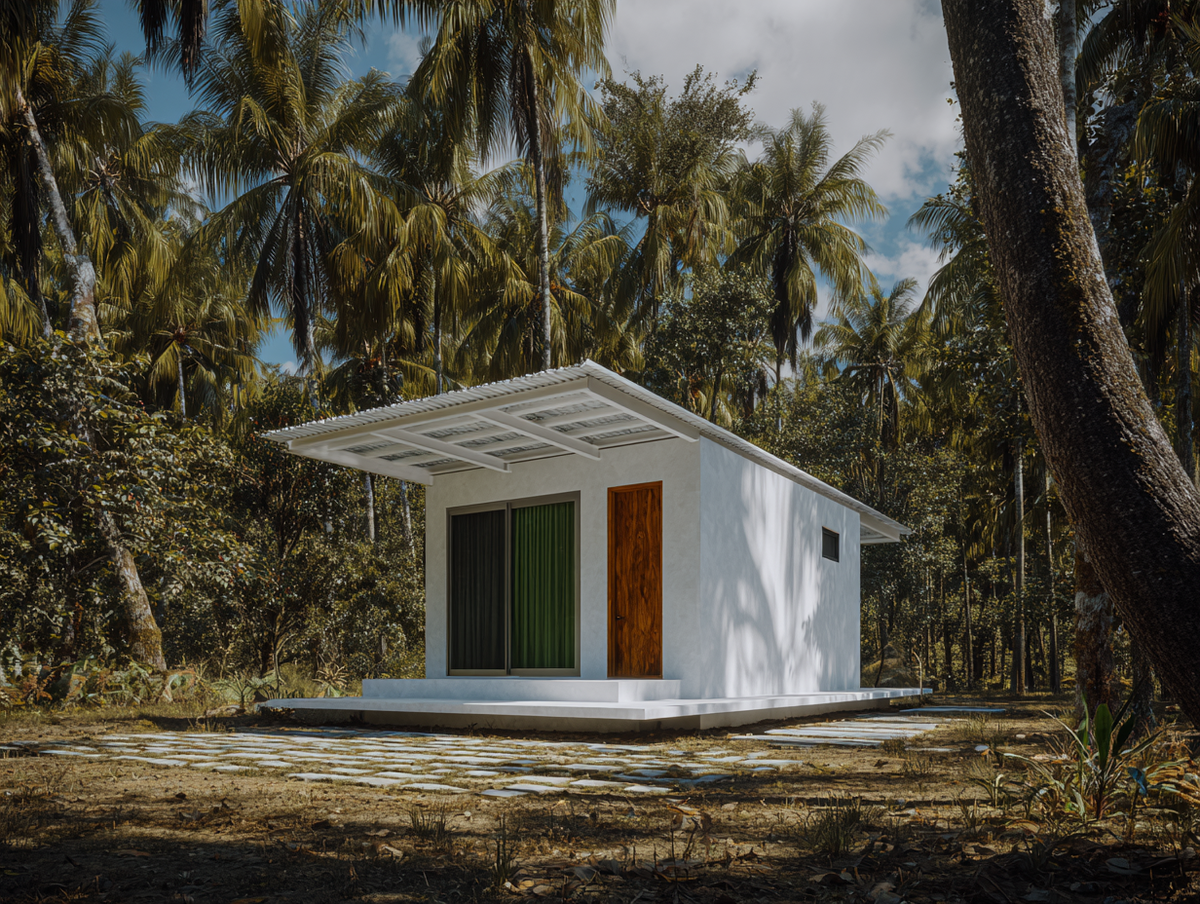
Prefab homes in Costa Rica cost between $1,500 and $2,000 per square meter for quality steel frame construction, require the same CFIA-stamped permits as traditional builds, and are typically ready to occupy in 3 to 5 months versus 10 to 14 months for conventional block-and-rebar construction. The method works well for homes under 200 square meters on accessible lots. It fails on steep sites, remote locations, and highly custom designs. This guide explains when prefab is the right call, when it is not, and how the numbers actually compare.
Most of what you read online about prefab homes in Costa Rica is written by manufacturers trying to sell you a product. We are architects who design custom homes here, and we get questions about prefab constantly — from clients weighing it against a custom build, from buyers who have been quoted by three different prefab companies and cannot reconcile the numbers, from people trying to figure out whether the renders they are looking at will actually produce a house they want to live in. This is the version the manufacturers will not give you.
Prefab construction in Costa Rica is real, it works, and for certain projects it is the smartest way to build. But it is not a magic bullet, and the gap between what companies promise and what actually gets delivered on a hillside in Guanacaste is wide enough to lose serious money in.
For a full comparison of all construction methods — prefab, concrete block, structural steel, and hybrid — see our best construction method guide.
In This Article
- What "Prefab" Actually Means — and What Is Always Included
- What Is a Prefab Home in Costa Rica?
- How Much Do Prefab Homes Cost?
- Where Prefab Works Best
- When Prefab Is the Wrong Choice
- Building Permits for Prefab Homes
- How to Choose a Prefab Builder
- Is Prefab Right for Your Project?
- Frequently Asked Questions
First: What "Prefab" Actually Means, and What Is Always Included
Before any cost number means anything, you have to pin down what is in the quote. Prefab pricing in Costa Rica ranges from $800 per square meter to over $2,000 per square meter, and most of that spread is explained not by quality but by scope. A $950 quote and a $1,900 quote can describe houses that look identical in renders and wildly different in what you actually move into.
What Is Included in an Honest Prefab Quote
I like to consider these items every time, so we are comparing apples to apples. When our quotes reference an all-in number, it covers everything needed to hand over a home ready to occupy: finished floors (tile or polished concrete), interior wall surfaces fully finished, bathroom vanities and basic built-ins, kitchen cabinetry, interior doors, windows installed, electrical and plumbing finished out, home delivered move-in ready.
That is the standard any serious quote — prefab or custom — should hold itself to, and it is the standard a foreign buyer should expect before wiring a deposit.
Even a properly defined all-in number does not include everything it takes to live on the property. Site access improvements, solar systems and battery storage, water storage tanks, landscaping, pool, fencing and perimeter walls, exterior lighting, window coverings, appliances beyond what is specified, and movable furniture are typically separate line items. On a typical project these add $15,000 to $60,000 depending on site conditions and finish ambitions — and that is without the often obligatory pool.
What Shell-Only Quotes Leave Out
When a manufacturer quotes you $950 per square meter, they often mean the structural shell on a prepared pad with rough-in only — no finishes, no kitchen, no tile, sometimes no interior doors. Permits may or may not be included. Site preparation almost never is. Ask, in writing, for every quote: does this include permits, site prep, the specific foundation type your lot requires, floors, interior surfaces, kitchen, bathroom vanities, and built-ins? If the answer is vague, the quote is not real.

What Is a Prefab Home in Costa Rica?
A prefab home in Costa Rica is any residential structure whose primary components — structural frame, wall panels, or complete modules — are manufactured off-site and transported to the building lot for assembly. The word covers four distinct construction systems that are often marketed interchangeably: steel frame modular, precast concrete panel, shipping container, and flat-pack kit homes.
One distinction is worth making up front. The kind of prefab sold in Costa Rica is not prefab in the sense that someone from the US or Europe might expect — a home that rolls off an assembly line with zero client input. What the better builders here deliver is closer to a model home system: a set of base plans with defined structural parameters and standard specifications, which the client can adjust in size, layout, finish level, and site-specific details.
Steel Frame Modular Homes (Model-Home Style)
Steel frame is the most common prefab type sold to expats and second-home buyers in Costa Rica. A structural steel skeleton is engineered for a defined floor plan family, partially fabricated off-site, transported, and assembled on your lot. Walls are typically cement board or fiber cement on the outside, drywall on the inside, with mineral wool or polyurethane insulation in between. A 100-square-meter home can be delivered in three to five months from contract to move-in.
Advertised prefab pricing is almost always below what the finished product actually costs. Once you add what a North American or European buyer expects — proper insulation, quality windows, finished floors, real kitchens, built-in vanities, tile in the bathrooms — the honest all-in range settles between $1,500 and $2,000 per square meter. At that point prefab is not competing with cheap construction. It is competing with custom.
Precast Concrete Panel Homes
Precast concrete is the budget option — the INVU-style houses you see in developments across the Central Valley. A basic two-bedroom precast home runs $35,000 to $60,000. I need to be direct about this category: if you are coming from the US, Canada, or Europe, you are not going to be happy in one of these houses. The finishes are minimal: polished concrete floors, basic aluminum windows, no hot water heater, no closets, no kitchen cabinetry above the counter, no insulation in any meaningful sense.
Container Homes
Container homes are their own category. The short version: they work for specific applications — guesthouses, ADUs, off-grid projects — but they are not cheaper than steel frame, and the thermal challenges in a tropical climate are real. A 40-foot high-cube container with proper insulation, finishes, electrical, and plumbing typically lands at $45,000 to $75,000 for a single-container unit, which is not a bargain per square meter.
Flat-Pack and Kit Homes from International Manufacturers
Flat-pack kits are what you find advertised online from Turkish, Chinese, and European companies. The product itself can be fine, but importing a complete home to Costa Rica means dealing with customs, port fees at Caldera or Limón, inland transport on roads that were not designed for oversized loads, and then finding a local crew who can assemble a system they have never worked with before. Unless you are bringing your own crew or working with a manufacturer that has local partners already installed, this path carries more risk than most buyers realize.
How Much Do Prefab Homes Cost in Costa Rica?
A quality steel frame prefab home in Costa Rica costs $1,500 to $2,000 per square meter all-in when it includes permits, foundation, finished floors, interior surfaces, kitchen, bathroom vanities, and built-in elements — essentially everything you need to move in. Budget precast concrete homes can be had for $600 to $900 per square meter, but at a quality level most foreign buyers find unacceptable. The real advantage of quality prefab is not price. It is speed and predictability.
How Prefab Compares to Traditional Construction Cost
A traditional concrete block and rebar home in Costa Rica — built custom, not prefab — costs $1,800 to $2,200 per square meter all-in. For a 100-square-meter home, traditional custom construction lands at $180,000 to $220,000 for the house itself, before the site and lifestyle costs — access improvements, solar, water storage, landscaping — which typically add another $15,000 to $60,000 on top.
Quality steel frame prefab lands close to this range. The reason to choose prefab is not to save money. It is because you want speed, predictability, and the engineering confidence of starting from a proven system.
Cost Comparison: Prefab vs Traditional (100 m² home, all-in)
| Construction Type | Quality Level | All-In Cost/m² | 100 m² Total | Timeline |
|---|---|---|---|---|
| Precast concrete (INVU style) | Minimal, local market | $600 – $900 | $60K – $90K | 2 – 3 months |
| Steel frame prefab | North American/European standard | $1,500 – $2,000 | $150K – $200K | 3 – 5 months |
| Traditional block & rebar | North American/European standard | $1,800 – $2,200 | $180K – $220K | 10 – 14 months |
Where Prefab Construction Works Best in Costa Rica
Prefab works best for homes under 200 square meters, on accessible lots within driving distance of the Central Valley, where speed to occupancy or speed to rental revenue is worth paying for. A traditional build in Costa Rica takes 10 to 14 months. A prefab home can be fabricated in 6 to 10 weeks and assembled and finished on site in another 8 to 12 weeks. Total timeline: 3 to 5 months from contract to move-in.
When Build Speed Saves You Money
For anyone paying rent while building, the time savings translates directly into cash. If you are paying $1,500 a month in rent, cutting six to seven months off your build saves you $9,000 to $10,500 — which helps offset the premium of quality construction.
Prefab for Airbnb and Vacation Rental Properties
Speed matters for investment properties, but with a caveat worth naming plainly. If you are building a vacation rental prefab-style, you are most likely targeting the lower or mid tier of the rental market, not the high-end villa segment where the serious nightly rates live. The math for getting your unit generating income six or seven months earlier still works, but the earlier-revenue advantage is smaller than the marketing tends to suggest, because the nightly rates at this segment are modest and the competition for each booking is real.
Factory Precision vs On-Site Construction Quality
A steel frame fabricated in a climate-controlled factory is, in theory, more precise than one welded on site by a crew working in rain and mud. In practice, though, the advantage is marginal. A good site crew on a custom build produces a structure with no meaningful quality gap versus a prefab frame. And the parts of the house that actually cause problems in the tropics — window flashing, roof penetrations, waterproofing at wet areas — are installed on site in both cases, by the same kind of crew. Factory precision does not save you from sloppy on-site finishing, which is where most construction defects in Costa Rica actually originate.
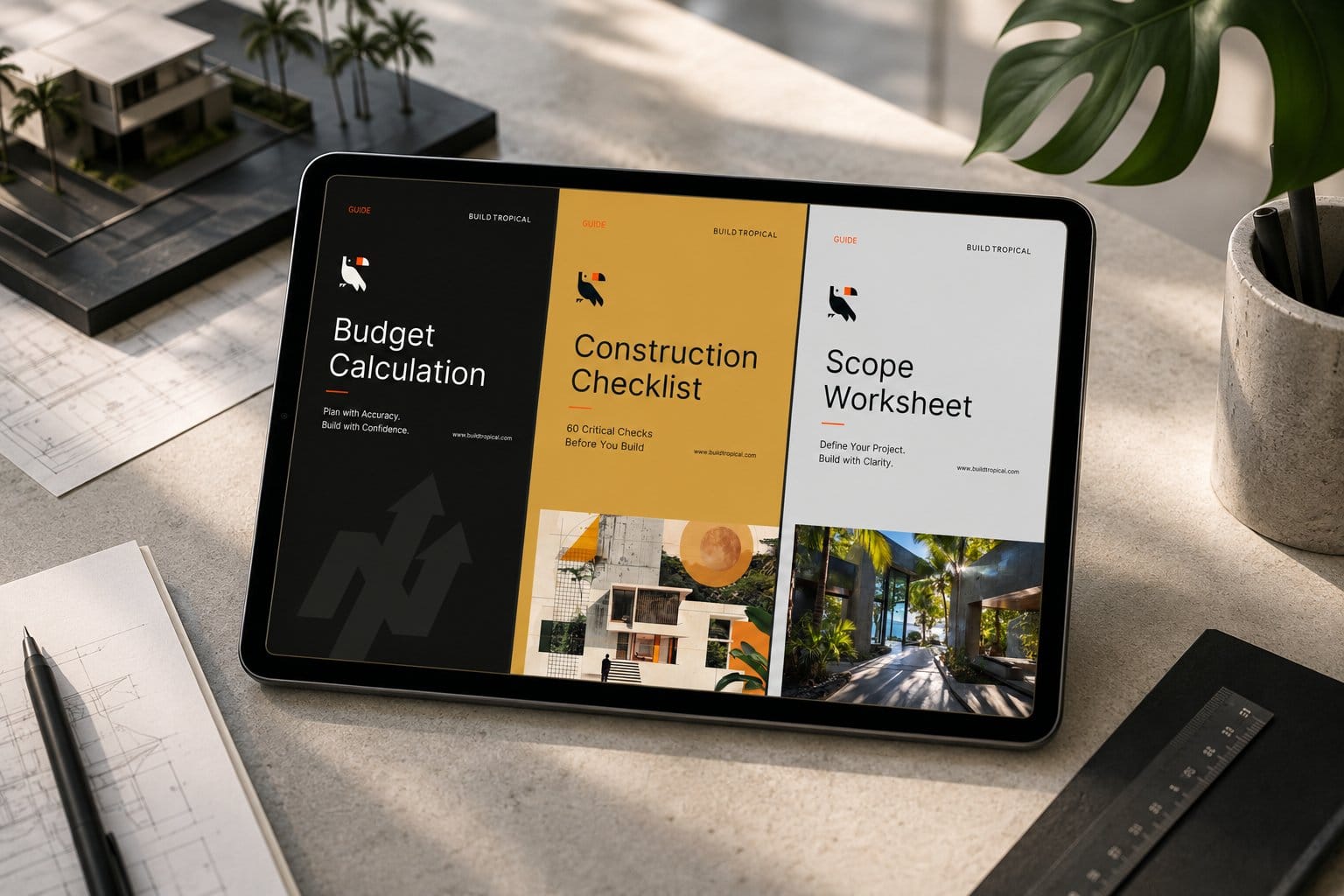
Most budget blowouts in Costa Rica are locked in long before anyone pours concrete — in the scope you never defined and the number you never pressure-tested. Build Ready is the 70-point checklist, scope worksheet and budget model I use to get that on paper before a client talks to land agents, architects or contractors.
See what is inside Build Ready →When Prefab Is the Wrong Choice for Your Costa Rica Build
Prefab is the wrong choice when your lot cannot be reached by a crane truck, when your design requires significant custom engineering, when the site is more than four hours from the Central Valley, or when the home is over 250 square meters.
Steep Lots and Difficult Access Roads
If a crane truck cannot reach your building pad, assembling prefab modules becomes exponentially more expensive. I worked on a project in Montezuma where the access road had a 22-degree grade and a hairpin turn above a drop. The transport and rigging cost alone would have added $18,000 to the project, and the insurance carrier for the crane operator refused the job. We built traditional.
Highly Custom Architectural Designs
Prefab works best with standardized dimensions and repeatable modules within a defined system. If you want a 6-meter cantilever over a ravine or a curved wall following a hillside contour, you are better off with conventional construction. The moment you start re-engineering every connection, you lose the efficiency that makes prefab attractive in the first place.
Remote Locations Far from the Central Valley
Most prefab manufacturers in Costa Rica are based in the Greater Metropolitan Area around San José and Cartago. If your lot is on the Osa Peninsula, the Caribbean coast near Puerto Viejo, or the Nicoya interior, transport costs and logistics eat into the savings. For any site more than four hours from San José, run the transport numbers before committing.
Large Homes Over 250 Square Meters
At this scale, genuine prefab barely exists as a category in Costa Rica. Most homes over 250 square meters marketed as prefab are really custom builds that use some prefabricated structural components. The economics have already shifted: the cost difference between prefab and traditional narrows further as size increases, and you gain more design freedom with conventional construction. Above 300 square meters I almost always recommend traditional.
Building Permits for Prefab Homes in Costa Rica
A prefab home in Costa Rica requires the exact same permits as a traditional home. There is no shortcut. You need a registered architect to stamp the plans, structural engineering calculations, CFIA registration, and a municipal building permit. If the lot is in a sensitive environmental zone or near the maritime zone, you also need SETENA environmental clearance.
What Permits You Need for a Prefab Build
The permit stack for any home in Costa Rica — prefab or traditional — includes CFIA plan registration, municipal permit (permiso de construcción), and sometimes SETENA environmental review depending on lot conditions. Homes in the Zona Marítimo Terrestre have additional concession and ICT requirements. None of this is waived because the house is prefabricated.
How to Evaluate "We Handle Permits"
Many reputable prefab builders handle the permit process for clients. The question is not whether the company handles permits. It is how they handle them. For a straightforward project on a flat, titled lot in a non-sensitive zone, a capable prefab company's in-house architect can run the whole permit process cleanly. For lots with complexity — slope, maritime zone proximity, environmental sensitivity — ask specific questions. Who is the architect of record? What is their CFIA number? Have they worked on sites like yours before? Will they commission a topographic survey and soils report before stamping the structural plans?
Professional Fees and CFIA Costs
Professional fees for architecture and engineering in Costa Rica run 10 to 12 percent of the construction cost, per the CFIA fee schedule. This applies whether you build prefab or traditional, and it is not negotiable below a floor the CFIA enforces. For a $180,000 build, expect $18,000 to $22,000 in professional fees.
How to Choose a Prefab Home Builder in Costa Rica
Choose a prefab builder by verifying their CFIA registration, reviewing a fully itemized scope of work, getting written warranty terms of at least five years on the structure, and asking direct questions about their engineering, supply chain, and project management approach.
Ask to See Completed or In-Progress Work
Renders and Instagram photos are not enough. Ask to see completed homes the company has built, or in-progress projects you can visit on site. Talk to past clients if there are any. The goal is to understand how they actually build, not just what they show in marketing materials.
Verify CFIA Registration
The company should have a registered engineer or architect responsible for their structural designs. Ask for the CFIA registration number and verify it through the CFIA portal. This is not optional — stamping construction plans without CFIA registration is a legal violation in Costa Rica.
Demand a Complete Scope of Work
The quote should specify exactly what is included: foundation type and depth, slab specification, wall assembly with insulation R-value, window and door specifications by manufacturer and model, electrical panel size and circuit count, plumbing fixture list, roofing material and warranty, kitchen cabinetry specification, bathroom vanity specification, floor finishes by room, and any built-in elements. If the quote says "standard finishes" without defining what standard means, you will end up paying more later.
Get Construction Warranty Terms in Writing
Costa Rica does not have strong consumer protection laws for construction the way the US or Canada do. Get the warranty terms in writing. Structural warranties should be a minimum of five years. If a company cannot articulate their warranty in writing, assume they do not have one.
Understand the Supply Chain
Where does their steel come from? Where are the panels fabricated? How do they handle delays in material delivery from ports? A company that imports steel from China has a different risk profile than one sourcing from a regional supplier in Central America.
Is a Prefab Home Right for Your Costa Rica Project?
Prefab is the right call when your home is under 200 square meters, your lot is accessible and relatively flat, you are within a few hours of the Central Valley, and speed to occupancy or rental revenue matters to you. It is the wrong call on difficult lots, for large or highly custom homes, or when your primary motivation is finding the absolute cheapest way to build.
The best prefab projects I have been involved with started with three things: a clear program describing what the client actually needed, a suitable lot that was accessible and buildable and properly permitted, and a realistic budget that included everything — not just the structural shell but the foundation, site work, permits, professional fees, kitchen, finishes, and built-ins.
Frequently Asked Questions
How long does it take to build a prefab home in Costa Rica?
A prefab home in Costa Rica typically takes 3 to 5 months from contract signing to move-in, including roughly 6 to 10 weeks of off-site fabrication and 8 to 12 weeks of on-site assembly and finishing. Traditional custom construction takes 10 to 14 months for an equivalent home.
Are prefab homes in Costa Rica cheaper than traditional construction?
Quality prefab homes are modestly cheaper than traditional custom construction, but not dramatically so. Prefab lands at $1,500 to $2,000 per square meter all-in; traditional custom lands at $1,800 to $2,200. The ranges overlap, and on an equivalent-scope basis the difference is often smaller than the headline numbers suggest. The real advantage of quality prefab is speed and predictability, not price.
Do prefab homes require the same permits as traditional homes in Costa Rica?
Yes. Prefab homes in Costa Rica require the same CFIA plan registration, municipal building permit, and where applicable SETENA environmental clearance as any traditional concrete construction. There is no permit category that exempts prefabricated structures.
Can prefab homes handle Costa Rica's earthquakes and rainy season?
Properly engineered steel frame prefab homes meet or exceed Costa Rica's seismic code and perform well in earthquakes due to the ductility of steel. Water intrusion during the green season is the more common failure mode, which is why insulation, flashing, and window assembly quality matter more than the structural system itself.
What is the best prefab home size for Costa Rica?
The best prefab home size for Costa Rica is between 80 and 200 square meters. Below 80 square meters, fixed costs like permits and utility connections become disproportionate. Above 200 square meters, the efficiency advantage of prefab begins to erode and traditional construction often becomes competitive.
Do banks in Costa Rica finance prefab homes?
Some Costa Rican banks finance prefab homes, but the loan process is harder than for traditional construction. Most of the people I know who build prefab in Costa Rica pay cash or finance from abroad rather than working through local construction lending.

Matt Usher is an architect based in Costa Rica specializing in residential and hospitality projects. He writes for Build Tropical about the realities of designing and building in the tropics.