Should You Build or Buy a Home in Costa Rica in 2026?
The build-or-buy decision in Costa Rica is not mostly about price. It is about what you can verify in a finished home, and what the climate does to whatever got cut on the way up.

The first turnkey I bought in Costa Rica looked spotless at the walkthrough. Fresh paint, new fixtures, tile floors, a staged living room. Eighteen months later I was replacing a section of roof structure where untreated framing had rotted behind the drywall. The previous owner had cut a corner I could not see, and I inherited it.
That experience changed how I think about the build-or-buy question. The financial comparison is real, and I will run it briefly. But the decision is not mostly about money. It is about what you can verify, what you cannot, and how much that uncertainty is worth to you in a climate that punishes cheap materials harder than almost anywhere I have invested.
In This Article
- The Climate Does Not Forgive Shortcuts
- What Buying Gives You Control Over
- What Building Gives You That Buying Cannot
- The Case for Newer, Well-Documented Turnkeys
- When the Math Actually Tips the Decision
- The Decision Framework I Actually Use
- Frequently Asked Questions
The Climate Does Not Forgive Shortcuts
The Pacific coast of Costa Rica is a brutal environment for a building. Humidity sits above 75 percent most of the year. The rainy season dumps water for six months. Salt air within a few kilometres of the coast accelerates corrosion on anything metal. Termites and wood-boring insects are active year-round. UV exposure degrades sealants, paint, and plastics faster than in temperate climates.
None of this is a reason not to invest here. It is a reason to care deeply about what the building is actually made of. A home built with the wrong materials or wrong detailing will cost you money for the entire time you own it, and it will cost you more when you sell. A home built right will outperform almost any comparable investment on a long hold.
The question is whether the home you are looking at was built right. When you build, you answer that question yourself. When you buy, you inherit someone else's answer. If building, the first decision is which construction method to use — see our best construction method guide.

What Buying Gives You Control Over, and What It Does Not
Buying a turnkey is fast, predictable, and avoids construction risk. Those are real advantages and I still buy turnkeys regularly. But the control you give up matters, and most buyers underestimate it.
You can verify the surface. You cannot easily verify what is behind the surface.
A good inspection will catch a lot. I pay $2,000 to $3,000 for inspections and I have walked away from two deals based on what came back. But inspections in Costa Rica are not as robust as inspections in Canada or the US. Inspectors typically cannot open walls, cannot test the concrete mix, cannot verify rebar specifications, and cannot confirm what roof membrane or insulation is actually in place behind the finish.
What matters most is buried by the time the house is finished.
Foundation and structural concrete. Whether the rebar was properly tied, spaced, and coated against corrosion. Whether the concrete mix was appropriate for coastal conditions. Whether the foundation drainage was installed to handle wet-season water tables. You cannot inspect this after the fact without destructive testing.
Electrical. Whether the wiring is appropriately rated, whether grounding is done correctly, whether breakers are properly sized. I have seen turnkey homes with beautiful kitchens and dangerous panel work.
Plumbing and water systems. Whether PVC unions were properly glued, whether hot-water lines were insulated, whether the septic system was sized correctly for the home.
Roof assembly. Whether underlayment is appropriate for tropical rain, whether flashing is correctly detailed around penetrations, whether ventilation is adequate to prevent condensation in the roof cavity. A roof that looks fine from outside can be actively rotting from the inside.
Wall construction. Walls in Costa Rica are concrete block or aluminum-framed, not wood. For block walls, what matters is whether the reinforcement was properly placed and the cells were properly filled and sealed. For steel-frame builds, the structural steel specification is where corners get cut. Under-spec'd steel or inadequate corrosion protection on the frame is the expensive problem, and it is not visible once the walls are closed up.
What Building Gives You That Buying Cannot
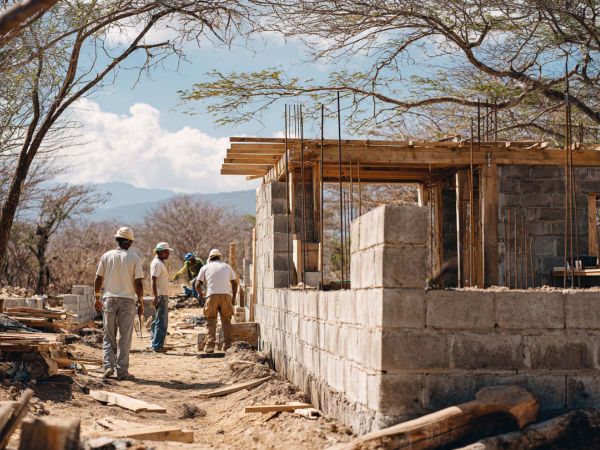
When you build, you specify the materials and the details that matter for this climate. You do not have to hope. You watch the concrete being poured. You see the rebar before it is covered. You approve the roof membrane before the tile goes on.
The specific decisions that matter most, in my experience:
Rebar and concrete. Adequate concrete cover over the rebar, a high-quality mix appropriate for coastal conditions, and properly tied placement before the pour. This is where structural longevity is decided. Get these wrong and spalling and corrosion problems show up within a decade.
Roof system. Most homes in Costa Rica use single-ply zinc sheet with no insulation underneath. It is cheap, it is fast, and it turns the space below into an oven. The upgrade that actually matters is insulation and a proper underlayment. Almost nobody does this on a budget build, and it is the single biggest comfort and energy-cost difference between a well-built home and a cheap one.
Exterior wood and metalwork. Hardwood species appropriate for exposure: teak, laurel, cristobal, and pochote hold up. For exterior metal, anodized or powder-coated aluminum and stainless fasteners. Galvanized steel corrodes fast near the coast.
Ventilation. Cross-ventilation and roof venting that lets the building breathe. Homes built like sealed boxes with AC as the only climate control are uncomfortable and grow mold.
Drainage. Site drainage, foundation drainage, and roof drainage all handled intentionally. Water management is the single most important element of building durability in Costa Rica. It is also the cheapest to do right and the most expensive to fix later.
The Case for Newer, Well-Documented Turnkey Homes
I am not arguing that every turnkey is a hidden problem. The Costa Rica construction market has matured. There are builders on the Pacific coast producing homes that I would be comfortable owning without having watched them go up, because the builder has a track record, the documentation is complete, and the design decisions are visible in the finished product.
What I look for in a turnkey I am willing to buy: a builder with 10 or more comparable homes in the area that I can look at and whose owners I can talk to. A complete set of construction drawings and permit documents. CFIA registration on the plans. Evidence the home was permitted and inspected through municipal channels rather than built informally. Visible design decisions that tell me the builder understood the climate: overhangs sized for tropical rain, cross-ventilation, appropriate orientation for sun and wind, materials that make sense for the coast.
If a listing cannot produce the permit package, if the builder cannot be identified, or if the home shows obvious climate-inappropriate design choices, I walk. Whatever the price looks like, the long-term cost will be higher than I want to carry.
When the Math Actually Tips the Decision
For most buyers at the $400,000 to $600,000 price point on the Pacific coast, the financial difference between building and buying is smaller than people expect. A mid-range 180 square metre build on pre-owned land runs roughly $450,000 all-in once you include CFIA fees at 10 to 12 percent of construction, SETENA, municipal permits, utility connections, legal, and the 12 to 18 months of holding costs on land that is not producing income. A comparable turnkey in the same area runs $440,000 to $475,000 once you include closing costs at roughly 3.75 percent, due diligence, and year-one fixes.
That is a narrow enough spread that the decision should not turn on price. It should turn on what you are actually buying.
The Decision Framework I Actually Use
I ask three questions in this order.
Can I verify what I am buying? Complete CFIA-registered plans, municipal permits, inspection records, a known builder with a track record, and design choices that show competence. If the documentation is thin or missing, I treat the turnkey as higher risk and weight building more heavily.
Do I need income now? If the property needs to generate rent starting in month two, I cannot wait 15 months for a build. Turnkey wins on time to income, assuming question one checks out.
Am I building something the market cannot deliver? If I need a specific layout, a hospitality property, a multi-unit project, or something the existing inventory simply does not produce, building wins regardless of the other two questions.
For straightforward single-family purchases where the turnkey is well-documented and the inventory matches what I need, I buy. For situations where I cannot verify what I am getting, or where I need something the market is not producing, I build.
Bottom Line
A well-built turnkey from a reputable builder with complete documentation is one of the best investments on the Pacific coast. A turnkey from an unknown builder with no permit package is a risk that the purchase price does not capture.
Building costs you time and exposes you to construction risk. In exchange, it gives you certainty about materials, structure, and detailing in a climate that does not forgive getting those things wrong.
Figure out which problem you would rather own. That is the decision.
Frequently Asked Questions
Is it cheaper to build or buy a house in Costa Rica?
At the $400,000 to $600,000 price point on the Pacific coast, the difference is narrower than most people expect. A mid-range 180 square metre build runs roughly $450,000 all-in. A comparable turnkey runs $440,000 to $475,000 with closing costs and first-year fixes. The decision should not turn on price — it should turn on what you can verify about the construction quality.
What are the hidden costs of buying a turnkey in Costa Rica?
Closing costs run roughly 3.75 percent of purchase price. Beyond that, the real hidden costs are construction deficiencies you discover after purchase — roof issues, electrical problems, plumbing failures, and foundation drainage that was never installed. A thorough inspection ($2,000 to $3,000) catches some of this but cannot see behind finished walls.
How long does it take to build a house in Costa Rica?
Traditional construction takes 10 to 14 months for a typical single-family home. Add 2 to 4 months for permits before construction begins. Total timeline from first meeting to move-in is typically 14 to 20 months. Steel frame prefab can cut the build phase to 3 to 5 months.
What should I look for when buying a turnkey home in Costa Rica?
A builder with a verifiable track record, complete CFIA-registered construction drawings, municipal permits, and design decisions that show the builder understood the coastal climate — adequate overhangs, cross-ventilation, appropriate materials, and proper drainage. If the permit package is missing or the builder cannot be identified, walk away.
Do I need an architect if I am buying, not building?
Not required, but worth considering for a pre-purchase review. An architect can evaluate the construction quality, identify climate-inappropriate design decisions, and flag issues an inspector might miss. On a $400,000+ purchase, a $1,500 architectural review is cheap insurance.
James is a real estate investor on the Pacific coast of Costa Rica with a background in commercial real estate in Canada. He writes for Build Tropical about the financial realities of buying, holding, and operating rental property in the tropics.