# Build Tropical | Building, Buying & Living in Costa Rica
> Expert guides to building, buying, and living in Costa Rica
Public Ghost content for AI and LLM tooling. This file includes a bounded export of public pages first, then recent public posts.
Append `.md` to any post or page URL to get the content in Markdown (for example, `/example-post.md`).
## Pages
### About
URL: https://www.buildtropical.com/about/
Last updated: 2026-08-25T14:10:51.000Z
Build Tropical is an independent publication covering what it actually takes to build, buy, and live in the tropics.
We bring together architects, investors, and expats to share firsthand knowledge about building and living in Costa Rica — and beyond. Practitioner-written, backed by real project data, and built from years of on-the-ground experience.
## Why we exist
Most information about tropical construction and relocation comes from people who've never poured a foundation in 90% humidity. We started Build Tropical because the gap between what people are told and what actually happens on the ground is enormous — and expensive. Everything here is written by practitioners who design, build, invest in, and live in these places every day. Everything here is written by practitioners who design, build, invest in, and live in these places every day.
Our writers are practitioners. They've designed buildings that survive rainy seasons, run the numbers on vacation rental deals that looked too good to be true, navigated the daily realities of raising families in a country where the permitting office closes at noon, and managed construction crews through Guanacaste's dry season and wet season alike.
## What we cover
Architecture and construction in tropical climates — real costs, real timelines, real material choices. The financial realities of buying property as a foreigner, from closing costs to property management. The ground-level reality of hiring crews, sourcing materials, and getting permits stamped. And the honest, unglamorous details of daily expat life that nobody puts on Instagram.
We publish original research, cost breakdowns from actual projects, and guides built from lived experience. When we share numbers, they come from real budgets — not estimates pulled from a Google search.
## The Writers

### James — Investor
Background in commercial real estate in Canada, now based on the Pacific coast. Covers where to buy, what the rental numbers really look like, and how to avoid the mistakes that cost people six figures. Skeptical by nature, spreadsheet-first.

### Laura — Expat
Moved from the US to Costa Rica in 2020 with her husband and two kids. Writes about the stuff nobody tells you — visas, schools, healthcare, groceries, and what it actually costs to live here month to month. Honest about the downsides.
### Carolina — Contractor
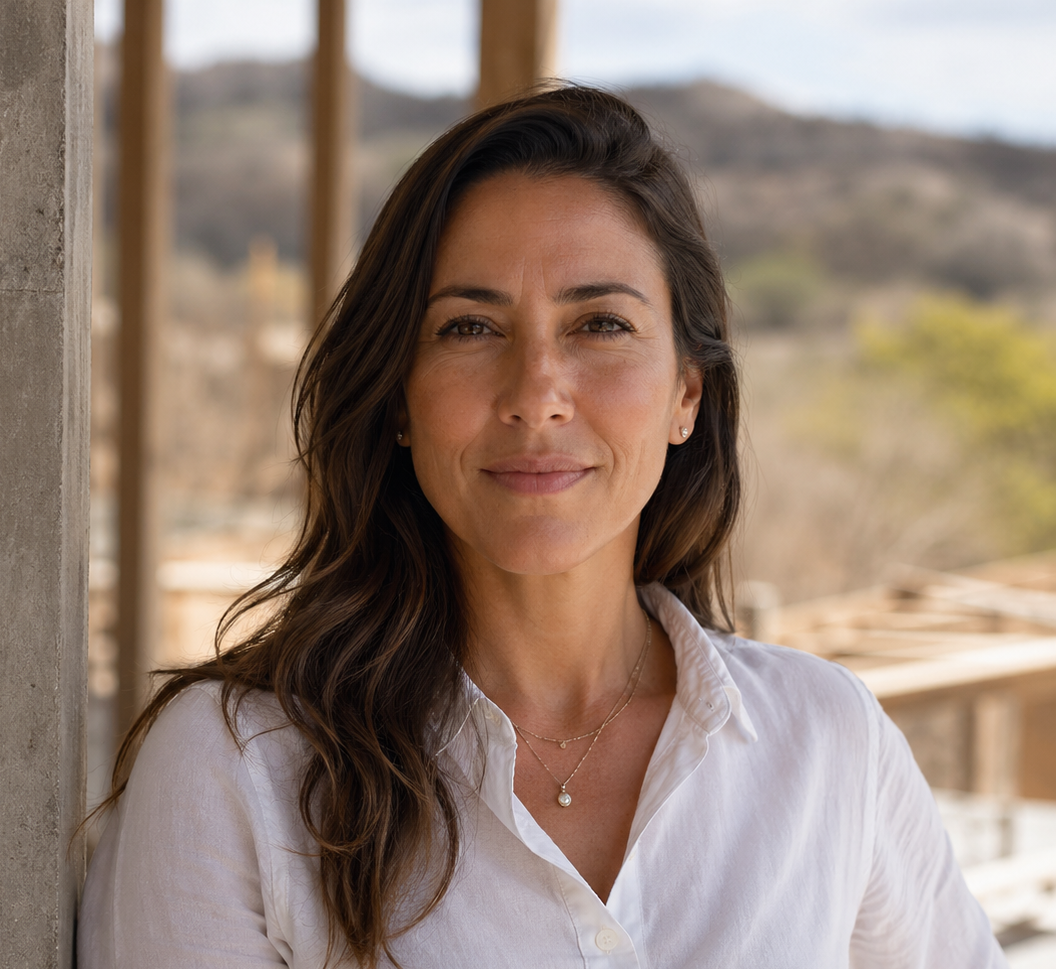
Costa Rican builder from Guanacaste. Grew up on job sites, studied civil engineering at TEC, has been running construction crews for fourteen years. Writes about hiring crews, managing builds, material sourcing, and everything foreign clients get wrong. The local perspective you won't find anywhere else.

### Matt — Architect
Trained in Austria, worked at international firms in London and China, now runs a practice in Costa Rica. Writes about what things actually cost, how permits work, and which building methods survive the tropics. Every claim backed by real project numbers.
## Get in touch
Have a question about building or living in the tropics? Want to contribute or collaborate? Reach us at [james@buildtropical.com](mailto:james@buildtropical.com).
### Contact
URL: https://www.buildtropical.com/contact/
Last updated: 2026-04-26T01:36:22.000Z
Have a question about building, buying, or living in Costa Rica? We'd love to hear from you.
Email us directly at [**laura@buildtropical.com**](mailto:laura@buildtropical.com) — we read everything and respond within a few days.
---
### Send us a message
### Newsletter
URL: https://www.buildtropical.com/newsletter/
Last updated: 2026-04-27T15:30:04.000Z
One email per week. Practical, no-fluff content about building, buying, and living in Costa Rica — written by people who actually do it.
## Subscribe to Build Tropical
Free. One email per week. Unsubscribe any time.
[Subscribe — it's free](#/portal/signup)
## The Writers

### James — Investor
Background in commercial real estate in Canada, now based on the Pacific coast. Covers where to buy, what the rental numbers really look like, and how to avoid the mistakes that cost people six figures. Skeptical by nature, spreadsheet-first.

### Laura — Expat
Moved from the US to Costa Rica in 2020 with her husband and two kids. Writes about the stuff nobody tells you — visas, schools, healthcare, groceries, and what it actually costs to live here month to month. Honest about the downsides.

### Carolina — Contractor
Costa Rican builder from Guanacaste. Grew up on job sites, studied civil engineering at TEC, has been running construction crews for fourteen years. Writes about hiring crews, managing builds, material sourcing, and everything foreign clients get wrong. The local perspective you won't find anywhere else.

### Matt — Architect
Trained in Austria, worked at international firms in London and China, now runs a practice in Costa Rica. Writes about what things actually cost, how permits work, and which building methods survive the tropics. Every claim backed by real project numbers.
## What we don't do
No spam. No daily emails. No affiliate pitches disguised as advice. No selling your email to anyone. Ever. You can unsubscribe with one click, any time.
### Join the newsletter
Costa Rica, from the ground up — fresh stories every week.
[Subscribe — it's free](#/portal/signup)
### Privacy Policy
URL: https://www.buildtropical.com/privacy/
Last updated: 2026-04-27T14:53:07.000Z
Last updated: April 27, 2026
Build Tropical is a publication about building, buying, and living in Costa Rica. We respect your privacy and keep things simple. This policy explains what we collect, why, and what we do with it.
## What we collect
When you subscribe to our newsletter, we collect your **name** and **email address**. That is it. We do not ask for your phone number, location, payment information, or anything else.
When you visit our website, our hosting provider (Ghost Pro) automatically logs basic technical information such as your IP address, browser type, and pages visited. This is standard web server behavior and is used solely for site performance and security.
## How we use your information
Your email address is used for one purpose: sending you our newsletter. We publish once per week. We do not send promotional emails, upsells, or partner offers. We do not sell, rent, share, or trade your email address with anyone. Ever.
## Email tracking
Our email platform (Ghost) tracks whether emails are opened and which links are clicked. We use this data in aggregate to understand what content resonates with readers. We do not use it to build individual profiles or target specific subscribers.
## Cookies
Build Tropical uses only essential cookies required for the site to function — session management and authentication for logged-in members. We do not use advertising cookies, tracking pixels, or third-party analytics services such as Google Analytics or Facebook Pixel.
## Third-party services
We use the following third-party services to operate this site:
**Ghost Pro** — hosting, email delivery, and membership management. Ghost stores data in the EU and maintains GDPR compliance. Their privacy policy is available at ghost.org/privacy.
We do not embed third-party trackers, social media widgets, or advertising scripts on this site. Images are self-hosted through Ghost, not loaded from external CDNs.
## Your rights
You can unsubscribe from the newsletter at any time using the link at the bottom of every email. Once you unsubscribe, we stop emailing you immediately.
If you want your data deleted entirely — including your name, email, and any associated records — email us and we will remove it within 30 days.
Under the GDPR and similar regulations, you also have the right to access, correct, or port your personal data. Contact us at the address below for any of these requests.
## Children
Build Tropical is not directed at children under 16\. We do not knowingly collect personal data from anyone under 16\. If we learn that we have, we will delete it promptly.
## Changes to this policy
If we make changes to this privacy policy, we will update the date at the top of this page. For significant changes, we will notify subscribers by email.
## Contact
Questions about this policy or your data? Email us at **hello@buildtropical.com**.
### Build Ready
URL: https://www.buildtropical.com/build-ready/
Last updated: 2026-08-07T02:11:38.000Z
Build Tropical · Costa Rica
# Plan every step and every cost
*of building in Costa Rica.*
Seventy checks across the five phases of a build, a scope brief your architect can work from, and a budget model that gives you a real all-in number.
[Get Build Ready — $199 →](https://buildtropical.gumroad.com/l/buildready?wanted=true&ref=buildtropical.com)
**18 people** viewing this right now
70 checks 3 tools Instant download One-time purchase

Fillable
What budgets miss
+25–35%
Soft costs, permits, connections and contingency — on top of the build price.
70
Critical checks
3
Tools included
5
Phases covered
$199
One-time · yours to keep
**Made by the people who do this for a living in Costa Rica** — an architect, a contractor, a real estate investor, and expats who've made the move. Every item comes from a real project and a real lesson, not a template.
What's inside
## Three tools. *One clear head start.*
Three documents, built specifically for Costa Rica. One defines what you're building. One tells you what it costs. One keeps you from skipping the step that undoes both.
01
### The Construction Checklist
70 critical checks across the five phases of a Costa Rica build: before you buy the land, before you hire an architect, during design, before you hire a contractor, and during construction. Over 30 pages as a fillable PDF — tick each point as you clear it.
70 checks30+ pages5 phasesFillable PDFTick as you go

02
### The Scope Worksheet
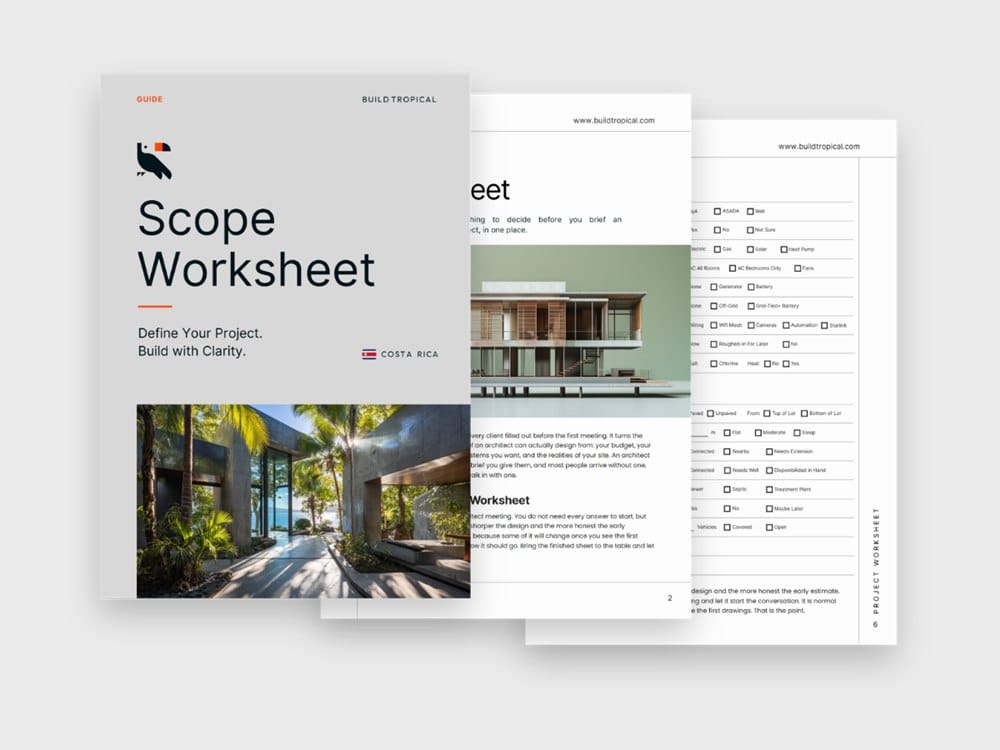
The brief we wish every client arrived with. Define your budget, program, priorities, systems, and site realities in one place, so your architect designs from facts instead of guesses. Fillable PDF.
Budget & programPrioritiesSystems & siteFillable PDF
03
### The Budget Calculator
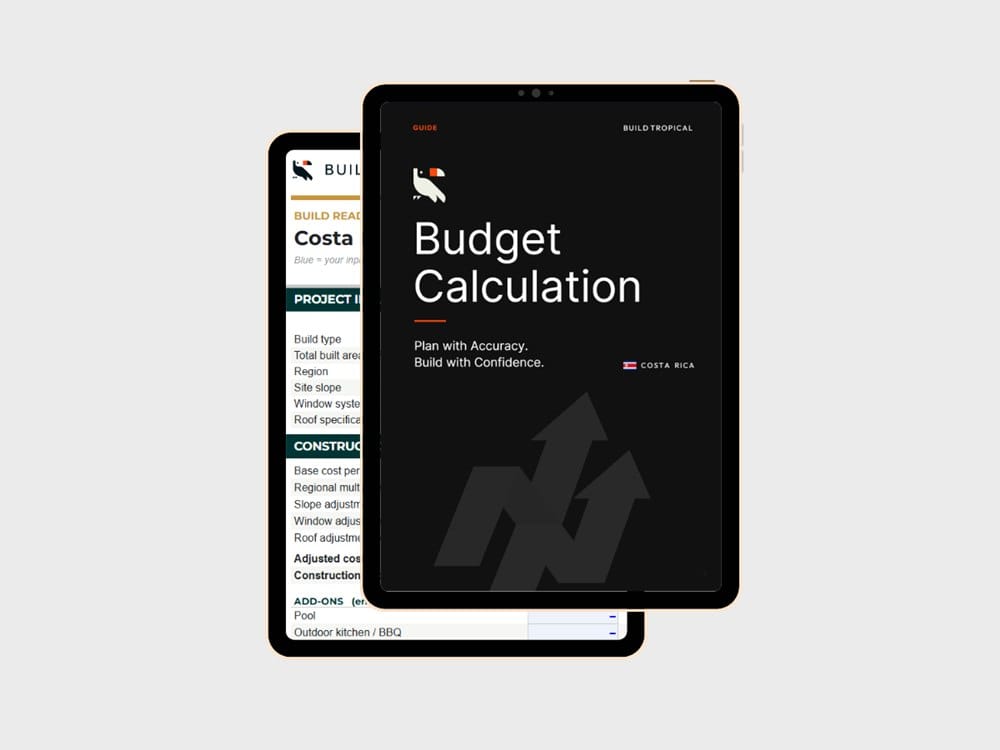
An Excel and Google Sheets model that gives you a real all-in number: construction, soft costs, permits, contingency, even rental yield. Change one input and the whole picture updates.
Excel + Google SheetsPermits & contingencyRental yieldCosta Rica cost base
How it works
## An hour now *saves six figures later.*
The three tools are built to be used in this order, and each one answers the question the next depends on. A decision changed at this stage costs nothing. The same change after construction drawings are complete runs $5,000 to $15,000.
1
### Fill the Scope Worksheet
Get honest about what you're actually building.
2
### Run the Budget Calculator
Turn it into a real number before you talk to anyone.
3
### Work the Checklist
Move through every phase without stepping on the mistakes that sink projects.
Who it's for
## Written for the weeks *before you commit.*
Every decision below is cheap to make now and expensive to revisit later.
You're buying land in Costa Rica, or you already own a lot.
You're planning to build a home, a rental, or both.
You want to brief an architect and hire a contractor in Costa Rica without getting burned.
You'd rather spend an hour deciding now than $50,000 fixing it later.
What buyers say
## Bought early. *Used the whole way through.*
"I read the whole guide on a flight and landed *knowing exactly what questions to ask my contractor.*"
Sarah W.
Tamarindo
"Worth ten times what I paid. *It saved me from signing a contract that had no payment schedule in it.*"
Daniel K.
Nosara
"Finally something that explains the permit process *in plain language instead of legal soup.*"
Marisol V.
Santa Ana
"I had been researching for eight months and *learned more in one afternoon* with this guide."
Tom B.
Playa Hermosa
"The cost breakdown alone changed my entire budget. *I was off by almost forty percent.*"
Anneke de V.
Uvita
"This is the guide I wish someone had handed me *before my first build in Guanacaste.*"
Greg H.
Playa Flamingo
"Clear, honest, and *no sales pitch hiding in the middle.* Just useful information."
Camila R.
Escazú
"I sent it to my wife and she went from *nervous about building to actually excited.*"
Peter L.
Santa Teresa
"The section on choosing a lot *saved us from buying a property with a water access problem.*"
Jenna C.
Ojochal
"Practical from the first page. *You can tell it was written by someone who actually builds.*"
Miguel A.
Atenas
"I used the checklist during three contractor meetings and *it made me sound like I knew what I was doing.*"
Rachel S.
Manuel Antonio
"Best money I have spent on this project so far, and *I have not even broken ground yet.*"
Owen F.
Playa Grande
"It answered questions *I did not even know I needed to ask.*"
Lucia M.
Dominical
"Straightforward, realistic timelines. *No fantasy schedules that fall apart in rainy season.*"
Brian T.
Mal País
"I keep going back to it. *Every phase of my build has a section that suddenly becomes relevant.*"
Elena P.
Puerto Viejo
"If you are building in Costa Rica and skip this, *you are paying tuition to learn the same lessons.*"
Chris D.
Jacó
Why we made this
## Nearly every expensive mistake in Costa Rica *is a known one.*
Avoidable with the right question at the right moment. Build Ready is that list of questions, in order, from the land search to the hand-off. We don't pad it, we don't sell optimism, and every step earned its place by saving someone real money, time, or peace of mind.
[Get Build Ready — $199 →](https://buildtropical.gumroad.com/l/buildready?wanted=true&ref=buildtropical.com)
BT
> "Every item comes from a real project and a real lesson, not a template."
The Build Tropical team
Architect · Contractor · Investor · Expats who made the move
The stakes
## The expensive part isn't building. *It's finding out late.*
A geotechnical soil study costs a few hundred dollars. The gap between a simple slope and a structural retaining wall is $5,000 versus $150,000\. Every one of these is knowable before you commit to a project.
$5,000 → $100,000
What access to a lot can cost, depending on distance, slope, soil and drainage. A driveway is never just a driveway — and it's the cost that most often ends a project after the land is already paid for.
Land, but no permit
Parcels sold on *derechos* rather than registered title. Some municipalities will not issue a construction permit at all. One search at the Registro Nacional settles it before you sign.
Torn out and redone
Finishes installed before the rough electrical and plumbing inspection. If the inspector requires a change, everything covering the work comes out — one of the most common expensive mistakes on Costa Rica sites.
**Everything you need to know, in the order you need to know it.** Every check above is one line in the checklist — and it runs from the land search all the way to the hand-off.
[Get Build Ready — $199 →](https://buildtropical.gumroad.com/l/buildready?wanted=true&ref=buildtropical.com)
Get it now
## Everything you need *before building in Costa Rica.*

Build Tropical · Full Guide 01
### Build Ready
The complete Costa Rica pre-construction set: a brief your architect can build from, a budget that holds up, and the sequence of checks that protects both.
$299 $199 one-time
[Get Build Ready — $199 →](https://buildtropical.gumroad.com/l/buildready?wanted=true&ref=buildtropical.com)
Instant download · No subscription
**24 buyers** this month
↑ Last purchased **2 hours ago**
What's included
—
Construction Checklist
Fillable PDF · 70 Costa Rica-specific checks across 5 phases
—
Scope Worksheet
Fillable PDF · budget, program, priorities, systems, site
—
Budget Calculator
Excel + Google Sheets · rental yield included
—
Instant download
Yours to keep · one-time purchase, no subscription
Common questions
## Questions about *Build Ready*
Is this specific to Costa Rica? +
Completely. Every number, permit, and rule is Costa Rica-specific — CFIA registration, SETENA, municipal permits, the maritime zone, titled vs. concession land, and more.
Do I need special software? +
No. The PDFs open and fill in any PDF reader. The calculator works in Excel or free Google Sheets.
I already own land in Costa Rica — is it still worth it? +
Yes. You'll use the design, contractor, and construction phases, plus the full budget model, from day one.
Is this financial or legal advice? +
No. It's a practical toolkit built from real projects. Always confirm the specifics with your own architect, lawyer, and accountant.
How do I get it? +
Instant download after purchase through Gumroad. Both a fillable PDF set and a spreadsheet you can open in Excel or copy into Google Sheets.
Keep going
## Three real quotes, *read before yours arrives.*
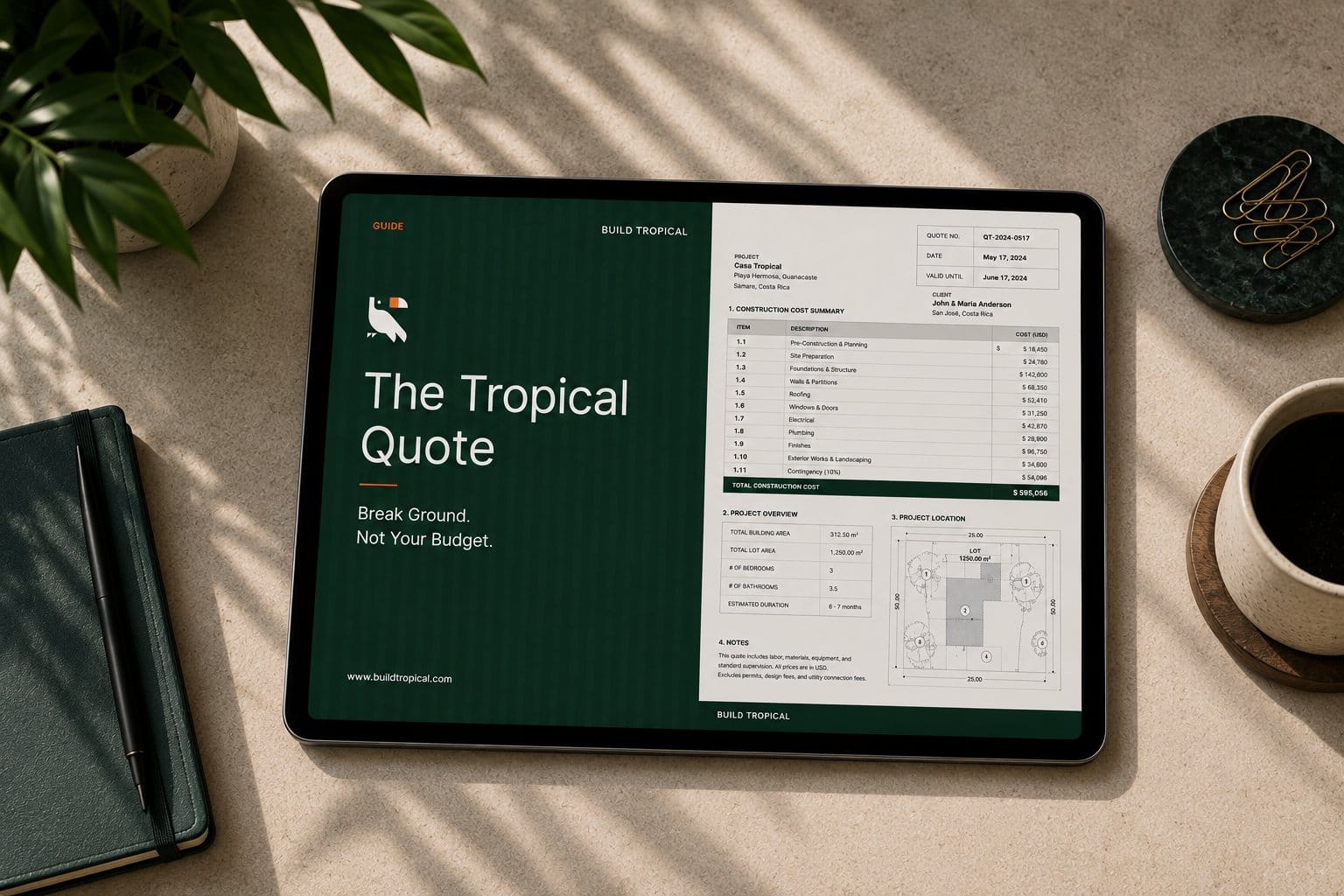
Three real Costa Rica construction quotes, annotated line by line — so you know what a quote should contain, how to compare one against another, and what to question, before you receive your own.
Coming soon Build Tropical · Full Guide 02 · in production
Email address Notify me →
Thanks — we'll email you the day it's out. Check your inbox to confirm.
Build Tropical · buildtropical.com
Cost benchmarks from real Costa Rica project data · Not financial advice
## Posts
### Property Title Due Diligence in Costa Rica: A Step-by-Step Guide for Foreign Buyers
URL: https://www.buildtropical.com/property-title-due-diligence-costa-rica/
Last updated: 2026-08-27T14:59:59.000Z
Title due diligence in Costa Rica is not optional and it is not a formality. The National Registry is a public registry system that is generally reliable, but the reliability of the system does not mean that every property in it is clean, clear, and exactly as the seller represents it. Liens, encumbrances, boundary disputes, easement conflicts, environmental restrictions, and the distinction between titled and concession land near beaches are all things the registry contains information about and that a proper due diligence process will surface before they become the buyer's problem.
The buyers who skip due diligence to save a few thousand dollars occasionally get lucky. More often they are the case studies that Costa Rica real estate lawyers use to explain why due diligence matters.
**Property Title Due Diligence in Costa Rica: The Non-Negotiables**Every real property purchase in Costa Rica requires a title search in the National Registry, a survey comparison verifying the boundaries against the registered plano catastrado, confirmation of whether the property is titled or concession land, a check for liens, mortgages, and annotations on the registry entry, and review of any environmental restrictions or easements affecting the property. This process is conducted by a Costa Rican lawyer and a licensed topographer and should be completed before any purchase contract is signed.
In this article
[The National Registry and how it works](#)[Step 1: Title search](#)[Step 2: Titled vs concession](#)[Step 3: Boundary verification](#)[Step 4: Liens and encumbrances](#)[Step 5: Environmental restrictions](#)[Step 6: Uso de suelo and zoning](#)[Step 7: Water access](#)[Step 8: Road access and easements](#)[What commonly goes wrong](#)[FAQ](#)
## The National Registry and How It Works
Costa Rica's National Registry (Registro Nacional) is the central repository for property records, corporate information, and other legal registrations. Real property is registered by folio real number, a unique identifier that links to all recorded information about the property: current owner, boundary description, area, registered liens, mortgages, encumbrances, and annotations.
The registry is public and searchable. Your lawyer will pull the full registry entry for any property you are considering and read it against what the seller has represented. The registry entry is the authoritative source on the legal status of the property as recorded. What it does not tell you is everything that might affect the property that has not been recorded, which is why the due diligence process involves multiple complementary checks rather than just the registry search.

## Step 1: Title Search
The title search reviews the chain of ownership for the property going back a minimum of ten years, and often further. The purpose is to verify that each transfer was properly executed, that the seller at each stage had clear title to convey, and that there are no gaps or irregularities in the ownership history that could give rise to a future claim.
Your lawyer will verify that the current seller's name on the registry matches who you are contracting with, which sounds obvious but is a step that catches discrepancies in corporate structures, name changes, and properties held through entities that have not been properly maintained. Properties held through a sociedad anónima require verification that the SA is current, properly registered, and that the person signing on its behalf has the legal authority to do so.
The title search also reviews all annotations currently on the registry entry. An annotation can be anything: a pending lawsuit, a voluntary lien, a third-party claim. Annotations that are not cleared before closing transfer with the property and become the buyer's issue.
## Step 2: Titled Versus Concession Land
This is the most consequential distinction in Costa Rica real estate, particularly for properties near the coast. Titled land is registered in the National Registry with a full fee-simple ownership right that can be held by any person or entity, including foreigners. Concession land, governed by the Maritime Zone Law, covers most of the land within 200 meters of the high-tide line on Costa Rica's beaches and cannot be directly owned by foreigners or by corporations with foreign majority ownership.
The distinction is not always obvious from a physical inspection or a casual description. Some beachfront properties are titled. Some land that appears to be well back from the beach is in the Maritime Zone because of how the high-tide line runs. Your lawyer must verify the land classification against the Maritime Zone maps maintained by INDER and the relevant municipality before you can assess what you are actually buying and whether you can legally own it in the structure you intend to use.
Purchasing concession land without understanding the legal structure required to hold it is one of the more common and expensive mistakes foreign buyers make. Concession rights can be held by foreigners through qualifying legal structures, but this requires specific advice and compliance that is distinct from a straightforward titled land purchase.
I reviewed a transaction last year where a buyer was about to purchase what the listing described as beachfront titled land. The title search showed the property was partially titled and partially within the Maritime Zone concession area. The portion in the Maritime Zone was more than half the lot. The purchase price assumed full titled ownership of the entire parcel. The due diligence process caught this before the buyer wired any money.

## Step 3: Boundary Verification
The registry entry for a property includes a reference to its plano catastrado, the cadastral survey registered with the Catastro Nacional. Your lawyer will obtain a copy of the registered plano and a licensed topographer will verify, through a physical survey of the property, that the boundary markers on the ground match the registered plano and that the area of the property matches what is represented.
Boundary discrepancies are common, particularly in older rural properties and in areas where the original surveys were done with less precision than modern GPS-based methods allow. A discrepancy between the registered plano and the actual ground boundaries is not always a disqualifying problem but it is something that must be identified, understood, and resolved before closing. Sometimes this means the registry entry needs to be updated to reflect the actual boundaries. Sometimes it reveals an encroachment problem with a neighbor. Sometimes it reveals that the property is smaller than represented.
The topographic survey that a licensed topographer produces for this verification is distinct from the engineering topographic survey commissioned for construction purposes, though both are often needed for a buildable lot purchase.
## Step 4: Liens and Encumbrances
A mortgage or lien on a property in Costa Rica is registered in the National Registry and appears in the property's registry entry. The title search will identify any registered mortgages, voluntary liens, and legal annotations, including the amounts and the beneficiaries. Costa Rica law provides that registered liens follow the property rather than the owner, which means a lien that is not cleared at closing becomes the buyer's obligation regardless of what the seller represented.
Clearing liens at closing is standard practice, where the purchase proceeds are used to discharge any registered mortgages or liens at the time of transfer. Your lawyer manages this process. The key is that the existence of liens must be known before the purchase price is agreed and before any funds change hands, because the cleared-lien property is a different purchase than the same property with a $300,000 mortgage attached.
Before you commit
Most budget blowouts in Costa Rica are locked in long before anyone pours concrete — in the scope you never defined and the number you never pressure-tested. **Build Ready** is the 70-point checklist, scope worksheet and budget model I use to get that on paper before a client talks to land agents, architects or contractors.
[See what is inside Build Ready →](https://www.buildtropical.com/build-ready/)
## Step 5: Environmental Restrictions
Costa Rica has active environmental protection legislation. Several categories of land carry restrictions that significantly limit or prohibit construction. Properties within a certain distance of a forest, within a protected area boundary, within a wetland zone, or within a riverine protection zone may have construction restrictions that are not obvious from a physical inspection and are not always disclosed by sellers.
The environmental due diligence check involves reviewing the property against SINAC maps, INDER records, municipal zoning maps, and where relevant, the SETENA environmental management database. A property that appears to be a clean residential lot may be in a restricted zone that prohibits or significantly limits the construction you intended. This check is particularly important for rural properties, hillside lots near forest, and any property near water.

## Step 6: Uso de Suelo and Zoning
The uso de suelo, or land use certificate, confirms that the municipal zoning for the property permits the intended use. Residential construction on land zoned for agriculture, commercial use on land zoned residential, or any construction on land zoned for conservation or protection, requires municipal approval that may or may not be obtainable.
The uso de suelo is also required as part of the building permit package. Confirming it before purchase rather than after ensures that your intended construction is actually permitted on the land you are buying. The alternative, discovering after purchase that the zoning does not permit your project, is an expensive problem.
## Step 7: Water Access
Water access confirmation is a due diligence step that is frequently omitted and frequently consequential. The check involves confirming with the relevant water authority, either AyA or the local ASADA, that a water connection is available for the specific property and that the system has capacity to serve it. A written letter confirming availability is the document that matters. Verbal assurances from the seller or agent are not a substitute.
For properties outside established water service areas, a hydrogeological assessment of well viability before purchase is the relevant check. We have covered this in detail in our [guide to water availability and building in Costa Rica](https://www.buildtropical.com/water-availability-building-costa-rica).
## Step 8: Road Access and Easements
Confirm that the property has legal road access, not just physical access. A property that is currently accessed via a road across a neighbor's land without a registered easement is vulnerable to losing that access if the neighbor's ownership changes or the relationship deteriorates. Legal road access means an easement registered in the National Registry or a public road boundary.
Also check for any easements that cross the property, which would affect what can be built and where. Power line easements, water line easements, and drainage easements are all common and can significantly affect the usable area of a property.
## What Commonly Goes Wrong
The patterns that appear most often in problematic Costa Rica property transactions cluster around a few predictable failures: buyers purchasing without a lawyer and missing registered liens or annotations, buyers relying on the seller's description of the land type without independently verifying titled versus concession classification, buyers purchasing without boundary verification and discovering a significant discrepancy after the fact, and buyers not checking environmental restrictions on rural or coastal lots.
The common thread is the belief that the physical property and the seller's representation are a sufficient basis for a purchase decision. They are not. The registry entry, the boundary survey, the land classification, and the environmental status are separate inquiries that each have the potential to surface material information.
The due diligence process for a Costa Rica property purchase costs $1,500 to $4,000 depending on the complexity of the property and the scope of the checks. On a $300,000 purchase, that is less than 1.5 percent. It is the best-spent money in the transaction.
For more on the legal and practical aspects of property ownership in Costa Rica, see our guides to [buying land in Costa Rica](https://www.buildtropical.com/buying-land-costa-rica), [beachfront property](https://www.buildtropical.com/beachfront-property-costa-rica), and [whether foreigners can build in Costa Rica](https://www.buildtropical.com/foreigners-build-costa-rica).
## Frequently Asked Questions About Property Due Diligence in Costa Rica
### What is a title search in Costa Rica and do I need one?
A title search reviews the National Registry entry for a property, verifying the chain of ownership, identifying registered liens and encumbrances, and checking for annotations or claims. It is conducted by a Costa Rican lawyer and is an essential step before any property purchase. Without it, you cannot know the legal status of the property you are buying.
### What is the difference between titled and concession land in Costa Rica?
Titled land is registered with full fee-simple ownership rights in the National Registry, open to any buyer including foreigners. Concession land is within the Maritime Zone, governed by a separate law that restricts direct ownership to Costa Rican citizens and qualifying corporations. The distinction is critical for coastal properties and must be verified through your lawyer before purchase.
### How long does property due diligence take in Costa Rica?
A complete due diligence process for a residential property typically takes two to four weeks depending on the complexity of the property, the response time of the relevant agencies (water authority, municipality), and whether any issues surface that require further investigation. Rushed due diligence to meet an artificial deadline is a risk not worth taking.
### What does property due diligence cost in Costa Rica?
Lawyer fees for a standard residential purchase title search and due diligence run $1,500 to $3,000\. A licensed topographer for boundary verification adds $800 to $2,500 depending on the property size and terrain. Environmental and zoning checks may add additional fees. Total due diligence costs of $2,000 to $5,000 are common for a standard residential purchase.
### What happens if a lien is found on a property in Costa Rica?
A registered lien on a property can be cleared at closing using purchase proceeds, similar to how a mortgage is discharged in a North American property transaction. The purchase contract should specify that the sale is conditioned on delivery of clear title at closing. Your lawyer manages the lien discharge process and confirms with the registry that the annotation has been removed before the transfer is completed.

Build Tropical · Full Guide 01
Planning a Build in Costa Rica?
Most budget blowouts are locked in before anyone pours concrete. Build Ready is the 70 point checklist, scope worksheet and budget model that drags those decisions into the open, so you know your real number and your real scope before you commit to land, an architect or a contractor.
[See Build Ready — $199 →](https://www.buildtropical.com/build-ready/)

ABOUT THE AUTHOR
James Caldwell
James Caldwell is a real estate investor and writer based on the Pacific coast of Costa Rica. He spent fifteen years in commercial real estate in Canada before shifting his focus to the Costa Rica market. He writes for Build Tropical about the numbers behind property decisions, the ones that hold up and the ones that do not.
### Home Builders in Costa Rica: How to Find the Right One and What to Expect
URL: https://www.buildtropical.com/home-builders-costa-rica/
Last updated: 2026-08-25T15:00:00.000Z
The Costa Rica construction market does not work the way most foreign buyers expect. There is no licensing system for general contractors the way North America and Europe have. There is no single platform where verified, insured, bonded builders are listed with ratings and track records. What there is instead is a fragmented market of independent contractors, small construction firms, and a handful of larger design-build operations, ranging in quality from excellent to very poor, with no reliable external signal that tells you which is which from a distance.
This is not a reason to be afraid of building in Costa Rica. It is a reason to approach the contractor selection process carefully, with the right questions and the right framework for evaluating answers.
**Home Builders in Costa Rica: How to Navigate the Market**The Costa Rica residential construction market includes independent maestros de obras working on smaller projects, small to mid-size contractor firms handling residential work, and design-build companies that manage design and construction under one roof. Quality varies significantly within each category and is not reliably indicated by firm size, age, or marketing presentation. The most reliable indicator of a contractor's quality is a portfolio of completed projects you can visit and past clients you can call.
In this article
[How the construction market works](#)[Types of builders in Costa Rica](#)[Why you need an architect separate from your contractor](#)[How to find candidates](#)[Evaluating a builder](#)[What to expect from the process](#)[Regional availability](#)[FAQ](#)
## How the Construction Market Works
Costa Rica has no government licensing body for general contractors equivalent to a state contractor's license in the US. The CFIA licenses architects and engineers, whose stamps are required on any permitted project, but there is no analogous credential for general contractors. A contractor can legally offer construction services without any formal credential beyond business registration.
This means the vetting burden falls entirely on the client. The market does have internal reputation mechanisms. Contractors who do good work get referrals. Contractors who do poor work or mismanage client funds get known within the expat community, which is small enough that word travels. But these mechanisms are informal and slow, and a foreign buyer arriving new to the market does not have access to them without effort.
The formal quality signal in a Costa Rica construction project is the architect and structural engineer. Their stamps on the plans are the professional credentialing layer that the contractor system lacks. A well-designed project with a competent architect providing construction supervision is more reliably well-built than a project where the contractor operates without design oversight. This is the structural reason we recommend that foreign buyers start with the architect rather than the contractor.

## Types of Builders in Costa Rica
The residential construction market divides roughly into three tiers. The first is the independent maestro de obras, a skilled construction foreman who manages a small crew and takes on projects in the $50,000 to $200,000 range, typically smaller homes, renovations, or accessory structures. The best maestros are exceptionally skilled and often represent the most cost-effective way to build a simple project. The risk is that a maestro typically has limited administrative capacity, no contract infrastructure, and may not have experience managing the coordination requirements of a complex project.
The second tier is small to mid-size contractor firms with a principal contractor overseeing multiple crews and projects simultaneously. These firms can handle standard residential projects from $150,000 to $600,000 and have more administrative structure than an independent maestro. The principal contractor may or may not be actively present on your specific site, which is the key question to investigate.
The third tier is established larger contractors who build at significant scale and do so continuously. These firms are worth understanding separately because the constant flow of projects changes what they can offer. A contractor who has ten or more active projects per year can afford to employ a better structural engineer, a more experienced maestro de obras, and senior site staff who stay with the company rather than drifting between employers. The continuity of their workforce is itself a quality signal. Because they are always building, their best people have reason to stay. They have also absorbed the permit and coordination experience that comes from building repeatedly in the same markets. For larger or more complex projects, a well-established contractor at this scale can offer meaningful operational depth that a smaller firm cannot match.
## Why You Need an Architect Separate from Your Contractor
The question of whether to use a design-build firm — a single company that handles both architecture and construction — is worth addressing directly, because it gets presented to foreign buyers as a convenient option. In our experience it can turn out very badly, and we do not recommend it.
The reason is structural. When the architect and the contractor are the same entity, there is no independent professional whose job is to verify that what gets built matches what was designed. The oversight role that an architect provides in a well-run project, reviewing work on site, calling out deficiencies, rejecting substandard execution, is eliminated when both parties report to the same management. The client has no one working specifically on their behalf in the field.
This matters less on simple projects where the scope is clear and the margins for error are small. It matters significantly on complex builds, hillside sites, custom homes, or anything involving imported systems or non-standard finishes. These are precisely the projects that most foreign buyers are undertaking.
The correct structure is an architect engaged separately, with a clear construction supervision scope in their contract, and a contractor engaged separately on the basis of drawings that the architect has produced. The architect then reviews the contractor's work throughout the build. This arrangement takes more coordination but provides genuine independent quality control. It is the standard we work from.
The projects that go most badly for foreign clients are almost always the ones where the client hired a contractor without a properly engaged architect in a supervisory role. The architect-contractor separation is not bureaucracy — it is the only meaningful quality check on a Costa Rica construction site.

## How to Find Builder Candidates
Referrals from the local expat community are the most reliable starting point. Talk to people who have built recently in the area where you are building and ask specifically about who built their house and whether they would hire them again. The Costa Rica expat Facebook groups and local community forums are imperfect but useful sources of recent first-hand experience.
Your architect, once engaged, will typically have working relationships with contractors they have collaborated with before and whose work they can vouch for from direct experience. An architect's contractor referral is more reliable than a cold search because it comes with professional accountability on both sides.
For larger contractors, their track record in the specific region where you are building is the starting point. A contractor who has delivered ten or more projects in Guanacaste has absorbed the local permit process, the contractor networks, and the site conditions in a way that a firm operating there occasionally has not. Ask for project references specifically in your geography, not just their best projects wherever those happened to be.
Before you commit
Most budget blowouts in Costa Rica are locked in long before anyone pours concrete — in the scope you never defined and the number you never pressure-tested. **Build Ready** is the 70-point checklist, scope worksheet and budget model I use to get that on paper before a client talks to land agents, architects or contractors.
[See what is inside Build Ready →](https://www.buildtropical.com/build-ready/)
## Evaluating a Builder
Ask for a portfolio of completed residential projects in the region where you are building, specifically projects comparable in size and type to yours. Visit at least one completed project in person. Photographs are useful but insufficient. A site visit shows you finish quality, detailing, and how the building has aged in the specific climate conditions of the area.
Request three references from projects completed in the past two years and call them. Ask the same four questions you would ask of any contractor: did the project finish on schedule, did the final cost match the quote, how were problems handled, and would you hire them again.
Ask who will be present on site daily during your project. The maestro de obras who runs the day-to-day construction is often more consequential for quality than the principal contractor, who may be managing several projects simultaneously. Ask to meet the maestro.
Ask specifically about experience working with foreign clients who are not on site regularly. This is a distinct skill set from managing a local client who visits daily. A contractor who has done this well for other foreign buyers will have communication systems, reporting protocols, and decision-making structures in place. A contractor who has not will be learning at your expense.
## What to Expect From the Process
A well-run residential construction project in Costa Rica, from the signing of the construction contract to handover of the finished building, runs 10 to 16 months for a standard home. Foundation to structure is typically 2 to 3 months. Structure to rough-in is 2 to 3 months. Finishes and systems, which is where the most schedule slippage typically occurs, is 4 to 6 months. Complex designs, hillside sites, or projects with significant imported materials extend the timeline.
Payment terms should be milestone-based. Standard advance payments of 10 to 15 percent at contract signing, with subsequent payments tied to inspectable progress stages: foundation complete, structural frame complete, roof complete, rough-in complete, finishes complete. Each payment should follow a site inspection or photo documentation that confirms the milestone has been reached.
The best home builder for your project in Costa Rica is the one who has built something similar, in a similar location, for a foreign client, and who can show you the building and put you in touch with the client. That is the only credential that matters.

## Regional Availability
Labor markets and contractor availability vary significantly by region. Guanacaste and the northern Pacific coast have the deepest construction labor pool, with established networks of contractors and subcontractors serving the concentration of foreign buyer activity in Tamarindo, Flamingo, and the Papagayo corridor.
The Southern Pacific, including Uvita and Dominical, has a smaller local construction workforce. Projects in the Southern Pacific often face longer lead times for material delivery and more limited contractor options at the mid to upper quality level. This does not make building there impossible but it does mean the preparation and planning phase needs to account for a different logistics environment.
The Nicoya Peninsula, including Santa Teresa and Nosara, has grown its construction workforce substantially as the market has developed. Experienced contractors working regularly in these markets exist, but the pool is shallower than in Guanacaste and travel costs for materials and specialized trades from the mainland add to project costs.
For more on the construction process, see our guide to [hiring a contractor in Costa Rica](https://www.buildtropical.com/hiring-contractor-costa-rica), our [construction timeline overview](https://www.buildtropical.com/construction-timeline-costa-rica), and our guide to [questions to ask your contractor before signing](https://www.buildtropical.com/contractor-questions-costa-rica).
## Frequently Asked Questions About Home Builders in Costa Rica
### Do home builders in Costa Rica need to be licensed?
There is no government licensing system for general contractors in Costa Rica. CFIA registration is required for architects and engineers whose stamps appear on permitted drawings, but general contractors have no equivalent credential. This makes client-side due diligence, including portfolio review and reference checks, the primary quality assurance mechanism.
### What is the difference between a contractor and a design-build firm in Costa Rica?
A contractor builds from designs produced by an architect who is engaged separately by the client. A design-build firm provides both architectural design and construction management under one contract. We do not recommend the design-build structure because it removes the independent oversight that a separately engaged architect provides — there is no one working specifically on the client's behalf to verify that construction matches the design and meets quality standards. The correct structure is an architect engaged separately, with a construction supervision scope, and a contractor working from that architect's drawings.
### How much does it cost to build a home in Costa Rica?
Construction costs in Costa Rica run $1,200 to $2,500 per square meter depending on region, finish level, construction method, and site conditions. See our [complete cost of building guide](https://www.buildtropical.com/cost-of-building-in-costa-rica) for a full breakdown by region and finish level.
### How long does it take to build a house in Costa Rica?
A standard residential project runs 10 to 16 months from construction contract signing to handover. This does not include the design phase (2 to 4 months) or the permit process (3 to 6 months after design completion). From the decision to build to keys in hand, 18 to 24 months is a realistic expectation for a mid-size residential project.
### How do I find a good home builder in Costa Rica as a foreigner?
Start with referrals from the local expat community and from your architect once engaged. Request a portfolio of completed projects comparable to yours, visit at least one in person, and call two to three past client references. Ask specifically about experience managing projects for foreign clients who are not on site regularly. The contractor's track record with remote client management is as important as their construction quality.

Build Tropical · Full Guide 01
Planning a Build in Costa Rica?
Most budget blowouts are locked in before anyone pours concrete. Build Ready is the 70 point checklist, scope worksheet and budget model that drags those decisions into the open, so you know your real number and your real scope before you commit to land, an architect or a contractor.
[See Build Ready — $199 →](https://www.buildtropical.com/build-ready/)

ABOUT THE AUTHOR
Carolina Vargas
Carolina Vargas is a general contractor based in Guanacaste, Costa Rica. She has built residential and hospitality projects on the Pacific coast for over twelve years. She writes for Build Tropical about the realities of construction from the contractor's side of the table.
### Interior Design in Costa Rica: Local Materials and What Actually Works in the Tropics
URL: https://www.buildtropical.com/interior-design-costa-rica/
Last updated: 2026-08-25T13:37:54.000Z
Interior design in the tropics is a different discipline from interior design in a temperate climate. The materials that photograph beautifully in a staged US or European home perform differently in an environment with year-round heat, high humidity, salt air within a few kilometers of the coast, and a rainy season that tests everything. The decisions that matter most in a tropical interior are not about aesthetics first — they are about using the right materials from the start. Choose correctly and the interior performs without drama. The challenge is knowing what works and what does not.
We have designed interiors for homes and boutique hospitality projects across Costa Rica for over a decade. What follows is the practical guide we give clients when the conversation turns to finishes and materials.
**Interior Design in Costa Rica: What the Climate Demands**The primary design discipline in a Costa Rica interior is selecting materials that are beautiful and that perform in high humidity, heat, and salt air. Porcelain tile, polished concrete, and sealed stone perform exceptionally well. Natural wood requires careful species selection and ongoing maintenance. Fabric-heavy interiors require constant attention in coastal environments. The best tropical interiors use local materials, respect the indoor-outdoor relationship that the climate enables, and design for real maintenance loads rather than photoshoot conditions.
In this article
[The climate challenge](#)[Flooring: what works](#)[Walls and surfaces](#)[Wood in tropical interiors](#)[Textiles and soft furnishings](#)[The indoor-outdoor relationship](#)[Local materials worth knowing](#)[Lighting in tropical spaces](#)[Working with local craftspeople](#)[FAQ](#)
## The Climate Challenge
The Costa Rica Pacific coast operates at temperatures between 25 and 35 degrees Celsius year-round, with relative humidity frequently above 80 percent in coastal areas and higher during rainy season. Salt air within a few kilometers of the coast accelerates oxidation on metals, degradation of finishes, and mold growth on organic materials. Insects are present in ways that temperate climates simply are not.
This climate does extraordinary things to certain materials. It shortens the lifespan of others dramatically. And it means that an interior designed for a European or North American home, with its wool rugs, upholstered sofas, painted MDF cabinetry, and decorative iron hardware, will require constant maintenance to look presentable and will age quickly. The most beautiful and most livable Costa Rica interiors are the ones designed with the climate as a collaborator rather than an obstacle to overcome.

## Flooring: What Works
We use a lot of tile in our projects, and for good reason. Porcelain tile is hard, impermeable, easy to clean, and available in large formats that cover floor areas with minimal grout lines. Large format rectified porcelain in lighter tones is our default recommendation for primary living spaces. It performs consistently in tropical conditions and ages well.
Parquet flooring is tricky in Costa Rica. The expansion and contraction from humidity shifts causes problems in most coastal applications, and we generally steer clients away from it. Solid hardwood is more viable in protected interior areas, but the species and the treatment matter significantly. The right hardwood from the right provider, properly dried and properly treated, can work in wall paneling, ceiling applications, and select interior floor areas. The wrong wood from the wrong supplier is a recipe for disaster. Do not buy just any wood. Work with a reputable timber supplier who can tell you exactly what the species is, how it was dried, and where it came from. This is not a purchase to make at a random hardware store.
Natural stone, particularly locally sourced volcanic stone, works well for specific applications — outdoor terraces, bathrooms, kitchen areas. It requires sealing but is a strong and genuinely local material choice.
## Cabinetry and Kitchen Finishes
Imported kitchen cabinetry from a professional European or North American provider can perform very well in Costa Rica, and the majority of our clients use it. MDF-core cabinetry from a quality manufacturer with proper sealing and finish systems is a different material from budget MDF in a hardware store — the quality of the board, the thickness of the finish, and the sealing of all edges determine how it performs in humid conditions. Source it right and it holds up. Source it wrong and it does not. We recommend clients use professional kitchen suppliers rather than local carpenters working with untreated local MDF for kitchen applications specifically.
Leather on furniture does not work well in coastal tropical environments. It absorbs humidity, develops mold, and degrades quickly. We avoid specifying it.
## Walls and Surfaces
The wall surfaces most common in Costa Rica residential construction, concrete block or fiber cement board on steel frame, are excellent bases for interior finishes. Microcement, a thin-coat surface applied over existing substrates, has become popular in contemporary Costa Rica interiors and performs well in interior conditions. It creates a seamless surface with a sophisticated look and is available in a range of tones.
Paint selection matters more in the tropics than in temperate climates. Quality exterior-grade or moisture-resistant interior paints resist the mold growth that standard interior paints are vulnerable to in high-humidity conditions. Budget paint in a coastal environment will show mold within two to three years. Investing in quality paint products at the outset is significantly more cost effective than repainting frequently.
Tiled walls in bathrooms and kitchen areas are standard and sensible. Large format tiles on bathroom walls read as contemporary and reduce the grout maintenance compared to traditional smaller formats. Matching floor and wall tile in bathrooms creates a clean, cohesive look that is easy to maintain.
The most common interior problem we see in coastal Costa Rica homes is not the climate — it is material selection that did not account for the climate. Organic surfaces in high-humidity zones, untreated pine near the coast, porous finishes in bathrooms. Design for the environment from the start and the interior performs without drama. Retrofit the right material after the wrong one has failed and it costs significantly more.

## Wood in Tropical Interiors
Wood belongs in a tropical interior and we use it regularly, but the source and species matter as much as the application. The right hardwood from a reputable, professional supplier — properly dried, properly treated, properly specified for the intended use — performs very well. The wrong wood from the wrong source is a problem regardless of the application.
Teak is the benchmark and earns its reputation. It contains natural oils that resist moisture and insects, ages well in coastal conditions, and is appropriate for a wide range of applications from ceilings to furniture frames to decking.
Locally available hardwoods can also work well in wall paneling, structural beams, ceilings, and carefully chosen interior floor areas. The critical variable is the supplier. Work with a professional timber provider who sources legally, documents species, and can tell you how the wood was dried. This is not a category to improvise in.
Pine untreated is a problem in Costa Rica. Termites find it very attractive and the damage can be significant. If pine is specified anywhere, it must be properly treated. We generally steer clients toward hardwoods rather than softwoods for this reason.
Bamboo and similar materials we do not use in our projects. Beyond the aesthetic preference, bamboo carries real pest and moisture issues in tropical coastal conditions that are not worth managing.
The applications where wood performs most reliably in tropical interiors are ceilings, structural and decorative beams, and millwork details such as door frames, window surrounds, and built-in cabinetry. Exterior decking that is fully exposed to rain and direct sun requires more careful species selection and more diligent upkeep than covered or interior applications.
Before you commit
Most budget blowouts in Costa Rica are locked in long before anyone pours concrete — in the scope you never defined and the number you never pressure-tested. **Build Ready** is the 70-point checklist, scope worksheet and budget model I use to get that on paper before a client talks to land agents, architects or contractors.
[See what is inside Build Ready →](https://www.buildtropical.com/build-ready/)
## Textiles and Soft Furnishings
Textiles can absolutely work in a coastal Costa Rica interior — the key is choosing the right ones rather than avoiding them altogether. Outdoor-rated fabrics, woven from solution-dyed acrylic or polyester, perform well and have improved dramatically in comfort and aesthetic quality in recent years. But good interior textiles also work well: natural fibers including linen, cotton canvas, and performance blends handle the tropical environment fine when the fabric weight and weave are appropriate. The question is not whether to use textiles but whether the specific textile is easy to clean. That is the filter. If it can be wiped down or washed without drama, it belongs in the conversation. Heavily constructed upholstery with difficult cleaning requirements is the category to avoid, not textiles as a whole.
Area rugs work well when they are flat-woven and easy to take outside and air. Deep pile rugs accumulate moisture and are harder to manage.
## The Indoor-Outdoor Relationship
The single most important opportunity in tropical interior design is the relationship between the interior and the exterior, and it is the one that most distinguishes a well-considered tropical home from a house that happens to be in the tropics. When the climate permits near-constant cross-ventilation, when the view is part of the daily experience, and when the outdoor living area is as usable as the interior, the design task is to blur that boundary rather than define it.
Sliding or folding glass wall systems that open an entire living space to a covered terrace change how the space functions. The terrace becomes an extension of the living room rather than an ancillary outdoor area. The ceiling line that runs continuously from interior to exterior under a deep overhang creates a spatial continuity that is one of the most distinctive achievements of good tropical architecture.
When this relationship is designed well, the interior reads larger, the ventilation is better, and the occupant is in continuous contact with the landscape that is the primary reason to be in Costa Rica at all.

## Local Materials Worth Knowing
Several locally available materials are underused in Costa Rica interiors. Volcanic stone, quarried in the Central Valley and available in various finishes from rough to polished, is a genuinely distinctive material with deep roots in the region. It has thermal mass, a texture that photographs beautifully, and a sense of place that imported materials cannot replicate.
Local hardwoods, when legally sourced from professional suppliers and properly dried and finished, are available for millwork, furniture, and select flooring applications. The supply chain for legal timber in Costa Rica requires attention — not all wood sold locally is sustainably or legally sourced, and the species is not always what it is claimed to be. Working with professional, accountable suppliers rather than informal sources is the standard we apply to every project.
## Lighting in Tropical Spaces
Lighting in a tropical interior needs to account for two things: the brightness of the exterior during daylight hours and the relative darkness of the interior at night. During the day, the challenge is often reducing glare from bright tropical light rather than adding it. Deep overhangs, translucent screens, and carefully positioned windows that bring in diffuse light rather than direct sun are more valuable than additional artificial fixtures.
At night, the tropical residential interior benefits from warm, layered lighting rather than uniform overhead brightness. The high ceilings that characterize well-designed tropical homes respond well to indirect lighting coves, pendant fixtures, and table lamps that create pools of warm light rather than a uniformly lit ceiling.
IP65 or higher rated fixtures in bathrooms and outdoor-adjacent areas are necessary, not optional. Moisture ingress into standard interior-rated fixtures in high-humidity environments produces failures, corrosion, and safety issues.
The best tropical interiors do not fight the climate. They use it. The breeze, the light, the materials that the environment produces naturally, and the relationship between inside and outside that the weather allows nearly year-round.
For more on tropical design principles, see our guide to [tropical house design in Costa Rica](https://www.buildtropical.com/tropical-house-design-costa-rica) and our article on [passive cooling and natural ventilation](https://www.buildtropical.com/passive-cooling-tropical-home-costa-rica).
## Frequently Asked Questions About Interior Design in Costa Rica
### What flooring is best for a beach house in Costa Rica?
Large format porcelain tile is the most practical and widely used option, performing well in high humidity, salt air, and heavy foot traffic. Polished concrete is a design-forward alternative that also performs well with proper sealing. Natural stone is excellent for specific applications like terraces and bathrooms. Wood flooring requires careful species selection, with teak being the most reliable option, and ongoing maintenance.
### How do you prevent mold in a Costa Rica interior?
Mold prevention starts in the design phase: impermeable surfaces rather than organic materials in high-humidity zones, adequate cross-ventilation to prevent moisture accumulation, moisture-resistant or exterior-grade paint, and outdoor-rated textiles rather than natural fiber upholstery. Running air conditioning or dehumidification during extended periods of vacancy also significantly reduces mold risk.
### What local materials work best for tropical interior design?
Volcanic stone for flooring and wall applications, locally sourced hardwoods including teak and guanacaste for ceilings, beams, and millwork, and natural fiber elements used selectively where ventilation and maintenance are manageable. The most successful tropical interiors use local materials that respond naturally to the climate rather than importing products designed for different conditions.
### How do you design the indoor-outdoor relationship in a Costa Rica home?
The most effective approach is a covered transitional space, a deep terrace or rancho with a continuous ceiling line from the interior, with large opening systems such as folding or sliding glass walls that allow the living area to open fully to the exterior. Cross-ventilation through the main living spaces, achieved through window placement and opening design, reduces or eliminates the need for air conditioning in well-ventilated coastal environments.
### What should I know about furniture for a tropical home in Costa Rica?
Choose furniture frames in teak or powder-coated aluminum for durability in coastal conditions. Cushions should be outdoor-rated, in solution-dyed acrylic or polyester fabric, or stored inside when not in use. Avoid furniture with MDF or particle board components that will absorb moisture. Area rugs should be flat-woven, synthetic, and easy to wash. Deep pile rugs and natural fiber textiles require constant attention in high-humidity coastal environments.

Build Tropical · Full Guide 01
Planning a Build in Costa Rica?
Most budget blowouts are locked in before anyone pours concrete. Build Ready is the 70 point checklist, scope worksheet and budget model that drags those decisions into the open, so you know your real number and your real scope before you commit to land, an architect or a contractor.
[See Build Ready — $199 →](https://www.buildtropical.com/build-ready/)

ABOUT THE AUTHOR
Matt Usher
Matt is an architect based in Costa Rica. He designs and builds residential and hospitality projects across the country and writes for Build Tropical about tropical construction, design, and the realities of building in the tropics.
### Gated Communities in Costa Rica: Costs, Rules, and Who They Actually Suit
URL: https://www.buildtropical.com/gated-communities-costa-rica/
Last updated: 2026-08-25T13:36:14.000Z
Gated communities are the most common structure through which foreign buyers in Costa Rica encounter the residential real estate market, particularly at the upper end. The concept is familiar, the sales process is well-organized, and the promise of security, amenities, and a managed community appeals to buyers who are making a major decision from abroad and want to reduce uncertainty. What is less clearly communicated in most sales processes is what life inside a condominium regime actually looks like, what the ongoing costs are, and what constraints come with the property that would not exist on an independent lot.
This is my honest look at what gated communities in Costa Rica actually offer, what they cost, and who they genuinely suit.
**Gated Communities in Costa Rica: What You Are Actually Buying**A property in a gated community in Costa Rica is subject to a condominium regime governed by the Ley Reguladora de la Propiedad en Condominio. This gives the homeowner association real authority over the property: HOA fees, use restrictions, design controls, rental rules, and in some cases approval requirements for changes to your own home. Monthly HOA fees range from $200 to $1,500 depending on the development and amenities. The security, infrastructure, and community management these fees provide are real benefits. So are the constraints.
In this article
[How gated communities work in Costa Rica](#)[What HOA fees actually cover](#)[Security and infrastructure benefits](#)[The restrictions that matter](#)[Rental rules in gated communities](#)[Resale liquidity](#)[Who gated communities suit](#)[Who they do not suit](#)[FAQ](#)
## How Gated Communities Work in Costa Rica
A gated community or residential condominium in Costa Rica is established under a condominium regime registered with the National Registry. Each owner holds an individual titled interest in their lot or unit plus a proportional interest in the common areas. The homeowners association manages the common infrastructure, security, and amenity maintenance, funded by monthly dues assessed against each property owner.
The condominium regime's rules are established in the constitutive deed and internal regulations, which are registered documents that bind all current and future owners. These are not suggestions. They are legal obligations that run with the property. Before purchasing in any gated community, your lawyer should review the constitutive deed and regulations in full, because what those documents say about rental activity, construction modifications, pet policies, and use restrictions determines much of what you can and cannot do with the property.

## What HOA Fees Actually Cover
Monthly HOA fees in Costa Rica gated communities range from around $200 per month in smaller or less amenity-rich developments to $1,500 per month in large resort-style communities with extensive common infrastructure. The typical range for established communities in places like Guanacaste or Escazu is $300 to $700 per month.
What those fees cover varies by community. Security and gatehouse staffing is the baseline. Roads, drainage, common area landscaping, and lighting maintenance is standard. Communities with swimming pools, tennis courts, gyms, or beach clubs add management costs for those facilities. Some larger communities employ full-time maintenance staff, groundskeeping crews, and administrative personnel.
The things HOA fees typically do not cover are utility connections to individual properties, individual property maintenance, and capital reserves at some smaller developments that have not properly funded their long-term maintenance reserves. Before buying, ask for two to three years of HOA financial statements and ask specifically whether there are any special assessments, which are one-time additional charges beyond the monthly fee, currently in discussion or recently paid. A development with a large deferred maintenance liability and an underfunded reserve is a financial risk that should be priced into the acquisition.
## Security and Infrastructure Benefits
The genuine advantages of a gated community for a foreign buyer, particularly one who is not in the country full-time, are real. A staffed security gate with access control significantly reduces the casual crime risk that unguarded properties in the same area would face. The knowledge that your property is in a managed environment, with neighbors and staff who will notice if something is wrong, is valuable when you are managing from another country.
That said, the quality of security and infrastructure varies enormously across Costa Rica gated communities — far more than the label implies. At one end, there are communities in the Southern Pacific, particularly around Uvita, that are genuinely well-executed: remote, beautiful, fully paved, with professional security and real communal infrastructure. One development worth noting is ESM, where the developer has invested properly in the communal build-out — five communal areas, paved roads, covered structures — a reasonable example of what a serious gated community in an emerging region can look like when the developer follows through. At the other end of the spectrum, there are early-stage developments in areas like Nosara and the Esperanza corridor where the gate exists but roads are unpaved, infrastructure is thin, and the community is still largely a concept rather than a reality. Neither the name nor the price point tells you reliably which one you are looking at. Visit and verify.
The infrastructure benefit is also meaningful where it genuinely exists. Roads within a well-run condominium are typically better maintained than public roads in rural coastal areas. Common area lighting, perimeter walls or fencing, and in larger communities CCTV coverage provide a security layer that an independent property owner in the same area would need to fund independently.
For a vacation home or investment property managed from abroad, the peace of mind that comes from a managed community has a real monetary value, even if it is hard to quantify precisely.
The security benefit of a well-managed gated community is real, but the quality of that security varies enormously. A community with a professional security firm and controlled access is meaningfully different from one with a guard who waves most cars through. Visit, talk to residents, and understand what the security actually consists of before treating it as a primary purchase driver.

## The Restrictions That Matter
The restrictions in a condominium regime that most commonly affect foreign buyers fall into several categories. Design and modification restrictions typically require HOA approval for any exterior changes, additions, or modifications to the property. How strict those restrictions are varies significantly by community and by region. Some established resort communities impose tight aesthetic controls — approved palettes, matching materials, setback rules — that leave little room for design individuality. Others, particularly newer or smaller developments, are considerably more flexible and allow owners to build what they want within basic site parameters. If architectural freedom matters to you, the internal regulations on design approval are worth reading carefully before purchase, not after.
Use restrictions vary widely. Some communities restrict commercial activity including Airbnb rentals, either limiting rental periods, requiring registration, or prohibiting short-term rental entirely. This is not always disclosed clearly in the sales process and it is one of the most consequential restrictions for buyers who are planning an investment property or want flexibility to rent when they are not using the home.
Pet restrictions, vehicle restrictions, noise restrictions, and landscaping requirements are more minor but can affect daily quality of life in ways that buyers from North America, where HOA restrictions exist but are often less enforced, do not fully anticipate.
Before you commit
Most budget blowouts in Costa Rica are locked in long before anyone pours concrete — in the scope you never defined and the number you never pressure-tested. **Build Ready** is the 70-point checklist, scope worksheet and budget model I use to get that on paper before a client talks to land agents, architects or contractors.
[See what is inside Build Ready →](https://www.buildtropical.com/build-ready/)
## Rental Rules in Gated Communities
This is where buyers with investment intentions most commonly encounter surprises. Rental activity within a condominium regime is subject to the community's internal regulations, not just national law. Some communities in Costa Rica actively welcome short-term rental and provide management infrastructure to support it. Others restrict rental to periods of 30 days or longer to maintain a residential rather than hotel character. Others prohibit short-term rental entirely.
The rental rules, their enforceability, and how actively they are enforced vary significantly. Before purchasing a property in a gated community with any rental intention, read the specific rental clauses in the internal regulations with your lawyer. Do not rely on verbal assurances from the sales agent that rentals are fine. Get the specific regulatory text and verify that what you intend to do is explicitly permitted.
## Resale Liquidity
Properties in established gated communities tend to have better resale liquidity than comparable independent properties in the same market. The structure is familiar to international buyers, the title is clean and well-defined, and the managed environment appeals to the same buyer profile that bought the property originally. In markets like Guanacaste where the primary buyer is foreign, community properties often sell faster and with fewer complications than independent lots or homes on public roads with less infrastructure.
The trade-off is that a property's value is partially tied to the health of the HOA and the quality of the community's management. A well-managed community with funded reserves, professional administration, and responsive maintenance holds its value. A community with chronic HOA funding problems, deferred maintenance, or conflict among owners does not.
The right question about a gated community is not whether the amenities look good on the tour. It is whether the HOA is financially sound, professionally managed, and aligned with how you intend to use the property.

## Who Gated Communities Suit
Gated communities suit foreign buyers who are not in the country full-time and who value the peace of mind that comes from a managed environment. Buyers who want a straightforward purchase with clear infrastructure, no uncertainty about road access or utility connections, and a resale market that is familiar to other international buyers. Buyers who are investing in a property that will be rented through a community management program and who want the operational simplicity of a managed rental structure.
They suit buyers who are less interested in design flexibility and more interested in the security of a known product.
## Who They Do Not Suit
Gated communities are less well-suited to buyers who want maximum flexibility in how they use and modify their property. Independent-minded buyers who will find HOA restrictions frustrating rather than reassuring. Buyers who want to build something architecturally distinctive, because the design controls in most communities will limit how far from the approved aesthetic they can go. And buyers who are doing the return calculation carefully, because the HOA fee is a fixed cost against rental income that can meaningfully reduce the net yield compared to an equivalent independent property.
For more on the broader land and property market, see our guides to [buying land in Costa Rica](https://www.buildtropical.com/buying-land-costa-rica) and [property titles and due diligence in Costa Rica](https://www.buildtropical.com/property-title-due-diligence-costa-rica).
## Frequently Asked Questions About Gated Communities in Costa Rica
### How much are HOA fees in Costa Rica gated communities?
Monthly HOA fees range from approximately $200 to $1,500 depending on the development, its amenities, and the size of the community. The typical range for established Guanacaste or Central Valley communities is $300 to $700 per month. Before buying, review two to three years of HOA financial statements and confirm whether any special assessments are pending.
### Can I rent my property on Airbnb if it is in a gated community in Costa Rica?
It depends entirely on the community's internal regulations. Some communities explicitly permit short-term rental. Others restrict rental to 30-day minimums or prohibit it altogether. This must be verified by reviewing the specific regulatory text with a lawyer before purchasing, not by relying on verbal assurances from the sales agent.
### What is a condominium regime in Costa Rica?
A condominium regime is a registered legal structure established under the Ley Reguladora de la Propiedad en Condominio that governs properties within a gated or managed community. It gives the homeowners association legal authority to assess dues, enforce use restrictions, and manage common areas. The rules are registered documents that bind all current and future owners.
### Are gated communities safer in Costa Rica?
Generally yes, compared to unguarded independent properties in the same area. A staffed security gate with access control, perimeter fencing, and common area monitoring reduces casual crime risk meaningfully. However, security quality varies significantly between communities — from professional security firms with 24-hour coverage and fully paved infrastructure to early-stage developments where the gate is the only feature that qualifies as security. Evaluate the actual setup during a visit, ask about road conditions, communal infrastructure, and HOA financial health rather than relying on the sales presentation.
### Do gated communities in Costa Rica hold their value?
Properties in well-managed gated communities with funded HOA reserves and professional administration generally hold their value and offer better resale liquidity than comparable independent properties. Properties in communities with chronic funding problems, deferred maintenance, or management conflicts carry more risk. Due diligence on the HOA's financial health is as important as due diligence on the property itself.

Build Tropical · Full Guide 01
Planning a Build in Costa Rica?
Most budget blowouts are locked in before anyone pours concrete. Build Ready is the 70 point checklist, scope worksheet and budget model that drags those decisions into the open, so you know your real number and your real scope before you commit to land, an architect or a contractor.
[See Build Ready — $199 →](https://www.buildtropical.com/build-ready/)

ABOUT THE AUTHOR
James Caldwell
James Caldwell is a real estate investor and writer based on the Pacific coast of Costa Rica. He spent fifteen years in commercial real estate in Canada before shifting his focus to the Costa Rica market. He writes for Build Tropical about the numbers behind property decisions, the ones that hold up and the ones that do not.
### Airbnb Occupancy Rates in Costa Rica by Region: What the Numbers Actually Show (2026)
URL: https://www.buildtropical.com/airbnb-occupancy-rates-costa-rica/
Last updated: 2026-08-25T13:36:02.000Z
The occupancy figures that get quoted in Costa Rica Airbnb investment conversations are almost always wrong. Not deliberately in most cases, but because they are drawn from peak season data, projected forward across the full year, or sourced from platforms that measure different things in different ways. The number a developer shows you in a sales presentation is not the same number your property will achieve when the green season arrives and the available listings in your area have doubled since the data was collected.
I want to give you a more useful picture. What the data from 2025 and early 2026 actually shows by region, what the seasonal patterns look like, and what the numbers mean for the investment math.
**Airbnb Occupancy in Costa Rica: The Real Numbers**National average annual Airbnb occupancy in Costa Rica runs approximately 37 to 44 percent depending on the data source and market segment. Tamarindo leads measurable markets at around 48 to 56 percent blended annual occupancy with average daily rates near $343\. Nosara commands higher rates but lower raw occupancy. San José shows the most stable occupancy at around 53 percent but at a far lower nightly rate of around $59\. The Southern Pacific and secondary markets are less saturated and show better potential for new entrants. The gap between high season and green season occupancy in beach markets is the number most investors fail to properly account for.
In this article
[How to read occupancy data](#)[Tamarindo and North Guanacaste](#)[Nosara and Samara](#)[Santa Teresa and the Nicoya Peninsula](#)[Southern Pacific](#)[San José and Central Valley](#)[The seasonal pattern every investor needs to understand](#)[What the numbers mean for the investment thesis](#)[FAQ](#)
## How to Read Occupancy Data
Occupancy data for Costa Rica short-term rentals comes from several sources including AirDNA, AirROI, Airbtics, and various real estate research platforms. Each measures slightly differently, pulls from different data sets, and calculates occupancy in slightly different ways. The figures you will see across sources for the same market will often vary by 5 to 15 percentage points, which is not a sign that the data is unreliable but a sign that you should not anchor to any single number.
For investment purposes, the most useful number is blended annual occupancy rather than peak season occupancy. A property that achieves 70 percent occupancy in December and January but 25 percent in September and October has a blended annual occupancy that is closer to 45 percent than to 70\. The total revenue that number produces is what pays the mortgage, the management fee, and the maintenance costs. Always ask for and model the full-year figure.

## Tamarindo and North Guanacaste
Tamarindo is the most data-rich short-term rental market in Costa Rica by volume of active listings, which makes it the most useful benchmark for the whole country. As of early 2026, Tamarindo shows blended annual occupancy in the range of 40 to 56 percent depending on the source, with average daily rates between $343 and $357\. The wide occupancy range between sources reflects both methodology differences and the significant spread between top-performing and bottom-performing listings. Entry-level or poorly differentiated listings in Tamarindo show occupancy as low as 21 percent. Top-performing properties with pools, strong reviews, and professional management achieve 60 to 65 percent blended annually.
The listing count in Tamarindo, currently over 1,300 active properties on major platforms, is the more important context for these numbers. The market has roughly doubled in supply since 2020 while demand growth has been meaningful but not proportional. The result is that occupancy in the middle of the market has compressed from where it was in 2021 and 2022\. Differentiation, through design quality, management professionalism, and a distinct product, matters more in Tamarindo now than it did when the market was less saturated.
The northern Guanacaste corridor, including Playas del Coco and the Papagayo area, shows lower listing density and somewhat more stable occupancy because the supply boom has not hit as hard. The tradeoff is lower average daily rates compared to Tamarindo's beach access premium.
## Nosara and Samara
Nosara operates differently from Tamarindo. The supply of short-term rentals is constrained by environmental zoning, which limits buildable land near the beach, and the buyer profile skews toward lifestyle purchasers rather than pure investment buyers. The result is a market where the average daily rate, in the range of $350 to $500 for well-located properties in the wellness and surf category, is 20 to 40 percent higher than Tamarindo while the occupancy sits in the 45 to 51 percent range for the broader market. Premium properties targeting the wellness and yoga demographic can exceed this.
The Nosara market is less about raw occupancy and more about yield per occupied night. A well-positioned Nosara property achieving 48 percent occupancy at $420 per night generates more gross revenue than a Tamarindo property achieving 55 percent at $300 per night. The calculation still needs to account for management fees, maintenance, and the higher acquisition cost of a Nosara property before the net yield comparison is meaningful.
Samara, south of Nosara, is quieter and less internationally known. Occupancy rates are lower and so are average daily rates, but the acquisition cost is also lower. It is a more speculative market, with returns depending more on Samara's trajectory than on established demand.
The most consistent mistake I see in Costa Rica Airbnb investment analysis is modeling high season occupancy as a proxy for full-year performance. Tamarindo's peak month can hit 60 percent occupancy at $464 per night. The slowest month hits 27 percent at $317\. The blended year is what you actually earn. Model both ends.

## Santa Teresa and the Nicoya Peninsula
Santa Teresa is the most interesting market for new investment in the short-term rental space right now, not because it is the highest-performing market but because it has not yet been as saturated as Tamarindo. Supply has grown significantly and Santa Teresa is now Costa Rica's most expensive beach market by listing price average, which reflects both the quality of what is being built and the strength of demand. The average daily rates for quality properties are strong, in the $300 to $600 range for well-positioned villas, and the guest profile, surf and wellness travelers, sustains those rates reasonably well across the year with some green season softness.
The access challenge that makes Santa Teresa harder to reach is also what has slowed the pace of speculative construction. The rental market there is competitive but not flooded in the way Tamarindo is. As access improves through road upgrades and expanded local flight service, that competitive advantage will compress. The window for entering a less-saturated Santa Teresa market is real but not permanent.
## Southern Pacific
The Southern Pacific, including Uvita, Dominical, and Ojochal, is consistently flagged by market analysts as undersaturated relative to its natural appeal. The listing count is low, the demand from the specific traveler drawn to the whale tail and the jungle setting is genuine, and the acquisition costs are meaningfully lower than the northern Pacific coast.
The constraint is access. The Southern Pacific attracts a smaller and more self-selecting guest pool than Tamarindo or Santa Teresa, which produces lower raw occupancy in most properties. The properties that outperform in Uvita tend to be distinctive in either their setting, their design, or both. A generic two-bedroom with a pool in Uvita will underperform a comparable property in Tamarindo because the demand pool is smaller. A distinctive villa in an extraordinary location will hold its own.
Before you commit
Most budget blowouts in Costa Rica are locked in long before anyone pours concrete — in the scope you never defined and the number you never pressure-tested. **Build Ready** is the 70-point checklist, scope worksheet and budget model I use to get that on paper before a client talks to land agents, architects or contractors.
[See what is inside Build Ready →](https://www.buildtropical.com/build-ready/)
## San José and Central Valley
San José shows the most stable annual occupancy of any Costa Rica market, around 53 percent, at an average daily rate of approximately $59 per night. The demand is driven by business travel, airport transit, and urban tourism rather than the beach-driven seasonal pattern that affects coastal markets. The result is lower revenue per occupied night but lower seasonal volatility.
For investors who find the seasonal pattern of beach markets difficult to underwrite, the Central Valley warrants a look. The investment math is different, the guest profile is different, and the property type is different, but the occupancy stability is genuine.

## The Seasonal Pattern Every Investor Needs to Understand
Costa Rica's Pacific coast has two distinct seasons: dry season from December through April and rainy season from May through November. For Airbnb investment, the revenue implications of this pattern are more significant than most buyers understand when they run initial projections.
In Tamarindo, the peak month reaches 60 percent occupancy at rates near $464 per night. The slowest month drops to 27 percent occupancy at around $317\. Green season, May through October, is genuinely soft, with months in the 30 to 40 percent occupancy range. A property that generates $8,000 gross in a peak month might generate $2,500 in a slow green season month.
This matters because annual debt service, management fees, and operating costs do not follow the seasonal pattern. They are relatively constant. The six-month high season needs to subsidize the six-month shoulder and green season. If your investment underwriting assumes consistent occupancy year-round, you are building the business case on incorrect assumptions.
The difference between a Costa Rica Airbnb investment that works and one that does not is almost never the property. It is whether the investor properly accounted for green season in the annual model.
## What the Numbers Mean for the Investment Thesis
A well-managed two to three bedroom property with pool in a strong coastal market, Tamarindo, Nosara, or Santa Teresa, at realistic 50 to 60 percent annual occupancy and average daily rates of $300 to $400, generates gross annual revenue of $55,000 to $85,000\. After management fees of 20 to 25 percent, utilities, insurance, maintenance reserves, and property tax, net revenue lands in the $30,000 to $50,000 range. On a total investment of $400,000 to $600,000 (land plus construction), that is a net yield of 5 to 8 percent for a well-performing property in a well-chosen location.
Properties that underperform this range are typically either in the wrong location, inadequately differentiated, or poorly managed. Properties that outperform tend to have a specific advantage: a genuinely exceptional site, a design that produces compelling photography, or management that consistently generates strong reviews. The average well-built Airbnb in a competitive Costa Rica market is not a passive investment. It requires active management and a reason for guests to choose it.
For more on the build cost side of the investment, see our [guide to building an Airbnb in Costa Rica](https://www.buildtropical.com/cost-build-airbnb-costa-rica) and our analysis of [Costa Rica real estate investment](https://www.buildtropical.com/investing-costa-rica-real-estate).
## Frequently Asked Questions About Airbnb Occupancy in Costa Rica
### What is the average Airbnb occupancy rate in Costa Rica?
National average annual occupancy runs approximately 37 to 44 percent depending on the data source and market segment. Tamarindo leads measurable beach markets at 40 to 56 percent blended annually. San José shows the most stable occupancy at around 53 percent, driven by business and transit demand rather than seasonal tourism.
### Which region in Costa Rica has the best Airbnb occupancy rates?
Tamarindo has the highest raw occupancy among beach markets with substantial data. Nosara achieves comparable or better revenue per occupied night through higher average daily rates despite slightly lower occupancy. Santa Teresa represents the best relative opportunity for new investment because supply has not saturated the market to the same degree. The Southern Pacific is undersaturated and growing.
### How does green season affect Airbnb income in Costa Rica?
Significantly. Beach markets in Guanacaste and the Pacific coast see occupancy drop to 25 to 40 percent during the green season months of May through October, compared to 55 to 70 percent during peak dry season. Revenue in a slow green season month may be 30 to 40 percent of what a peak month produces. Annual investment underwriting must account for this seasonal pattern rather than projecting peak performance year-round.
### What net yield can I expect from a Costa Rica Airbnb investment?
Net yields for well-managed, well-located properties in strong coastal markets run 5 to 8 percent on total investment (land plus construction). Gross revenue for a two to three bedroom with pool at realistic occupancy runs $55,000 to $85,000 annually. After management fees of 20 to 25 percent and operating costs, net revenue is substantially lower. Properties that outperform tend to have a specific differentiator in location, design, or management quality.
### How many Airbnb listings are there in Tamarindo?
As of early 2026, Tamarindo has approximately 1,300 active listings on major platforms, roughly double the 2020 count. This supply growth, without proportional demand growth, has compressed occupancy for undifferentiated mid-market properties. Top-performing properties with strong reviews and distinctive features continue to outperform the market average.

Build Tropical · Full Guide 01
Planning a Build in Costa Rica?
Most budget blowouts are locked in before anyone pours concrete. Build Ready is the 70 point checklist, scope worksheet and budget model that drags those decisions into the open, so you know your real number and your real scope before you commit to land, an architect or a contractor.
[See Build Ready — $199 →](https://www.buildtropical.com/build-ready/)

ABOUT THE AUTHOR
James Caldwell
James Caldwell is a real estate investor and writer based on the Pacific coast of Costa Rica. He spent fifteen years in commercial real estate in Canada before shifting his focus to the Costa Rica market. He writes for Build Tropical about the numbers behind property decisions, the ones that hold up and the ones that do not.
### International Schools in Costa Rica: A Regional Guide for Expat Families (2026)
URL: https://www.buildtropical.com/international-schools-costa-rica/
Last updated: 2026-08-25T13:35:53.000Z
School infrastructure is the single most important practical factor in where an expat family with children can realistically live in Costa Rica. More important than the beach, the community, the cost of housing, or the quality of the internet. Because everything else can be worked around. The school situation determines what is actually possible for your family, and it is the thing most people research least carefully before making a location decision they then spend years trying to undo.
This guide is the research I wish I had done more carefully before we moved. Real school names, real curricula, real grade ranges, organized by region.
**International Schools in Costa Rica: What Families Need to Know**The strongest international school infrastructure is in the Central Valley, particularly Escazú, Santa Ana, and the greater San José area, where more than 23 accredited international schools operate. Guanacaste has grown substantially and now offers several solid options in the Tamarindo corridor and Nosara. Del Mar Academy in Nosara offers a full Pre-K to Grade 12 program with IB accreditation — a much stronger option than most people expect. The Southern Pacific has two bilingual K-12 schools in the Uvita area but limited secondary options. Santa Teresa remains thin on school infrastructure.
In this article
[Central Valley](#)[Guanacaste and the northern Pacific coast](#)[Nosara](#)[Southern Pacific](#)[Santa Teresa and the Nicoya Peninsula](#)[What curricula actually mean](#)[Costs](#)[How to evaluate a school](#)[FAQ](#)
## Central Valley: Where the Schools Are
The Central Valley has the deepest concentration of international schools in Costa Rica by a wide margin. More than 23 accredited international schools operate in the greater San José area, concentrated in Escazú, Santa Ana, and Heredia. If school quality is the primary factor in your location decision, the Central Valley is almost certainly where you should be.
### American Curriculum Schools
**Country Day School (CDS)** in Escazú is one of the most established international schools in Costa Rica, running from pre-kindergarten through Grade 12\. The school offers a US curriculum, NEASC accreditation, and the IB Diploma Programme in the upper years. It is widely considered the premium option in the market and priced accordingly.
**Lincoln School** in Moravia offers a US curriculum combined with IB options. Tuition runs approximately $10,754 per year for Grades 1 through 5 and $12,566 for Grades 6 through 8\. Diverse student body with a strong academic reputation.
**The American International School of Costa Rica** in San José offers full US accreditation with Advanced Placement courses, part of the Nord Anglia family of schools. It positions itself as the highest-end option in the market.
**Berkeley Academy** in Santa Ana offers US and Costa Rican AP and College Board certification for K-12 students. Accredited by both the Costa Rican Ministry of Education and US institutions.
### IB Schools
**Pan-American School** in San Antonio de Belén, Alajuela is the first IB Continuum School in Costa Rica, offering the full IB sequence: Primary Years Programme, Middle Years Programme, and Diploma Programme. Strong reputation for academic rigor and global citizenship. Not publicly listed tuition.
**United World College (UWC)** in Ciudad Colón, western Central Valley, offers the complete IB programme and is part of the global UWC network. Selective admissions, international student body.
**European School** in San José also offers IB programming alongside a European-oriented curriculum.
### Bilingual Schools
**Blue Valley School** in Escazú runs from age 2 through Grade 12 and offers a US High School Diploma, NEASC-accredited American diploma, and the IB Diploma in Grades 11 and 12 alongside the Costa Rican Bachillerato. Annual tuition runs approximately $13,200 for early years. A strong all-rounder for families wanting flexibility at graduation.
**Mount View School** in Escazú serves ages 1 through 18 with English as the primary instruction language, adding Portuguese, Mandarin, and French in certain grades. Introduced the IB Diploma Programme in 2024\. ACEP and MEP accredited.
**Marian Baker School** on the eastern slopes of the Central Valley is a small, English-speaking school running from preschool through high school. Known for a close-knit community and personal attention.
**The British School of Costa Rica** with campuses in Escazú offers Cambridge International examinations and IGCSE certifications alongside bilingual English-Spanish education.
**Lighthouse International School** in Escazú runs Pre-K through Grade 9 in primarily English instruction with a college-preparatory, Christ-centered approach. Annual tuition runs $4,590 to $7,953, making it one of the more accessible options in the international school category.
**West College** in Escazú has operated for over 35 years with a multilingual, investigative approach. Established community reputation.
**Humboldt Schule** operates as a German international school with annual tuition around $10,500.

## Guanacaste and the Northern Pacific Coast
Guanacaste's school options have grown significantly alongside its expat population. The Tamarindo and Brasilito corridor now has several solid options, and the choices are meaningfully better than most people expect going in.
### Tamarindo and Brasilito Corridor
**CRIA — Costa Rica International Academy** in Brasilito is a US-accredited international school running from Pre-K through Grade 12, offering a bilingual English-Spanish American-style education. Accredited by the Middle States Association (US) and Costa Rican MEP. The closest thing to a Central Valley-caliber international school on the northern Pacific coast, and a serious option for families who want to be in Guanacaste without compromising on secondary education. criacademy.com
**Journey School of Costa Rica** in Tamarindo (with a second campus in Jacó) is an authorized IB World School offering the IB Diploma Programme, currently a candidate school for the IB Middle Years Programme. US-accredited by the Middle States Association and CIS accredited. This is one of the strongest options in the coastal market. journeyschoolofcostarica.com
**Pacific Waldorf School** in Canafistula, near Tamarindo, offers a holistic, bilingual nature-integrated curriculum from Pre-K through Grade 8\. Well suited for families drawn to alternative pedagogy. Does not run through high school.
**Tide Academy** in Tamarindo provides personalized learning from elementary through high school with small class sizes and flexible scheduling. Suited for families who want individualized instruction.
**Educarte** in Tamarindo offers bilingual education from preschool through high school.
### Northern Guanacaste
**La Paz Community School** in Playa Flamingo runs bilingual Pre-K through high school with an inquiry-based learning approach and a strong emphasis on environmental stewardship. A solid option for families on the Flamingo-Potrero corridor.
**Lakeside International School** in Comunidad offers bilingual education from preschool through high school following a project-based learning model.
CRIA and Journey School are the two options in Guanacaste that most closely approximate what families expect from an international school in terms of accreditation, curriculum, and secondary school pathways. If university admissions outside Costa Rica is a priority, these are the schools worth looking at closely. Both have open enrollment for the 2026-27 school year.
## Nosara
Nosara's school situation is considerably stronger than most people realize before they move there. Del Mar Academy is not a small community school — it is a serious international institution.
**Del Mar Academy** in Nosara runs from preschool through Grade 12 on an 11-acre campus with approximately 300 students from multiple countries. The school uses a bilingual Montessori and constructivist approach and is an IB World School offering the IB Diploma Programme, with the IB Middle Years Programme candidacy in progress. Facilities include a soccer field, pool, and climbing wall. This is the only school in the Nosara area offering a full high school program with internationally recognized credentials. For families considering Nosara with older children, the situation is significantly better than the coastal Pacific coast average. delmaracademy.com
Nosara also has several micro-school and homeschool options following US-based curricula for additional flexibility.

Build Tropical Newsletter
Thinking about making the move?
One email a week on what things actually cost here, what goes wrong, and what we would do differently. Written by people who live here and build here.
Subscribe
Free. No spam. Unsubscribe anytime.
## Southern Pacific: Uvita, Dominical, Ojochal
The Southern Pacific has improved its school infrastructure more than its reputation suggests. Two bilingual K-12 schools operate in the Uvita area and serve the broader Costa Ballena corridor.
Uvita is home to the two primary international and bilingual schools for the Southern Zone. Both offer K-12 bilingual education in English and Spanish. The region also has a holistic elementary education center in Ojochal with a grassroots curriculum model focused on whole-child development.
Public secondary schools in Cortés serve Spanish-speaking secondary students from across the Costa Ballena region. For expat families who need English-language secondary education or internationally recognized credentials, the two Uvita bilingual schools are the primary options. Neither yet offers an IB programme or US-recognized accreditation at the level of CRIA or Journey School.
The constraint in the Southern Pacific is not the absence of schools — it is the absence of secondary options with internationally recognized credentials. Families who need IB, AP, or a US-accredited diploma for university admissions abroad will find the Southern Pacific options genuinely limiting.
## Santa Teresa and the Nicoya Peninsula
Santa Teresa has limited school infrastructure. There are small bilingual programs for younger children, and the Gaia School on the Nicoya Peninsula follows a Waldorf-inspired curriculum for families drawn to alternative pedagogy. For secondary education with recognized credentials, Del Mar Academy in Nosara is the most viable option on the peninsula — and it is not close to Santa Teresa.
Families with children approaching secondary age who are considering Santa Teresa should factor this in as a primary constraint rather than a manageable inconvenience.
## What Curricula Actually Mean
The terms bilingual, international, and accredited are used loosely in Costa Rica. Here is what actually matters for families with one eye on university admissions abroad.
**IB (International Baccalaureate):** The most internationally portable credential. The IB Diploma Programme is recognized by universities in over 150 countries. Schools offering it: Country Day, Lincoln, Blue Valley, Mount View, Pan-American, UWC, European School, Journey School (Tamarindo), Del Mar Academy (Nosara).
**US-accredited curriculum:** Recognized by US university admissions systems. Useful for families planning to return. Schools with US accreditation: American International School, CRIA, Lincoln, Country Day, Berkeley Academy, Journey School.
**Cambridge/IGCSE:** Recognized by UK and Commonwealth universities and increasingly globally. The British School offers Cambridge examinations.
**Costa Rican Bachillerato:** The national diploma. Required by most bilingual schools alongside their international credential. Earned through national examinations in Grade 11.
**Bilingual (non-accredited):** A broad category covering schools that teach in English and Spanish but may not offer internationally recognized credentials at graduation. Appropriate for younger children or families planning to stay in Costa Rica long-term. Less suited for families who want flexibility for university abroad.

## Costs
**Central Valley international schools:** $8,000 to $20,000+ per year per child. Country Day and the American International School sit at the top. Lighthouse International, at $4,590 to $7,953, is among the more accessible options. Blue Valley runs around $13,200 for early years. Lincoln runs $10,754 to $12,566 depending on grade.
**Guanacaste and Pacific coast:** Generally $6,000 to $12,000 per year for the established bilingual and international options. Journey School and CRIA sit toward the top of this range.
**Nosara (Del Mar Academy):** Tuition is not publicly listed on their site — contact the school directly.
**Southern Pacific:** The bilingual schools in Uvita are among the more affordable options in the country, reflecting both the lower cost base of the region and the more limited scope of their programs.
Additional costs across most private schools: one-time enrollment or matriculation fee, annual technology fees, materials charges, and in some cases transport and uniform costs. Always request a full fee breakdown before committing.
## How to Evaluate a School
Visit in person. The difference between what a school website presents and what the actual environment looks like is significant enough that a day of visits is non-negotiable before making a location decision based partly on school availability.
Ask about teacher turnover specifically for English-language instruction. High turnover in that position is the most reliable early indicator of quality problems in smaller international schools.
Ask about the graduation pathway: what credentials does a student receive and where are those credentials recognized for university admissions? A school that offers only the Costa Rican Bachillerato is appropriate for different families than one offering the IB Diploma or a US-accredited diploma.
Call current parents, not just the admissions office. Ask them what the school does well and where it falls short. Ask how the school handled the last difficult situation — a staffing change, a curriculum shift, a conflict — not just what its strengths are on a good day.
The best thing I did before we chose where to live in Costa Rica was spend two days visiting schools in person. What I saw was completely different from what the websites suggested. Do the visits. Make the calls. It is the most important research you will do.
For a broader look at expat living across the country, see our guides to [living in Nosara](https://www.buildtropical.com/living-in-nosara), [living in Uvita](https://www.buildtropical.com/living-in-uvita), [living in Santa Teresa](https://www.buildtropical.com/living-in-santa-teresa-costa-rica), and [living in Atenas](https://www.buildtropical.com/living-in-atenas-costa-rica).
## Frequently Asked Questions About International Schools in Costa Rica
### Where are the best international schools in Costa Rica?
The strongest concentration of accredited international schools is in the Central Valley, specifically Escazú, Santa Ana, and the greater San José area, where more than 23 international schools operate. The highest-profile options are Country Day School, Lincoln School, the American International School, and Pan-American School. On the Pacific coast, CRIA in Brasilito and Journey School in Tamarindo offer accredited international curricula. Del Mar Academy in Nosara offers a full IB program from preschool through Grade 12.
### Does Nosara have a good school?
Yes, and better than most people expect. Del Mar Academy in Nosara runs from preschool through Grade 12 with approximately 300 students, an 11-acre campus, and IB World School status offering the IB Diploma Programme. It is the only school in the area offering full secondary education with internationally recognized credentials. This significantly changes the calculus for families considering Nosara with children of all ages.
### What international school options exist in Guanacaste?
The Tamarindo and Brasilito corridor has several solid options. CRIA (Costa Rica International Academy) in Brasilito offers US-accredited bilingual education from Pre-K through Grade 12\. Journey School in Tamarindo is an IB World School with US and CIS accreditation. Pacific Waldorf School runs through Grade 8 near Tamarindo. La Paz Community School in Flamingo offers bilingual Pre-K through high school. For secondary education with internationally recognized credentials, CRIA and Journey School are the primary options in Guanacaste.
### How much do international schools cost in Costa Rica?
Central Valley international schools run $8,000 to $20,000 or more per year per child. Lighthouse International in Escazú starts at $4,590\. Blue Valley runs around $13,200 for early years. Lincoln runs $10,754 to $12,566 depending on grade. Pacific coast bilingual and international schools generally run $6,000 to $12,000 per year. Beyond tuition, budget for enrollment fees, technology fees, materials, and where applicable transport and uniforms.
### What is the difference between bilingual and international schools in Costa Rica?
Bilingual schools teach in English and Spanish but may follow the Costa Rican national curriculum without offering internationally recognized graduation credentials. International schools offer foreign curricula such as US, British, or IB programs alongside or instead of the national curriculum, and produce credentials recognized by universities abroad. The distinction matters most for families planning to return abroad or whose children will apply to universities outside Costa Rica.

ABOUT THE AUTHOR
Laura Whitfield
Laura Whitfield moved to Costa Rica from the US in 2020 with her husband and two kids. She writes for Build Tropical about expat life, moving abroad, and what daily life in Costa Rica actually looks like when the honeymoon phase is over.
### Questions to Ask Your Contractor in Costa Rica Before You Sign Anything
URL: https://www.buildtropical.com/contractor-questions-costa-rica/
Last updated: 2026-08-25T13:35:43.000Z
Most of the problems I see on construction projects in Costa Rica were visible before the contract was signed. Not always, but often. A contractor who cannot answer a straightforward question about how he manages subcontractors, or who gets defensive when you ask to see references, or who quotes a price with no line-item breakdown, is giving you information before construction starts. The problem is that most foreign clients do not know which questions to ask.
This article is the list I give people when they ask me what they should find out before committing to a contractor. It is based on twelve years of watching what goes wrong and when.
**Contractor Questions in Costa Rica: What You Need to Ask**The right questions before signing a construction contract in Costa Rica cover four areas: professional credentials and legal standing, experience with similar projects in similar locations, how the contractor manages their team and their money, and how they communicate with clients who are not on site. A contractor who answers these questions clearly and without irritation is worth talking to further. A contractor who deflects, generalizes, or pressures you to decide before you have satisfactory answers is telling you something important.
In this article
[Credentials and legal questions](#)[Experience and portfolio questions](#)[Process and team questions](#)[Financial and payment questions](#)[Communication questions](#)[Red flags to watch for](#)[FAQ](#)
## Credentials and Legal Questions
The first category of questions is not negotiable. A contractor building in Costa Rica without the proper legal structure is exposing you to liability you do not want.
Ask whether the contractor operates as a legal entity, either a sociedad anónima or another registered business, and request the company's cedula juridica number. This lets you verify registration with the Ministerio de Hacienda. An individual working without a legal entity is not necessarily dishonest, but the legal protection in a dispute is significantly weaker.
Ask who will stamp the construction plans. A permit-eligible build in Costa Rica requires stamped plans from a CFIA-registered architect and structural engineer. If the contractor proposes to start without these, or claims the permit can be obtained informally, stop the conversation and do not proceed.
Ask whether they have experience working with the specific municipality where your project will be permitted. Different municipalities have different requirements, different processing times, and different relationships with the technical departments that review permit submissions. A contractor who has built ten houses in a different region is not the same as a contractor who has built five houses in your specific area and knows the local permit office.

## Experience and Portfolio Questions
Ask to see a portfolio of completed projects that resemble yours in type, scale, and location. Completed. Not renders, not photos of foundations, not projects under construction. Buildings that are finished and occupied, where you can see the quality of the work and where past clients can be reached.
Ask for three client references from the past two years and call them. Ask each reference the same set of questions: did the project finish on the agreed schedule, did the final cost land within the quoted range, how did the contractor handle problems when they arose, and would you hire them again? The answers to those four questions tell you more than any portfolio photo.
Ask how many projects the contractor is currently running alongside yours and who will be managing each of them. A contractor who takes on more work than their management capacity allows will stretch attention across projects in ways that consistently show in quality and schedule. One lead person managing six simultaneous builds is not the same as one lead person managing two.
## Process and Team Questions
Ask how the contractor structures their team. Do they employ a permanent crew or do they work with rotating day labor? A permanent crew builds consistency, accountability, and accumulated skill. Rotating labor is cheaper in the short term and riskier in terms of quality control. Neither is automatically disqualifying, but the answer tells you how the site is actually managed.
Ask who will be the point of contact on site day to day, and what their experience and authority level is. Will the maestro de obras have authority to make decisions when you are not available, or will every question wait for the contractor to appear? A well-run site needs a capable person present and empowered. Ask to meet the maestro before you sign.
Ask how the contractor handles design changes mid-construction. The honest answer is that they are expensive and to be avoided. A contractor who says "no problem, we can adjust as we go" is not doing you a favor. Changes to a concrete structure mid-build are significantly more expensive than changes made on paper during the design phase.
I always tell foreign clients to ask the contractor to describe their worst project, not their best one. How a contractor talks about a project that went wrong, what happened, what they did about it, and what they learned, tells you more about their character and competence than any success story.

## Financial and Payment Questions
Ask for a line-item breakdown of the quote. Not a single number or a cost-per-square-meter estimate. A real breakdown that shows materials, labor, subcontracted trades, site management, and profit margin separately. A contractor who cannot or will not provide this is asking you to trust a number you cannot verify.
Ask what the payment schedule looks like and how it is tied to verified progress. Milestone-based payments, where each payment is released against a specific, inspectable phase of work, protect you better than calendar-based draws. Reasonable advance payments for standard residential projects run 10 to 15 percent of the contract value. For larger or more complex builds, 20 to 25 percent may be appropriate for upfront material procurement. A contractor asking for 35 to 40 percent before any work begins is asking for more than the early project phases require.
Ask how material substitutions are handled. If the specified tile is unavailable, what is the process for selecting a replacement? Who approves it, how is the cost difference calculated, and how is the change documented? This question reveals how organized the contractor is about scope and documentation.
Before you commit
Most budget blowouts in Costa Rica are locked in long before anyone pours concrete — in the scope you never defined and the number you never pressure-tested. **Build Ready** is the 70-point checklist, scope worksheet and budget model I use to get that on paper before a client talks to land agents, architects or contractors.
[See what is inside Build Ready →](https://www.buildtropical.com/build-ready/)
## Communication Questions
For foreign clients managing a build remotely, communication is not a secondary concern. It is a primary one. Ask how the contractor reports progress to clients who are not on site. What is the cadence, what format does reporting take, and who sends it? A contractor who has built for foreign clients before will have a system. A contractor who has not will give you a vague answer about WhatsApp.
Ask what happens when you are unreachable and a decision needs to be made on site. Who has authority to make it, what categories of decisions require client approval, and how is the decision documented afterward? A clear answer to this question tells you the contractor has thought through the remote management scenario. A vague answer tells you they have not.
Ask for a point of contact who is available in your time zone, or a communication protocol that accounts for the time difference. Small delays in decision-making on a construction site compound into real schedule and cost impacts. A contractor who has managed this for other foreign clients will have a workable solution.
The best contractors I have worked with are the ones who welcome hard questions. They have already thought through every scenario you are asking about. It is the ones who deflect or rush you that deserve the most scrutiny.

## Red Flags to Watch For
A contractor who pushes you to decide quickly, citing other interested clients or a limited construction calendar, is using pressure where information and trust should be doing the work. Take the time you need.
A contractor who cannot provide a single client reference from a completed project similar to yours is not yet qualified to build your project.
A contractor who proposes to start construction before the permit is obtained is either inexperienced or deliberately cutting corners. The permit is not optional and it is not a formality.
A contractor who is offended by your questions has told you something important about how the relationship will function when there is a real disagreement on site.
A contract that has no provision for dispute resolution, no clear description of the scope, and no milestone-based payment structure is a document that protects the contractor, not you. Have your lawyer review any contract before signing.
For more on the construction process, see our guides on [how to hire a contractor in Costa Rica](https://www.buildtropical.com/hiring-contractor-costa-rica) and [the construction timeline and permit process](https://www.buildtropical.com/construction-timeline-costa-rica).
## Frequently Asked Questions About Hiring a Contractor in Costa Rica
### What credentials should a contractor in Costa Rica have?
A contractor should operate as a registered legal entity with a cedula juridica, have experience in projects similar to yours in type and location, and work with CFIA-registered architects and engineers to obtain proper permits. They should be able to provide client references from completed projects and a clear line-item cost breakdown.
### How much should I pay upfront to a contractor in Costa Rica?
Advance payments of 10 to 15 percent of the total contract value are reasonable for standard residential projects. For larger or more complex builds with significant upfront material procurement, 20 to 25 percent may be appropriate. A contractor requesting 30 to 40 percent before any work begins is asking for more than early project phases typically require.
### Can a contractor start building before the permit is approved in Costa Rica?
No. A construction permit is legally required before breaking ground. Any contractor who proposes to start without one is either building illegally or obtaining permits through informal channels. Unpermitted construction in Costa Rica cannot be legally sold and may be subject to demolition orders.
### How do I manage a contractor remotely from the US or Canada?
Establish a clear communication protocol before signing the contract: weekly photo reports, bi-weekly video calls, and a milestone-based payment schedule tied to inspectable progress rather than calendar dates. If you cannot visit the site regularly, hire a local project manager or appoint your architect to that role. Decisions deferred because of remote management add cost and schedule to every project.
### What should a construction contract include in Costa Rica?
A complete scope of works with specifications, a line-item budget breakdown, a milestone-based payment schedule, a clear change order process with required approvals, a timeline with key milestone dates, provisions for dispute resolution, and identification of who is responsible for obtaining permits. Have a Costa Rican lawyer review the contract before signing.

Build Tropical · Full Guide 01
Planning a Build in Costa Rica?
Most budget blowouts are locked in before anyone pours concrete. Build Ready is the 70 point checklist, scope worksheet and budget model that drags those decisions into the open, so you know your real number and your real scope before you commit to land, an architect or a contractor.
[See Build Ready — $199 →](https://www.buildtropical.com/build-ready/)

ABOUT THE AUTHOR
Carolina Vargas
Carolina Vargas is a general contractor based in Guanacaste, Costa Rica. She has built residential and hospitality projects on the Pacific coast for over twelve years. She writes for Build Tropical about the realities of construction from the contractor's side of the table.
### Living in Santa Teresa, Costa Rica: The Expat Guide to the Surf Town Everyone Is Talking About
URL: https://www.buildtropical.com/living-in-santa-teresa-costa-rica/
Last updated: 2026-08-25T13:35:21.000Z
Santa Teresa has become the most talked about beach town in Costa Rica among foreign buyers in the past three years, and the reputation is largely deserved. It is genuinely beautiful, the surf is excellent, and the community that has built up around it is one of the more interesting mixes of people you will find anywhere on the Pacific coast. It has also become expensive, the road in is still a commitment, and the version of Santa Teresa that exists in most people's imagination before they arrive is somewhat different from the one they encounter when they get there.
I want to give you the honest version.
**Living in Santa Teresa: What to Know Before You Go**Santa Teresa is one of the most visually stunning and community-oriented beach towns in Costa Rica, with consistent surf, a strong international expat and digital nomad presence, and a food and wellness scene that punches well above its size. It is also one of the most expensive places to live on the Pacific coast, the road access remains limited, and services thin out quickly outside the main strip. It suits people who are specifically drawn to the surf culture, outdoor lifestyle, and the particular social energy of the town.
In this article
[What Santa Teresa actually is](#)[The surf and outdoor life](#)[Community and who lives here](#)[Cost of living](#)[Getting there and getting around](#)[Services and infrastructure](#)[Schools and families](#)[Who Santa Teresa is right for](#)[FAQ](#)
## What Santa Teresa Actually Is
Santa Teresa sits at the southern tip of the Nicoya Peninsula, connected to the rest of Costa Rica by roads that have improved but remain genuinely rough in sections, particularly from the ferry crossing at Paquera or the inland route through Cobano. The town itself is essentially one long road running parallel to the beach, with restaurants, surf shops, yoga studios, and a growing number of well-designed residential and hospitality projects lining both sides. There is no town center in the traditional sense. It is a linear settlement, and you move through it rather than gathering in it.
Mal Pais to the south is quieter and more residential. Playa Hermosa to the north is even more so. When people talk about Santa Teresa they usually mean the main strip, which is where most of the social life, the food, and the surf access is concentrated.

## The Surf and Outdoor Life
The surf at Santa Teresa is the primary reason most people come and the primary reason many stay. It is a powerful beach break that works across a wide range of swell, with consistent offshore winds in the morning and enough variety along the coast to find something at most surf levels. It is not a beginner wave in the traditional sense, but there are sections that work for less experienced surfers and a strong community of instructors and surf schools for those who want to learn properly.
Beyond surfing, the outdoor life in Santa Teresa is one of the best anywhere on the coast. The beaches north and south of the main town are extraordinarily beautiful. There are horses on the beach in the early morning. The jungle comes down close to the water in sections. People run the main road before the heat arrives, practice yoga at dawn, and spend afternoons on boards or in the water. If you want a daily life built around physical activity and natural beauty, Santa Teresa delivers at a very high level.
## Community and Who Lives Here
Santa Teresa has one of the most cosmopolitan expat communities in Costa Rica. Brazilians, Argentines, Europeans, North Americans, Israelis. The mix is more internationally varied than Nosara, which skews heavily toward the US and Canada, and the social energy reflects that. People here tend to be younger than the average expat community in other Costa Rica towns, more transient, and more oriented toward the surf and social life than toward settling permanently.
The permanent community of long-term residents does exist and is warm, but the town has a higher turnover of people than somewhere like Nosara or Atenas. It is a place many people come to for a season and some stay for years. The social scene is active and the restaurants are genuinely good. There is nightlife, though it is nothing extreme. The overall character is young, active, international, and oriented outward.
Santa Teresa has some of the best restaurants on the Pacific coast. The combination of international residents, high-end tourism, and a community that takes food seriously has produced a dining scene that surprised me the first time I visited. Small, owner-run places doing food from scratch. Nothing generic.

## Cost of Living: Honest Numbers
Santa Teresa is expensive. This has been true for several years and the trajectory has not reversed. Long-term rental for a modest one to two bedroom in the main area runs $1,500 to $2,500 per month. Anything with a pool, an ocean view, or a modern finish goes considerably higher. To buy, entry-level condos near the surf break start at $450,000 to $500,000\. Well-located contemporary homes run $1.2 million and above, and luxury compounds with architectural distinction command $2 million or more. Active listings in Santa Teresa averaged $1.55 million through 2025, confirming it as Costa Rica's most expensive beach market by listing price.
Groceries are manageable at the local mini-supers and the weekend market, though the selection is limited and anything imported costs more than you would expect. Eating out at the better restaurants runs $50 to $80 for two. A coffee at one of the good cafés costs what it would in a US city. The general cost of living for a couple comfortable with the lifestyle runs $4,000 to $6,000 per month depending on housing.
## Getting There and Getting Around
Getting to Santa Teresa from San José takes three and a half to four hours if you take the ferry from Puntarenas, which most people consider the more reliable option. The inland route through Cobano is longer and harder on a vehicle. The roads within the Mal Pais and Santa Teresa corridor have improved but are not paved throughout, and a 4x4 is strongly recommended. The local airstrip receives charter flights and some commercial prop service, which is how many regular visitors and part-time residents manage the access problem.
Within the town, getting around means a car, a motorbike, or an ATV. Walking the main strip is possible. Getting between Mal Pais, Santa Teresa, and Playa Hermosa without a vehicle is inconvenient.
Build Tropical Newsletter
Thinking about making the move?
One email a week on what things actually cost here, what goes wrong, and what we would do differently. Written by people who live here and build here.
Subscribe
Free. No spam. Unsubscribe anytime.
## Services and Infrastructure
Santa Teresa's infrastructure has grown substantially but it has not caught up with the demand that the past few years of development have created. Internet is generally adequate for remote work in the main area, with fiber reaching some properties and cable internet more broadly available. There are pharmacies, a small clinic, a bank, and the basic commercial services a small tourist town supports.
For anything serious, the nearest hospital is in Puntarenas, which is a ferry ride and a drive away. San José for specialist care is the better part of a day. Power outages happen. Water pressure varies. These are not dealbreakers for the right person, but they are real features of daily life that the Instagram version of Santa Teresa does not include.

## Schools and Families
Santa Teresa is not well-served by schools. There are options for younger children, including some bilingual programs, but secondary education in the area is very limited. Families with older children face the same choice that confronts parents across most remote Pacific coast towns: boarding school, remote schooling, or relocation.
The town is genuinely family friendly in character. The beach is safe, the community is watchful, and the outdoor life is excellent for children. Several families have made it work and love it. The school question is the one that determines whether it remains workable as children get older.
## Who Santa Teresa Is Right for
Santa Teresa is right for people who came for the surf and found everything else along with it. For younger buyers and investors who want a property in a market with strong rental demand and real lifestyle appeal. For remote workers who can manage with decent but not flawless internet and who want a social life built around the beach rather than a city. For people who are specifically drawn to the particular energy of the town and who find the access challenges a worthwhile tradeoff for what they get in exchange.
Santa Teresa is the kind of place that is exactly as good as its reputation, for the people it is right for. And genuinely not right for a meaningful number of people who arrive expecting something different.
It is probably not right for families whose school situation is not resolved. Not right for people who need easy access to urban services without planning and driving. Not right for people who want a more integrated experience with Costa Rican daily life, because Santa Teresa's main strip is as international as anywhere in the country.
For comparison with other Pacific coast towns, see our guides to [living in Nosara](https://www.buildtropical.com/living-in-nosara) and [living in Uvita](https://www.buildtropical.com/living-in-uvita). For the investment side of Santa Teresa, see our [best areas to buy land guide](https://www.buildtropical.com/best-areas-buy-land-costa-rica).
## Frequently Asked Questions About Living in Santa Teresa
### How expensive is it to live in Santa Teresa, Costa Rica?
Santa Teresa is one of the most expensive places to live on the Costa Rica Pacific coast. Long-term rental for a one to two bedroom runs $1,500 to $2,500 per month, with pool and ocean view properties going significantly higher. Total monthly costs for a couple living comfortably run $4,000 to $6,000 depending on housing quality and lifestyle.
### Is Santa Teresa good for families?
Santa Teresa is family friendly in character but limited in school infrastructure. There are bilingual options for younger children and the outdoor environment is exceptional for kids. Secondary school options in the area are insufficient for most expat families, which is the most common reason families who love the town eventually relocate.
### How do you get to Santa Teresa from San José?
The most reliable route is the ferry from Puntarenas to Paquera, followed by a drive down the Nicoya Peninsula, totaling three and a half to four hours under normal conditions. An inland route through Cobano is possible but longer and harder on vehicles. The local airstrip receives charter and some commercial prop service for those who prefer to avoid the drive.
### Is the internet good enough for remote work in Santa Teresa?
Internet in Santa Teresa has improved substantially and is adequate for most remote work in the main area. Fiber is available at some properties, cable internet more broadly. Power outages occur more frequently than in the Central Valley and a UPS plus cellular backup is worth having. Verify coverage at any specific property before committing.
### What is the surf like in Santa Teresa?
Santa Teresa is one of the best surf destinations on the Pacific coast. The beach break is powerful and consistent, working across a wide range of swell. It favors intermediate and experienced surfers but has sections accessible to beginners with instruction. Offshore winds in the morning are reliable. The surf community is active and well-organized around local schools and surf culture.

ABOUT THE AUTHOR
Laura Whitfield
Laura Whitfield moved to Costa Rica from the US in 2020 with her husband and two kids. She writes for Build Tropical about expat life, moving abroad, and what daily life in Costa Rica actually looks like when the honeymoon phase is over.
### The Best Architecture Firms in Costa Rica: A Guide for Foreign Buyers (2026)
URL: https://www.buildtropical.com/best-architects-costa-rica/
Last updated: 2026-08-25T13:32:34.000Z
Finding the best architecture firm in Costa Rica as a foreign buyer is a different search than it looks. Awards and published portfolios matter, but they are not where the most useful signal comes from. In practice, you can tell very early, in the quality of a first proposal, in the questions an architect asks before any fee is agreed, in the attention they give before a contract is signed. Firms that take that early engagement seriously tend to take the project seriously. Firms that skip it rarely improve once the contract is in place.
Costa Rica has a smaller but genuinely strong architecture market with a range of firms worth knowing. The firms in this guide were selected based on the quality and character of their work, their market reputation, and their fit with the type of projects foreign buyers are typically doing here. What follows is my honest read on each one and a framework for deciding which fits your project.
**Best Architecture Firms in Costa Rica: What Actually Matters**Costa Rica has strong architecture firms across the range from internationally published studios doing award winning sustainable design to coastal specialists with deep regional knowledge and direct principal attention. The right firm depends on your design ambitions, your budget, your involvement preference, and where you are building. Studio Saxe and Salagnac are the most recognized names internationally. SARCO has the deepest design and build track record with foreign clients. Studio Octava is a newer firm bringing a different perspective on tropical architecture with strong personal attention. Zurcher, CRN, Carazo, Rouillon, and Aarcano each suit specific project types and client profiles. The quality of the early engagement, how an architect responds to your brief before any contract is signed, is one of the most reliable indicators of how the project itself will run.
In this article
[What to look for in a Costa Rica architect](#)[The best architecture firms in Costa Rica](#)[How your involvement level shapes the choice](#)[Questions to ask before you hire](#)[What a good relationship looks like](#)[FAQ](#)
## What to Look For in a Costa Rica Architect
CFIA registration is the legal baseline, every architect stamping plans in Costa Rica must be registered with the Colegio Federado de Ingenieros y Arquitectos. That is the floor, not the ceiling. What matters above the floor is not what most people look for when they start evaluating firms.
The most reliable early signal is how an architect engages with your project before any contract is signed. You can see the difference. An architect who asks careful questions, puts genuine effort into a first proposal, and pays attention to what is specific about your site, your program, and your situation is showing you something real about how they work. An architect who sends a generic presentation and pushes for a decision is also showing you something real. The quality of that early engagement, before money has changed hands and before either party is committed, is one of the most honest indicators of how the relationship will run once the project begins.
Portfolio is worth looking at, but it tells a more limited story than most clients expect. What the visual record cannot tell you is how a client actually experienced the process, whether the building was delivered on budget, or how the architect handled the inevitable complications that come with building in Costa Rica. Ask for client references and call them. Ask specifically how the architect performed when something went wrong, not just when things went smoothly.
Technical resolution is another useful lens, and it shows up visually in the work: how a roof terminates at a glass wall, how a deep overhang is structured, how a hillside section deals with drainage. An architect who thinks through these problems rather than delegating them produces buildings that hold up differently from those who do not. You can often see this in the photographs, not in the design, but in the execution detail.
Listening remains the most important quality and the one most immediately legible in the first conversation. An architect who talks for most of the initial meeting and asks few questions about what you are specifically trying to build is already working on a project that is not yours.

## The Best Architecture Firms in Costa Rica
What follows is a considered selection of firms worth knowing for foreign buyers building in Costa Rica. This is not a definitive ranking and it is not exhaustive it is based on portfolio quality, market reputation, and fit with the type of work this audience is typically doing.
### 1\. Studio Saxe
Benjamin Garcia Saxe, San José and London. Founded 2004\. Ranked first on Architizer's independent list of best architecture firms in Costa Rica. The most internationally published practice in the country, with a signature aesthetic that is unmistakably recognizable across the portfolio. The work is deeply tropical: open, permeable, and materially inventive. A distinct design voice that the studio has developed consistently over twenty years. Hire them and you know exactly what you will get.
**Best for:** Clients who want internationally recognized, award winning design and are committed to the Studio Saxe aesthetic, working within a structured studio process. studiosaxe.com
### 2\. Salagnac Arquitectos
Evangelina Quesada and Lucca Spendlingwimmer, Nosara. Founded 2006\. One of the most awarded residential tropical architecture studios in Costa Rica, with multiple A+Awards finalist designations and recognition for Best Luxury Tropical Residential Architecture. The studio is based in Nosara and the vast majority of their work is there and in the immediate surrounding area. The work is rigorously bioclimatic: charred timber facades, generous shade, buildings that earn comfort through orientation and natural ventilation. Beautiful projects within a consistent and recognizable regional aesthetic.
**Best for:** Clients building in Nosara or the surrounding area who want multiple award recognized bioclimatic design from a studio deeply rooted in that specific region. salagnacarquitectos.com
### 3\. SARCO Architects
Roderick Anderson and Tatiana Anderson, Central Valley. Family firm founded 1972, now in its second generation, with over 178 completed projects and a Top 100 luxury architects worldwide ranking. The work is large scale, very modern, and built for the high end of the Costa Rica market. Their SARCO System manages the full process from concept through construction, designed specifically for international clients from the US, Canada, and Europe regardless of time zone.
**Best for:** International buyers who want a complete full service process where everything is taken care of from start to finish, with no need to manage multiple parties across borders. sarcoarchitects.com
### 4\. Studio Octava
Founded by Matt Usher and Rhina Portillo, Studio Octava is a newer entrant in the Costa Rica market bringing a fresh and different perspective to tropical design. The studio treats bioclimatic performance as a starting point: cross ventilation, shading, and passive cooling resolved before aesthetic decisions are made. The studio has recently taken on some larger projects, though their website notes they will consider smaller residential work when there is a strong personal match with the owner. Direct founding architect involvement from first conversation through handover.
**Best for:** Families and international buyers who want direct personal attention from the founding architects, a bioclimatic approach to tropical design, and a full service experience from first conversation through handover. [studiooctava.com](https://www.studiooctava.com/?ref=buildtropical.com)
### 5\. Zurcher Arquitectos
San José. Large, long established firm operating at a scale most others on this list cannot match. Resort and large scale residential work in some of the most prestigious developments in the country. Deep engineering and project management infrastructure built for complex programs.
**Best for:** Clients developing at significant scale, boutique hotels, resort adjacent projects or large residential developments where program complexity requires a large office with hospitality experience. zurcherarquitectos.com

### 6\. CRN Architecture
Coastal focus: Santa Teresa, Nosara, Tamarindo, and Guanacaste. Founded 2015\. Architecture, consulting, and construction in the beach markets where most of this audience builds. Deep knowledge of local permit offices, contractor networks, and site conditions across the Pacific coast markets.
**Best for:** Clients who value regional operational fluency over international pedigree, a team that knows the specific coast where you are building from the inside. crnarchitecture.com
### 7\. Carazo Arquitectura
Rodrigo Carazo, San José. Founded 2005\. Ranked sixth on Architizer. Large scale, contemporary, and strongly urban in sensibility. Commercial, mixed use, and institutional programs executed with a clean and confident modern aesthetic.
**Best for:** Clients with large scale urban or commercial programs in the Central Valley who want an established contemporary practice with significant built work at that scale. carazoarquitectura.com
### 8\. Jaime Rouillon Arquitectura
Founded 1994\. A beautiful and very particular project catalogue, one of the more distinctive aesthetic visions on this list. The work has a strong atmospheric quality: light, space, and sensory experience are clearly the driving forces. The founding architect gives direct personal attention to each project from beginning to end, without delegating the client relationship to a team.
**Best for:** Clients drawn specifically to the studio's vision who want a personal and highly curated design experience where spatial and atmospheric quality is the primary ambition. rouillonarquitectura.com
### 9\. Aarcano Arquitectura
Esteban Castro and Carla Carranza, San José. Ranked eighth on Architizer. Cleanly contemporary in style, with a portfolio that spans multifamily residential developments and individual residential projects. The work sits confidently on the architectural concept side, with a practical and well organized approach to program.
**Best for:** Clients with multifamily or development programs, or individual residential projects in the Guanacaste coast markets, who want a straightforward contemporary approach with solid architectural fundamentals. aarcano.com
The best signal in the search process is not a firm's ranking on any list. It is the quality of the conversation when you describe your project and then go quiet and listen to what comes back.

Before you commit
Most budget blowouts in Costa Rica are locked in long before anyone pours concrete — in the scope you never defined and the number you never pressure-tested. **Build Ready** is the 70-point checklist, scope worksheet and budget model I use to get that on paper before a client talks to land agents, architects or contractors.
[See what is inside Build Ready →](https://www.buildtropical.com/build-ready/)
## How Your Involvement Level Shapes the Choice
How you want to participate in the design is a more important variable than most people realize. There is a meaningful difference between a client who wants to hand over a brief and trust the architect's judgment, and a client who wants to be in every conversation, understand every decision, and contribute substantially to the aesthetic direction. Both are legitimate. They require different architects.
If you want significant personal involvement in design strong visual preferences, specific programmatic ideas, and genuine access to the person doing the thinking work with a firm where the founding architect or partner is your primary contact throughout the project. Not a project manager, not a junior architect who rotates. In a larger office, the principal designs the concept and hands execution to a team that may change as internal priorities shift. The design process becomes mediated, and mediation costs you specificity and responsiveness.
If you are comfortable giving significant latitude and want a firm with deep operational infrastructure permit coordinators, construction administration staff, established contractor relationships a larger office may serve you better. The tradeoff is that you work within a system rather than with a person.
The other decision axis is personal fit. Choosing an architect is closer to selecting a long term collaborator than engaging a service provider. The project will run a year or more. Hundreds of decisions will be made that affect your building and your budget. If the first substantive conversation with an architect does not feel generative if it feels like a pitch, or like they are describing a building they have already designed that is information worth acting on before any contract is signed.
Choosing an architect in Costa Rica is not primarily a technical vetting exercise. It is a compatibility decision. The professional qualifications matter. The CFIA registration matters. But the quality of the working relationship over 12 or more months matters more than any credential. You can often see it early, in how they engage before anything is signed. Some clients call it a marriage. That is not an exaggeration.
## Questions Worth Asking Before You Hire
The most useful questions reveal how an architect thinks rather than the answers they have prepared.
What is your design philosophy and how does it show up in a project like mine? A clear, specific answer that references built work is a good sign. A vague answer about sustainability and innovation that could apply to any firm is not.
What does your process look like from first meeting to construction documents, and what do you need from me at each stage? This reveals whether they treat the design phase as complete before breaking ground one of the most important qualities in Costa Rica's concrete construction environment where changes mid build are expensive.
Can I speak to two or three past clients whose projects resemble mine? A firm with a genuine built portfolio provides references without hesitation. Ask the references what the architect was like when something went wrong on site, not just when things went well.
Who will I be working with day to day? In a larger office this is the most important question. If the answer is primarily a project architect who may rotate out, and you want direct design access, you now have the information you need to make the right choice.
## What a Good Architect Client Relationship Looks Like
A good working relationship is one where the design gets better through the collaboration, not despite it. Where the client's program, constraints, and vision are genuinely incorporated rather than acknowledged before being overridden. Where the architect's expertise is applied to solve real problems on the specific project rather than to repeat the firm's established formal language on every commission.
The projects that consistently produce the best buildings are the ones where the client and architect have a shared understanding of what they are trying to create, built early enough in the process that hard decisions, the ones requiring someone to change their mind, are navigable rather than adversarial. That understanding either exists by the end of the first substantive design conversation or it does not. If it does not exist by the time the first design is presented, it rarely develops later.
The best signal in the search process is not a ranking on any list, including this one. It is the quality of the conversation when you describe your project and then go quiet and listen to what comes back.
For more on the design and construction process in Costa Rica, see our [guide to architect fees in Costa Rica](https://www.buildtropical.com/architect-fees-costa-rica) and our article on [tropical house design principles](https://www.buildtropical.com/tropical-house-design-costa-rica). For what happens after you hire, see our [construction timeline guide](https://www.buildtropical.com/construction-timeline-costa-rica).
## Frequently Asked Questions About Architecture Firms in Costa Rica
### What is the best architecture firm in Costa Rica?
Studio Saxe is consistently ranked first by Architizer the most comprehensive international database of architecture firms based on awards won, project recognition, and overall portfolio. Salagnac Arquitectos ranks second. For foreign buyers, the best firm depends less on international rankings and more on project type, location, and desired level of personal architect involvement. A coastal specialist with deep regional knowledge may serve a specific project better than an internationally recognized studio.
### What qualifications should a Costa Rica architect have?
CFIA registration is the mandatory credential for any architect practicing legally in Costa Rica. Beyond this, the relevant qualifications are project specific: a completed portfolio in the climate zone and terrain type of your site, demonstrated experience with the construction method you are considering, and references from clients whose project type and location resemble yours.
### How much does an architect cost in Costa Rica?
Architect fees in Costa Rica typically run 8 to 15 percent of total construction cost depending on project scope, services included, and firm scale. On smaller projects the effective percentage is higher because fixed professional costs do not scale down proportionally. For a full breakdown, see our [architect fees guide](https://www.buildtropical.com/architect-fees-costa-rica).
### Should I hire a Costa Rica architect or bring one from the US or Europe?
A foreign architect without Costa Rica specific experience does not know the permit system, the CFIA requirements, the local construction methods, the material supply chains, or the contractor management environment. These are not minor details they determine whether a project runs well or expensively. A Costa Rica based architect with a strong portfolio and local operational experience is almost always the right choice. Where they studied matters far less than where they have actually built.
### How do I verify an architecture firm's work in Costa Rica?
Ask for a portfolio of completed buildings with locations and client contact information. Visit completed projects if you can site visits reveal build quality and design resolution that photographs do not. Ask specifically about projects similar to yours in site type, scale, and construction method. Request references and call them. An architect who cannot provide multiple completed project references with contactable clients should be approached with significant caution.
### What is the most famous architecture in Costa Rica?
Benjamin Garcia Saxe's Casa Flotanta is widely considered the most internationally recognized piece of contemporary Costa Rican architecture. Raised on wooden pillars above a hillside in Puntarenas, it has been published in major architecture media globally and is the project most associated with Costa Rica's contemporary design identity. Studio Saxe has produced several other internationally published projects including Ocean Eye and A Forest for a Moon Dazzler. Beyond residential work, the Four Seasons at Peninsula Papagayo by Zurcher Arquitectos is among the most recognized hospitality projects in the country.
### How do I find a good architect in Costa Rica as a foreigner?
Start with completed projects rather than portfolios. Ask any firm you consider for a list of completed buildings in Costa Rica with client contact information, then call those clients. Ask specifically how the firm performed when something went wrong on site, not just during the design phase. Verify CFIA registration. Confirm whether the person you meet in the first conversation is the person who will be designing and managing your project throughout, or whether they hand off to a team. Most issues foreign buyers encounter with architects in Costa Rica come from that handoff, not from the initial presentation.
Smaller firms typically offer more direct access to the principal throughout the project, more responsiveness to design input, and a more personal working relationship. Larger firms offer more operational infrastructure permit coordinators, construction administration staff, established contractor networks and the ability to handle complex or concurrent programs. Clients who want to participate actively in design decisions are generally better served by smaller firms where the decision maker is directly accessible.
## Sources
The firm descriptions in this guide are based on a combination of published portfolio work, firm websites, Architizer's independent rankings and editorial coverage, ArchDaily project documentation, and direct observation of completed projects in Costa Rica. Architizer rankings referenced: architizer.com/firms. Individual firm websites: studiosaxe.com, salagnacarquitectos.com, sarcoarchitects.com, studiooctava.com, zurcherarquitectos.com, crnarchitecture.com, carazoarquitectura.com, rouillonarquitectura.com, aarcano.com.

Build Tropical · Full Guide 01
Planning a Build in Costa Rica?
Most budget blowouts are locked in before anyone pours concrete. Build Ready is the 70 point checklist, scope worksheet and budget model that drags those decisions into the open, so you know your real number and your real scope before you commit to land, an architect or a contractor.
[See Build Ready — $199 →](https://www.buildtropical.com/build-ready/)

ABOUT THE AUTHOR
James Caldwell
James Caldwell is a real estate investor and writer based on the Pacific coast of Costa Rica. He spent fifteen years in commercial real estate in Canada before shifting his focus to the Costa Rica market. He writes for Build Tropical about the numbers and decisions behind building and buying property here.
### How Much Does It Cost to Build an Airbnb in Costa Rica?
URL: https://www.buildtropical.com/cost-build-airbnb-costa-rica/
Last updated: 2026-08-09T03:30:47.000Z
Building for Airbnb and building a home are not the same brief. They overlap significantly, but the design decisions that make a rental property perform well are not identical to the ones that make a home comfortable to live in long term. The cost structure reflects this. A well-designed short term rental in Costa Rica costs more per square meter than a comparable primary residence because the elements that drive rental performance, the pool, the outdoor kitchen, the durable finishes, the guest privacy, are not optional and they are not cheap.
I have designed properties specifically for short term rental on the Pacific coast. The economics of this type of project are different from residential design and the mistakes are different too. What follows is my honest breakdown of what it costs to build a rental-ready property in Costa Rica, what drives cost up and down, and what actually earns back versus what gets over-specified for no return.
**Building an Airbnb in Costa Rica: What the Numbers Actually Look Like**A rental-ready two bedroom property with pool in coastal Costa Rica costs $180,000 to $320,000 to build depending on region, finish level, and site conditions, not including land. The pool adds $30,000 to $55,000 to the build cost and is essentially not optional in most coastal markets. Design for durability: guests are harder on finishes than owners, and maintenance costs compound quickly on cheap materials. The honest math on rental yield is 4 to 8 percent net on total investment, the projects that do better are the ones with a specific differentiator, not just a nice house near the beach.
In this article
[What a different brief means in design](#)[The cost range and what drives it](#)[The pool question](#)[Design decisions that protect returns](#)[What gets over-specified and what gets cut wrong](#)[The honest math](#)[FAQ](#)
## What a Different Brief Means in Design
When I design a primary residence, I am designing for a specific person's habits, preferences, and way of living. The kitchen layout reflects how they cook. The bedroom placement reflects their privacy needs. The storage is calibrated to their belongings. A short term rental has none of this specificity in the occupant, instead, it has a set of performance requirements that apply across the full range of guests who will use the property.
The layout needs to work for a honeymooning couple and a family of four. The finishes need to survive guests who are not personally invested in the property's condition. The outdoor area needs to function without an owner on site to manage it. The plumbing needs to be accessible for fast repair when something goes wrong during a guest stay. These requirements push the design toward different decisions than a primary residence would produce, more durable finish selections, simpler plumbing layouts, more generous outdoor living area relative to indoor, and a storage system that works without an owner managing it.
Privacy is a specific design consideration for multi unit rentals. If the goal is to build two or three units on a single lot, a common approach to spreading land cost across multiple income-generating properties, the units need to be positioned so that guests in one unit cannot see, hear, or feel the presence of guests in the adjacent unit. Getting privacy wrong in a multi unit rental is the fastest way to generate consistent negative reviews.

## The Cost Range and What Drives It
A rental-ready two bedroom property with pool in coastal Costa Rica costs $180,000 to $320,000 to build depending on region, finish level, site conditions, and whether the pool is included in that number or added separately. That range is wide because it covers everything from a simple, well built concrete block structure with tile floors and standard cabinetry to a steel frame contemporary build with polished concrete floors, large-format glazing, an outdoor kitchen, and a designer pool.
The region matters. Labor and material costs in Guanacaste run higher than in the Southern Pacific because the concentration of construction activity, the higher cost of living for trades workers, and the imported-materials premium in areas far from the port all add to the per-square-meter cost. A 100-square-meter house that costs $110,000 to build in Uvita might cost $130,000 to $145,000 to build in a high-demand Guanacaste beach town. Site conditions add cost independently: a hillside lot with challenging terrain, poor road access, or a complex foundation requirement adds $15,000 to $40,000 to the baseline before the structure begins.
For a standalone two bedroom rental unit without pool, the minimum viable product in many coastal markets, construction costs run $90,000 to $160,000 depending on the variables above. With pool, add $30,000 to $55,000\. For a three bedroom property with pool and a well-finished outdoor living area, the range starts at $200,000 and goes to $350,000 or more for a property at the quality level that commands premium nightly rates.
## The Pool Question
In most coastal markets in Costa Rica, a rental property without a pool is at a fundamental competitive disadvantage. This is not universal, there are markets and price points where a pool-less property can compete, but as a general rule, guests choosing between two comparable properties at similar prices will choose the one with a pool. The pool is not an amenity. It is a filter criterion. Properties that show up in Airbnb searches without a pool are invisible to a large portion of the guest population before they even see the listing.
A standard pool in Costa Rica, a simple rectangular design, 8 to 10 meters long, tile finish, standard equipment, costs $28,000 to $40,000 installed, including excavation, structure, filtration, and coping. An infinity edge pool with a view orientation, or a design forward pool with a tanning ledge and water features, runs $45,000 to $70,000\. The operational costs, chemicals, maintenance service, equipment replacement, run $150 to $300 per month depending on size and management frequency.
The pool's contribution to rental income is real but not linear. A property that lists at $150 per night without a pool might list at $200 per night with one, and might also achieve 15 to 20 percent higher occupancy because it shows up in more filtered searches. Over a year at realistic occupancy, the incremental gross income from adding a pool typically runs $8,000 to $18,000 depending on the market and the property's performance. At a $35,000 pool cost, the payback period is two to four years of incremental income, a reasonable return on the investment if the property is managed competently.
In most coastal markets in Costa Rica, a rental property without a pool is competing with one hand tied behind its back. Guests filter by pool before they filter by anything else. Budget for it from the start, design it into the site properly, and treat it as core infrastructure rather than an upgrade.

## Design Decisions That Protect Returns
Flooring is the most consequential finish decision in a rental property. Guests roll suitcases across floors, drop things, track sand in from the beach, and manage poolside drips on interior surfaces. Porcelain tile is the right answer in most of the property, 60x60 or larger format, a finish that does not show wear, and grout lines that can be cleaned. Polished concrete is durable and aesthetically strong in a more design forward property. Wooden flooring of any kind requires more maintenance, is more sensitive to humidity, and shows damage faster under rental use. The cost difference between tile and wood is less significant than the maintenance cost difference over five years of rental operation.
Outdoor kitchens earn their construction cost back through rental performance. A covered outdoor kitchen, a simple stainless steel barbecue station, a sink, counter space, a refrigerator, costs $8,000 to $18,000 to build properly. It shows well in photographs, it enables guests to use the outdoor space for meals, and it differentiates the property from listings that have only an indoor kitchen. For properties in the $150 to $300 per night range, an outdoor kitchen is often the difference between a listing that photographs adequately and one that photographs compellingly.
Landscaping is consistently under-budgeted in rental builds. Budget $8,000 to $20,000 for initial landscaping on a standard rental property, with a monthly maintenance cost of $200 to $400 thereafter. The return on this investment is in photography and first impression, both of which directly affect booking conversion rates.
Before you commit
Most budget blowouts in Costa Rica are locked in long before anyone pours concrete — in the scope you never defined and the number you never pressure-tested. **Build Ready** is the 70-point checklist, scope worksheet and budget model I use to get that on paper before a client talks to land agents, architects or contractors.
[See what is inside Build Ready →](https://www.buildtropical.com/build-ready/)
## What Gets Over-Specified and What Gets Cut Wrong
The most common over-specification in rental builds is high end kitchen cabinetry. Guests use the kitchen to make coffee, heat things up, and occasionally cook a simple meal. They do not evaluate the cabinet construction method. A clean, well organized kitchen with durable mid range cabinetry, a good countertop surface, and quality appliances performs identically in the rental market to a custom cabinet kitchen that costs three times as much. The money is better spent on the pool, the outdoor space, or the photography budget.
What gets cut wrong is air conditioning capacity. Undersized AC systems in Costa Rica's coastal climate produce guest complaints and negative reviews consistently. The temptation is to save $1,500 to $2,000 on smaller units. The cost of those savings is a review that says "the air conditioning didn't keep up", which shows up in every future potential guest's search. Size the AC correctly, use inverter units for efficiency, and provide individual room control where possible.
Mattress quality also gets cut too often. Guests sleep on the mattress every night. The difference between an adequate mattress and a good mattress in terms of guest experience is significant. The difference in cost is $300 to $600 per unit. This is one of the highest-return investments per dollar in a rental property and is regularly left out of the construction budget as a cost to be addressed "later," which means it does not get addressed before the first guests arrive.
The properties that generate genuine returns in the Costa Rica rental market are not the ones that tried to spend as little as possible. They are the ones that spent intelligently, on the pool, the outdoor space, the photography, and the mattresses.

## The Honest Math
A well built two bedroom with pool in a strong coastal market, total investment of $200,000 to $250,000 for the build plus $100,000 to $200,000 for land depending on location, generates gross rental income of $30,000 to $55,000 per year at realistic occupancy, 55 to 65 percent blended across the year in a well performing coastal market. Management fees at 20 to 25 percent of gross, plus utilities, insurance, maintenance reserve, and property tax, consume 40 to 55 percent of gross. Net yield on total investment lands in the 4 to 8 percent range depending on how well the property performs and how well you bought the land.
The projects that outperform this range have a specific differentiator: a genuinely exceptional view, a design that photographs dramatically, a location with meaningful scarcity, or a management operation that consistently generates strong reviews and return bookings. The projects that underperform are the ones that assumed a generic well built property would achieve top of market occupancy without a reason for guests to choose them specifically.
For the full picture on rental income expectations, see James's [Airbnb rental income guide](https://www.buildtropical.com/airbnb-rental-income-costa-rica) and his analysis of [building rental property in Costa Rica](https://www.buildtropical.com/building-rental-property-costa-rica). For a vetted list of architects experienced with investment builds, see our guide to the [best architecture firms in Costa Rica](https://www.buildtropical.com/best-architects-costa-rica).
## Frequently Asked Questions About Building an Airbnb in Costa Rica
### How much does it cost to build an Airbnb property in Costa Rica?
A rental-ready two bedroom property with pool in coastal Costa Rica costs $180,000 to $320,000 to build, not including land. The wide range reflects region, finish level, site conditions, and whether the pool is included. A simple well built two bedroom without pool starts around $90,000 to $130,000\. For a three bedroom with pool and well-finished outdoor living area, budget $200,000 to $350,000.
### Do I need a pool to make money on Airbnb in Costa Rica?
In most coastal markets, yes. A pool is effectively a filter criterion for a large percentage of guests, properties without pools are excluded from many searches before a guest evaluates anything else. The pool adds $28,000 to $55,000 to the build cost and generates incremental rental income of $8,000 to $18,000 per year through higher nightly rates and better occupancy. The payback period is typically two to four years of incremental income.
### What design features matter most for rental performance?
In order of impact on rental income: pool, outdoor living area and kitchen, quality photography (which reflects the design quality), mattress and bed quality, and air conditioning capacity. The most over-specified element in rental builds is high end kitchen cabinetry, which guests do not evaluate and which does not affect booking rates. The most under-specified is typically the outdoor area, which drives both photography quality and the actual experience guests remember.
### What is a realistic rental yield on a Costa Rica Airbnb property?
A net yield of 4 to 8 percent on total investment, land plus construction plus furnishing, is the realistic range for a well performing property in a strong coastal market. Gross rental income at 55 to 65 percent blended annual occupancy on a two bedroom coastal property typically runs $30,000 to $55,000 per year. After management fees of 20 to 25 percent, utilities, insurance, maintenance reserves, and property tax, net income is substantially lower than gross.
### How long does it take to build an Airbnb property in Costa Rica?
From design completion to handover, expect 10 to 16 months for a standard two bedroom with pool on a straightforward site. Add three to six months for permit approval before construction can begin, and two to three months for the design process. Total timeline from land ownership to first guest: 15 to 24 months is realistic depending on the municipality and project complexity.

Build Tropical · Full Guide 01
Planning a Build in Costa Rica?
Most budget blowouts are locked in before anyone pours concrete. Build Ready is the 70 point checklist, scope worksheet and budget model that drags those decisions into the open, so you know your real number and your real scope before you commit to land, an architect or a contractor.
[See Build Ready — $199 →](https://www.buildtropical.com/build-ready/)

ABOUT THE AUTHOR
Matt Usher
Matt Usher is an architect based in Costa Rica. He designs and builds residential and hospitality projects across the country and writes for Build Tropical about tropical construction, design, and the realities of building in the tropics.
### Best Areas to Buy Land in Costa Rica for Building (2026)
URL: https://www.buildtropical.com/best-areas-buy-land-costa-rica/
Last updated: 2026-08-08T02:21:14.000Z
The question of where to buy land in Costa Rica does not have one answer. It has three different answers depending on what you are actually trying to do: build a primary residence, build a vacation home with some rental income, or build a rental property as a straightforward investment. Those three objectives send you to different parts of the map, with different price ranges, different risk profiles, and different time horizons for when the decision makes sense. Getting the objective clear before looking at the geography is more useful than any specific area recommendation.
What follows is my current read on the main land markets in Costa Rica, where prices are, what they reflect, and where the rational case for buying is stronger or weaker depending on what you are trying to accomplish.
**Best Areas to Buy Land in Costa Rica: How to Think About It**The best area to buy land in Costa Rica depends on your investment objective, timeline, and tolerance for access challenges. Guanacaste's established markets have high entry prices and compressed yields; the northern corridor near Liberia airport has better fundamentals for new buyers. The Nicoya Peninsula, Santa Teresa, Playa Hermosa, Montezuma, offers some of the country's most beautiful beaches, stronger relative value than Guanacaste, and a less saturated rental market. The Southern Pacific is the entry-level coastal option with the strongest nature appeal but the most limited services. The Central Valley is a different use case: lifestyle over yield.
In this article
[Start with the objective](#)[Guanacaste](#)[Nicoya Peninsula](#)[Southern Pacific](#)[Central Valley](#)[What land costs per region](#)[Where I see the rational buy](#)[FAQ](#)

Build Tropical · Full Guide 01
Planning a Build in Costa Rica?
Most budget blowouts are locked in before anyone pours concrete. Build Ready is the 70 point checklist, scope worksheet and budget model that drags those decisions into the open, so you know your real number and your real scope before you commit to land, an architect or a contractor.
[See Build Ready — $199 →](https://www.buildtropical.com/build-ready/)
## Start With the Objective
A primary residence buyer and a rental investment buyer are not looking for the same land, and confusing the two frameworks produces decisions that serve neither goal well. The primary residence buyer should weight lifestyle quality, community, services access, and personal fit heavily. The vacation home buyer with rental income as a component should weight rental market strength and guest access. The pure investment buyer should weight yield, liquidity, and market trajectory above everything else.
Where these frameworks produce genuinely different land decisions: a primary residence buyer might rationally choose the Southern Pacific despite its distance from services because the environment suits them. A pure investment buyer has a much harder case for the Southern Pacific because the guest access challenges limit occupancy relative to better-connected markets.

## Guanacaste: Established Market, Elevated Prices
Guanacaste is the most liquid and most internationally recognized land market in Costa Rica. The direct flight connections through Liberia airport, the dry-season climate, and the established tourism and expat infrastructure have made it the default destination for buyers coming from North America who want Pacific coast lifestyle without a difficult access story. All of that is real and it is priced in.
In Tamarindo and Flamingo, land that would have sold for $150,000 to $200,000 in 2018 is listed at $300,000 to $450,000 for comparable parcels in 2026\. The appreciation has been real. What has also happened is that the yield math for rental investment has compressed: the combination of higher land costs, significant construction cost increases, and a short term rental market that now has 2x the 2019 supply makes the investment case thinner than it was. Building on land in Tamarindo at current prices to generate Airbnb income requires a strong property at a premium nightly rate to produce returns that justify the capital.
The Liberia airport corridor, Playas del Coco, Ocotal, the developments north of Tamarindo, is a more interesting area for new land purchases. Infrastructure investment is ongoing, the supply of rental properties has not saturated the market the way Tamarindo has, and the flight access improvements at Liberia are a genuine underlying demand driver. Land prices here are lower than Tamarindo for comparable proximity to services, though they have also moved significantly from their 2018 levels.
## Nicoya Peninsula: Santa Teresa, Playa Hermosa, Montezuma
Santa Teresa, Playa Hermosa, and Montezuma on the southern Nicoya Peninsula have some of the most beautiful beaches in the country. The combination of consistent surf, clear water, and a barefoot-elegant aesthetic that photographs spectacularly well has created a buyer profile that is willing to pay a premium and that sustains strong rental rates in high season.
Santa Teresa is the most developed of the three and has the strongest rental market. A well located villa in the Mal Pais area with ocean exposure is a real rental performer in high season, average daily rates for quality properties run $300 to $800 per night depending on size, season, and finish quality. The occupancy pattern is seasonal: December through March and the surf season shoulder months are strong; July and August have good demand from European travelers. The overall supply of high quality rentals has grown but has not saturated the way Guanacaste has, partly because the access challenges limit the speculative construction that flooded markets like Tamarindo.
Land in the Santa Teresa area now runs $80 to $250 per square meter for residential lots with reasonable access, depending on proximity to the beach, elevation, and view quality. Oceanfront and beach adjacent land is significantly more. These prices have moved substantially in the past five years.
Playa Hermosa, just north of Santa Teresa, is quieter and less commercial. The beach is exceptional. Land prices are lower than Santa Teresa for comparable distance from the water, which makes it interesting for buyers who want the environment without paying the full Santa Teresa premium on the land itself.
Montezuma, at the southern tip of the Peninsula, is the most speculative of the three. The waterfalls and the character of the town have sustained a consistent visitor profile for decades. Land prices are lower than Santa Teresa. The investment thesis is that the Peninsula's overall trajectory continues and Montezuma eventually benefits from proximity to what has become a legitimate destination corridor. That is a longer-hold argument.
The Nicoya Peninsula's access challenges are a feature, not a bug, they are the reason the market is not yet saturated. The road situation is improving and flight access to the local airstrip is increasing. Some of the scarcity premium that underpins current Santa Teresa pricing will adjust when access becomes easier. That is a reason to understand what you are buying, not a reason to avoid the market.

## Southern Pacific: Uvita, Dominical, Ojochal
The Southern Pacific is the entry-level coastal land market in Costa Rica for foreign buyers, and it has an appeal that is genuinely distinct from the Pacific coast markets to the north. The Marino Ballena national marine park, the whale and dolphin sightings, the waterfalls coming down from the Talamanca range, the intact jungle that covers the hills behind the coast, this is Costa Rica in a more undeveloped form.
Land prices in the Uvita area run $20 to $80 per square meter for residential lots, depending on location, view quality, and road access. Dominical is in a similar range. Ojochal tends to have smaller lots with more infrastructure already in place.
The rental investment case in the Southern Pacific is more challenging than on the northern Pacific coast. Guest access is the limiting factor, the drive from San José is three and a half to four hours, there is no major commercial airport nearby, and the roads can be difficult in rainy season. Properties that perform well as rentals in Uvita tend to be distinctive in either their nature setting or their design, and they attract a buyer who specifically chose the Southern Pacific over Guanacaste. That is a real market, but it is smaller than the Guanacaste or Santa Teresa rental demand pool.
## Central Valley: Different Use Case Entirely
The Central Valley, Escazu, Santa Ana, Atenas, is not a coastal lifestyle market. It is a different question: where in Costa Rica do I want to live year round, with good access to international schools, quality healthcare, urban services, and a climate that is more temperate than the coast? The buyers who end up in the Central Valley are often families, retirees, or expats on assignment who need the infrastructure that the coast does not provide.
Land prices in Escazu and Santa Ana are high by Costa Rica standards, $200 to $500 per square meter for residential lots in established areas. Atenas, which has a strong retirement reputation and a famously comfortable climate, runs considerably less: $15 to $60 per square meter depending on the specific location. The rental investment case in the Central Valley is weak for vacation rentals. The long term rental market, particularly in Escazu, is more active, supported by the expat and diplomatic community in San José.
The land market in Costa Rica rewards buyers who are clear about what they are buying it for. The mistakes I see most often are buyers who apply investment metrics to a lifestyle decision, or lifestyle preferences to an investment thesis.

## What Land Costs Per Region in 2026
Guanacaste established markets (Tamarindo, Flamingo): $200 to $500 per square meter for residential lots. Guanacaste airport corridor (Coco, Ocotal): $80 to $250 per square meter. Nicoya Peninsula, Santa Teresa: $80 to $250 per square meter for residential land; $300 to $600 for premium beach adjacent lots. Nosara: $100 to $350 per square meter, depending on beach proximity and view. Southern Pacific (Uvita, Dominical): $20 to $80 per square meter for standard residential lots. Central Valley (Escazu, Santa Ana): $200 to $500 per square meter; Atenas: $15 to $60 per square meter.
These ranges reflect what I see in deals I look at, not listed asking prices, which frequently run 10 to 20 percent above where properties actually transact. Verify against current listings and completed sales with a local real estate lawyer before drawing conclusions about a specific parcel.
## Where I See the Rational Buy in 2026
For an investor with a five to ten year horizon who wants coastal land in a market with genuine rental demand and room for appreciation: Santa Teresa and the Nicoya Peninsula represent the strongest relative value on the Pacific coast right now. The access challenges are improving and the rental market there produces better relative yields than Tamarindo at current prices because you are not competing against a saturated short term rental supply.
For a lifestyle buyer who wants the Central Pacific coast and cares about access: the Liberia airport corridor in Guanacaste gives you the infrastructure and connectivity that matters for comfortable daily life, at prices that have moved but not to the extreme of the Tamarindo-Flamingo corridor.
For a primary residence buyer who genuinely values nature over services: the Southern Pacific offers the strongest environment relative to price anywhere on the Pacific coast. The investment return is secondary. The life quality return is primary.
For a fuller picture of the investment side of Costa Rica real estate, see our [investing in Costa Rica guide](https://www.buildtropical.com/investing-costa-rica-real-estate) and our look at [buying beachfront property](https://www.buildtropical.com/beachfront-property-costa-rica).
## Frequently Asked Questions About Buying Land in Costa Rica
### What is the best area in Costa Rica to buy land for building a vacation rental?
For rental investment, the Nicoya Peninsula markets, particularly Santa Teresa, currently present the strongest fundamentals relative to entry price. The established Tamarindo market has seen short term rental supply double since 2020, compressing yields. Santa Teresa has a less saturated rental market and strong average daily rates for quality properties. The Southern Pacific has genuine rental potential but is limited by guest access challenges compared to markets with better flight connections.
### How much does land cost in Costa Rica near the beach?
Beach adjacent and ocean view land ranges widely by region. In Guanacaste's established markets, walk to beach lots run $400 to $1,000 per square meter. In Santa Teresa, $300 to $600 for well located beachside land. In Nosara, $200 to $500 near the beach. Southern Pacific beachfront land starts around $100 per square meter for less competitive locations. All figures reflect actual transaction prices, not asking prices.
### Is it better to buy land in Guanacaste or the Southern Pacific?
Guanacaste has better infrastructure, easier access for guests and owners, and a more liquid real estate market, but it is significantly more expensive and the rental market in established areas is saturated. The Southern Pacific has stronger nature and lower entry prices, but limited services, longer drive times, and a smaller rental demand pool. The decision depends on whether you are optimizing for lifestyle, investment returns, or some combination.
### What due diligence should I do before buying land in Costa Rica?
Verify that the title is registered and clean in the National Registry. Confirm whether the land is titled or concession, critical near the beach. Check the uso de suelo to confirm the zoning allows what you intend to build. Commission a topographic survey. Verify water access, ASADA connection, AyA availability, or well viability. Confirm road access and legal easements. Use a Costa Rican real estate lawyer for the title search and purchase.
### Is land in Costa Rica still appreciating in 2026?
In most coastal markets, the rate of appreciation has moderated from the 2020 to 2023 pace. The Tamarindo and established Guanacaste markets have seen price growth slow significantly. The Nicoya Peninsula markets, Santa Teresa, Nosara, have continued to appreciate because supply constraints and lifestyle demand remain strong. The Southern Pacific has seen gradual appreciation without the boom-level moves of the northern coast.

ABOUT THE AUTHOR
James Caldwell
James Caldwell is a real estate investor and writer based on the Pacific coast of Costa Rica. He spent fifteen years in commercial real estate in Canada before shifting his focus to the Costa Rica market. He writes for Build Tropical about the numbers behind property decisions, the ones that hold up and the ones that do not.

Build Tropical · Full Guide 01
Planning a Build in Costa Rica?
Most budget blowouts are locked in before anyone pours concrete. Build Ready is the 70 point checklist, scope worksheet and budget model that drags those decisions into the open, so you know your real number and your real scope before you commit to land, an architect or a contractor.
[See Build Ready — $199 →](https://www.buildtropical.com/build-ready/)
### Can Foreigners Build a House in Costa Rica? Yes, Here's How
URL: https://www.buildtropical.com/foreigners-build-costa-rica/
Last updated: 2026-08-08T02:21:15.000Z
Foreigners can build in Costa Rica. On titled land, the legal rights are identical to those of a Costa Rican citizen, you can purchase, build, modify, rent, and sell with the same standing under the law. This is one of the things that makes Costa Rica unusual in Central America and a genuine destination for foreign buyers, not just renters. What is different for foreign builders is not the right to build but the process of doing it, a process that has its own sequence, its own requirements, and several places where not knowing the system adds cost and time to a project that was never in the plan.
I have managed construction projects for foreign clients for twelve years on the Pacific coast. Most of the problems I see are not legal problems. They are process problems: the wrong contractor hired too early, the soil study skipped, the permit submission missing a document because nobody told the client it was required. This article is the briefing I give clients at the start of every project.
**Can Foreigners Build in Costa Rica? Yes, Here Is What It Takes**Foreigners have full property rights on titled land in Costa Rica, same as citizens. Concession land near the beach is a different legal situation requiring a separate analysis. Building requires a CFIA-registered architect and structural engineer, a municipal building permit, water access sign-off, and use-of-soil certification. Most foreigners hold property through a Costa Rican corporation (SA), which affects how permits are signed. Managing a build remotely is possible and common, but requires a trusted local presence. When you sell, capital gains tax and transfer tax apply and are worth understanding before you build.
In this article
[The legal basics](#)[What you need to build](#)[The corporation question](#)[Managing from abroad](#)[Where foreigners get into trouble](#)[What happens when you sell](#)[What I actually recommend](#)[FAQ](#)

Build Tropical · Full Guide 01
Planning a Build in Costa Rica?
Most budget blowouts are locked in before anyone pours concrete. Build Ready is the 70 point checklist, scope worksheet and budget model that drags those decisions into the open, so you know your real number and your real scope before you commit to land, an architect or a contractor.
[See Build Ready — $199 →](https://www.buildtropical.com/build-ready/)
## The Legal Basics: What Foreigners Can Do
On titled land, land with a registered title in the National Registry, a foreigner has the same property rights as a Costa Rican. You can buy it, build on it, modify it, rent it, and sell it. There is no requirement to be a resident, no minimum ownership period, no restriction on repatriating sale proceeds. This is one of the structural reasons Costa Rica attracts foreign real estate buyers at the volume it does.
Concession land is a different conversation. Maritime zone concessions, the land within 200 meters of the high tide line on Costa Rica's beaches, are governed by the Maritime Zone Law, which restricts concession ownership to Costa Rican citizens and corporations with a majority of Costa Rican shareholders. Foreigners can hold concession rights through a qualifying structure, but this requires specific legal advice and is not the same as titled land ownership. If you are buying near the beach, the distinction between titled and concession land is the first thing your lawyer should clarify. Never assume that proximity to the beach means concession, some beachfront land is titled, and never assume that concession land is straightforwardly purchasable as a foreigner without the right structure in place.

## What You Actually Need to Build
A building permit in Costa Rica is not a single document. It is a package submitted to the municipalidad that brings together approvals from multiple agencies. The core components: architectural plans stamped by a CFIA-registered architect, structural plans and calculations stamped by a CFIA-registered structural engineer, a certified uso de suelo confirming the property is zoned for residential construction, and sign-off from AyA or the local ASADA on water and sewer service. Depending on the municipality and project, you may also need SETENA environmental viability for larger projects and documentation from other agencies with jurisdiction in specific areas.
CFIA registration is non-negotiable. Every architect and engineer who stamps a set of plans in Costa Rica must be registered with the Colegio Federado de Ingenieros y Arquitectos. If a contractor offers to build without stamped plans or tells you the permit can be obtained informally, that is a legal exposure, not a cost-saving measure. Unpermitted construction in Costa Rica cannot be legally sold and can be subject to demolition orders.
The timeline for permit approval varies by municipality and project complexity. A straightforward residential permit in a cooperative municipality can take three to six months from submission. Complex projects, environmentally sensitive sites, or projects in municipalities with backlogs can take longer. If you need to break ground by a specific date, work backward from permit submission and leave adequate margin.
## The Corporation Question
Most foreign buyers hold Costa Rican property through a sociedad anónima, an SA, a Costa Rican corporation, rather than in their personal name. The reasons are practical: liability protection, estate planning, ease of transfer (you can sell the corporation rather than the property itself), and the ability to add partners or investors. Your lawyer sets this up at the time of purchase and manages its annual maintenance requirements.
From a construction permit standpoint, the corporation matters because it is the legal owner of the property and the entity that signs the permit application. The SA needs a legal representative, typically a Costa Rican national or resident with a cédula, who can sign on behalf of the corporation. Your architect will ask who the legal representative is early in the permit process. Make sure your lawyer has designated one and that they are reachable when signatures are needed. I have seen permits stall for weeks because the legal representative was unreachable and could not sign a document.
The corporation question trips up foreign clients more than almost anything else in the permit process. The SA is the legal owner and the entity that signs. That means you need a designated legal representative with a cédula who is actually reachable during business hours in Costa Rica, not a cousin of your lawyer who moved to the US. Sort this out before the permit process starts.

## Managing a Build When You're Not Here
It is possible to manage a Costa Rica build remotely and do it well. It requires the right people on the ground and a communication structure that actually works. The minimum setup I recommend to foreign clients who cannot be on site regularly: a trusted local project manager or architect representative who visits the site weekly, a contractor with a track record of working with foreign clients, and a regular reporting cadence, weekly photo updates, bi-weekly video calls, and clear decision protocols so the project does not stall waiting for client input.
The payment structure matters more in a remote scenario than in a supervised one. I use milestone-based payments tied to verifiable site progress, foundation complete, framing complete, rough-in complete, rather than calendar-based draws. This gives the client a concrete progress marker for each payment and prevents overpayment relative to work completed.
What remote management cannot replace is the judgment call on site. A material arrives that is different from what was specified. A subcontractor proposes a detail change that seems minor but affects the design. A weather event damages work that needs to be assessed for repair scope. These situations require someone on the ground with the authority and knowledge to make decisions.
## Where Foreigners Consistently Get Into Trouble
The most common mistake is hiring a contractor before the design is complete. A contractor hired on a concept sketch rather than a complete set of construction documents is being asked to quote a project that is not yet designed. The quote will be wrong, the scope will change, and the contract will not protect either party because the project it describes does not fully exist yet.
The second most common mistake is paying too much upfront. Advance payments are normal in Costa Rica, materials need to be purchased, crew mobilization has a cost. But a contractor requesting 30 to 40 percent of the total contract before any work starts is asking for more money than the early phases of a project consume. I work with advance payments of 10 to 15 percent of the contract value for standard residential builds, and up to 20 to 25 percent for larger or more complex projects where material procurement is more substantial upfront, with the remainder in milestone-based draws.
Buying land without confirming utilities and water access is a third consistent problem. A lot that looks buildable may not have an available water connection, and drilling a well is not guaranteed to produce usable water on every site. Confirm water availability before purchase, not after.
The legal right to build is the easy part. The process of building well, with the right team, the right documents, and the right financial structure, is where most foreign clients need the most guidance.
## What Happens When You Sell: Taxes to Know
If you eventually sell the property, Costa Rica has taxes that apply to the transaction. I am a contractor, not a tax attorney, verify current figures with your lawyer and accountant before making decisions based on them.
Capital gains tax in Costa Rica applies to the profit on a property sale at a rate of 15 percent of the gain. The gain is calculated as the difference between the registered purchase price and the registered sale price, adjusted for documented improvements. This is a significant consideration for properties that have appreciated substantially: a property purchased for $200,000 and sold for $500,000 generates a taxable gain of $300,000, resulting in a capital gains tax obligation of $45,000\. Planning the ownership structure and the documented cost basis from the beginning of the investment is considerably more effective than trying to optimize at the point of sale.
The transfer tax on a property sale is 1.5 percent of the registered property value, typically paid by the buyer in a standard transaction. Stamp duties and notary fees add another 1 to 2 percent of the transaction value. If you are selling a corporation that holds the property rather than the property itself, the tax structure is different and needs specific legal analysis.
The annual property tax, impuesto sobre bienes inmuebles, is 0.25 percent of the registered property value. Properties above a threshold also pay a luxury home tax (impuesto solidario) on the amount above the threshold. These are modest ongoing costs compared to property tax in most US states, but they are part of the full ownership cost picture.

## What I Actually Recommend Before Breaking Ground
Confirm titled ownership and boundary clarity with a registered plano catastrado before anything else. Verify water access, ASADA connection, AyA availability, or well viability, before purchasing the land. Commission a topographic survey and soil study before starting the design. Hire an architect with CFIA registration and a portfolio of completed builds in Costa Rica before engaging a contractor. Complete the full design before signing a construction contract. Structure payments as milestone-based draws. Have your legal representative identified and reachable before the permit submission process begins.
None of this is complicated. All of it requires planning that most foreign clients have not done when they first call me. Starting in the right order is the closest thing to a guarantee of a manageable project.
For the full permit process, see our [building permits guide](https://www.buildtropical.com/building-permits-costa-rica). For how to hire the right contractor, see our [contractor hiring guide](https://www.buildtropical.com/hiring-contractor-costa-rica). For a vetted list of architecture firms experienced with foreign clients, see our guide to the [best architects in Costa Rica](https://www.buildtropical.com/best-architects-costa-rica).
## Frequently Asked Questions About Foreigners Building in Costa Rica
### Can a foreigner build a house in Costa Rica without being a resident?
Yes. On titled land, foreigners have the same property rights as Costa Rican citizens regardless of residency status. You can buy, build, rent, and sell without being a resident. Residency affects other aspects of life in Costa Rica, healthcare access, driving rights, CAJA enrollment, but it does not affect property ownership or the right to construct on titled land.
### What is the difference between titled land and concession land in Costa Rica?
Titled land has a registered title in the National Registry and can be owned outright by anyone, including foreigners. Concession land in the Maritime Zone, within 200 meters of the high tide line on most beaches, is regulated by a separate law that restricts direct concession ownership to Costa Rican citizens and qualifying corporations. Foreigners can access concession land through a properly structured entity, but this requires specialized legal advice. Always verify with a lawyer and a title search before purchasing land near a beach.
### How long does it take to get a building permit in Costa Rica?
Three to six months is a realistic range for a standard residential permit from submission to approval, assuming the permit package is complete and the municipality is functional. Complex projects, environmentally sensitive sites, or municipalities with backlogs can take longer. The permit package itself, CFIA-stamped plans, uso de suelo, water and sewer approvals, takes one to two months to assemble after the design is complete.
### What taxes apply when selling a property in Costa Rica?
A capital gains tax of 15 percent applies to the profit on a property sale. Transfer taxes and stamp duties add approximately 1.5 to 2.5 percent of the transaction value. Annual property tax is 0.25 percent of the registered property value. Properties above the luxury home tax threshold pay an additional annual tax on the amount above the threshold. Verify current rates and your specific situation with a Costa Rican tax attorney before making decisions.
### Do I need a Costa Rican corporation to buy and build in Costa Rica?
Not legally required, but common practice and generally advisable for foreigners. Holding property through a Costa Rican SA provides liability separation, estate planning flexibility, and the ability to transfer ownership by selling the corporation rather than the property itself. The corporation has annual maintenance costs and regulatory requirements. Your lawyer advises on the right structure based on your specific ownership, financing, and tax situation.

ABOUT THE AUTHOR
Carolina Vargas
Carolina Vargas is a general contractor based in Guanacaste, Costa Rica. She has built residential and hospitality projects on the Pacific coast for over twelve years. She writes for Build Tropical about the realities of construction from the contractor's side of the table.

Build Tropical · Full Guide 01
Planning a Build in Costa Rica?
Most budget blowouts are locked in before anyone pours concrete. Build Ready is the 70 point checklist, scope worksheet and budget model that drags those decisions into the open, so you know your real number and your real scope before you commit to land, an architect or a contractor.
[See Build Ready — $199 →](https://www.buildtropical.com/build-ready/)
### Living in Uvita and the Southern Pacific: Expat Guide
URL: https://www.buildtropical.com/living-in-uvita/
Last updated: 2026-08-09T03:18:38.000Z
Uvita is what a lot of people imagine Costa Rica looked like twenty years ago, green, unhurried, not yet overrun. The whale tail at Marino Ballena is genuinely one of the more remarkable natural features in the country. The jungle presses in close. The expat population is smaller and, in my experience, tends to skew toward people who made a deliberate choice to be somewhere that has not been smoothed down for easy consumption. That character is both Uvita's appeal and its limitation, and understanding the tradeoff is the whole question for anyone thinking about living there.
The Southern Pacific, Uvita, Dominical to the north, Ojochal to the south, is not one place. It is a loose string of communities along the coast, each with a slightly different personality, connected by the Costanera highway and separated by the jungle that grows back fast between them.
**Uvita and the Southern Pacific: The Short Version**Uvita is quieter, greener, and cheaper than Nosara or Tamarindo, but it is not cheap. Services are limited and the drive to anything resembling urban infrastructure is long. Schools are very limited, which is a real constraint for families. Internet has improved substantially. The expat community is smaller and more intentionally chosen. It suits people who prioritize nature, quiet, and authenticity over convenience and community density.
In this article
[What the Southern Pacific actually is](#)[Cost of living](#)[The lifestyle](#)[Getting around](#)[Schools](#)[Internet](#)[Who it's right for](#)[FAQ](#)
## What the Southern Pacific Actually Is
Dominical sits at the northern edge of the Southern Pacific corridor and has the most established surf scene in the area, a beach break that was pulling adventurous surfers long before the Costanera highway made the coast accessible. It is small, funky, and has not gentrified the way some people expected it to. The town itself is a handful of streets, a few good restaurants, and a beach that is beautiful in the way that powerful waves and rocky shoreline tend to be.
Uvita is about 15 kilometers south of Dominical. It has grown faster than Dominical in the past decade, driven largely by the national marine park at Playa Ballena. There is a Mini Super, a few decent restaurants, a small weekly farmers' market, and the kind of commercial layer that tells you expats are here in real numbers. It is not a resort town, but it is not remote either.
Ojochal is south of Uvita, past the bridge, and feels different from both. It has a reputation as the most cosmopolitan of the three, a disproportionate number of French and Belgian expats relative to its size, a handful of genuinely excellent restaurants, and a community that is quiet and intentional in character. It is also more residential than commercial, which means you need to drive for most daily errands.

## Cost of Living: Real Numbers
Uvita is cheaper than Nosara or Tamarindo, but the gap is not as large as some people assume and it has been narrowing as the area has grown. A two bedroom home in the Uvita area rents for $1,200 to $1,900 per month. To buy, the range starts around $200,000 for older homes that need work and goes well above $500,000 for newer builds with ocean exposure.
Groceries in Uvita run about 10 to 20 percent cheaper than in Nosara or Escazu, depending on what you are buying. The farmers' market and direct purchases from local producers can bring the food budget down meaningfully. A family of four spending carefully on groceries can get to $600 to $800 per month. Eating out at the better restaurants in the corridor costs what a good restaurant costs anywhere, $50 to $80 for two with wine, particularly in Ojochal where the restaurant scene punches above its size.
Utilities in the Southern Pacific run higher than the Central Valley because air conditioning is more widely needed and electricity rates in this zone are not the cheapest. Budget $150 to $250 per month for electricity in a reasonably air-conditioned home.
## The Lifestyle: Nature First and Slower
The whale tail at Marino Ballena is not just a tourist attraction, it is the organizing feature of the coastline and the thing that defines what Uvita is as a place. Kayaking out to it at low tide, watching humpback whales from November through March, swimming in the protected coves, this is available to you as a daily reality if you live there. That is unusual anywhere.
Beyond the whale tail, the Southern Pacific has waterfalls, jungle trails, and wildlife in concentrations that remind you this part of Costa Rica is still largely intact. Macaws are common. Sloths are regular sightings. The rivers that come down from the Talamanca range are clean and swimmable in ways that rivers near more developed areas are not.
The pace is genuinely slower. There is no nightlife. There are no crowds. There is no social pressure to be seen at the right place. I find this appealing. Some people find it isolating. Which of those responses you have tells you something important about whether Uvita is actually right for you.
The first time I visited Uvita I couldn't believe how green it was. It was May, early rainy season, and everything was the kind of green that makes the Pacific coast look overexposed by comparison. A friend who lives in Ojochal told me that visitors always say that. Then I asked her how she handles five months of daily afternoon rain and she said she'd bought good rain gear and stopped scheduling things for 3pm. That's Uvita.

## Getting Around and Distance From Services
The Costanera highway has made the Southern Pacific dramatically more accessible than it was a decade ago, and the drive to San José from Uvita is now three and a half to four hours on a good day. The operative phrase is "on a good day." The mountains between the coast and San José have their own weather systems and the road can slow significantly in rainy season.
The nearest city with full urban services, a real hospital, a full shopping mall, specialty shops, government offices, is San Isidro de El General, about an hour inland. San Isidro has a public hospital (CAJA), several private clinics, a PriceSmart, and enough commercial infrastructure to handle most needs. It is not glamorous, but it is functional and accessible enough that living in Uvita does not mean doing without urban services entirely.
For anything in the Uvita corridor itself: there are pharmacies, a small supermarket, basic medical services, and the kind of restaurants and cafés that a small expat-friendly town supports. A 4x4 is strongly recommended, roads into residential areas off the highway can be rough.
Build Tropical Newsletter
Thinking about making the move?
One email a week on what things actually cost here, what goes wrong, and what we would do differently. Written by people who live here and build here.
Subscribe
Free. No spam. Unsubscribe anytime.
## Schools: Honest About the Limitations
Schools in the Southern Pacific corridor are very limited. There are some bilingual options for younger children, and the public schools in the area are adequate for Spanish-immersion learning. For secondary education, the choices narrow sharply. Families with kids in high school age are making real tradeoffs, boarding school, remote schooling, or a move to somewhere with better infrastructure.
This is the most consistent reason I hear for people leaving the Southern Pacific after genuinely loving it. Not the roads, not the distance from services, not the internet, the schools. If you have children approaching secondary school age, or if you are planning to have children in the next few years, factor this in seriously before choosing Uvita as your long term base.
## Internet and Remote Work
This is actually a positive story for the Southern Pacific, and it surprises people who assume that remoteness means bad connectivity. Fiber internet has reached Uvita and parts of the corridor, and where it is available, speeds are reliable and fast enough for normal remote work including video calls and file-heavy work. The Dominical area still has more variable service in some residential zones, but the trend is clearly toward better coverage.
Power outages are more common in the Southern Pacific than in the Central Valley, the infrastructure is less redundant and tropical storms hit harder on the southern coast. A UPS for a router and a laptop, plus some kind of cellular backup for serious work sessions, is worth having. But the baseline is substantially better than it was four or five years ago.
Uvita delivers something that is hard to find in most places in Costa Rica: the sense that you are somewhere the world has not quite caught up to yet. Whether that is freedom or limitation depends entirely on what you are looking for.

## Who Uvita Is Right for, and Who It Is Not
Uvita is right for people who made a deliberate choice to prioritize nature access, quiet, and a smaller, more self-selected community over convenience and services. It works well for remote workers who can tolerate occasional connectivity variability and who are drawn to an environment where the outdoors is genuinely central to daily life. It works well for couples or individuals who are not constrained by school logistics.
It is not the right fit for families whose school situation is not sorted, for people who need regular access to urban services without wanting to drive an hour each way, or for anyone whose income requires consistent and reliable internet with no tolerance for interruption. It is also not for people who want a lively social scene, the expat community in the Southern Pacific is warm but small.
For a broader look at expat options across Costa Rica, see our [best places to live guide](https://www.buildtropical.com/best-places-to-live-costa-rica) and our [Nosara guide](https://www.buildtropical.com/living-in-nosara) for comparison with the Nicoya Peninsula lifestyle.
## Frequently Asked Questions About Living in Uvita
### How does Uvita compare to Nosara for expat living?
Uvita is quieter, cheaper, and less developed than Nosara. The nature access is extraordinary. Nosara has a stronger expat community, better school options, more active social infrastructure, and is significantly more expensive. Uvita suits people who prioritize nature and quiet over community density and services. Nosara suits people who want active lifestyle and community with fewer compromises on quality.
### What are schools like in Uvita and the Southern Pacific?
Very limited. There are bilingual options for younger children, and public schools for Spanish-immersion education. Secondary school options in the corridor are insufficient for most expat families, and families with older children frequently face a choice between boarding school, remote schooling, or relocating. This is the most common reason families who otherwise love the Southern Pacific decide to move.
### How is the internet in Uvita for remote work?
Better than most people expect. Fiber internet has reached Uvita and parts of the corridor, providing reliable speeds for most remote work including video calls. Some residential areas still have more variable cable internet service. Power outages occur more frequently than in the Central Valley; a UPS and cellular backup are worth having. Verify coverage at a specific property before committing.
### What is the cost of living in Uvita compared to other Costa Rica destinations?
Uvita is cheaper than Nosara or Tamarindo but more expensive than rural Costa Rica towns with fewer expats. Long term rental for a two bedroom runs $1,200 to $1,900 per month. Groceries are 10 to 20 percent cheaper than the more developed coastal markets. Total monthly costs for a couple living comfortably run approximately $3,000 to $4,500 depending on lifestyle and housing quality.
### Do you need a 4x4 vehicle to live in Uvita?
Strongly recommended. The Costanera highway itself is paved and accessible in any vehicle. Roads into residential areas off the highway range from decent to genuinely rough, and in rainy season some areas become difficult without four-wheel drive. Many people living in the corridor manage fine with a 4x4, but it limits where you can comfortably live if you go without one.

ABOUT THE AUTHOR
Laura Whitfield
Laura Whitfield moved to Costa Rica from the US in 2020 with her husband and two kids. She writes for Build Tropical about expat life, moving abroad, and what daily life in Costa Rica actually looks like when the honeymoon phase is over.
### The Hidden Cost of Paradise: Why Construction in Costa Rica Breaks People
URL: https://www.buildtropical.com/hidden-cost-paradise-construction-costa-rica/
Last updated: 2026-08-08T02:21:16.000Z
The cost of building in Costa Rica surprises almost everyone. Not because they did not budget — most people who get far enough to break ground have thought about money. It surprises them because the numbers they budgeted against were wrong before they started. They were working from an incomplete picture, and the items missing from that picture tend to arrive not as polite line items but as emergencies mid construction, when the project is already committed and the leverage is gone.
I am going to describe the costs that actually break builds. Not the obvious ones — material costs, contractor fees, basic site work. The ones that come later, the ones that compound, and the one that is almost entirely within the client's control to avoid.
**Hidden Construction Costs in Costa Rica: The Honest List**The costs that break Costa Rica builds are import taxes on specialty materials, the premium of managing a project from another country, and mid construction design changes in a concrete structure. Professional fees for engineers, surveyors, and CFIA registration are not optional extras — they are mandatory costs that get omitted from early budgets. Site conditions revealed after purchase can add tens of thousands of dollars before a foundation is poured. The single most effective thing a client can do is decide everything before construction starts — and find an architect who will hold you to that.
In this article
[The import tax reality](#)[The distance premium](#)[Design changes: the most expensive mistake](#)[Professional fees that get forgotten](#)[What the site itself costs](#)[The emotional cost](#)[How to go in with eyes open](#)[FAQ](#)

Build Tropical · Full Guide 01
Planning a Build in Costa Rica?
Most budget blowouts are locked in before anyone pours concrete. Build Ready is the 70 point checklist, scope worksheet and budget model that drags those decisions into the open, so you know your real number and your real scope before you commit to land, an architect or a contractor.
[See Build Ready — $199 →](https://www.buildtropical.com/build-ready/)
## The Import Tax Reality
Costa Rica manufactures a fraction of what goes into a modern home. Electrical components, plumbing fixtures, cabinetry hardware, specialty glazing, roofing membranes, insulation systems, kitchen appliances — most of this comes in from the US, Europe, or elsewhere in Latin America. And most of it carries an import duty, a value-added tax of 13 percent, and logistics costs that together add between 30 and 60 percent to the price of the item before it reaches the job site.
The practical consequence: a kitchen appliance package that costs $12,000 in the US costs $16,000 to $19,000 landed in Costa Rica, depending on what is in it and how it was shipped. A skylight system designed for a roof detail costs three times what the same product would cost installed in Florida. Specialty windows — large format, high-performance glazing — are significantly more expensive here than in North American markets, and the lead times can be 8 to 14 weeks from the point of order.
The solution is not to refuse to use imported materials. It is to know which items on your finishes schedule carry the import premium and to cost them correctly from the start. I build the import cost into every specification document I produce. Contractors who do not are not necessarily being dishonest — they may be quoting what the item costs at source, which is what they know. The landed cost is what matters.

## The Distance Premium
Most people who build in Costa Rica do not live in Costa Rica while they build. They are in the US, Canada, or Europe, managing a construction project in another country over video calls, WhatsApp messages, and periodic site visits. That distance has a cost that never appears in a construction quote.
The first category is site visit costs. For a client doing a serious 12 month build, I typically expect six to ten trips to the site — foundation inspection, framing review, rough-in walkthrough, finishes selection, punch list, and handover, plus the unexpected ones that arise when a decision needs to be made in person. At $800 to $1,400 per round trip from a US city plus accommodation and ground transport, that is $8,000 to $20,000 in travel that most initial budgets do not include.
The second category is time. Managing a construction project remotely is a part-time job that most clients do not fully account for until they are in it. Reading drawings, responding to contractor questions, reviewing invoices, making decisions on material substitutions, resolving disputes — these tasks accumulate.
The third category is what happens when no one is watching. This is not a claim that Costa Rican contractors are dishonest. It is a structural observation about construction in any country: work quality, material substitutions, and schedule adherence all respond to supervision. A project with an on site owner or a trusted local project manager moves differently than one where the owner appears every six weeks. If you cannot be present and cannot hire someone to be present on your behalf, that gap in oversight has a cost that materializes in the punch list or, worse, after handover.
## Design Changes: The Most Expensive Mistake
This is the cost I have seen break more projects than any other, and it is the one most within the client's control. In a concrete block or concrete frame structure, changing something mid construction is not a matter of redrawing a line. Concrete sets. Columns are poured. Block walls are laid. A window that moves 60 centimeters to the left after the lintels are in requires cutting block, relocating structural steel, repouring, and replastering. The direct material and labor cost of that change might be $800\. The schedule impact is two to three days minimum. On a project with ten such changes, the cumulative cost in money and schedule can exceed $20,000 and add four to six weeks to the build.
The structural reason for this is worth understanding. In wood frame construction — what most North American clients are familiar with from watching renovation shows — walls can be moved, openings can be cut, and the structure can be modified with relatively minor effort. Concrete and block cannot. The design decisions made on paper in a concrete building are essentially permanent once construction starts.
The right response is to decide everything before construction starts. Every opening position, every room dimension, every ceiling height, every electrical outlet, every light fixture location, every plumbing rough-in. This is not an unreasonable demand — it is what construction documents are for. The problem is that not all architects treat the design phase as genuinely non-negotiable before breaking ground. Some will accept a rough brief, start producing construction drawings, and allow clients to keep refining during construction because it keeps the client engaged and the project moving. That approach transfers the cost of incomplete design decisions onto the construction budget, where they are 10 to 20 times more expensive to resolve.
The architect you want for a Costa Rica build is one who will not break ground until every decision is made. Who treats the design phase as a complete and closed process before construction begins. Who has enough professional confidence to tell a client "we are not starting until this is resolved" and mean it. That quality is not universal among architects here, and it is worth asking directly in your first conversation: what is your policy on design changes after construction begins? The answer tells you a great deal about how your project will run.
Every change to a concrete structure mid-build has a cost that compounds. The answer is not to blame people for changing their minds — it's to make the decision process so thorough upfront that changes become rare. That means finding an architect who treats the design phase as non-negotiable, who won't break ground until everything is decided, and who has enough spine to hold the client to that commitment.

## The Professional Fees That Get Forgotten
A construction permit in Costa Rica requires a structural engineer's stamp on the structural plans and calculations, an architect's CFIA registration on the architectural drawings, and sign-off from various other technical professionals depending on the project and location. These are required by law, and any contractor who tells you he can start without them is building illegally or has obtained the permits through channels you do not want to know about.
The costs: a topographic survey on a complex or sloped lot runs $800 to $2,500\. A soil study, which is required on many sites and strongly recommended on all of them, runs $1,500 to $3,500 depending on the number of borings and the laboratory analysis required. CFIA registration fees for the architectural and structural plans are calculated on the project value and typically run $3,000 to $8,000 for a mid sized residential build. Environmental permits through SETENA, required on sites above a certain development threshold, add $1,500 to $10,000 depending on the complexity and the municipality.
None of these appear in a contractor's construction quote. They are the client's responsibility to organize and fund, typically before construction starts. Add them up on a mid size residential project and you are looking at $8,000 to $20,000 in pre construction costs that are not optional and frequently not in the client's initial budget.
## What the Site Itself Costs
Site conditions revealed after purchase are one of the most reliable sources of construction budget surprises. A lot that looks flat from the road has a back corner that drops three meters and requires a retaining wall. A lot with a well symbol on the survey has a well that requires rehabilitation before it can supply the volume a residence needs. A hillside lot with a stunning view has a rock shelf at 1.2 meters that changes the foundation system entirely.
The solution is a comprehensive pre purchase site study. Topographic survey, soil study, water access verification, utility connection assessment. On a lot that checks out cleanly, this costs $3,000 to $6,000 and gives you a complete picture of what you are buying. On a lot that reveals problems, it saves you from buying a construction problem that your budget is not designed to absorb. I have had clients skip this step to save money before purchase and spend $40,000 on foundation surprises in the first two months of construction. The math is not close.
The clients who build well in Costa Rica are the ones who treat the design and due diligence phase as the most important part of the process — before a single permit is filed or a shovel goes in the ground.
## The Emotional Cost
I do not usually include this in a construction article, but it belongs in an honest accounting of what building in Costa Rica costs. Managing a complex project in another country, in a different regulatory system, with a contractor team you interact with primarily over video, while spending more money than you have spent on almost anything — this is stressful. It is stressful for people who are prepared for it. It is genuinely damaging for people who were not.
I have watched capable, intelligent people make poor decisions mid project because they were anxious about the build and did not have a trusted advisor on the ground to stabilize their judgment. The emotional cost is real and it is proportional to how unprepared you were for the realities described above.

## How to Go In With Your Eyes Open
The preparation that actually works is front-loaded. Budget the professional fees before any contractor is hired. Commission the site studies before you finalize the purchase. Choose an architect who will not break ground until the design is complete. Hire a local project manager if you cannot be on site regularly, or appoint your architect to that role from the start. And cost every imported item at its landed price, not its source price.
The clients I have seen build well here are not the ones who had the easiest projects — there are no easy projects. They are the ones who treated the preparation phase as the most important part of the process and who found professionals they trusted enough to take seriously. The alternative is making expensive decisions under pressure, which is where most of the cost overruns described above actually originate.
For a full breakdown of construction costs in Costa Rica, see our [cost of building guide](https://www.buildtropical.com/cost-of-building-in-costa-rica). For the construction timeline and permitting process, see our [building permits guide](https://www.buildtropical.com/building-permits-costa-rica). For a vetted list of architecture firms that work with foreign clients, see our guide to the [best architects in Costa Rica](https://www.buildtropical.com/best-architects-costa-rica).
## Frequently Asked Questions About Hidden Construction Costs in Costa Rica
### What are the most common hidden costs in a Costa Rica construction project?
Import taxes on specialty materials, pre construction professional fees (topographic survey, soil study, CFIA registration), site conditions revealed after purchase, and mid construction design changes in concrete structures. Remote management costs — travel, time, local project management — are also consistently underestimated. Together these can add 15 to 30 percent to initial budget estimates that omit them.
### How much do import taxes add to building materials in Costa Rica?
Most imported building products carry a combination of import duty plus Costa Rica's 13 percent IVA plus logistics and handling costs. The total landed premium over source price typically runs 30 to 60 percent depending on the product and country of origin. Specialty items — large-format windows, high-performance roofing membranes, kitchen appliances — should be costed at their landed price, not their US or European retail price.
### Why are design changes so expensive in Costa Rica construction?
Costa Rica builds primarily in concrete block and reinforced concrete frame. Unlike wood frame construction, concrete cannot be easily modified once it sets. A window moved 60 centimeters after the lintel is poured requires cutting block, relocating structural steel, and replastering — work that costs 10 to 20 times more than the same decision made on paper. The solution is completing every design decision before construction starts.
### What professional fees should I budget for before construction starts?
Topographic survey ($800 to $2,500), soil study ($1,500 to $3,500), CFIA architectural and structural registration fees ($3,000 to $8,000 depending on project value), and environmental permits where required ($1,500 to $10,000). These are mandatory costs that precede the permit submission and typically do not appear in contractor construction quotes.
### How do I avoid mid construction design changes in Costa Rica?
Work with an architect who treats the design phase as a closed process before construction begins — someone who will not submit permit documents until every decision is finalized and who maintains that position when clients want to continue refining during construction. Complete the design, produce the full construction document set, review it thoroughly, and only then break ground. Every decision made on paper costs a fraction of the same decision made in concrete.

ABOUT THE AUTHOR
Matt Usher
Matt Usher is an architect based in Costa Rica. He designs and builds residential and hospitality projects across the country and writes for Build Tropical about tropical construction, design, and the realities of building in the tropics.

Build Tropical · Full Guide 01
Planning a Build in Costa Rica?
Most budget blowouts are locked in before anyone pours concrete. Build Ready is the 70 point checklist, scope worksheet and budget model that drags those decisions into the open, so you know your real number and your real scope before you commit to land, an architect or a contractor.
[See Build Ready — $199 →](https://www.buildtropical.com/build-ready/)
### Is the Guanacaste Construction Boom Over? What the Data Shows in 2026
URL: https://www.buildtropical.com/guanacaste-real-estate-market-2026/
Last updated: 2026-08-08T02:21:17.000Z
The question I get most often about the Guanacaste real estate market right now is some version of: is it still worth getting into? The honest answer is that it depends which part of Guanacaste you mean, which end of the market you are looking at, and what you are trying to do with the asset. "Guanacaste" covers a lot of ground — Liberia airport to the northern tip of the Nicoya Peninsula, from Tamarindo and Flamingo down through Nosara and Samara — and different pockets of that market are in genuinely different places in 2026\. Some have stalled. Some are holding. And some buyers, watching the established markets price out rational investment, have started looking south along the Peninsula to markets that the Guanacaste boom pushed into relevance but never fully absorbed.
I want to be direct about what this article is: a read on a market I watch and invest in, not a pitch for Costa Rica real estate in general. There are parts of Guanacaste right now where I would not put money. There are parts where the fundamentals still make sense.
**Guanacaste in 2026: What the Numbers Actually Show**The Guanacaste construction boom of 2020 to 2023 has moderated. Tamarindo and Flamingo are seeing inventory sit longer and price growth slow. The Airbnb market in the most-developed areas is more competitive than the sales pitches suggest. Infrastructure improvements around the Liberia airport corridor continue to support value in that specific pocket. And buyers priced out of Guanacaste or skeptical of its Airbnb saturation are increasingly looking at Santa Teresa and the Southern Nicoya Peninsula, where fundamentals remain stronger relative to price.
In this article
[What the Guanacaste boom was](#)[Where prices are now](#)[The Airbnb saturation question](#)[Infrastructure as a value driver](#)[The pivot south to Nicoya](#)[Where I see the opportunity](#)[FAQ](#)

Build Tropical · Full Guide 01
Planning a Build in Costa Rica?
Most budget blowouts are locked in before anyone pours concrete. Build Ready is the 70 point checklist, scope worksheet and budget model that drags those decisions into the open, so you know your real number and your real scope before you commit to land, an architect or a contractor.
[See Build Ready — $199 →](https://www.buildtropical.com/build-ready/)
## What the Guanacaste Boom Actually Was
From roughly 2020 through 2023, Guanacaste experienced one of the strongest real estate runs in Costa Rica's history. The drivers were familiar: pandemic-era remote work freed US and Canadian buyers from geographic constraints, Liberia airport had significantly expanded its direct flight connections, and the combination of lifestyle appeal and perceived investment potential in vacation rentals sent demand sharply upward. Properties that had been sitting on the market for two or three years sold in weeks. Prices in Tamarindo and Flamingo moved 20 to 35 percent in some segments within 18 months.
What also got built during the boom was a significant amount of speculative inventory. Developers who had been sitting on entitled land started construction. Smaller investors built two-bedroom villas expressly for short-term rental. By the time the first wave of that supply came online in 2022 and 2023, the demand picture had shifted — the buyer who was fleeing a city in 2020 was no longer in the same emotional state, and interest rates in the US and Canada had moved in ways that changed the calculus for leveraged buyers. The boom did not collapse, but it definitively moderated.

## Where Guanacaste Prices Are in 2026
Tamarindo and Flamingo are the most liquid and most watched sub-markets in Guanacaste, and they tell different stories. In Tamarindo, the mid-market — call it $250,000 to $500,000 for a two to three bedroom property — is seeing longer days on market than the peak period, more price negotiations than sellers would have accepted in 2021 and 2022, and a buyer who is genuinely more cautious and better-informed. A two-bedroom condo in a managed complex that would have sold in 45 days in 2022 is now sitting 90 to 150 days in some cases. Prices have not collapsed — they are broadly holding at post-boom levels — but the idea that anything listed will sell quickly at ask is no longer true.
The upper end of the Tamarindo and Flamingo market — architect-designed homes above $800,000 — has held better. There are fewer properties in that segment, the buyers are less leveraged, and the lifestyle appeal at that price point is not primarily a yield calculation. What has softened is the mid-range investment buy: the two-bedroom rental unit purchased primarily on the assumption that Airbnb income would service costs and generate yield.
Nosara and Samara are on a different trajectory. Both are smaller, more constrained by environmental zoning, and have a buyer profile that is less purely investment-oriented. Nosara in particular has continued to appreciate because the supply of buildable land near the beach is genuinely limited and demand from lifestyle buyers remains strong.
## The Airbnb Saturation Question
The Airbnb story in Guanacaste's most developed markets needs to be examined with real numbers rather than projections. The growth in short-term rental supply has been substantial. In the greater Tamarindo area alone, the number of active Airbnb listings roughly doubled between 2020 and 2024\. Supply growth of that magnitude, in any rental market, puts downward pressure on occupancy rates and average daily rates unless demand is growing at the same pace. Demand has grown, but not at that rate.
What that means in practice: properties projecting 70 to 75 percent annual occupancy during the sales process are frequently achieving 50 to 60 percent when the management fees, green season softness, and platform competition are factored in. A property running 65 percent blended annual occupancy at current average daily rates in Tamarindo, after a 25 percent management fee and operating costs, generates a net yield in the 4 to 6 percent range on a fully-priced recent purchase. That is not a bad yield, but it is not the 8 to 12 percent that some sellers and developers were projecting at the peak.
Green season in Guanacaste — May through November — is genuinely soft for rentals. Properties that generate strong income from December through April are carrying most of their annual yield in a six-month window. When you underwrite a Guanacaste rental, always model the green season separately and see if the math still works. It often does not at the occupancy figures being quoted.

## Infrastructure as a Value Driver
The most straightforward positive case for Guanacaste real estate right now centers on infrastructure, specifically the Liberia airport corridor and the road improvements that have followed expanded flight access. Liberia's Daniel Oduber Quirós International Airport now receives direct service from a significantly broader range of US and Canadian cities than it did five years ago. Direct access from secondary US markets — not just Miami and Houston — materially changes who can consider Guanacaste without the San José connection. That access is a real demand driver and it has not fully run its course.
The areas most directly positioned to benefit from continued airport-related growth are in the northern Guanacaste corridor: Papagayo, Playas del Coco, Ocotal, and the developments between Liberia and the coast. These are less Airbnb-saturated than Tamarindo, have higher-end buyer profiles, and are adding infrastructure — roads, utilities, commercial services — that tends to support value.
## The Pivot South: Nicoya Peninsula
The buyers worth watching in the past two years are not the ones doubling down on Tamarindo — they are the ones who looked at Guanacaste pricing and competition and turned south, to the Nicoya Peninsula markets that the Guanacaste boom helped bring into focus but never fully absorbed.
Santa Teresa, Mal Pais, Playa Hermosa, and Montezuma — the string of markets at the southern tip of the Nicoya Peninsula — operate on a different dynamic. Santa Teresa in particular has some of the most beautiful beaches in the country, a surf and wellness buyer profile that commands strong seasonal rates, and a supply constraint that Tamarindo has long since lost: the road access is still limited enough that speculative construction has not blanketed the market the way it has farther north.
Prices in Santa Teresa have moved. A well-located villa in the Mal Pais area now starts above $500,000 and runs well past $1 million for anything with strong ocean exposure. But the rental market in Santa Teresa is less saturated than Tamarindo's, the buyer profile tends toward the higher end, and the average daily rates for quality properties remain strong relative to what comparable units in Guanacaste are achieving.
Playa Hermosa, just north of Santa Teresa, is quieter and has a beach that genuinely earns its reputation. Land prices are lower than Santa Teresa for comparable distance from the water. Montezuma, at the southern tip of the Peninsula, is the most speculative of the three — a longer-hold thesis on peninsula-wide trajectory continuing south.
The buyers worth watching in 2026 are not the ones asking which Tamarindo condo to buy. They are the ones asking whether the Guanacaste story has run its course — and whether the peninsula south of it is the next chapter.

## Where I See the Opportunity in 2026
In Guanacaste proper, I am most interested in the Liberia airport corridor and the northern coast markets that have not yet been as thoroughly saturated as Tamarindo. Properties in the Papagayo and Playas del Coco area, bought at a price that reflects current market reality rather than peak enthusiasm, can still make sense as long-hold investments with rental income as a component of the return rather than the whole story.
I am skeptical of Tamarindo mid-market investment buys at current ask prices where the investment thesis depends on Airbnb yields that the market has already compressed. That does not mean nothing in Tamarindo makes sense — it means you have to be more careful than the 2020 and 2021 buyers had to be, and you should stress-test the occupancy projections against what comparable properties have actually done rather than what they are projected to do.
On the Nicoya Peninsula, Santa Teresa is real and the investment case is stronger than its access challenges suggest. The difficulty of getting there is part of why the market is not yet saturated. That changes — road improvements and increased flight access to the local airstrip are both in process — and when it does, some of the scarcity premium that underpins current Santa Teresa pricing will adjust. That is not a reason to avoid the market; it is a reason to understand what you are buying and at what stage of the development curve.
For a broader look at where to put money in Costa Rica real estate, see our [best areas to invest guide](https://www.buildtropical.com/best-areas-invest-costa-rica) and our breakdown of [Airbnb rental income by region](https://www.buildtropical.com/airbnb-rental-income-costa-rica).
## Frequently Asked Questions About Guanacaste Real Estate in 2026
### Is Guanacaste real estate still a good investment in 2026?
It depends on the sub-market and the investment thesis. The Liberia airport corridor and northern Guanacaste markets with strong infrastructure fundamentals still present viable opportunities for long-hold investors. The Tamarindo mid-market is more competitive and Airbnb yields have compressed; buyers there need to underwrite conservatively. The Nicoya Peninsula markets to the south — Santa Teresa, Mal Pais — present a stronger relative case for new capital entering the Pacific coast market.
### What happened to Guanacaste property prices after the 2020 to 2023 boom?
Prices in the most-developed markets broadly held at post-boom levels rather than declining significantly. The change has been in market velocity: properties that sold in weeks at the peak now sit for 90 to 150 days in many cases, and sellers are negotiating more than they were in 2021 and 2022\. The upper end of the market has held better than the mid-market investment segment.
### How does Airbnb saturation in Guanacaste affect investment returns?
In Tamarindo and the most developed Guanacaste markets, short-term rental supply has roughly doubled since 2020 while demand has not grown at the same pace. The result is compressed occupancy rates and average daily rates for mid-market properties. Net yields after management fees and operating costs on recent purchases in this segment run 4 to 6 percent, below what was projected during the peak.
### Why are some buyers looking at Santa Teresa instead of Guanacaste?
Santa Teresa and the Southern Nicoya Peninsula offer strong lifestyle fundamentals, beaches among the best in the country, a less saturated short-term rental market, and a buyer profile that sustains strong average daily rates. The access challenges — road quality, limited commercial air service — have historically limited speculative development, creating supply constraints that support pricing. Buyers skeptical of Guanacaste Airbnb saturation are finding better relative value on the Peninsula.
### What does Guanacaste infrastructure investment mean for property values?
Expanded direct flight connections through Liberia airport are the most significant infrastructure driver for northern Guanacaste values. Increased US and Canadian city connections broaden the accessible buyer and renter pool materially. Properties in the airport corridor and northern coast markets that benefit directly from this access have the clearest infrastructure-driven value argument.

ABOUT THE AUTHOR
James Caldwell
James Caldwell is a real estate investor and writer based on the Pacific coast of Costa Rica. He spent fifteen years in commercial real estate in Canada before shifting his focus to the Costa Rica market. He writes for Build Tropical about the numbers behind property decisions — the ones that hold up and the ones that do not.

Build Tropical · Full Guide 01
Planning a Build in Costa Rica?
Most budget blowouts are locked in before anyone pours concrete. Build Ready is the 70 point checklist, scope worksheet and budget model that drags those decisions into the open, so you know your real number and your real scope before you commit to land, an architect or a contractor.
[See Build Ready — $199 →](https://www.buildtropical.com/build-ready/)
### Living in Nosara: The Complete Expat Guide
URL: https://www.buildtropical.com/living-in-nosara/
Last updated: 2026-08-09T03:18:36.000Z
Nosara has a reputation that arrives before you do. Wellness destination, surf mecca, one of the most talked-about expat spots on the Pacific coast. Some of that is accurate. What the reputation leaves out is that it is also one of the most genuinely active, community-rooted towns in Costa Rica — a place where people are not just talking about an outdoor lifestyle but actually living it, hard, every day. And that it costs more than you probably expect. Both things are true at the same time.
I have spent enough time in Nosara to have strong opinions about it. What follows is my honest read of what daily life there actually looks like.
**Nosara: The Short Version Before the Long One**Nosara is expensive by Costa Rica standards, heavily gringo, and genuinely active — surfing, tennis, paddle, and fitness culture are central to daily life, not just amenities. The roads are rough and dusty in dry season. The town is family friendly and calm, with no serious nightlife scene. Organic food and quality restaurants exist alongside the higher cost of living. It is a strong fit for people who want an active, health-forward lifestyle within a tight-knit international community.
In this article
[What Nosara actually is](#)[The active life](#)[Community and who lives here](#)[Cost of living](#)[Getting around](#)[Schools and families](#)[Internet](#)[Who it's right for](#)[FAQ](#)
## What Nosara Actually Is
Nosara is not a town in the way most people picture one. There is no main street, no central plaza, no concentrated commercial district. It is spread out across several distinct areas that function almost independently from each other: Playa Guiones, where the surf beach is and where most expats are concentrated; Playa Pelada to the north, quieter and more residential; the Tico town of Nosara itself, inland, where most of the year-round local population actually lives. Getting between them means driving, and the driving involves roads that range from rough to impassable in rainy season.
Guiones is the heart of expat Nosara. The beach there is wide, consistent for surfing, and backed by a protected wildlife refuge that prevents the kind of beachfront development that has changed other Costa Rica coast towns. This is part of why Nosara still feels the way it does. The tree canopy is intact because the setback requirements are enforced. What there is instead are homes set back into the vegetation — some of which are extraordinary — and a low-key commercial stretch with restaurants, yoga studios, surf shops, and a collection of services that have expanded significantly in the past five years.

## The Active Life in Nosara
This is what I think gets undersold in most descriptions of Nosara. Yes, it is a surf town and a wellness destination. But the activity culture there runs deeper than yoga mats and green smoothies. There are people who wake up at 5:30 a.m. to surf before the wind comes up, people training for triathlons, people playing serious tennis, people on paddleboards and kayaks in the estuary, people running the dirt roads before the heat arrives. The community around fitness and outdoor activity is genuine and self-reinforcing.
The tennis scene in Nosara is real. Several courts exist within the area, including some that are well-maintained and used consistently by a group of regulars who play at a competitive level. Paddle courts have appeared more recently. Surf schools operate at all ability levels, and the beach at Guiones is one of the more forgiving learning waves on the Pacific coast — long rides, not too powerful, consistent. If you are the kind of person who wants to build a daily routine around physical activity and outdoor life, Nosara gives you more options than almost anywhere else in Costa Rica.
## Community and Who Lives Here
Nosara is heavily gringo. That is not a criticism, just a description. The expat population — Americans, Canadians, Europeans, Israelis, a growing number of Brazilians and Argentines — makes up a significant and visible part of the Guiones area's daily life. The community is generally wealthy, health-conscious, and has often made a deliberate choice to be somewhere that aligns with those values. People talk to each other. There are social structures — events, markets, gatherings — that make it easier to meet people than in a lot of places.
It is not a party town. I want to be clear about this because people sometimes assume that a surf town on the Pacific coast of Costa Rica means nightlife and noise. Nosara is the opposite. The bars close at a reasonable hour. There is no club scene. People go to bed early because they are in the water at dawn. This is part of what makes it appeal to families — the weekend vibe is active and social, not late nights and hangovers.
The organic food scene in Nosara is genuine and has grown substantially. Several restaurants and cafés in Guiones prioritize local and organic sourcing, and the quality is high. There are farmers' markets and organic produce delivery options. If you care about what you eat and are willing to pay for it, Nosara supports that. If you are looking for cheap local food, you will find it in the Tico town, not in Guiones.

## Cost of Living: Honest Numbers
Nosara is expensive by Costa Rica standards. Long-term rental for a modest two-bedroom home in the Guiones area runs $1,800 to $2,800 per month. Anything with a pool or an ocean view is more. Three-bedroom homes that would be considered mid-range by local standards rent for $3,000 to $4,500\. To buy, you are looking at $400,000 and up for a livable single-family home with land, and the upper end of the market is well into the millions.
Groceries depend heavily on where you shop. There is a Super Nosara and a couple of smaller stores in Guiones. The selection is adequate for daily needs but not deep. For a wider range of products — the kind of thing you would find at a PriceSmart or an Auto Mercado — you are driving to Nicoya, which is about 45 minutes on a good day. Eating out at the better restaurants in Guiones costs what it would cost at a mid-range restaurant in a US city. A dinner for two with drinks at one of the established spots is $60 to $90.
## Getting Around: The Road Situation
The roads into and within Nosara are a subject of considerable discussion in the expat community. The main road in from Samara has improved. The roads within the Guiones area are gravel and dirt, and in dry season — roughly December through April — they are deeply, persistently dusty. You close your windows. You cover your things. You accept that dust is part of the experience. A 4x4 vehicle is not optional.
Getting to Nicoya for anything the town does not have takes 45 minutes to an hour depending on road conditions and the time of year. There is a small airstrip that receives charter flights and some commercial prop service. There is no major hospital in Nosara — for anything serious, you are going to Nicoya or San José. This is a real consideration for families and for older expats who may need more frequent medical access than Nosara's local clinic provides.
The roads into Guiones are genuinely dusty in dry season — this is not a minor inconvenience, it is a daily reality. In April, after four months without rain, the dust penetrates everything. If you own nice things, they live in closed storage or they get coated. I have talked to people who loved Nosara and left anyway because of the roads. I have also talked to people who bought a pressure washer and got on with it.
Build Tropical Newsletter
Thinking about making the move?
One email a week on what things actually cost here, what goes wrong, and what we would do differently. Written by people who live here and build here.
Subscribe
Free. No spam. Unsubscribe anytime.
## Schools and Families
School options in Nosara are limited. There is a small bilingual school that serves younger children and has a reasonable reputation within the community. For secondary education or for families who want a more complete academic program, the options in Nosara itself are insufficient, and families often end up making compromises — either boarding, remote schooling, or a move to somewhere with stronger school infrastructure when kids reach secondary age.
That said, Nosara is genuinely family friendly in character. The environment is safe. The community watches out for each other's kids. The outdoor life is extraordinary for children — the beach is a ten-minute bike ride, the wildlife is everywhere. I have talked to families who found the school limitations manageable because everything else about the environment was so positive. I have also talked to families who loved Nosara but left when their kids hit middle school age. Both are honest outcomes.

## Internet and Remote Work
Internet in Nosara has improved significantly and is now adequate for most remote work. Fiber has reached parts of the Guiones area, and where it is available, speeds are reliable and fast enough for video calls and normal work demands. Where it has not reached, the service is more variable — cable internet works fine most of the time, with occasional interruptions during storms or after infrastructure issues. Power outages happen, and a UPS or battery backup is worth having if you are doing video-heavy work.
Nosara has a functional remote work community. Cafés with good wifi exist. The general understanding that people are working remotely is baked into the social fabric. But if you have non-negotiable uptime requirements, I would not rely on Nosara as your only base.
## Who Nosara Is Right for — and Who Should Look Elsewhere
Nosara is right for people who want to organize their daily life around physical activity and outdoor access. If surfing, tennis, paddleboarding, trail running, or some combination of these is central to how you want to live, Nosara delivers more consistently than almost anywhere else in the country.
It works well for financially comfortable families with younger children who value environment and outdoor life over school infrastructure. It works well for remote workers who want community around them and can tolerate occasional internet variability. It works well for people who want to be around other health-conscious, intentional expats without the party culture that comes with some other Costa Rica beach towns.
It is probably not right for people on a tight budget — Nosara is one of the more expensive places to live in Costa Rica and the cost trajectory has been upward for years. It is not right for people who need reliable access to good healthcare, secondary schools, or urban services without wanting to drive 45 minutes regularly. And it is not right for people who want a more integrated experience with Costa Rican daily life — Guiones is an expat enclave, and while the Tico town of Nosara is nearby, the two communities have limited daily intersection.
Nosara is one of the few places in Costa Rica where the lifestyle actually matches the reputation — if the lifestyle you are after is active, health-forward, and genuinely connected to a community of people who made a similar choice.
For more on where to live in Costa Rica, see our [best places to live guide](https://www.buildtropical.com/best-places-to-live-costa-rica) and our [cost of living breakdown](https://www.buildtropical.com/cost-of-living-costa-rica).
## Frequently Asked Questions About Living in Nosara
### How expensive is it to live in Nosara compared to other Costa Rica towns?
Nosara is among the most expensive places to live in Costa Rica. Rental prices for a two-bedroom home in Guiones start around $1,800 per month and go significantly higher. The concentration of wealthy expats and the prestige of the location has driven prices up consistently over the past decade. For a direct comparison, Atenas or the Southern Pacific cost 30 to 50 percent less for comparable housing.
### Is Nosara good for families with children?
Nosara is family friendly in character — safe, active, outdoors-oriented, and community-minded. The school options are limited, with a small bilingual school for younger children and very little for secondary age. Families with younger children often find the environment excellent. Families with older kids frequently face a difficult choice about whether to stay or move to a location with stronger school infrastructure.
### What are the roads like getting to Nosara?
The main access road from Samara has improved and is paved for most of the route. Roads within the Guiones area are gravel and dirt — dusty in dry season, muddy in rainy season. A 4x4 vehicle is necessary. The town is about 45 minutes from Nicoya and several hours from San José by road. Charter flights use the local airstrip for those who prefer to avoid the drive.
### Is there good internet in Nosara for remote work?
Internet in Nosara has improved substantially. Fiber is available in parts of Guiones and provides reliable speeds for normal remote work including video calls. Cable internet is available more broadly with reasonable but not guaranteed reliability. Power interruptions during storms can affect connectivity. For most remote workers, Nosara's internet is workable; for those with demanding uptime requirements, verify coverage at any specific property before committing.
### What is the surfing like in Nosara?
Playa Guiones is one of the better learning and intermediate waves on the Pacific coast — a long, consistent beach break that is powerful enough to be interesting without being intimidating. It picks up swell reliably and the beach itself is wide and well-managed. For experienced surfers, it is a comfortable everyday wave rather than a destination spot, but it is surfable year-round.

ABOUT THE AUTHOR
Laura Whitfield
Laura Whitfield moved to Costa Rica from the US in 2020 with her husband and two kids. She writes for Build Tropical about expat life, moving abroad, and what daily life in Costa Rica actually looks like when the honeymoon phase is over.
### The Best Construction Method for Costa Rica: Steel, Concrete, Wood, and More
URL: https://www.buildtropical.com/best-construction-method-costa-rica/
Last updated: 2026-08-08T02:21:18.000Z
There is no single best construction method for Costa Rica. The right answer depends on two things: your site and your design. Those two factors do more to determine the correct structural system than your budget does, and they are the first things I look at on any project before I give a client a recommendation. What I can tell you, after twelve years of building on the Pacific coast, is that the market itself has already revealed a preference. The most architecturally ambitious homes being built today — the ones with long open spans, large glass openings, cantilevered volumes — are almost always built in steel frame. That is not a coincidence. It reflects what each system can and cannot do.
I have built in both concrete block and structural steel frame, on flat sites and hillsides, in Guanacaste and farther south. Neither method is universally better. But they are genuinely different, and the wrong choice for your project creates problems that no amount of good management can fix later.
**Construction Method in Costa Rica: What Actually Decides It**The two real options in Costa Rica are concrete block and structural steel frame. Everything else is a detour. Concrete block offers thermal mass and a 50-year track record. Steel frame handles long spans, complex forms, and the architectural language of the high-end coastal market. Larger or more complex builds often use both in a hybrid. The decision comes down to your site, your design, and what you are trying to build — not a blanket rule.
In this article
[The two real options](#)[Concrete block: strengths and limits](#)[Steel frame: why the design market moved here](#)[Hybrids](#)[How to read your site and design](#)[The other methods](#)[FAQ](#)

Build Tropical · Full Guide 01
Planning a Build in Costa Rica?
Most budget blowouts are locked in before anyone pours concrete. Build Ready is the 70 point checklist, scope worksheet and budget model that drags those decisions into the open, so you know your real number and your real scope before you commit to land, an architect or a contractor.
[See Build Ready — $199 →](https://www.buildtropical.com/build-ready/)
## The Two Real Options
When a foreign client asks me which construction method to use, I start by eliminating options. Container homes, bamboo structures, ICF blocks, precast concrete panels — these come up in conversations, usually because someone saw a photo online or read something enthusiastic about innovation in tropical construction. I take those conversations seriously, and I explain what each system actually involves on a real job site in Costa Rica. The conversation usually ends the same way: we are back to concrete block or steel frame.
These two systems are the real options because they have the material supply chain, the engineering documentation, the trained labor pool, and the construction track record to build a home reliably in this climate. Everything else asks you to take on additional risk in exchange for something the two proven systems can already provide.
Choosing between concrete block and steel frame is a genuine decision with real consequences. They produce different buildings. They cost differently on different sites. They suit different design programs. And they age differently in the Costa Rican climate.

## Concrete Block: Where It Works, Where It Limits You
Concrete block construction — bloques de concreto with a reinforced concrete frame of columns and beams — is the standard method in Costa Rica. It has been for fifty years. The sequence is straightforward: foundation pour, columns and footings, block courses laid by the maestro de obras and his cuadrilla, lintels over openings, ring beam at the top of the wall, roof structure. On a well-run site with a complete plan package, a 150-square-meter single-story home takes four to five months from foundation to handover.
Concrete block has real advantages. Thermal mass is one of them. Concrete absorbs heat during the day and releases it more slowly overnight, which moderates interior temperatures in climates without a constant sea breeze. On hillside sites above the coast, or in the Central Valley where the wind pattern is different from a beachfront lot, this is genuinely useful. Concrete does not care about termites, and it does not rot. The labor pool for block construction is the deepest in the country — every region has experienced block masons.
Where concrete block limits you is in what it can span and what forms it can take. Concrete is strong in compression and weak in tension. Long horizontal spans — an open living area with no intermediate columns, a wide glass wall with a minimal lintel, a cantilevered volume — push a concrete block structure into significant engineering complexity and cost. A 6-meter open span in concrete block is possible. A 12-meter span, or a deep cantilever over a hillside, is a different conversation entirely. Simpler programs suit concrete block well. A rectangular footprint, conventional window sizes, a clear roof line — these play to the system's strengths. When the design calls for something more ambitious, the material starts to work against you.
## Steel Frame: Why the Design Market Moved Here
Steel frame construction in Costa Rica is not the thin-stud residential framing familiar from North America. It is structural steel — hollow square and rectangular tube sections, welded and bolted into frames, painted with epoxy primer or red oxide. The primary columns and beams are structural steel tube. The secondary roof framing — purlins, bracing, lateral members — uses lighter galvanized cold-formed sections. The wall infill is then finished with plaster on mesh, fiber cement board, or concrete block depending on the design. It is a heavier, more industrial structural system than it might appear in a finished building, and it is precisely that structural capacity that makes it the right tool for ambitious residential architecture in Costa Rica.
The reason the design market moved here is span and form. Structural steel tube handles long clear spans, large openings, and irregular architectural geometries in ways that concrete block simply cannot match without an engineering budget that starts to undermine the whole exercise. A 10 or 12-meter open span in structural steel is straightforward. A cantilevered roof deck over a hillside view, a glass wall with a minimal header, a volume that steps and rotates with the terrain — these come out of structural steel without the engineering gymnastics that concrete block requires. Concrete builds are far more restricted in what they can span and what forms they can take. This is not a marginal difference. It is the reason the architectural language of the high-end tropical home looks the way it does.
The corrosion question comes up on every coastal project, and it is worth addressing directly. Structural steel properly primed, treated, and enclosed — plastered walls, protected connections, appropriate drainage detailing — performs well on the coast. I have a project on the Guanacaste coast that is five years old, well within reach of salt air, and shows zero corrosion issues. The exposed structural members in open pavilion areas need specific coating systems and periodic inspection. Enclosed members behind finished walls need a quality primer and proper detailing at penetrations. This is a craftsmanship question, not a reason to avoid the system.
I have a project on the Guanacaste coast that is five years old — well within reach of salt air — and shows zero corrosion issues. The structural steel is properly primed and the wall assembly is correctly detailed. Corrosion in steel frame construction is a craftsmanship problem, not a material problem.
For a detailed breakdown of steel frame construction in Costa Rica, including costs and timeline, see our [steel frame guide](https://www.buildtropical.com/steel-frame-house-costa-rica).

## Hybrids: What Larger Builds Actually Use
Above a certain scale or program complexity, the question stops being "concrete block or steel frame" and becomes "how much of each." Hybrid construction — concrete foundation and slab with steel frame superstructure, concrete cores for wet areas and service runs with steel volumes for the living spaces — is common on larger residential projects and almost universal in boutique hospitality. It is not a compromise. It is often the most rational engineering response to a complex program or a difficult site.
A typical hybrid pattern on a Pacific coast villa: concrete strip and pad foundations, concrete slab on grade for the ground floor, steel frame from the slab up for the structural walls and roof. Bathrooms and kitchen built around a concrete block wet wall for plumbing stability. The living and sleeping volumes in steel, which allows the spans and openings the design needs. This gives you the foundation durability and floor thermal mass of concrete where it matters, and the design flexibility of steel where the architecture actually lives.
Larger builds also tend to have mixed structural demands. A pool deck, a covered terrace, a separate casita or guest structure — these may be built in different systems depending on their design and relationship to the main structure. What matters is that the systems are properly detailed where they meet and that the structural engineer has signed off on the combination.
## How to Read Your Site and Your Design
A smaller, simpler build on a flat or gently sloping site can go either way. Concrete block is familiar, well-priced, and easy to quote in most regions. Steel frame on a straightforward small house is also fine, and it builds faster — typically 20 to 30 percent faster on the build phase, which matters when every additional month has a cost.
A larger or architecturally ambitious build almost always points toward steel frame, or a steel-forward hybrid. The design language of the expensive coastal markets requires the structural flexibility that steel provides. If a client wants a building that looks like the homes in the architecture magazines coming out of the Pacific coast, that building is being built in steel frame. Concrete block produces a different kind of building, and there is nothing wrong with that building, but it is a different one.
Hillside sites have their own logic. Steel frame adapts better to irregular foundations and split-level programs. Concrete block on a steep slope means significant formwork, more complex column placement, and structural solutions that add cost without adding value. Steel frame on the same slope is lighter, easier to sequence, and more compatible with the stepped or cantilevered forms that hillside sites often call for.
On thermal performance: if your site has consistent sea breeze and good passive cooling through cross-ventilation, the thermal mass advantage of concrete matters less. If your site is inland, at elevation, or in a location where daytime heat builds without a consistent breeze, concrete's thermal inertia is a real benefit worth having.
The question is not which method is better. It is which method is right for this site, this design, and this client. I have never given the same answer twice on the same day.

## What About the Other Methods
Container homes come up often enough that I will address them directly. The appeal is visual — the industrial aesthetic photographs well, and the idea of a repurposed shipping container has an appealing logic to it. The construction reality is different. Containers are designed to stack cargo, not to span as rooms with large openings. Cutting into them for windows and doors undermines the structural system that makes them useful. Insulating them adequately for a tropical climate is difficult and expensive. If a client has a fixed budget and wants the fastest, most cost-effective path to a livable, attractive building, a straightforward steel frame house is cheaper to build, faster to finish, more comfortable to inhabit, and easier to modify than a container build. I say this without reservation.
Prefab concrete systems exist in Costa Rica — panel and post systems used primarily for local affordable housing. They are not a product built to the expectations of foreign buyers in terms of finish quality, design flexibility, or span capacity. You will see them in municipal housing projects. You will not see them in the homes this audience is building.
Wood structural framing is a more nuanced conversation. A properly engineered timber structure, executed by one of the handful of specialist companies in Costa Rica working with engineered lumber and full structural documentation, is a legitimate and architecturally striking method. It is a luxury product with a specialist price tag and a very short list of people who can do it correctly. The low-tech version — rough timber frames built by general builders without engineering — does not meet the structural and durability standards I require on my projects, and I would not recommend it to a client. Wood also appears widely in Costa Rica as exposed ceiling structure, decorative beams, decking, millwork, and substructure for certain roof and terrace applications. That is appropriate and common. It is the load-bearing wall system that demands a specialist.
## Frequently Asked Questions About Construction Methods in Costa Rica
### What is the most common construction method in Costa Rica?
Reinforced concrete block is the most widely used construction method in Costa Rica, with a 50-plus year track record across residential, commercial, and public building. Structural steel frame — hollow tube columns and beams, with light gauge galvanized secondary framing — has grown significantly in the coastal residential market over the past fifteen years and is now the dominant method for architecturally ambitious builds in the high-end Pacific coast market.
### Is steel frame or concrete block better for a coastal home in Costa Rica?
Both can perform well on the coast with proper detailing. Steel frame with quality plaster cladding and corrosion-resistant fixings handles salt air without structural problems. The more important factor is your design: if your home requires long spans, large openings, or a modern open form, steel frame is the right system. If your design is simpler and more compact, concrete block is equally valid and may be more economical in your region.
### Do steel frame and concrete block cost the same to build in Costa Rica?
They come out closer than most people expect. Steel frame typically builds faster, which reduces labor costs on the construction phase. Concrete block may have lower material costs in some regions. The real cost difference tends to come from the design complexity the methods enable: a simple steel frame house and a simple concrete block house cost similarly, but a complex steel frame home in concrete block will carry a larger cost premium because of the structural engineering required to achieve the same spans.
### What construction method do high-end homes in Costa Rica use?
The majority of architecturally ambitious homes in the Costa Rica coastal market are built in structural steel frame — hollow tube primary structure with light gauge galvanized secondary framing — or in a hybrid of steel and concrete. Structural steel handles the long spans, large glazing, and open forms that characterize contemporary tropical residential architecture. Larger or more complex builds typically use hybrid systems with a concrete slab and foundation base.
### Can you mix construction methods in the same building in Costa Rica?
Yes, and on larger projects it is common. A typical hybrid might use a concrete slab and foundation, concrete block for wet walls and service cores, and steel frame for the main living and sleeping volumes. The systems need to be properly detailed where they connect and the structural engineer needs to sign off on the combination. Mixing methods is a legitimate and often rational engineering solution, not a compromise.

ABOUT THE AUTHOR
Carolina Vargas
Carolina is a general contractor based in Guanacaste, Costa Rica. She has built residential and hospitality projects on the Pacific coast for over twelve years. She writes for Build Tropical about the realities of construction from the contractor's side of the table.

Build Tropical · Full Guide 01
Planning a Build in Costa Rica?
Most budget blowouts are locked in before anyone pours concrete. Build Ready is the 70 point checklist, scope worksheet and budget model that drags those decisions into the open, so you know your real number and your real scope before you commit to land, an architect or a contractor.
[See Build Ready — $199 →](https://www.buildtropical.com/build-ready/)
### Small House Design in Costa Rica: Smart Layouts, Real Costs, and the Quality Trap
URL: https://www.buildtropical.com/small-house-costa-rica/
Last updated: 2026-08-09T02:03:35.000Z
The most common request I get from budget-conscious clients is a small house. Under 150 square meters. Efficient. Affordable. Something that makes the most of a modest budget without feeling like a compromise.
These projects are difficult to design well. They are also difficult for architects to serve profitably. Our fees on a small project do not make up 12 percent of the budget. They often land at 15 to 18 percent, because the design work does not shrink proportionally with the square meters. That is why we developed model homes with a certain efficiency built in. Many people in areas like Alegria or ESM are looking specifically for compact, well-designed homes, and model plans allow us to offer architectural quality at a price point that makes sense for both sides.
Small houses also attract the wrong buyers. Clients who come with a small budget but a large-house mentality. They want to maximize the square meters and the features, cramming a three-bedroom program, two bathrooms, a laundry room, and a home office into 120 square meters. The result is a house where everything is tight, nothing feels generous, and the client is disappointed because they got the square meters they asked for but not the experience they imagined.
The better approach is the opposite. Plan smaller. Give every space room to breathe. Invest in the features that make a small house feel like a considered home rather than a compressed one. A 90-square-meter house with a beautiful terrace, good ceiling height, and quality finishes will make you happier than a 130-square-meter house where every room was shrunk to fit the program.
For the construction method that best suits compact builds, see our [best construction method guide](https://www.buildtropical.com/best-construction-method-costa-rica).
**Small Houses in Costa Rica: What You Need to Know:** The covered terrace is the secret weapon of tropical small-house design. It doubles your livable area at half the cost per square meter of enclosed space. The biggest design enemy in a small house is circulation (hallways, stairs, entry areas), which can eat 20 to 25 percent of the floor area if the plan is not carefully resolved. Smaller houses cost more per square meter than larger ones because of fixed overhead costs (mobilization, permits, kitchen/bath ratio). Smaller projects are less attractive to established builders, which is why most small houses in beach towns are built by marginal contractors without proper design. The solution is not to accept bad quality but to find a builder who does good small work and an architect who sees compact design as a challenge, not a downgrade.
### In This Guide
- Why small works in the tropics
- The circulation problem
- Smart layouts
- The cost-per-sqm trap
- The quality trap
- The terrace as secret weapon
- Material choices
- FAQ
## Why Smaller Works Better in the Tropics
In a cold climate, you want to be inside. The house is a shelter from the weather, and every square meter of interior space contributes to comfort. In the tropics, you want to be outside. The climate is the amenity, and the house is a series of thresholds between inside and outside that you move through depending on the time of day, the rain, and the sun.
This fundamental difference means that a well-designed 100-square-meter house in Costa Rica can live like a 140 or 150-square-meter house in a temperate climate. The covered terrace is not a porch. It is the living room, the dining room, the morning coffee spot, and the evening hangout. The enclosed interior is where you sleep, shower, cook, and retreat from the rain. Everything else happens under the roof but open to the air.
Designing for this requires intentionality. On a small project, I would want a terrace of 50 to 60 square meters to function as a real outdoor living space. Not all of it needs to be roofed. A partially covered terrace is cheaper and often looks better in terms of design and flow. The covered portion handles dining and seating, the open portion catches the sun and connects to the garden or pool. The terrace must be properly oriented to avoid direct afternoon sun and connected to the interior in a way that makes the transition seamless.
The alternative approach, which works well on tighter lots, is to skip the traditional terrace entirely and treat the interior with large sliding door moments. Floor-to-ceiling glass panels that open completely, collapsing the wall between inside and outside. When the doors are open, you feel like you are outside. When they are closed, you have a climate-controlled interior with a view. This technique gives you the indoor-outdoor connection without dedicating separate square meters to a terrace structure. For more on tropical design principles, see our guide on [tropical house design in Costa Rica](https://www.buildtropical.com/tropical-house-design-costa-rica).
## The Circulation Problem: Where Small Houses Lose Square Meters
Circulation is the space you walk through to get from one room to another: hallways, stairs, entry vestibules, transition areas. In a 200-square-meter house, you might dedicate 30 square meters to circulation, roughly 15 percent. The house absorbs it. You barely notice.
In a 100-square-meter house, the same functional circulation routes take 20 to 25 square meters, which is 20 to 25 percent of the total area. Suddenly a quarter of your house is hallway. The rooms feel small because they are. The plan feels cramped because the circulation is eating the space that should be living area.
This is the single biggest design challenge in small tropical houses, and it is where an architect earns their fee. The solution is not to eliminate circulation (you still need to get from the bedroom to the bathroom) but to integrate it. Open-plan living that combines kitchen, dining, and sitting area eliminates the hallways between them. A bedroom that opens directly onto the terrace eliminates the hallway between the bedroom and the living area. A bathroom accessed from the bedroom rather than from a corridor saves the corridor entirely.
Every meter of hallway eliminated is a meter returned to living space. In a 100-square-meter house, reducing circulation from 25 to 15 square meters effectively adds a room.
## Smart Layouts for Costa Rica's Climate
### 80 to 100 Square Meters: The Solo or Couple Sweet Spot
Open-plan living, kitchen, and dining in one space (30 to 40 sqm). One bedroom with en-suite bathroom (15 to 20 sqm). Covered and open terrace as primary living space (50 to 60 sqm). Laundry and storage integrated. Total enclosed area: 80 to 100 sqm. Total livable area including terrace: 130 to 160 sqm.
This format works beautifully for a solo owner, a couple, or a rental unit. The key is the terrace. Without a generous terrace, 80 square meters feels tight. With it, the house feels spacious because you spend 70 percent of your waking hours outdoors.
### 120 to 150 Square Meters: The Family and Rental Sweet Spot
Open-plan living, kitchen, and dining (35 to 45 sqm). Two bedrooms with en-suite or shared bathroom (30 to 45 sqm). Covered and open terrace (50 to 60 sqm). Laundry, storage, and possibly a small study nook (10 to 15 sqm). Total enclosed area: 120 to 150 sqm. Total livable area including terrace: 170 to 210 sqm.
This is the most efficient format for a vacation rental. Two bedrooms accommodate couples traveling together or a family with children. The 2BR format is the highest-demand listing type on Airbnb in Costa Rica's beach markets. For the rental income math, see our guide on [building a rental property in Costa Rica](https://www.buildtropical.com/building-rental-property-costa-rica).

Build Tropical Newsletter
Thinking about making the move?
One email a week on what things actually cost here, what goes wrong, and what we would do differently. Written by people who live here and build here.
Subscribe
Free. No spam. Unsubscribe anytime.
## The Cost-Per-Square-Meter Trap: Why Smaller Is More Expensive Per Meter
This surprises every budget-focused client, and it needs to be understood before you set your expectations.
A smaller house costs less in total. But it costs more per square meter. The reasons are structural, not arbitrary.
Design fees: an architect charges 9 to 12 percent of the construction cost on a standard project. On a $300,000 project, that is $27,000 to $36,000\. On a $180,000 small house, the fee should be $16,200 to $21,600 at 9 to 12 percent, but the reality is that the architect does nearly the same amount of work. The design process, the drawings, the coordination with engineers, the permit process. On small projects, the effective fee often lands at 15 to 18 percent of construction cost because the work simply does not scale down with the square meters. This is the main reason we developed model home plans. A pre-designed, efficient layout that can be adapted to a specific site gives clients architectural quality without custom-design pricing.
Mobilization: getting crews, equipment, scaffolding, temporary utilities, and a bodega to the site costs roughly the same whether you are building 100 square meters or 200 square meters. That fixed cost spread over fewer square meters raises the per-meter price.
Permits: the same process, the same timeline, similar costs regardless of the house size. The municipal tax is a percentage of construction value, so it scales, but the time and legal costs do not.
Kitchen and bathrooms: these are the most expensive rooms per square meter in any house, and a small house has the same number of kitchens and bathrooms as a large house. A 100-square-meter house with one kitchen and two bathrooms might dedicate 30 square meters to those rooms, which is 30 percent of the total area at the highest cost per meter. A 200-square-meter house with the same kitchen and bathrooms dedicates 30 square meters to those rooms at 15 percent of the total area. The expensive rooms are a larger proportion of a small house.
The practical implication: if mid-range construction costs $1,800 to $2,200 per square meter for a 200-square-meter house, expect $2,200 to $2,600 per square meter for a 100-square-meter house at the same finish level. The total is lower ($220,000 to $260,000 vs $360,000 to $440,000), but the per-meter rate is higher.
## The Quality Trap: Why Most Small Houses in Beach Towns Look the Way They Do
This is the section I feel most strongly about, and it is the reason I wrote this article.
Walk through any beach town in Costa Rica and look at the small houses. The 80 to 120-square-meter builds on modest lots. Most of them share the same characteristics: minimal or no terrace (the builder maximized enclosed area instead of outdoor living), low ceilings (the cheapest option), small windows poorly placed (no cross-ventilation strategy), no overhangs (the walls take direct rain and sun), cheap finishes that age badly, and a general feeling of being a box that happens to be in the tropics rather than a house designed for the tropics.
This happens because smaller projects are less attractive to established, professional builders. The total contract value is lower. The margin is tighter. The builder's fixed costs (project management, insurance, equipment, supervision) are distributed over fewer square meters, compressing profit. A builder who can choose between a $400,000 project and a $150,000 project takes the larger one every time.
The result: small houses get built by marginal contractors. Builders who are starting out, or who cannot compete for larger projects, or who cut corners to make a thin margin work. These builders do not have architects. They work from a basic plan, often one that was not designed for the specific site or climate. The house gets built, but it is not designed. And the difference between built and designed is the difference between the 90 percent that look cheap and the 10 percent that feel like home.
The solution is not to accept that small means cheap. It is to hire an architect who treats compact design as a worthy challenge and find a builder who does quality small work. These people exist. They are harder to find because they are not marketing to the budget segment. Ask your architect for builder recommendations specifically for smaller projects.
## The Covered Terrace: The Secret Weapon of Tropical Small Design
I have mentioned the terrace throughout this article because it is the single most important element of a small tropical house.
The cost difference tells the story. Covered outdoor terrace space costs roughly $800 to $1,500 per square meter. Enclosed interior space costs $1,800 to $2,600 per square meter depending on the situation and type of build. Dollar for dollar, covered outdoor space adds more livability in the tropics than any additional interior room.
A 50-square-meter terrace (partially covered, partially open) costs $30,000 to $55,000 and adds a living room, a dining room, and a morning coffee spot that you will use 300 days a year. An additional 50-square-meter interior room costs $90,000 to $130,000 and gives you a space you might use when it rains.
The architect's job in a small house is to maximize the outdoor living area within the budget. Orient it away from the afternoon sun (east or north-facing is ideal). Extend the roof overhang to 1.5 to 2 meters over the covered portion so rain does not reach the living area. Connect it to the interior with full-width openings (sliding doors or folding doors) so the transition is seamless. Design it to feel like a room, not an afterthought. Or, if the lot does not allow a large terrace, use the sliding door approach to make the interior feel like it extends outdoors when the glass is open.

## Material Choices That Make Small Spaces Feel Larger
Material selection in a small house is a design decision, not just a budget decision.
Porcelain tile throughout the house in one format eliminates visual transitions between rooms. When the floor is the same from the kitchen through the living area through the bedroom, the space reads as continuous rather than compartmentalized.
Full-height glass on the terrace wall makes the interior feel like it extends outdoors. The boundary between inside and outside dissolves visually, and the perceived size of the house expands to include the view.
White or light-colored walls reflect light and make rooms feel larger. Dark walls absorb light and make rooms feel smaller. In a compact house, every visual trick matters.
High ceilings where the structure allows (2.7 to 3 meters instead of the standard 2.4 meters) add a sense of volume that compensates for limited floor area. The cost of raising the ceiling is modest (taller walls, slightly more material) and the spatial impact is significant.
For more on material performance in the tropics, see our guide on [building materials in Costa Rica](https://www.buildtropical.com/building-materials-costa-rica). For the full cost breakdown, see our [cost of building guide](https://www.buildtropical.com/cost-to-build-house-costa-rica-2026).
A well-designed 100-square-meter house in Costa Rica can live like a 140-square-meter house in a temperate climate. The covered terrace is not a porch. It is the living room, the dining room, and the morning coffee spot.
## Frequently Asked Questions About Small House Design in Costa Rica
### How much does it cost to build a small house in Costa Rica?
A 100-square-meter house at mid-range finish costs roughly $220,000 to $260,000 in construction ($2,200 to $2,600 per square meter). This is more per square meter than a larger house due to fixed overhead costs, but less in total. Add 25 to 40 percent for infrastructure, finishes, and site work for the all-in number.
### What is the best size for a rental property in Costa Rica?
120 to 150 square meters enclosed with 35 to 50 square meters of covered terrace. Two bedrooms, two bathrooms, open-plan living. This is the most efficient format for vacation rental demand and the highest-performing listing type on Airbnb in Costa Rica's beach markets.
### Why do small houses cost more per square meter?
Fixed costs (mobilization, permits, design) do not scale down proportionally with house size. Kitchens and bathrooms, the most expensive rooms per square meter, are the same count in a small house as in a large one. And smaller projects attract less competitive builder pricing because the total contract value is lower.
### Can I build a good small house for under $150,000?
It is difficult at current costs. At $2,200/sqm, a $150,000 construction budget gives you roughly 68 square meters of enclosed space. With a smart plan, generous terrace, and a model home design rather than full custom architecture, this can work as a compact home or studio. The key is the architect and the builder. Do not sacrifice design quality to maximize square meters.
### How do I make a small house feel bigger?
Open-plan layout (eliminate hallways), generous terrace of 50 to 60sqm (partially covered, partially open), or large sliding door moments that collapse the wall between inside and outside. Full-height glass on the terrace wall, continuous porcelain tile throughout (no transitions), light-colored walls, and high ceilings where structure allows (2.7 to 3 meters). Every design decision in a small house either expands or contracts the perceived space.
\---

ABOUT THE AUTHOR
Matt Usher
Matt is an architect based in Costa Rica who designs and builds residential and hospitality projects. He writes about construction, design, and the realities of building in the tropics at Build Tropical.
### Property Management in Costa Rica: How to Manage a Rental From Abroad
URL: https://www.buildtropical.com/property-management-costa-rica/
Last updated: 2026-08-08T02:21:19.000Z
You built the property. You furnished it. The listing is live. The first booking comes in. And then you realize that you are in Toronto and the guest is locked out at 9 PM because the smart lock battery died and nobody is there to replace it.
Property management is the operational layer that makes or breaks a rental investment. The numbers on paper can look excellent. Net yields of 5 to 7 percent, strong occupancy, growing demand. But those numbers only materialize if someone is managing the property, the guests, the cleaning, the maintenance, and the hundred small problems that arise when you rent a house in the tropics to strangers.
This guide covers what property management costs, what it includes, and whether the 20 percent fee is worth paying or whether you should try to do it yourself.
**Property Management in Costa Rica: What to Know:** PM companies for short-term vacation rentals charge 15 to 25 percent of gross rental income. Long-term rental management runs 8 to 12 percent. A standard PM agreement covers guest communication, booking management, cleaning coordination, minor maintenance, listing management, and financial reporting. Major repairs, restocking, and marketing beyond listing platforms are typically extra. A caretaker ($300 to $600/month) handles physical presence and basic maintenance but is not a PM. Self-management saves the fee but costs 10 to 15 hours per week of remote coordination. The math favors hiring a PM for most absentee owners.
### In This Guide
- What PM companies charge
- What's included
- What costs extra
- Finding a good PM
- Managing from abroad
- The caretaker role
- Self-management
- The math
- FAQ

Build Tropical · Full Guide 01
Planning a Build in Costa Rica?
Most budget blowouts are locked in before anyone pours concrete. Build Ready is the 70 point checklist, scope worksheet and budget model that drags those decisions into the open, so you know your real number and your real scope before you commit to land, an architect or a contractor.
[See Build Ready — $199 →](https://www.buildtropical.com/build-ready/)
## What Property Management Companies Charge in Costa Rica
The fee structure is straightforward: a percentage of gross rental income.
For short-term vacation rentals (Airbnb, VRBO, direct bookings), the standard PM fee is 15 to 25 percent of gross rental income. Most companies in established markets (Tamarindo, Nosara, Flamingo) charge 18 to 22 percent. Companies in less competitive markets or with fewer listings may charge at the higher end.
For long-term rentals (12-month leases to local professionals or expats), PM fees run 8 to 12 percent of gross monthly rent. The management is less intensive because there is no guest turnover, no cleaning between stays, and fewer operational demands.
On a vacation rental grossing $60,000 per year, a 20 percent PM fee is $12,000 annually. That is real money. The question is whether the alternative (self-management) costs less in time, stress, and quality of service.
## What a Standard PM Agreement Includes
A professional PM company handling a vacation rental typically covers the following in their base fee.
Guest communication: responding to inquiries, confirming bookings, sending check-in instructions, handling questions during the stay, managing reviews. Response time matters. Airbnb's algorithm favors listings that respond within an hour. A PM handles this 24/7.
Booking management: managing the booking calendar across platforms (Airbnb, VRBO, Booking.com, direct website), coordinating availability, handling cancellations and date changes.
Cleaning coordination: scheduling cleaning crews between guests, inspecting the property after each checkout, ensuring the property is guest-ready for each arrival. This is the most operationally intensive part of STR management and the hardest to do from another country.
Minor maintenance and repairs: replacing light bulbs, fixing a running toilet, dealing with a tripped breaker, arranging pest control, addressing small issues before they become guest complaints.
Listing management: maintaining listing photos, updating descriptions, adjusting pricing based on season and demand. Some PMs use dynamic pricing tools (PriceLabs, Beyond Pricing) to optimize nightly rates.
Financial reporting: monthly statements showing income, expenses, PM fees, and net disbursement to the owner. Quarterly or annual summaries for tax filing purposes.

## What Costs Extra
The base PM fee does not cover everything. These items are typically billed separately.
Major repairs and capital improvements: a broken AC unit, a pool pump replacement, a roof leak, appliance replacement. The PM coordinates the repair and bills the owner at cost plus a management markup (typically 10 to 15 percent).
Restocking supplies: toilet paper, soap, cleaning products, coffee, kitchen basics. Some PMs include basic restocking in the fee. Others bill it monthly at cost. Clarify this before signing.
Marketing beyond listing platforms: professional photography updates, social media promotion, email marketing to past guests. Some PMs include this. Most treat it as an add-on service.
Emergency repairs: a burst pipe at 2 AM, a tree through the roof during a storm, a security breach. The PM handles the response and the owner pays for the repair. Good PMs have emergency protocols and trusted contractor relationships that get problems solved fast.
## The Deep Clean Strategy: Routine Maintenance and the Airbnb Insurance Play
I have not seen this written about anywhere else, so pay attention.
Every rental property needs regular deep cleaning beyond the turnover cleans between guests.
Routine deep cleans between high season and low season cover mattress cleaning, upholstery treatment, detailed kitchen and bathroom scrubbing, grout cleaning, appliance deep-cleaning, and curtain or blind washing. Budget $200 to $400 per deep clean, two to three times per year. This is preventive maintenance that keeps the property looking fresh and prevents the slow accumulation of grime that eventually shows up in guest reviews.
Then there are the nightmare guests. Every rental owner encounters them eventually. The group that leaves your property in shambles. Feces on sheets, kitchen destroyed, cigarette smoke permeating the furniture, damage to fixtures. It happens. They are terrible people, but they are not entirely avoidable. Screening helps. Avoiding group bookings reduces the frequency. But it happens.
Here is what I do when it does: I file a claim through Airbnb's AirCover insurance. I bring in a professional deep cleaning service and ask them to provide a detailed quote for a full restoration clean, including deep mattress sanitization, upholstery treatment, smoke odor removal, and comprehensive surface cleaning. That quote typically comes in at $4,000 to $5,000\. Airbnb's insurance covers it. The property gets a deeper, more thorough clean than it would have received in a routine cycle, the mattresses and upholstery come back like new, and the cost is covered by the platform's insurance rather than your maintenance budget. You turn a terrible experience into a net positive for the property's condition. The guests were awful. The outcome was a freshly deep-cleaned rental paid for by someone else.
## Finding and Vetting a Property Management Company
The quality gap between good and bad PMs in Costa Rica is enormous. A good PM makes your investment work. A bad one lets your property deteriorate while collecting a fee.
Ask for current client references. Call at least three owners who have properties under management with the company. Ask about communication frequency, response time to problems, financial reporting quality, and whether their property has been well maintained.
Ask for occupancy and revenue data on comparable properties. A PM who manages similar properties in the same market should be able to show you actual occupancy rates and average nightly rates. If they cannot or will not share this data, they are either underperforming or hiding it.
Check their Airbnb and VRBO listings. Look at listing quality (photos, descriptions, pricing), response rate, review scores, and the consistency of reviews across their portfolio. A PM with 4.8+ average review scores across multiple properties is doing good work. A PM with inconsistent scores has inconsistent management.
Review their response times. Send an inquiry to one of their listings as if you were a potential guest. How fast do they respond? How helpful is the response? This is what your guests will experience.
Ask about their cleaning crew. The cleaning team is the frontline of guest experience. How are they trained? Who inspects after each clean? What happens if a guest arrives and the property is not ready?
For more on evaluating service providers in Costa Rica, see our guide on [hiring a contractor](https://www.buildtropical.com/hiring-contractor-costa-rica), which covers a similar vetting process.

## Managing From Abroad: What to Expect
If you hire a PM, your role shifts from operations to oversight. The minimum oversight framework for an absentee owner:
Weekly reports: a brief update on bookings, guest issues, and maintenance items. Some PMs send these proactively. Others need to be asked. Establish the cadence at contract signing.
Monthly financial statements: income, expenses, PM fees, net disbursement. Review these. Compare actual income to your projections. Look for unexpected expenses that might indicate deferred maintenance or property issues.
Quarterly photo or video walk-throughs: the PM sends a video tour of the property showing the current condition of every room, every piece of furniture, and the exterior. This is your remote inspection. It catches deterioration before guests do.
Annual in-person visit: nothing replaces walking through your own property once a year. Check the things a video does not show: how the grout looks, whether the mattresses need replacing, whether the AC units are clean, whether the landscaping is overgrown. This visit also reinforces your relationship with the PM and signals that you are paying attention.
Clear escalation protocols: what constitutes an emergency that the PM handles immediately without owner approval? What threshold requires owner authorization? Typically, repairs under $200 to $500 are handled by the PM directly. Anything above requires owner approval before proceeding.
## The Caretaker Role (Different From PM)
A caretaker is not a property manager. The roles overlap but they are not the same.
A caretaker provides physical presence at or near the property. They handle basic maintenance (lawn mowing, pool cleaning, checking for leaks or damage), security (physical presence deters theft, especially on remote coastal properties), and routine upkeep. A caretaker costs $300 to $600 per month depending on the scope of duties and whether housing is included.
A PM handles the business: bookings, guests, pricing, cleaning coordination, financial reporting. A caretaker handles the physical: maintenance, security, presence.
On remote coastal properties that sit empty between guests, both roles are valuable. The caretaker protects the property between stays. The PM generates the income. Some PMs include a caretaker service in their fee. Others expect the owner to arrange it separately.
For more on why physical presence matters for property protection, see our guide on [construction site security in Costa Rica](https://www.buildtropical.com/construction-site-security-costa-rica).
The caretaker is the single best security investment for a remote coastal property. A person who lives nearby, knows the neighborhood, and checks the property daily prevents more problems than any camera system. Budget $300 to $600 per month. On a property grossing $60,000 annually, that is less than 10 percent of gross income for peace of mind and property preservation.
## The Math: PM Fee vs Self-Management
A vacation rental grossing $60,000 per year with a 20 percent PM fee pays $12,000 annually for management. That $12,000 buys you 24/7 guest communication, cleaning coordination, listing management, minor maintenance, and monthly financial reporting.
Self-management saves the $12,000 but costs you 10 to 15 hours per week of remote coordination: responding to guest messages at all hours, coordinating cleaning crews across time zones, troubleshooting problems by phone, managing listings and pricing, and processing payments and accounting.
At 12 hours per week over 52 weeks, that is 624 hours per year. Divide $12,000 by 624 hours and you are paying yourself $19 per hour to do property management from another country, in a different time zone, for a property you cannot physically inspect.
For most absentee owners, the PM fee is worth it. The exception: owners who live in Costa Rica, enjoy hospitality, and treat property management as a part-time business rather than a chore. Those owners can self-manage effectively because they are on the ground and available.
For the full rental income analysis, see our guide on [Airbnb rental income in Costa Rica](https://www.buildtropical.com/airbnb-rental-income-costa-rica-2026). For the investment framework, see [investing in Costa Rica real estate](https://www.buildtropical.com/investing-costa-rica-real-estate).
A good property manager makes your investment work. A bad one lets your property deteriorate while collecting a fee. The quality gap in Costa Rica is enormous, and the vetting process matters more than the fee percentage.
## Frequently Asked Questions About Property Management in Costa Rica
### How much does property management cost in Costa Rica?
15 to 25 percent of gross rental income for short-term vacation rentals (most charge 18 to 22 percent). 8 to 12 percent for long-term rentals. On a property grossing $60,000/year, a 20 percent fee is $12,000 annually.
### Should I self-manage my Costa Rica rental property?
Only if you live in Costa Rica or enjoy the operational work enough to dedicate 10 to 15 hours per week from abroad. For most absentee owners, the PM fee is worth the time savings and operational quality. Self-management from another country, in a different time zone, is harder than it sounds.
### What is the difference between a property manager and a caretaker?
A PM handles the business (bookings, guests, pricing, cleaning, finances). A caretaker handles the physical property (maintenance, security, presence). On remote coastal properties, you may need both. Some PM companies include caretaker services.
### How do I find a good property manager in Costa Rica?
Ask for current client references, request occupancy and revenue data on comparable properties, check their listing quality and review scores on Airbnb/VRBO, test their response time by sending an inquiry, and ask about their cleaning and maintenance protocols. The vetting process is as important as the fee negotiation.
### What maintenance reserves should I budget for a rental property?
1 to 2 percent of property value annually. On a $500,000 property, that is $5,000 to $10,000 per year set aside for repairs, replacements, and capital improvements. Tropical climate, salt air, and heavy guest use accelerate wear on everything.
\---

ABOUT THE AUTHOR
James Caldwell
James is a real estate investor on the Pacific coast of Costa Rica with a background in commercial real estate in Canada. He writes for Build Tropical about the numbers behind tropical property investment.

Build Tropical · Full Guide 01
Planning a Build in Costa Rica?
Most budget blowouts are locked in before anyone pours concrete. Build Ready is the 70 point checklist, scope worksheet and budget model that drags those decisions into the open, so you know your real number and your real scope before you commit to land, an architect or a contractor.
[See Build Ready — $199 →](https://www.buildtropical.com/build-ready/)
### Construction Timeline in Costa Rica: What to Expect From Start to Finish
URL: https://www.buildtropical.com/construction-timeline-costa-rica/
Last updated: 2026-08-08T02:21:20.000Z
The question every client asks after "how much" is "how long." The answer for a standard residential project in Costa Rica is 6 to 10 months of construction, plus 3 to 6 months of pre-construction (design, permits, contractor selection). That is 9 to 16 months from the first meeting with your architect to the day you get the keys.
Those numbers are real, but they are ranges for a reason. The difference between a 9-month project and a 16-month project is rarely the construction itself. It is what happened before construction started, and how many decisions were left unresolved when the first block was laid.
**Construction Timeline in Costa Rica: The Overview:** Pre-construction (design, permits, contractor selection) takes 3 to 6 months. Construction takes 6 to 10 months for a standard residential project: foundation (2 to 4 weeks), walls and structure (4 to 8 weeks), roof (2 to 3 weeks), mechanical rough-in (2 to 4 weeks), finishes (4 to 8 weeks), exterior and site work (parallel), punch list and handover (2 to 4 weeks). The three biggest causes of delay are change orders, material delivery issues, and rain season scheduling. A well-prepared project with complete drawings and pre-selected finishes builds faster than a project that makes decisions during construction.
### In This Guide
- Pre-construction phase
- Foundation
- Walls and structure
- Roof
- Mechanical rough-in
- Interior finishes
- Exterior and site
- Punch list
- What causes delays
- How to stay on schedule
- FAQ

Build Tropical · Full Guide 01
Planning a Build in Costa Rica?
Most budget blowouts are locked in before anyone pours concrete. Build Ready is the 70 point checklist, scope worksheet and budget model that drags those decisions into the open, so you know your real number and your real scope before you commit to land, an architect or a contractor.
[See Build Ready — $199 →](https://www.buildtropical.com/build-ready/)
## Pre-Construction: The Phase Nobody Counts (3 to 6 Months)
Most clients start counting the timeline from the day construction begins. The real timeline starts months earlier.
Architect selection and design takes 2 to 4 months. This is the phase where the house is designed, the site is analyzed, the orientation is set, and the construction drawings are produced. Rushing this phase is the single most expensive mistake you can make because incomplete drawings create change orders during construction. For more on what the architect does, see our guide on [architect fees in Costa Rica](https://www.buildtropical.com/architect-fees-costa-rica).
Permits and institutional approvals take 2 to 4 months running parallel with design. CFIA registration, municipal permit, water and electricity availability letters, and INS insurance. The water availability letter from AyA is the current bottleneck, taking 3 to 6 months in some areas. For the full permit breakdown, see our guide on building permits in Costa Rica (coming soon).
Contractor selection takes 2 to 4 weeks of receiving proposals, checking references, and negotiating the contract. Do not rush this. The contractor you choose determines the quality and the timeline of everything that follows. See our guide on [hiring a contractor in Costa Rica](https://www.buildtropical.com/hiring-contractor-costa-rica).

## Foundation (2 to 4 Weeks)
Site preparation comes first: clearing vegetation, grading, setting up temporary utilities and the bodega (material storage). Then excavation for the foundation, installation of rebar per the structural engineering drawings, formwork, and the concrete pour.
The foundation is the most weather-sensitive phase. A heavy rain the day before a pour can flood the excavation and delay the work by days. During rainy season, we schedule pours for the morning when conditions are typically dry and have contingency days built into the schedule.
The architect inspects the foundation rebar before the pour. This is a critical checkpoint. Once the concrete is poured, the rebar is encased and invisible. If the spacing is wrong or the grade is incorrect, the error is permanent.
## Walls and Structure (4 to 8 Weeks)
This is the phase where the house becomes visible. Block laying (or steel frame erection), columns, beams, lintels, and the structural skeleton of the house take shape.
For concrete block construction, a crew of 4 to 6 masons can lay the walls of a 150 to 200 square meter house in 4 to 6 weeks. Steel frame construction is faster: the wall panels go up in 2 to 3 weeks because the framing is prefabricated off-site.
During this phase, the electrical conduit and plumbing rough-in for the walls happens. The electrician lays conduit inside the block walls (or through the steel stud cavities) before the walls are finished. Getting this wrong means chasing walls later, which is expensive and messy.
## Roof (2 to 3 Weeks)
The roof structure (steel trusses or beams) goes up first, followed by the roofing material. Once the roof is on, the house is "dried in," meaning it is protected from rain. This is a significant milestone because interior work can now proceed regardless of weather.
Roof installation is one of the phases least affected by rain because the work happens above, and the crew can work in light rain. Heavy downpours stop work on any outdoor phase.
## Mechanical Rough-In: Electrical and Plumbing (2 to 4 Weeks)
With the roof on, the mechanical trades move inside. Electrical wiring is pulled through the conduit that was placed during wall construction. Plumbing supply and drain lines are installed. AC pre-installation (refrigerant lines, drain lines, electrical connections) happens if the project includes air conditioning.
This is the last phase before the walls are finished (plastered, painted, or covered). The architect inspects the rough-in to verify that everything matches the drawings: outlet locations, switch heights, fixture connections, drain locations. Once the walls close up, changes become expensive.

## Interior Finishes (4 to 8 Weeks)
This is the longest and most variable phase, and it is where projects either stay on schedule or blow past it.
Tile installation comes first: floors, bathroom walls, kitchen backsplash. Then painting: ceilings, walls, trim. Then fixture installation: toilets, sinks, faucets, shower hardware. Then cabinetry: kitchen cabinets, bathroom vanities, closet systems. Then doors: interior doors, exterior doors, hardware. Then final electrical: outlets, switches, light fixtures. Then final plumbing: connections, testing.
The sequence matters. Tile before paint (because tile work creates dust). Paint before fixtures (because paint splatter). Fixtures before final connections. Each trade depends on the previous one being complete.
This is the phase where missing decisions cause the most damage. If the client has not selected the floor tile, the tile installer cannot start. If the tile installer cannot start, the painter waits. If the painter waits, the fixture installer is delayed. One missing decision can cascade through the entire finish schedule and add weeks to the project.
My approach: every finish decision is documented and confirmed before this phase begins. Tile selections, paint colors, fixture specifications, cabinet designs, door styles, hardware finishes, light fixture models. All of it. On paper. Signed off. No surprises.
## Exterior and Site Work (Parallel With Finishes)
Landscaping, driveway finishing, pool construction (if in scope), perimeter wall or fence, gate installation, and final grading happen in parallel with interior finishes. This is efficient because different crews work different areas simultaneously.
Pool construction takes 4 to 6 weeks from excavation to filling and typically starts during the wall phase so it is ready by handover. Landscaping happens in the final 2 to 4 weeks.
## Punch List and Handover (2 to 4 Weeks)
The punch list is a walk-through of the completed house with the client (or their representative) and the contractor. Every deficiency is documented: a paint drip, a tile chip, a door that does not close smoothly, a fixture that is not level, a switch that controls the wrong light.
On a well-built project, the punch list is short and the corrections take one to two weeks. On a poorly managed project, the punch list is long and the corrections drag on for a month or more.
After corrections are complete, the architect submits the completion letter to the CFIA and the municipality. The keys are handed over. The project is done.

## What Causes Construction Delays in Costa Rica
### Change Orders
The number one cause of delays. Every change order stops the current work sequence, requires material reordering, and often means rescheduling subcontractors. A single change to the kitchen layout during the finish phase can add two to three weeks. Multiple change orders compound.
Prevention: complete design and finish selections before construction starts.
### Material Delivery
Imported materials (specific fixtures, appliances, specialty tile) take 6 to 12 weeks from order to delivery. If these items are ordered after construction starts instead of during design, the project waits for delivery. Locally available materials rarely cause delays because the supply chain is reliable.
Prevention: order imported items during the design phase. Have them on site before the phase that requires them.
### Rain Season
The Pacific coast rainy season (May through November) affects outdoor work: foundation excavation, exterior walls, roof installation, landscaping. Indoor work continues regardless of rain. A well-managed project schedules the outdoor-intensive phases for the dry season and moves inside during the rains.
Prevention: start construction in November or December so the foundation and structure are complete before the heavy rains begin in May.
### Subcontractor Scheduling
Specialized trades (electricians, plumbers, tile installers, cabinet makers) serve multiple projects. If your project is not ready when the subcontractor is scheduled, they move to another job. Getting them back may take days or weeks.
Prevention: maintain the construction sequence. Do not let one phase slip into the next trade's scheduled window.
The three biggest causes of delay are preventable: change orders (complete your design before construction), material delivery (order imported items during design), and rain season scheduling (start construction in November/December). A well-prepared project builds 30 to 40 percent faster than one that makes decisions during construction.
## How I Keep Projects on Schedule
My approach is simple and it works. Every project gets a detailed construction schedule at contract signing, broken into weekly milestones. Every week, I compare actual progress to the schedule and identify any deviation. If we are behind, I address the cause immediately: is it a material delay? A subcontractor no-show? A client decision that has not been made? The solution is different for each cause, but the discipline is the same: measure weekly, correct immediately, never let a small delay compound into a large one.
Communication with the client follows the same cadence. Weekly progress reports with photos, budget updates, and a comparison of actual vs planned timeline. No surprises. The client always knows where the project stands.
For more on how to evaluate a contractor's management capabilities, see our guide on [hiring a contractor in Costa Rica](https://www.buildtropical.com/hiring-contractor-costa-rica). For the full cost picture, see our [cost of building guide](https://www.buildtropical.com/cost-to-build-house-costa-rica-2026).
The difference between a 9-month project and a 16-month project is rarely the construction itself. It is what happened before construction started, and how many decisions were left unresolved when the first block was laid.
## Frequently Asked Questions About Construction Timelines in Costa Rica
### How long does it take to build a house in Costa Rica?
6 to 10 months of construction for a standard residential project (150 to 250 square meters). Add 3 to 6 months of pre-construction (design, permits, contractor selection) for a total of 9 to 16 months from first meeting to handover.
### What is the fastest construction method?
Steel frame construction is faster than concrete block. The steel structure goes up in 2 to 3 weeks vs 4 to 6 weeks for block walls. Total project time for steel frame is 4 to 7 months vs 6 to 10 months for block. See our guide on [steel frame construction](https://www.buildtropical.com/steel-frame-house-costa-rica).
### When is the best time to start construction in Costa Rica?
November or December. This schedules the outdoor-intensive phases (foundation, walls, roof) during the dry season (December through April) and moves interior finishes into the rainy season when outdoor weather does not affect the work.
### What causes the most construction delays?
Change orders (decisions made during construction instead of during design), imported material delivery (6 to 12 week lead times), and rain season scheduling conflicts. All three are preventable with proper planning.
### Can I build during the rainy season?
Yes. Interior work (electrical, plumbing, tile, paint, fixtures) is unaffected by rain. Outdoor work (foundation, exterior walls, roof, landscaping) is disrupted by heavy afternoon rains from May through November. A well-managed project schedules outdoor work for mornings and plans around the rain pattern.
\---

ABOUT THE AUTHOR
Carolina Vargas
Carolina is a general contractor based in Guanacaste, Costa Rica. She has built residential and hospitality projects on the Pacific coast for over twelve years. She writes for Build Tropical about the realities of construction from the contractor's side of the table.

Build Tropical · Full Guide 01
Planning a Build in Costa Rica?
Most budget blowouts are locked in before anyone pours concrete. Build Ready is the 70 point checklist, scope worksheet and budget model that drags those decisions into the open, so you know your real number and your real scope before you commit to land, an architect or a contractor.
[See Build Ready — $199 →](https://www.buildtropical.com/build-ready/)
### Living in Tamarindo, Costa Rica: The Honest Expat Guide (2026)
URL: https://www.buildtropical.com/living-in-tamarindo-costa-rica/
Last updated: 2026-08-09T02:03:37.000Z
Tamarindo is the first beach town most Americans hear about when they start researching Costa Rica. It is the most developed, the most accessible, and the most divided in opinion among expats who live here. Some people love it. Some people think it lost its soul to tourism and real estate development. Both perspectives have merit, and both describe the same town.
For comparison with other Pacific coast expat towns, see our guide to [living in Nosara](https://www.buildtropical.com/living-in-nosara).
I do not live in Tamarindo. I live in the Central Valley. But I have spent extended time there, I have friends who live there year-round, and I visit regularly enough to know what the Tuesday afternoon version of Tamarindo looks like, not just the Saturday sunset version. This is that Tuesday version.
For the investment and real estate side of Guanacaste, see our [Guanacaste real estate market 2026 guide](https://www.buildtropical.com/guanacaste-real-estate-market-2026).
## Living in Tamarindo: What to Expect
Tamarindo is the most accessible beach town in Costa Rica, one hour from Liberia airport on paved roads. Monthly cost of living for a couple runs $3,500 to $5,500, roughly 30 to 50 percent above the Central Valley. The heat is real and year-round. International schools (CRIA, La Paz) are 30 minutes north. Healthcare is clinic-level in town with the hospital in Liberia (one hour). The expat community is large, established, and English-speaking. Restaurants and services are the best on the Pacific coast. It does not feel like "authentic Costa Rica" and that is either a feature or a bug depending on what you came for.
### In This Guide
- What daily life looks like
- Cost of living
- Schools
- Healthcare
- The heat
- The community
- Restaurants and food
- Surfing and activities
- Who it's for
- Who it's not for
- FAQ
## What Daily Life in Tamarindo Actually Looks Like
The morning is the best part. You wake up early because everyone does in the tropics. The temperature is manageable before 10 AM. People walk the beach, surf, run, or sit at a coffee shop watching the town come alive. The farmers market on Saturday morning is a genuine highlight.
By late morning, the heat builds. By noon, you are inside or under shade. Errands happen early: grocery shopping at Auto Mercado (the one in nearby Huacas/Flamingo) or the smaller markets in town, banking at BAC or Banco Nacional, hardware store runs.
The afternoon is hot. From December through April, it is dry heat with a persistent wind. From May through November, the rains come in the afternoon, the temperature drops briefly, and the town gets a green season reprieve. Air conditioning is not optional in Tamarindo. Your electricity bill will reflect this.
The evening is when Tamarindo comes alive again. The beach bars fill up at sunset. Restaurants open for dinner. The town has a social energy at night that most Costa Rican beach towns lack.
## Cost of Living in Tamarindo
Tamarindo is expensive by Costa Rica standards. Not by California or New York standards, but meaningfully above the Central Valley.
Housing: a 2-bedroom in a gated community or condo development runs $1,500 to $2,800 per month. A 3-bedroom house with a pool runs $2,500 to $4,500\. Beachfront or premium ocean-view properties start higher.
Groceries: 20 to 30 percent above Central Valley prices. The Auto Mercado in the Flamingo area is the best full-service grocery store nearby. For specialty items, PriceSmart is in Liberia (about an hour).
Dining out: higher than inland. A dinner for two at a mid-range restaurant runs $40 to $80\. At a premium restaurant, $80 to $150\. Casual lunch spots run $10 to $20 per person.
Utilities: electricity is the big one. Air conditioning in a 2-bedroom can add $200 to $400/month to your bill. Water is inexpensive. Internet is reliable in most of town ($50 to $80/month for fiber where available).
Transportation: you need a car. There is no functional public transit for daily life. Gas, insurance, and maintenance add $300 to $500/month.
Total monthly budget for a couple: $3,500 to $5,500 depending on lifestyle and housing. For the full comparison to other areas, see our [cost of living guide](https://www.buildtropical.com/cost-of-living-costa-rica).

## Schools Near Tamarindo
Tamarindo itself does not have a large international school. The options are north of town in the Flamingo-Brasilito-Potrero area, about 25 to 35 minutes by car.
CRIA (Costa Rica International Academy) is the most established international school in the region. English-language curriculum, small class sizes, K-12\. The commute from Tamarindo is manageable but daily.
La Paz Community School in Brasilito offers a bilingual program with a community-oriented approach. Smaller than CRIA, strong reputation among expat families.
There are also smaller private schools and homeschool co-ops in the area. The school community is tight-knit because it is small, which has both advantages (everyone knows each other) and limitations (fewer options if the fit is not right).
For families with school-age children, the school commute is the main logistical consideration of living in Tamarindo rather than Flamingo or Brasilito, where you would be closer to the schools but farther from Tamarindo's restaurant and social scene.
## Healthcare Access in Tamarindo
Tamarindo has private clinics for routine care, minor emergencies, and basic diagnostics. For anything serious, the nearest hospital is in Liberia, about one hour north. CIMA and the major private hospitals are in the Central Valley, about four hours by car.
This is the main healthcare trade-off of coastal living. In Tamarindo, a broken bone or a surf injury gets treated quickly at a local clinic. A cardiac event or a complex surgical need means a drive to Liberia or a transfer to San Jose. For retirees with significant health concerns, this distance matters.
For the full healthcare breakdown, see our guide on [healthcare in Costa Rica for expats](https://www.buildtropical.com/healthcare-costa-rica-expats).
Build Tropical Newsletter
Thinking about making the move?
One email a week on what things actually cost here, what goes wrong, and what we would do differently. Written by people who live here and build here.
Subscribe
Free. No spam. Unsubscribe anytime.
## The Heat: The Honest Version
This section exists because the number one reason expats leave Tamarindo is the heat, and nobody told them how real it would be.
Tamarindo is in Guanacaste, the driest and hottest province in Costa Rica. From December through April, daytime temperatures run 88 to 95 degrees Fahrenheit with low humidity. From May through November, temperatures are slightly lower but humidity climbs significantly.
You will run your air conditioning every day. Your electricity bill will be $250 to $500/month for a typical 2-bedroom. You will plan your outdoor activities around the heat: mornings and evenings outside, midday inside. You will sweat walking to your car. You will learn that the shade side of the street is the only side of the street.
If you love heat, Tamarindo is paradise. If you tolerate heat, it is manageable. If heat wears you down over time, the Central Valley's 70 to 80 degree year-round climate may be a better fit for long-term living.
The number one reason expats leave Tamarindo is the heat. Not crime, not cost, not boredom. The heat. If you have never lived in sustained 90-degree temperatures with high humidity, spend a full rainy season here before committing to a purchase. July and August will tell you everything you need to know.

## The Expat Community in Tamarindo
The expat community is large and English-speaking. You can live in Tamarindo and never speak Spanish (though I do not recommend it). There are expat social groups, sports leagues, volunteer organizations, yoga studios, surf schools, and enough fellow English speakers that you will build a social circle quickly if you make the effort.
The demographic skews toward: surf-oriented couples and families, digital nomads, retirees who want beach lifestyle, real estate investors who manage their own properties, and small business owners running restaurants, tours, or services.
The community is friendly but transient. People come and go. Some stay for years. Some leave after one rainy season. The core group of long-term residents is tight-knit. Breaking into that core takes time and showing up consistently.

## Where to Eat: Restaurants in Tamarindo
The restaurant scene in Tamarindo is the best on the Pacific coast and arguably the best in Costa Rica outside of San Jose.
The standout is Pangas Beach Club. Right on the beach, beautiful setting, excellent food and drinks. If you live in Tamarindo, Pangas becomes your go-to for a special dinner, a sunset drink, or hosting visitors from home. The atmosphere is exactly what people picture when they imagine living on the beach in Costa Rica, and the quality matches the setting.
Beyond Pangas, the town has strong options across price points: excellent sushi, Italian, seafood, farm-to-table, and casual surf-town eats. The competition among restaurants keeps quality high and drives a food scene that punches well above what you would expect from a small beach town.
Casual lunch spots and sodas (traditional Costa Rican eateries) are available for $6 to $12\. The farmers market on Saturday morning has fresh produce, bread, cheese, and prepared foods.
## Surfing, Activities, and Weekend Life
Surfing is the heartbeat of Tamarindo. Playa Tamarindo has waves for every level, from beginner foam to intermediate peaks. Playa Langosta, a short walk south, offers a reef break for more experienced surfers. Playa Grande, across the estuary, is a world-class beach break and the home of Leatherback sea turtle nesting.
Beyond surfing: stand-up paddleboarding in the estuary, yoga studios (multiple), CrossFit and gym options, sailing and fishing charters, horseback riding, national park access (Rincon de la Vieja, Santa Rosa), and the Flamingo Marina for boating.
Weekend trips from Tamarindo: Nosara (1.5 hours), Monteverde (3 hours), Arenal (3.5 hours), Nicaragua border (2 hours). The location gives you access to the entire northern half of the country.
## Who Tamarindo Is Great For
Active couples and families who want beach lifestyle with the best infrastructure available on the Pacific coast. Digital nomads who need reliable internet and a social community. Surfers who want to live near consistent waves. Retirees who prioritize restaurants, social life, and beach access over quiet and authenticity. Real estate investors who want to be near their rental property and manage it hands-on.
## Who Tamarindo Is Not For
People who want "authentic Costa Rica." Tamarindo is touristy and it feels like it. English is everywhere. The prices reflect tourist demand. If cultural immersion is your priority, this is not where you will find it.
Budget-conscious retirees. Tamarindo's cost of living is 30 to 50 percent above the Central Valley. If your retirement budget is under $3,000/month for a couple, the Central Valley or mountain towns are more realistic.
People who cannot handle sustained heat. This is not a light disclaimer. The heat is a lifestyle factor that affects your daily decisions, your energy, your electricity bill, and your long-term happiness.
For how Tamarindo compares to other areas, see our guide on the [best places to live in Costa Rica](https://www.buildtropical.com/best-places-to-live-costa-rica).
Tamarindo is the most divided-in-opinion beach town among Costa Rica expats. Some people love it. Some think it lost its soul. Both perspectives have merit, and both describe the same town.
## Frequently Asked Questions About Living in Tamarindo
### How much does it cost to live in Tamarindo?
A couple should budget $3,500 to $5,500 per month for a comfortable lifestyle including housing ($1,500 to $2,800 for a 2-bedroom), groceries, dining out, transportation, utilities (AC is a significant cost), and entertainment. This is 30 to 50 percent above Central Valley costs.
### Are there international schools in Tamarindo?
Not in Tamarindo itself. CRIA and La Paz are in the Flamingo-Brasilito area, about 25 to 35 minutes north. The commute is manageable but daily. Some families choose to live closer to the schools and drive to Tamarindo for social activities.
### Is Tamarindo safe?
Yes, with standard precautions. The town is well-trafficked and the expat community is established. Petty theft (car break-ins, unattended bags) is the main concern. Lock your car, do not leave valuables on the beach, and be aware of your surroundings at night.
### What is the best restaurant in Tamarindo?
Pangas Beach Club is the standout. Right on the beach, beautiful setting, consistently excellent food and drinks. The broader restaurant scene is the best on the Pacific coast, with strong options across all price points and cuisines.
### Is Tamarindo too touristy?
For some people, yes. English is widely spoken, prices reflect tourist demand, and the town does not feel like "authentic Costa Rica." For others, the developed infrastructure, restaurant scene, and international community are exactly what makes it livable. Visit for an extended stay before committing.
\---

ABOUT THE AUTHOR
Laura Whitfield
Laura moved to Costa Rica from the US in 2020 with her husband and two kids. She writes for Build Tropical about expat life, raising a family in Central America, and the practical realities of daily life in Costa Rica.
### Investing in Costa Rica Real Estate: The Complete Guide for Foreign Investors (2026)
URL: https://www.buildtropical.com/investing-costa-rica-real-estate/
Last updated: 2026-08-08T02:21:21.000Z
Costa Rica is one of the most accessible real estate markets in Latin America for foreign investors. Property rights for foreigners are strong. The political environment is stable. Tourism drives consistent rental demand. And the lifestyle appeal keeps drawing a steady flow of North American and European buyers who become investors, sometimes intentionally and sometimes by accident.
None of that means it is a good investment. Whether Costa Rica real estate makes money for you depends on what you buy, where you buy it, what you pay, and how realistic your assumptions are about returns, expenses, and the time it takes to sell if you need to exit. The market rewards informed investors. It punishes lazy ones. This guide covers both sides.
**Investing in Costa Rica Real Estate: The Summary:** Foreigners have full property ownership rights on titled land. Net rental yields run 5 to 7 percent on well-bought STR properties and 4 to 6 percent on long-term rentals. Average sale times are 360 to 420 days, making liquidity the biggest operational risk. Capital gains tax is 15 percent on post-2019 acquisitions. IVA (13%) applies to tourist rental income. Annual property tax is roughly 0.25 percent of registered value. The macro fundamentals are sound (4% GDP growth, controlled inflation, stable currency). The biggest risk is a US recession reducing foreign buyer demand, which drives the majority of the market.
### In This Guide
- Why CR attracts investors
- Property rights
- Investment types
- Returns by strategy
- Risks
- Taxes
- The buying process
- The framework
- FAQ

Build Tropical · Full Guide 01
Planning a Build in Costa Rica?
Most budget blowouts are locked in before anyone pours concrete. Build Ready is the 70 point checklist, scope worksheet and budget model that drags those decisions into the open, so you know your real number and your real scope before you commit to land, an architect or a contractor.
[See Build Ready — $199 →](https://www.buildtropical.com/build-ready/)
## Why Costa Rica Attracts Foreign Real Estate Investors
The fundamentals that make Costa Rica attractive to investors are structural, not speculative.
For a current read on specific Guanacaste market dynamics and where the data points in 2026, see our [Guanacaste real estate market 2026 guide](https://www.buildtropical.com/guanacaste-real-estate-market-2026).
Political stability. Costa Rica has been a democracy since 1949 with no military. Political transitions are peaceful. Property rights are codified in law and enforced by an independent judiciary. Foreign investors have the same property ownership rights as citizens on titled land.
Tourism. Costa Rica received over 3 million international tourists in 2024, the majority from North America. Tourism drives short-term rental demand, which drives property values in coastal and destination markets. This demand is diversified across beach, adventure, wellness, and eco-tourism segments.
Net migration. An estimated 350 or more high-net-worth individuals are expected to relocate to Costa Rica in 2026, bringing an estimated $2.8 billion in transferable assets. This demographic purchases property, hires architects and contractors, and adds to the permanent demand base.
Lifestyle appeal. Costa Rica consistently ranks among the most desirable places to live in the Americas. The combination of climate, nature, healthcare, safety, and cost of living attracts retirees, remote workers, and families. These people buy houses. Their presence supports property values.
For the latest market data, see our [2026 real estate market analysis](https://www.buildtropical.com/costa-rica-real-estate-market-2026).
## Property Rights for Foreign Investors in Costa Rica
This section is short because the answer is simple: foreigners have the same property ownership rights as Costa Rican citizens on titled land. No residency required. No special permits. No restrictions on the number of properties you can own.
The exception is the maritime zone (first 200 meters from high tide), where property is held through concessions, not title. Concessions have restrictions for foreign holders. For the full explanation, see our guide on [beachfront property in Costa Rica](https://www.buildtropical.com/beachfront-property-costa-rica).
For the land purchase process, title verification, and closing costs, see our guide on [buying land in Costa Rica](https://www.buildtropical.com/buying-land-costa-rica-foreigner-2026).

## Investment Types Ranked by Risk and Return
### Short-Term Vacation Rental (STR)
The most common strategy for foreign investors. Buy or build a property in a tourist destination, furnish it, list it on Airbnb and VRBO, and earn nightly rental income.
Net yield: 5 to 7 percent on all-in capital for a well-bought, well-managed property in an established market. Gross income of $50,000 to $80,000 per year on a 2-bedroom in Tamarindo, Nosara, or Flamingo, with a 45 to 55 percent expense ratio.
Risk: operationally intensive (guest management, cleaning, maintenance), regulatory risk (ICT registration, IVA), and occupancy depends on tourism health. See our guide on [Airbnb rental income in Costa Rica](https://www.buildtropical.com/airbnb-rental-income-costa-rica-2026).
### Long-Term Rental (LTR)
Buy a condo or house in the Central Valley and rent to local professionals, corporate relocations, or long-term expats.
Net yield: 4 to 6 percent. Lower gross income but lower expenses (no guest turnover, no cleaning between stays, no furnishing replacement). More stable occupancy. Less management.
Risk: lower return, less exciting on paper. But the Central Valley LTR market is driven by local demand (Costa Rican professionals, corporate housing), which is less cyclical than tourism-dependent STR markets. For pricing, see our guide on [average house prices in Costa Rica](https://www.buildtropical.com/average-house-price-costa-rica).
### Land Appreciation
Buy a lot in an early-stage market, hold for five to ten years, and sell at a higher price as the area develops.
Return: highly variable. 5 to 15 percent annual appreciation in areas that develop. Zero in areas that do not. The Southern Zone (Uvita, Dominical) is the current candidate for appreciation plays. Nosara was the same candidate ten years ago, and early buyers did very well.
Risk: illiquid, speculative, capital deployed with zero income during the hold period. See our guide on the [best areas to invest in Costa Rica](https://www.buildtropical.com/best-areas-to-invest-costa-rica).
### Development
Buy land, build multiple units (condos, townhouses, rental villas), sell or operate.
Return: highest potential. 20 to 40 percent return on equity for a successful development.
Risk: highest. Capital-intensive, management-intensive, regulatory risk, construction risk, market timing risk. This is not a strategy for first-time investors in Costa Rica.

## The Risks Nobody Puts in the Pitch Deck
### Liquidity
Average sale time in Costa Rica is 360 to 420 days. This is the most important number in this entire guide. If you need to sell in 90 days, expect to sacrifice 15 to 20 percent of fair value. Costa Rica real estate is not liquid. Your exit timeline is measured in months, not weeks.
### US Recession Exposure
Costa Rica's foreign buyer pool is overwhelmingly American and Canadian. A US recession directly reduces demand for vacation homes, investment properties, and second residences. The 2008-2010 period saw coastal property prices decline 20 to 35 percent. This is a systemic risk that you cannot diversify away within the Costa Rica market.
### Regulatory Uncertainty
ICT registration for STR operators. Evolving IVA enforcement on tourist rentals. The 15 percent capital gains tax on post-2019 acquisitions. Municipal zoning changes. Environmental restrictions. None of these are deal-breakers individually. Collectively, they create a regulatory environment that is tightening, not loosening. Model your returns conservatively.
### Property Management Dependency
If you are not in Costa Rica full-time, your investment depends on a property manager. A good PM makes the investment work. A bad PM destroys it. You are outsourcing the operational quality of your investment to someone in another country, and the quality of that relationship determines whether your 6 percent yield materializes or your property deteriorates.
### Currency Risk
Your investment is priced in dollars. Your operating expenses are partly in colones. A significant colon appreciation increases your expense base without increasing your revenue. The central bank has maintained relative stability, but currency risk is a variable that exists.
## Tax Implications for Foreign Investors
Capital gains tax: 15 percent on gains from the sale of properties acquired after July 2019\. This is calculated on the difference between your purchase price and sale price. Pre-2019 properties are exempt.
Rental income tax: progressive rates from 0 to 25 percent on net rental income earned in Costa Rica. Deductible expenses include property management fees, maintenance, insurance, property tax, depreciation, and utility costs.
IVA (value-added tax): 13 percent on tourist rental income (STR). This is collected from the guest and remitted to the tax authority. It is a pass-through cost, not an expense, but it must be managed.
Property tax: approximately 0.25 percent of the registered property value annually. Registered values are typically below market value, so the effective rate as a percentage of real value is lower.
US tax obligations: American citizens must file US tax returns regardless of where they live or where the income is generated. Foreign tax credits may apply. FBAR and FATCA reporting requirements apply if your Costa Rica financial accounts exceed the thresholds. Work with an expat-specialized tax professional.

## The Buying Process for Foreign Investors
The purchase process in Costa Rica is handled through a notary (notario publico), who serves as both the closing attorney and the registering authority. The notary verifies title, conducts due diligence, prepares the transfer documents, and registers the transaction with the National Registry.
Key steps: identify the property, negotiate the price, sign a purchase agreement (opcion de compra), deposit earnest money (typically 10 percent), conduct due diligence (title search, survey, zoning verification, municipal tax status), close with the notary, register the transfer.
Closing costs total approximately 3 to 4 percent of the purchase price: transfer tax (1.5 percent), stamps and registration fees (approximately 0.5 to 1 percent), notary fees (1 to 1.5 percent), and legal due diligence.
Timeline: 30 to 60 days from purchase agreement to closing is typical. Some transactions close faster. Complex deals with financing or title issues take longer.
For more on the land-specific buying process, see our guide on [buying land in Costa Rica](https://www.buildtropical.com/buying-land-costa-rica-foreigner-2026). For financing options, see our guide on [financing construction in Costa Rica](https://www.buildtropical.com/financing-construction-costa-rica).
## The Framework: Choose One Objective
The worst investment decisions I have seen in Costa Rica were not bad properties. They were good properties bought by people who tried to optimize for three things simultaneously: cash flow, appreciation, and personal use.
The property that maximizes cash flow is a 2-bedroom in a proven STR market, designed for guests, managed professionally, and available 365 days a year. It is not where you want to spend Christmas.
The property that maximizes appreciation is a lot in an emerging market, purchased at a discount, held for years with no income. It is not generating cash flow.
The property you want to use personally is chosen for lifestyle, not yield. The town you love, the view you want, the house that feels like home. The returns are secondary because the value is in the experience.
Pick one. Build the strategy around it. If you try to optimize for all three, you will compromise on each and satisfy none.
The most common mistake I see foreign investors make: buying a property they want to use personally and then expecting it to generate investment-grade returns. The best vacation home is not the best rental. The best rental is not the best place to spend Christmas. Choose one objective and optimize for it.
For more on building for rental income specifically, see our guide on [building a rental property in Costa Rica](https://www.buildtropical.com/building-rental-property-costa-rica). For the build vs buy math, see [build or buy in Costa Rica](https://www.buildtropical.com/build-or-buy-costa-rica).
The worst investment decisions I have seen in Costa Rica were not bad properties. They were good properties bought by people who tried to optimize for cash flow, appreciation, and personal use simultaneously.
## Frequently Asked Questions About Investing in Costa Rica Real Estate
### Is Costa Rica real estate a good investment?
Selectively, yes. Well-bought properties in established markets generate 5 to 7 percent net yields on STR and 4 to 6 percent on LTR. The macro fundamentals are sound. But returns depend on location, purchase price, and management quality. Poorly bought properties in oversupplied segments generate losses.
### Can foreigners own property in Costa Rica?
Yes. Foreigners have the same ownership rights as citizens on titled land. No residency required. The exception is the maritime zone (first 200 meters from high tide), where property is held through concessions with restrictions.
### What are the risks of investing in Costa Rica real estate?
Liquidity (360-420 day average sale times), US recession exposure, regulatory tightening (ICT registration, IVA, capital gains tax), property management dependency, and currency risk. None are deal-breakers. All must be factored into your return projections.
### What taxes do I pay on Costa Rica rental income?
Rental income tax at progressive rates (0-25% of net income), IVA at 13% on tourist rentals (collected from guest), and property tax at approximately 0.25% of registered value annually. Capital gains tax of 15% applies to properties acquired after July 2019\. US citizens must also file US returns.
### What is the best investment strategy for a first-time foreign investor in Costa Rica?
A purpose-built or well-bought 2-bedroom vacation rental in an established STR market (Tamarindo, Nosara, Flamingo) with professional property management. This provides the best combination of income, liquidity, and risk management for someone learning the market. Avoid development, land speculation, and concession-zone properties until you have experience.
\---

ABOUT THE AUTHOR
James Caldwell
James is a real estate investor on the Pacific coast of Costa Rica with a background in commercial real estate in Canada. He writes for Build Tropical about the numbers behind tropical property investment.

Build Tropical · Full Guide 01
Planning a Build in Costa Rica?
Most budget blowouts are locked in before anyone pours concrete. Build Ready is the 70 point checklist, scope worksheet and budget model that drags those decisions into the open, so you know your real number and your real scope before you commit to land, an architect or a contractor.
[See Build Ready — $199 →](https://www.buildtropical.com/build-ready/)
### Costa Rica vs Panama for Retirement: An Honest Comparison From Someone Who Chose Costa Rica
URL: https://www.buildtropical.com/costa-rica-vs-panama-retire/
Last updated: 2026-08-09T02:03:12.000Z
I need to be upfront about something: I have never lived in Panama. I researched it thoroughly when my husband and I were deciding where to move in 2019\. We read everything, talked to expats in both countries, visited Panama City and Boquete on a scouting trip, and ultimately chose Costa Rica. So this article is my research, not my testimony. I can tell you what I found, what the numbers showed, and why we made the decision we made. I cannot tell you what daily life in Panama actually feels like. Maybe this helps someone who is comparing the same two countries we compared.
**Costa Rica vs Panama: The Quick Comparison:** Both countries welcome retirees with $1,000/month pension visas. Panama offers more generous built-in retiree discounts (flights, restaurants, medical). Costa Rica offers universal public healthcare through CAJA that Panama does not match. Panama uses the US dollar, eliminating currency risk. Cost of living is similar in comparable areas, though Panama City is more expensive than San Jose. Panama has better infrastructure (roads, internet, modern amenities). Costa Rica has a stronger nature and wellness culture. Both are safe by Latin American standards. Neither is objectively "better." The right choice depends on what you prioritize.
### In This Guide
- Honest framing
- Residency programs
- Cost of living
- Healthcare
- Safety
- Culture and lifestyle
- Infrastructure
- Taxes
- Why we chose Costa Rica
- FAQ
## Two Countries, Two Very Different Personalities
The most useful thing I can tell you about Costa Rica vs Panama is that they feel fundamentally different despite being neighbors on the same isthmus.
Costa Rica feels like a nature reserve that happens to have a functioning economy. The identity of the country is built around conservation, biodiversity, and a pace of life that prioritizes relationships over efficiency. The infrastructure is improving but still behind. The bureaucracy is slow. The beauty is everywhere.
Panama, from what I experienced during our visit and from what expat friends who live there describe, feels like an emerging economy that happens to have beautiful nature. Panama City is modern, cosmopolitan, and efficient in a way that San Jose is not. The Canal has brought international investment, infrastructure, and a business sophistication that shapes the entire country. It is more polished. It is also more transactional.
Neither personality is better. They attract different people.
For a full picture of daily life in one of Costa Rica's most popular expat towns, see our [living in Nosara guide](https://www.buildtropical.com/living-in-nosara).
## Residency Programs Compared
Both countries offer Pensionado visas for retirees with pension income of at least $1,000 per month. The basic structure is similar. The details differ.
Panama's Pensionado program is arguably the most generous retiree visa in the Western Hemisphere. Qualifying retirees receive discounts of 25 percent on airline tickets, 25 percent on restaurants (Monday through Thursday), 15 to 25 percent on medical services, 50 percent on entertainment, 25 percent on utility bills, and various other reductions. These discounts are written into the program and broadly honored.
Costa Rica's Pensionado program does not include built-in discounts. What you get is residency, the right to enroll in CAJA public healthcare, and the right to own property and operate a business. The benefits are structural (healthcare, legal status) rather than transactional (discounts).
Panama also offers the Friendly Nations visa, which grants residency to citizens of roughly 50 countries (including the US) who establish a professional or economic tie to Panama, such as opening a bank account with a minimum deposit. This makes Panama's residency pathway potentially faster and simpler for non-retirees.
Costa Rica's alternative to Pensionado is the Rentista visa ($2,500/month non-pension income) or the Inversionista visa ($150,000 investment). Both require more documentation and longer processing than Panama's Friendly Nations option.
For the full breakdown of Costa Rica residency, see our guide on [Costa Rica residency visas explained](https://www.buildtropical.com/costa-rica-residency-visas).

## Cost of Living Compared
The short answer: similar, with meaningful differences in specific categories.
Panama City is more expensive than San Jose for comparable housing, dining, and services. A two-bedroom apartment in a nice Panama City neighborhood runs $1,500 to $2,500/month. The equivalent in Escazu runs $1,200 to $2,000.
Panama's interior (Boquete, Pedasi, Coronado) is comparable to Costa Rica's Central Valley (Atenas, Grecia) for housing and groceries. Both regions offer a comfortable retired lifestyle for $2,000 to $3,000 per month for a couple.
Panama uses the US dollar as its currency. This eliminates currency risk entirely, simplifies financial planning, and makes price comparisons straightforward. Costa Rica uses the colon, and while dollar pricing is common in expat areas, you are exposed to exchange rate fluctuations on local expenses.
Groceries in both countries are similar for local products. Imported goods cost more in Costa Rica due to higher import duties. Cars cost roughly double in Costa Rica due to import tax. In Panama, import duties on vehicles are lower, and the used car market is more accessible.
For our full Costa Rica cost breakdown, see our [cost of living guide](https://www.buildtropical.com/cost-of-living-costa-rica).
## Healthcare Compared
This is where the comparison gets interesting, and where Costa Rica has a structural advantage.
Costa Rica's CAJA public healthcare system provides universal coverage to every legal resident. Comprehensive care, no copays, no deductibles, funded by your monthly contribution (9 to 11 percent of declared income). The private hospital system in the Central Valley (CIMA, Clinica Biblica, Hospital Metropolitano) is modern and well-staffed.
Panama does not have an equivalent universal public system for expat retirees. The CSS (Caja de Seguro Social) exists for Panamanian workers and some residents, but coverage for foreign retirees is inconsistent and the system is not designed to absorb the expat population the way Costa Rica's CAJA is. Most expats in Panama rely on private insurance and out-of-pocket care.
Panama's private hospitals in Panama City are excellent. Johns Hopkins affiliated Hospital Punta Pacifica, Clinica Hospital San Fernando, and others offer high-quality care. Costs are competitive with Costa Rica's private hospitals.
The difference: in Costa Rica, you have a public healthcare safety net that catches you regardless of your private insurance status. In Panama, if your private insurance lapses or denies a claim, you are on your own. This is a meaningful structural difference for retirees, particularly as they age and their healthcare needs increase.
For our full Costa Rica healthcare guide, see [healthcare in Costa Rica for expats](https://www.buildtropical.com/healthcare-costa-rica-expats).

Build Tropical Newsletter
Thinking about making the move?
One email a week on what things actually cost here, what goes wrong, and what we would do differently. Written by people who live here and build here.
Subscribe
Free. No spam. Unsubscribe anytime.
## Safety Compared
Both countries are among the safest in Latin America. Both have petty crime as the primary concern for expats (car break-ins, opportunistic theft). Both have areas that are less safe (certain urban neighborhoods, border zones) that most expats avoid.
Costa Rica's overall security situation is well-documented in our guide on [whether Costa Rica is safe](https://www.buildtropical.com/is-costa-rica-safe-expats). Panama City has a reputation for being slightly safer in urban areas due to heavier police presence and more modern infrastructure. The Panamanian interior towns popular with expats (Boquete, Pedasi) have similar safety profiles to Costa Rica's popular areas.
Neither country should be dismissed on safety grounds by anyone moving from the US. Both are manageable with basic precautions.
## Culture, Lifestyle, and the "Feel" of Daily Life
This is the category that ultimately decided it for us, and it is the hardest to quantify.
Costa Rica's culture is family-oriented, nature-focused, and genuinely warm. "Pura vida" is overused in marketing but it describes something real about the pace and the priorities. Ticos value relationships, community, and balance in a way that shapes daily interactions. The country feels intimate. After six years, we know our neighbors, our kids' teachers, our coffee farmer, and the woman who sells us mangoes on Saturday.
Panama, from our visit and from what friends describe, is more international and more business-oriented. Panama City has world-class restaurants, modern shopping, and a cosmopolitan expat community that includes people from all over the world, not just North Americans. The energy is higher. The pace is faster. The culture is more urban.
For retirees who want quiet, nature, community, and a slower pace, Costa Rica wins. For retirees who want urban amenities, international sophistication, financial efficiency, and a more modern infrastructure, Panama has the edge.
If you are choosing between Costa Rica and Panama, visit both for at least two weeks each. Rent an apartment, not a hotel room. Do the grocery shopping, the banking, the driving. See a doctor. The daily texture of life in each country will tell you more than any comparison chart. The spreadsheet gets you to two finalists. The visit tells you which one feels like home.

## Infrastructure Compared
Panama wins on infrastructure, and it is not close. The roads are better. The internet is faster and more reliable. Panama City has a metro system. The banking system is more efficient and more international. The Panama Canal has generated a level of infrastructure investment that Costa Rica simply has not matched.
Costa Rica's infrastructure is improving. The roads to the Pacific coast have gotten better. Fiber internet is expanding. But potholes, power outages during storms, and bureaucratic slowness in government services are still part of daily life.
If infrastructure quality is a top priority, Panama delivers a meaningfully different experience than Costa Rica.
## Taxes Compared
Both countries use territorial tax systems, meaning neither taxes foreign-source income (Social Security, pensions, investment income from outside the country). For a typical American retiree, the tax treatment is comparable in both countries: zero local tax on your US income, continued US tax filing obligations.
Panama offers some additional tax advantages for business and investment income generated within Panama, including a special economic zone framework. This matters more for active investors than for retirees living on pension income.
I researched both countries before we moved. I chose Costa Rica. I have no lived experience in Panama. This is my research, not my testimony. Maybe it helps someone who is comparing the same two countries we compared.
## Why We Chose Costa Rica
We chose Costa Rica because it felt right in a way Panama did not during our research visit. That is not a rigorous analysis. It is the truth.
The specific reasons: the CAJA healthcare system gave us a safety net that Panama could not match, particularly with two young kids. The nature and outdoor lifestyle aligned with how we wanted our kids to grow up. The expat family community in the Central Valley was established and welcoming. The schools we visited felt right. And when we stood in Escazu and looked at the mountains and the coffee farms and the neighborhood where our kids might grow up, something clicked that did not click in Boquete or Panama City.
I do not know if we made the "right" choice because I cannot compare living experiences. I only know we are happy with the choice we made. If you are comparing the same two countries, I hope this research helps. Visit both. Trust the feeling as much as the spreadsheet.
For the full story of our move, see [moving to Costa Rica from the US](https://www.buildtropical.com/moving-to-costa-rica-from-us). For where to settle once you decide, see [best places to live in Costa Rica](https://www.buildtropical.com/best-places-to-live-costa-rica).
## Frequently Asked Questions About Costa Rica vs Panama for Retirement
### Which is cheaper to retire in, Costa Rica or Panama?
Comparable in most categories. Panama City is more expensive than San Jose. Interior towns in both countries (Boquete, Atenas) are similar. Panama's built-in Pensionado discounts (25% on restaurants, airlines, utilities) can reduce daily costs. Costa Rica's CAJA healthcare is effectively free after enrollment, which can offset other cost differences.
### Which has better healthcare for retirees?
Costa Rica has the structural advantage with its universal CAJA public system, which covers every resident regardless of private insurance status. Panama has excellent private hospitals in Panama City but no comparable universal public safety net for expat retirees. For retirees concerned about long-term healthcare security, Costa Rica's system is stronger.
### Is it easier to get residency in Panama or Costa Rica?
Panama's Friendly Nations visa is generally faster and simpler than Costa Rica's residency process. Both offer Pensionado visas with $1,000/month pension requirements. Panama's overall immigration process is more streamlined. Costa Rica's process takes 6 to 14 months and involves more bureaucracy.
### Which country is safer for expats?
Both are among the safest in Latin America. Panama City may feel slightly safer due to modern infrastructure and police presence. Costa Rica's expat communities (Escazu, Atenas, beach towns) are safe with basic precautions. Neither should be a concern for people accustomed to major US cities.
### Can I try both before deciding?
Yes, and I recommend it. Spend two to four weeks in each country. Rent, do not stay in hotels. Do the grocery shopping, the banking, the driving. See a doctor. Eat at the local restaurants, not the tourist ones. The daily experience will tell you more than any article, including this one.
\---

ABOUT THE AUTHOR
Laura Whitfield
Laura moved to Costa Rica from the US in 2020 with her husband and two kids. She writes for Build Tropical about expat life, raising a family in Central America, and the practical realities of daily life in Costa Rica.
### Hidden Costs of Building in Costa Rica: What the Per-Square-Meter Number Doesn't Include
URL: https://www.buildtropical.com/hidden-costs-building-costa-rica/
Last updated: 2026-08-08T02:21:23.000Z
Every client I work with asks the same first question: what does it cost per square meter to build? And every client, without exception, is surprised by what that number does not include. The per-square-meter price covers the house. It does not cover the road to the house, the water connection, the electricity pole, the retaining wall on the slope, the septic system, the landscaping, the gate, or the twenty finishing decisions that somehow add up to more than anyone budgeted.
I have watched clients plan a $350,000 build and spend $450,000\. Not because the construction went over budget. Because the construction was never the whole budget. This article, written with input from Carolina Vargas (our general contractor contributor), covers every cost category that the per-square-meter number leaves out. Read it before you set your budget, not after.

Build Tropical · Full Guide 01
Planning a Build in Costa Rica?
Most budget blowouts are locked in before anyone pours concrete. Build Ready is the 70 point checklist, scope worksheet and budget model that drags those decisions into the open, so you know your real number and your real scope before you commit to land, an architect or a contractor.
[See Build Ready — $199 →](https://www.buildtropical.com/build-ready/)
## Hidden Building Costs in Costa Rica: The Full Picture
Infrastructure (driveway, water, electricity, septic, retaining walls) typically adds 15 to 25 percent on top of the house construction cost. Change orders during construction are the single biggest budget killer and are almost entirely preventable with a thorough design process. Finishing touches (landscaping, gate, furnishing, technology, closet systems, curtains) collectively add 10 to 15 percent. Pre-construction costs (soil studies, surveys, legal, permits) add 3 to 5 percent. On a $350,000 construction budget, the true all-in cost including everything runs $430,000 to $500,000 or more.
### In This Guide
- Pre-construction costs
- Infrastructure
- Change orders
- Finishing touches
- The architect's role in preventing surprises
- The contractor's perspective
- FAQ
## Pre-Construction Costs Nobody Budgets For
Before the first block is laid, you will spend money on things that most clients consider part of the construction but are actually separate line items.

Topographical survey: $500 to $1,500 depending on the lot size and complexity. This maps the elevation, slope, and features of your lot. The architect needs it to design the house. The structural engineer needs it to design the foundation. You cannot skip it.
Soil study (estudio de suelos): $800 to $2,000\. Determines the load-bearing capacity of the ground, the water table level, and the soil composition. The structural engineer uses this to specify the foundation type and depth. On flat lots with known soil conditions, the study may be simpler. On hillside lots or lots with uncertain geology, it is essential.
Environmental assessment: if your project triggers SETENA review (generally projects over 500 square meters or in sensitive areas), the environmental viability study adds $2,000 to $5,000 and two to four months to the timeline.
Legal due diligence: title verification, property boundary confirmation, zoning verification, and closing costs on the land purchase. Budget $2,000 to $4,000 for legal and notary fees.
Permits and CFIA registration: the permit process itself costs roughly 2 to 4 percent of the declared construction value, covering CFIA registration, municipal tax, and INS worker insurance. For a $350,000 project, that is $7,000 to $14,000\. For the full permit breakdown, see our guide on building permits in Costa Rica (coming soon).
Total pre-construction costs: $6,000 to $25,000 depending on the lot complexity and whether SETENA is triggered.

## Infrastructure: The Big Hidden Cost
This is where the real surprises live. Infrastructure means everything between the property boundary and the house itself, and on a Costa Rica coastal lot it can cost $30,000 to $80,000 or more.
### Water Connection
If your lot has municipal water service (AyA or ASADA) at the property line, the connection cost is relatively modest: $500 to $2,000 for the hookup fee plus the cost of running pipe from the meter to the house. If the water main is 200 meters down the road and you need to extend the line, the cost jumps to $5,000 to $15,000 depending on distance and terrain. And in some areas, AyA has frozen new connections entirely due to capacity constraints. Verify water availability before you buy the lot.
### Electricity Connection
A standard residential electricity connection costs $500 to $1,500 if the grid runs past your property. If your lot is remote and requires a new transformer or an extended line run from the nearest pole, the cost can reach $5,000 to $15,000\. ICE or the local cooperative handles the connection, and the timeline is typically two to six weeks.
### Driveway and Access Road
On a flat lot with road frontage, the driveway is a minor cost: $3,000 to $8,000 for a paved or gravel approach. On a hillside lot, the driveway becomes a construction project in itself. A 50-meter driveway on a steep grade with retaining walls, drainage, and a paved surface can cost $15,000 to $40,000\. I have seen hillside driveways that cost more than the house foundation.
### Retaining Walls
Any sloped lot requires retaining walls, and their cost depends on height, length, and engineering complexity. A simple retaining wall under 1.5 meters costs $200 to $400 per linear meter. Engineered retaining walls over 2 meters cost $500 to $1,000 per linear meter or more. A hillside lot with a house pad that requires 40 meters of retaining wall at 2.5 meters average height can cost $25,000 to $40,000 in retaining structures alone.
### Septic System
Most coastal lots in Costa Rica do not have municipal sewer connections. You need a septic system, and the design depends on the soil study results. A standard biodigester system costs $3,000 to $8,000 installed. A more complex system on a lot with poor percolation or a high water table can cost $8,000 to $15,000\. The design must be included in the permit application.
### Perimeter Wall or Fence
Security fencing or a perimeter wall is standard in Costa Rica. Budget $3,000 to $12,000 depending on the lot perimeter, material (chain link, block wall, living fence), and height.
On a flat lot with road frontage and existing utility connections, infrastructure might cost $15,000 to $25,000\. On a hillside lot with a long driveway, retaining walls, and no utilities at the property line, infrastructure can reach $50,000 to $80,000\. This is the single biggest variable that the per-square-meter price does not capture.
## Change Orders: The Budget Killer That Is Almost Entirely Preventable
A change order is a modification to the construction scope after the contract is signed and work has begun. Every change order costs money. Not just the cost of the change itself, but the cost of stopping work, reordering materials, rescheduling subcontractors, and sometimes undoing work that was already completed.
Carolina and I agree on this completely: the vast majority of change orders are preventable. They happen because decisions were not made during design.
The client did not choose the tile before construction started, so the builder laid the floor with the assumption that a standard tile would be used. The client visits the site, sees the tile, and wants something different. The floor gets ripped up and relaid. The change order costs three times what selecting the tile during design would have cost.
The client did not finalize the kitchen layout before the plumbing rough-in. The drain location gets set based on the architect's best guess. The client buys a kitchen with a different sink position. The drain gets moved. That is a $500 to $1,500 change order that a 30-minute kitchen design meeting would have eliminated.
This is why I am relentless about finishing decisions during the design phase. Every tile selection, every fixture specification, every appliance dimension, every electrical outlet location, every cabinet layout. We resolve these in the architect's office, on paper, before construction starts. The cost of making these decisions in design is zero. The cost of making them during construction is whatever the change order says.
Carolina's perspective from the contractor side: "Change orders are not just expensive. They disrupt the schedule. My crew has a sequence. The electrician comes before the tile installer. The plumber comes before the drywall. When a change order arrives mid-construction, it breaks the sequence. The electrician has to come back. The tile installer waits. The schedule slips. And the client pays for all of it."
For more on how the architect-contractor relationship prevents these problems, see our guide on [architect fees in Costa Rica](https://www.buildtropical.com/architect-fees-costa-rica).

## Finishing Touches: The "Last 10 Percent" That Costs More Than You Think
Construction is done. The house is built. And then you realize you need everything else.
Landscaping: $5,000 to $20,000 depending on the lot size, the design complexity, and whether you are planting a lawn and some hedges or creating a designed tropical garden. On a rental property, professional landscaping is not optional because it is the first thing guests see in photos.
Gate and entry: an automated gate with motor, remote control, and a finished entry area costs $3,000 to $8,000.
Furnishing: for a rental-ready property, budget $200 to $300 per square meter. A 150-square-meter house needs $30,000 to $45,000 in furniture, linens, kitchenware, and decor.
Technology: internet installation ($200 to $500), security cameras ($500 to $1,500), smart locks ($200 to $500), smart home integration if desired ($1,000 to $5,000).
Window treatments: curtains, blinds, or shutters for every window. Budget $2,000 to $6,000 depending on the number of windows and the quality of the treatments.
Closet systems: built-in closets with shelving and drawers run $500 to $1,500 per closet.
Kitchen accessories: the appliances are in the construction budget. The pots, pans, utensils, dishes, glasses, coffee maker, blender, and everything else a kitchen needs to function are not. Budget $2,000 to $4,000.
Pool equipment and accessories: if the pool is in the construction scope, the pump, filter, and basic tile are included. The pool furniture, cover, cleaning equipment, and landscape around the pool are separate. Budget $3,000 to $8,000.
Collectively, these "finishing touches" add 10 to 15 percent to the total project cost. On a $350,000 construction budget, that is $35,000 to $52,000 in items that were not in the per-square-meter number.
## The Architect's Role in Preventing Hidden Costs
This is my pitch, and I make no apology for it: a thorough architect saves you money.
Not because architects are cheap. Because architects front-load decisions. Every decision made in the design phase costs nothing beyond the design fee. Every decision deferred to construction costs the decision itself plus the disruption, the rework, and the schedule impact.
A thorough design process includes: complete fixture and finish specifications before construction starts, detailed infrastructure planning (driveway, utilities, retaining walls) included in the project scope from day one, a comprehensive budget that accounts for every cost category in this article, and enough detail in the construction drawings that the builder does not have to guess about anything.
The projects I see that blow budgets are almost never the ones with thorough architects. They are the ones where the client hired the cheapest designer, got a basic floor plan, and handed it to a builder who filled in every unspecified detail with whatever was fastest and cheapest. The "savings" on design fees cost three to five times more in change orders, surprises, and rework.
For more on what architects charge and what you get for it, see our guide on [architect fees in Costa Rica](https://www.buildtropical.com/architect-fees-costa-rica). For the full construction cost breakdown, see our [cost of building guide](https://www.buildtropical.com/cost-to-build-house-costa-rica-2026). For how to hire the right contractor, see our guide on [hiring a contractor in Costa Rica](https://www.buildtropical.com/hiring-contractor-costa-rica).
Every decision made in the design phase costs nothing beyond the design fee. Every decision deferred to construction costs the decision itself plus the disruption, the rework, and the schedule impact.
## Frequently Asked Questions About Hidden Building Costs in Costa Rica
### How much does it really cost to build a house in Costa Rica all-in?
Take the per-square-meter construction cost and add 25 to 40 percent for infrastructure, pre-construction costs, finishing touches, and contingency. A $350,000 construction budget typically becomes $430,000 to $500,000 all-in. The gap depends on your lot (flat vs hillside, connected vs remote) and how many finish decisions are deferred to construction.
### What is the biggest hidden cost when building in Costa Rica?
Infrastructure. Driveway, retaining walls, water connection, electricity, and septic system collectively cost $15,000 to $80,000 depending on the lot. Hillside lots with no existing utility connections are the most expensive. This cost is rarely included in per-square-meter quotes.
### How do I avoid change orders during construction?
Make every design and finish decision before construction starts. Choose your tile, fixtures, appliances, kitchen layout, and electrical plan during the design phase, not on site. A thorough architect will lead you through these decisions systematically. Every decision resolved on paper is a change order prevented on site.
### Should I budget separately for landscaping and furnishing?
Yes. Landscaping runs $5,000 to $20,000\. Furnishing for a rental-ready property runs $200 to $300 per square meter ($30,000 to $45,000 for a 150sqm home). Neither is included in the construction per-square-meter price. Budget for these separately from day one.
### Does the per-square-meter price include permits and professional fees?
No. Professional fees (architecture, engineering, inspection) add 9 to 15 percent of the construction cost. Permits and CFIA registration add another 2 to 4 percent. On a $350,000 build, that is $38,000 to $66,000 in costs that sit outside the construction price.
\---

ABOUT THE AUTHOR
Matt Usher
Matt is an architect based in Costa Rica who designs and builds residential and hospitality projects. He writes about construction, design, and the realities of building in the tropics at Build Tropical.

Build Tropical · Full Guide 01
Planning a Build in Costa Rica?
Most budget blowouts are locked in before anyone pours concrete. Build Ready is the 70 point checklist, scope worksheet and budget model that drags those decisions into the open, so you know your real number and your real scope before you commit to land, an architect or a contractor.
[See Build Ready — $199 →](https://www.buildtropical.com/build-ready/)
### Healthcare in Costa Rica for Expats: CAJA, Private Insurance, and What to Actually Expect
URL: https://www.buildtropical.com/healthcare-costa-rica-expats/
Last updated: 2026-08-09T03:18:13.000Z
Healthcare was the question that kept me up the night before we moved. Not the house. Not the schools. Not the language. Healthcare. Because when you have two kids and you are about to move to a country where you do not speak the language fluently and you do not know a single doctor, the question of what happens if someone gets hurt or sick becomes very real.
Six years later, I can tell you that the Costa Rica healthcare system is better than I expected, more complicated than I expected, and structured in a way that no single article I read before moving accurately described. The reality is a hybrid. You use the public system for some things, the private system for others, and you learn which one to use when through a combination of advice, experience, and one very stressful night in an emergency room.
## Healthcare in Costa Rica: What Expats Need to Know
Every legal resident must enroll in CAJA, the public healthcare system. It covers everything from primary care to surgery with no copays or deductibles. The trade-off is speed: non-urgent specialist appointments take 3 to 6 months through CAJA. Most expats supplement with private insurance for faster access. INS (the national insurer) offers excellent private plans. Private hospitals in the Central Valley, especially CIMA and Hospital Metropolitano, are modern and well-staffed. Out-of-pocket private care is affordable by US standards. The system that works best is a hybrid: CAJA as your safety net, private insurance for fast access, and out-of-pocket for specific tests and routine visits.
### In This Guide
- CAJA public system
- How CAJA costs work
- Private hospitals ranked
- Private insurance
- The hybrid system
- Prescriptions
- Dental care
- Emergency protocol
- What surprised us
- FAQ
## The CAJA Public Healthcare System Explained
CAJA, the Caja Costarricense de Seguro Social, is Costa Rica's universal public healthcare system. Every legal resident is required to enroll and contribute. In return, you get access to a comprehensive healthcare system that covers primary care, specialist referrals, hospitalization, surgery, diagnostic imaging, lab work, and prescription medications. No copays. No deductibles. No surprise bills.
The system is organized in tiers. Your assigned EBAIS (Equipo Basico de Atencion Integral en Salud) is your neighborhood primary care clinic. This is your first point of contact for non-emergency care. The EBAIS refers you to a specialist at a regional clinic or hospital if needed. The specialist refers you to a national hospital for complex procedures.
The quality of care is real. The doctors are well trained, many studied internationally, and Costa Rica's health outcomes (life expectancy, infant mortality) are comparable to the US at a fraction of the cost. The CAJA is not a developing-world charity clinic. It is a functioning universal healthcare system that covers five million people.
The trade-off is speed. A non-urgent specialist appointment through CAJA can take 3 to 6 months. Your EBAIS may have long wait times for walk-in visits. Prescription availability can be inconsistent: a medication you depend on might be in stock one month and unavailable the next.
Emergency care, however, is prompt. I know expats who have been through cardiac events, broken bones, and acute illness through CAJA emergency departments and received excellent, timely care.
## How CAJA Costs Work for Expats
Your monthly CAJA contribution is based on your declared income, typically 9 to 11 percent. For a retiree on the Pensionado visa declaring $1,000 per month, that is roughly $90 to $110 monthly. For a family with higher declared income, it scales accordingly.
Enrollment happens after your residency application is filed. The process involves visiting your local CAJA office with your cedula or residency application receipt, proof of income, and patience. The bureaucracy is slow but functional.
Once enrolled, all services within the CAJA system are covered. There are no additional charges for doctor visits, hospital stays, surgeries, or prescriptions that are in the CAJA formulary. This is the most comprehensive public healthcare coverage most Americans have ever had access to.
For a full breakdown of how CAJA fits into your monthly budget, see our [cost of living guide](https://www.buildtropical.com/cost-of-living-costa-rica).

## Private Hospitals in Costa Rica: Where to Go and Why
The Central Valley has three private hospitals that serve most of the expat community. Each has strengths.
### CIMA Hospital (Escazu)
CIMA is the largest and most comprehensive private hospital in Costa Rica. Affiliated with the Baylor College of Medicine in Texas. Full range of specialties, modern imaging and surgical facilities, English-speaking staff across most departments. This is where most expats with complex medical needs end up. It is the hospital your international insurance is most likely to have a direct billing agreement with.
### Clinica Biblica (San Jose)
One of the oldest and most respected hospitals in Central America. Strong surgical reputation, excellent specialists, more affordable than CIMA for many procedures. Located in downtown San Jose, which is less convenient for expats in western suburbs but worth the drive for the quality of care.
### Hospital Metropolitano (San Jose / Locations Across GAM)
This is the hospital our family uses most. We go to Metropolitano for emergencies because there is a location close to our house and the emergency department is efficient and well-organized. We also go there for annual health check packages because they offer the best comprehensive screening packages I have found in the country: full blood panels, imaging, cardiac screening, and specialist consultations bundled at reasonable prices.
Beyond the packages, we buy specific tests individually as needed. If I want a particular blood panel or my husband wants a cardiac stress test, we walk in, request it, and get results within days. No referral needed. No insurance pre-authorization. Just a straightforward transaction.
## Private Insurance in Costa Rica for Expats
### INS (Instituto Nacional de Seguros)
This is what our family uses, and I recommend it to every expat who asks. We bought our INS policy through [comerseguros.com](https://comerseguros.com/?ref=buildtropical.com), which is an insurance broker that specializes in expat coverage. The team is responsive, easy to reach, and they handled the entire enrollment process for us.
Our experience with INS has been fantastic. Claims have been processed without drama. Appointments at private hospitals have been covered as expected. The bureaucratic friction that I feared based on my experience with US insurance has simply not materialized. It is the most unproblematic insurance relationship I have ever had.
INS plans vary by coverage level and age. For adults in their 30s to 50s, expect $60 to $150 per month per person. Rates increase with age, as they do everywhere. The coverage includes private hospital access, specialist visits, diagnostic imaging, lab work, and prescription coverage within the plan formulary.
### International Insurance (BUPA, Cigna, Allianz)
International plans run $100 to $500 per month, scaling steeply with age and pre-existing conditions. They offer broader coverage including medical evacuation and treatment outside Costa Rica. For expats who travel frequently or want the option of treatment in the US, international plans provide that flexibility. For expats who plan to receive all their care in Costa Rica, INS is typically more cost-effective.
### A Note on Insurance Protections
Multiple expat friends have told me that private insurance in Costa Rica seems to offer stronger consumer protections than what they experienced with private insurance in the US. Fewer denied claims, less fighting with the insurer, more straightforward coverage decisions. I cannot confirm this as a legal fact, and the specifics depend on your plan and your insurer. But it is something I have heard consistently enough to mention. If you are coming from the US insurance system and dreading dealing with another insurer, your experience here may be more pleasant than you expect.

Our family's healthcare setup: CAJA for the safety net and prescriptions. INS private insurance (through comerseguros.com) for fast specialist access. Hospital Metropolitano for emergencies and annual health checks. Out-of-pocket blood tests and specific diagnostics as needed. Total monthly healthcare cost for a family of four: roughly $400 to $600\. We have spent less on healthcare here than we did in the US, with better access.
Build Tropical Newsletter
Thinking about making the move?
One email a week on what things actually cost here, what goes wrong, and what we would do differently. Written by people who live here and build here.
Subscribe
Free. No spam. Unsubscribe anytime.
## The Hybrid System Most Expats Actually Use
Almost nobody uses just CAJA or just private care. The system that works is a hybrid, and learning which system to use for what is one of the most practical skills you develop as an expat.
CAJA for: enrollment (mandatory), prescriptions (many medications are free through the CAJA formulary), chronic condition management (regular specialist follow-ups), and the financial safety net of knowing that if something catastrophic happens, you are covered regardless of private insurance limits.
Private insurance for: fast specialist access (days instead of months), elective procedures on your timeline, hospital choice (CIMA, Metropolitano, Biblica), and the peace of mind that comes with knowing you can see a doctor this week, not in four months.
Out-of-pocket for: routine doctor visits ($50 to $80), specific blood panels or lab work ($30 to $60), dental cleanings ($40 to $70), and any test or consultation where the cost is low enough that filing an insurance claim is not worth the effort.
## Prescriptions and Medications in Costa Rica
The CAJA formulary covers a wide range of medications, dispensed at no additional charge from CAJA pharmacies. For common prescriptions (blood pressure, cholesterol, diabetes management, thyroid, contraception), the CAJA system works well.
Where it gets complicated: specific medications or brands you depended on in the US may not be in the CAJA formulary or available in Costa Rica at all. The generic equivalents may have different names. Dosages may differ. Some medications require a local prescription from a Costa Rican doctor, even if you have a valid US prescription.
The practical approach: bring a three to six month supply of any critical medication when you move. Give your Costa Rican doctor your complete medication list and ask them to prescribe local equivalents. Use the CAJA pharmacy for what they carry. Use private pharmacies (Farmacia Fischel, Farmacia La Bomba) for what CAJA does not stock. Budget $50 to $150 per month for out-of-pocket prescription costs depending on your medication needs.
## Dental Care in Costa Rica
Dental care is genuinely excellent and genuinely affordable. This is not marketing. Costa Rica has a well-established dental tourism industry because the quality of care is high and the prices are 40 to 70 percent below US costs.
A routine cleaning and checkup runs $40 to $70\. A filling costs $60 to $120\. A crown runs $400 to $600 compared to $1,000 to $1,500 in the US. Cosmetic dentistry (veneers, implants) is where the savings are most dramatic, with procedures running 50 to 70 percent below US prices.
The dentists in the Central Valley who serve the expat community are typically well-trained, many with US or European credentials, working with modern equipment in clean, professional offices. Ask the expat community for recommendations. Word of mouth is how most people find their dentist here.

## What to Do in a Medical Emergency
Call 911\. It works in Costa Rica and dispatches both ambulance and emergency services. Response times in the Central Valley are reasonable (10 to 20 minutes in most areas). On the coast, response times are longer and the nearest hospital may be an hour or more away.
If you can transport yourself, go directly to the nearest emergency room. In the Central Valley, CIMA, Clinica Biblica, and Hospital Metropolitano all have 24-hour emergency departments. If you are on the coast and the situation is serious, drive to the nearest CAJA hospital (every province has one) for stabilization, then transfer to a Central Valley private hospital if needed.
Keep a card in your wallet with your blood type, allergies, current medications, insurance policy number, and emergency contact. This sounds basic but it matters when you cannot communicate clearly in a stressful moment.
## What Surprised Us About Healthcare in Costa Rica
The biggest surprise was how accessible private care is. In the US, seeing a specialist means a referral from your PCP, insurance pre-authorization, a 3-week wait, and a $250 copay. In Costa Rica, I can call a specialist directly, get an appointment within a week, pay $80 to $150 out of pocket or run it through INS, and walk out with results the same day. The friction is dramatically lower.
The second surprise was prescription freedom. Many medications that require a prescription in the US are available over the counter in Costa Rica. Antibiotics, anti-inflammatories, and other common medications can be purchased at any pharmacy. This is both convenient and worth being careful about. Self-prescribing is easy. It is not always wise.
The third surprise was cost transparency. When I ask a Costa Rican doctor or hospital what something costs, they tell me. Before the procedure. In writing. There are no surprise bills, no balance billing, no mysterious charges that appear three months later. The price they quote is the price you pay.
For more on how healthcare fits into the retirement decision, see our guide on [retiring in Costa Rica](https://www.buildtropical.com/retiring-in-costa-rica). For the full cost picture, see [best places to live in Costa Rica](https://www.buildtropical.com/best-places-to-live-costa-rica).
In the US, seeing a specialist means a referral, insurance pre-authorization, a 3-week wait, and a $250 copay. In Costa Rica, I call directly, get an appointment within a week, and pay $80 to $150\. The friction is dramatically lower.
## Frequently Asked Questions About Healthcare in Costa Rica
### Is healthcare in Costa Rica good enough for expats?
Yes. The public CAJA system provides comprehensive coverage, and private hospitals in the Central Valley (CIMA, Clinica Biblica, Hospital Metropolitano) are modern, well-staffed, and affordable. Most expats use a hybrid of public and private care. Health outcomes in Costa Rica (life expectancy, infant mortality) are comparable to the US.
### How much does healthcare cost in Costa Rica for expats?
CAJA enrollment costs 9 to 11 percent of declared income (roughly $90 to $200/month for most expats). Private INS insurance runs $60 to $150/month per person. Out-of-pocket doctor visits cost $50 to $80\. A comprehensive annual health check package at a private hospital runs $300 to $600\. Total healthcare spending for a family of four: $400 to $600 per month.
### Does Medicare work in Costa Rica?
No. Medicare does not cover you outside the United States. You need CAJA enrollment (mandatory for residents) plus either private insurance or a cash reserve for medical expenses.
### What is the best private hospital in Costa Rica?
CIMA in Escazu is the most comprehensive. Clinica Biblica has the strongest surgical reputation. Hospital Metropolitano is excellent for emergencies and health check packages. All three are in the Central Valley. On the coast, private hospital access is limited to clinics, with serious care requiring a trip to San Jose.
### Can I buy prescription medication without a prescription in Costa Rica?
Many common medications (antibiotics, anti-inflammatories, some chronic condition drugs) are available over the counter at Costa Rican pharmacies. Controlled substances still require a prescription. Bring a supply of critical medications when you move, and work with a local doctor to establish prescriptions for long-term needs.
\---

ABOUT THE AUTHOR
Laura Whitfield
Laura moved to Costa Rica from the US in 2020 with her husband and two kids. She writes for Build Tropical about expat life, raising a family in Central America, and the practical realities of daily life in Costa Rica.
### Beachfront Property in Costa Rica: What It Actually Costs and What You Need to Know
URL: https://www.buildtropical.com/beachfront-property-costa-rica/
Last updated: 2026-08-08T02:21:24.000Z
Beachfront is the most searched, most romanticized, and most misunderstood word in Costa Rica real estate. Half the listings that use it are not beachfront. Half the buyers who want it do not understand what they are actually buying. And the ones who do buy it often discover that the premium they paid comes with risks and costs that nobody mentioned during the sales pitch.
I invest on the Pacific coast. I have looked at dozens of beachfront properties and purchased none of them. That is not because beachfront is bad. It is because the math has to be exceptional to justify the premium, the regulatory complexity, and the long-term risk. Sometimes it is. Most of the time it is not.
**Beachfront Property in Costa Rica: The Key Facts:** Most properties marketed as "beachfront" in Costa Rica are not. True beachfront within the maritime zone (first 200 meters from high tide) cannot be owned by foreigners, only leased through 50-year concessions. Titled oceanfront land beyond the maritime zone starts at $300,000 and goes well above $1 million in established markets. Rental income on genuine beachfront properties can be extraordinary, with nightly rates 2 to 3 times what comparable non-beachfront properties earn. Sea level rise projections from Climate Central show multiple Costa Rica beaches at risk of flooding by 2100\. For most investors, ocean view at elevation beats ocean front at sea level on both risk and long-term return.
### In This Guide
- What beachfront means
- Maritime zone explained
- Concession vs titled land
- Price ranges
- Rental income premiums
- Sea level rise risk
- Salt air and maintenance
- Ocean view vs ocean front
- FAQ

Build Tropical · Full Guide 01
Planning a Build in Costa Rica?
Most budget blowouts are locked in before anyone pours concrete. Build Ready is the 70 point checklist, scope worksheet and budget model that drags those decisions into the open, so you know your real number and your real scope before you commit to land, an architect or a contractor.
[See Build Ready — $199 →](https://www.buildtropical.com/build-ready/)
## What "Beachfront" Actually Means in Costa Rica (And Why Most Listings Are Not)
Walk through any Costa Rica real estate portal and you will see "beachfront" on listings that are 500 meters from the sand, up a hill, behind two other properties, or across a road. The term has been stretched so far by marketing that it is almost meaningless.
True beachfront means your property boundary touches the beach or is separated from it by nothing but the public zone. In Costa Rica, this is rare for private ownership because of the maritime zone law. Most genuine beachfront is government-controlled land available only through concessions. What most buyers call beachfront is actually "ocean view," "walking distance to beach," or "beach access" with a path or road between the property and the sand.
The distinction matters because price, legal structure, and risk are fundamentally different between a concession on the sand and a titled property on a hillside with an ocean view. Know which one you are buying before you fall in love with a listing photo.
## The Maritime Zone: Why You Cannot Own Beachfront in Costa Rica
Costa Rica's Ley de Zona Maritimo Terrestre (Law 6043) establishes a 200-meter strip from the mean high tide line along both coasts as public or restricted land. This is the maritime zone, and it controls everything about coastal property ownership.
The first 50 meters from high tide is the zona publica. It belongs to the state. Nobody can own it, build on it, or restrict access to it. This is why every beach in Costa Rica is legally public, regardless of what development sits behind it.
The next 150 meters is the zona restringida. This land can be leased through concessions granted by the local municipality, but it cannot be owned as titled property. Concessions typically run 5 to 20 years and are renewable, with some municipalities granting longer terms. Foreigners can hold concessions, but with restrictions. The terms vary by municipality, and the process involves municipal approval, development plans, and ongoing compliance.
Beyond the 200-meter mark, land can be titled (propiedad en fee simple) and owned outright by foreigners with the same rights as Costa Rican citizens. This is where true private beachfront ownership begins, but at 200 meters from the water, you are not on the beach. You are near it.
For a complete guide to the land purchase process, see our guide on [buying land in Costa Rica](https://www.buildtropical.com/buying-land-costa-rica-foreigner-2026).

## Concession Land vs Titled Land: What You Are Actually Buying
A concession is a lease, not ownership. You hold the right to use and develop the land for the term of the concession, subject to the conditions set by the municipality. You can build on it, live on it, and rent it. But you do not own the land underneath the building. The municipality does.
Concession risks that titled land does not carry: the concession can be revoked for non-compliance with development conditions. Transfer to a new owner requires municipal approval. Financing is harder because banks are reluctant to lend against a lease. And the long-term security depends on municipal politics and regulatory changes that you cannot control.
Titled land beyond the maritime zone carries none of these risks. You own it. You can sell it, mortgage it, pass it to heirs, and develop it without municipal concession approval. The trade-off is that titled oceanfront is farther from the water and significantly more expensive because the supply is limited and the demand is high.
My recommendation for foreign investors: titled land. The concession system works for some buyers, but the legal complexity, the transfer restrictions, and the dependency on municipal goodwill introduce risks that most foreign investors are not equipped to manage from another country.
## What Beachfront and Oceanfront Property Costs in Costa Rica
Prices vary enormously by location, proximity to the water, and whether the land is titled or concession.
Concession land in the maritime zone: varies widely by municipality and terms. Some concessions trade informally for $50,000 to $200,000, but the "price" is for the improvements and the assignment of the concession, not for the land itself. Due diligence is critical.
Titled oceanfront (beyond 200m, with direct beach access): $300,000 to $800,000 for a buildable lot in Guanacaste. $150,000 to $400,000 in the Southern Zone. Premium locations with unobstructed views in Nosara, Tamarindo, or Flamingo can exceed $1 million for land alone.
Finished beachfront homes: $800,000 to $2 million or more in established markets. A finished 3-bedroom with pool and ocean view in Tamarindo or Nosara lists for $1 million to $1.5 million. The same spec in the Southern Zone lists for $500,000 to $900,000.
These numbers reflect the premium. A comparable home 1 kilometer inland costs 30 to 50 percent less. The premium is for proximity, view, and the rental income that proximity generates. For current pricing across all regions, see our guide on [average house prices in Costa Rica](https://www.buildtropical.com/average-house-price-costa-rica).

## Rental Income on Beachfront Properties: Where the Numbers Get Interesting
This is where the beachfront premium justifies itself, if anywhere.
A genuine beachfront or direct-ocean-view property in an established rental market commands nightly rates of $300 to $500 or more during high season. A comparable 2-bedroom property a few blocks inland in the same town rents for $150 to $250\. The beachfront premium in rental income is 2 to 3 times what non-beachfront earns.
On an annual basis, a well-managed beachfront 2-bedroom in Tamarindo or Nosara can gross $80,000 to $120,000\. A comparable non-beachfront property in the same town grosses $50,000 to $65,000\. The rental premium is real, it is sustained by guest demand, and it makes sense. People pay for the experience and the location. Waking up to the sound of waves, walking to the sand, watching the sunset from your terrace. That experience has a price, and guests pay it willingly.
The question is whether the rental premium compensates for the purchase premium. If you pay $1.2 million for a beachfront property that grosses $100,000 per year (net $50,000 after expenses), your yield is roughly 4 percent. If you pay $600,000 for an ocean-view property that grosses $60,000 (net $30,000), your yield is 5 percent. The cheaper property produces a better return on capital. The expensive one produces more total income. The right answer depends on your capital constraints and your investment objective.
For the full rental income analysis, see our guide on [Airbnb rental income in Costa Rica](https://www.buildtropical.com/airbnb-rental-income-costa-rica-2026).
## Sea Level Rise: The Risk Nobody Talks About
Climate Central's Coastal Risk Screening Tool (https://coastal.climatecentral.org/) allows you to visualize projected sea level rise for any coastal location in the world, including Costa Rica. The projections are sobering.
Under current emissions scenarios, sea levels could rise up to 1 meter by 2100\. That may not sound like much until you look at what 1 meter means for low-elevation coastal properties. Beaches that tourists visit today, including Hermosa in Jacó, Dominical, Avellanas, Playa Negra, Junquillal, and Montezuma, could face significant flooding risk or partial submersion within this century.
For a property investor, this is a real risk variable that belongs in the due diligence. A beachfront lot at 3 meters elevation has a fundamentally different risk profile than a hillside lot at 30 meters elevation with the same ocean view. Both are "ocean property." Only one of them is threatened by a meter of sea level rise.
I am not saying do not buy coastal property. I am saying check the elevation. Use the Climate Central tool. Understand what your specific lot looks like under different sea level scenarios. And factor this into your long-term investment horizon. A property you plan to hold for 30 years should be evaluated against 30-year climate projections.
I know an owner whose property is currently about 150 meters from the sea. At the current rate of erosion and projected sea level rise, that property will be beachfront in 30 to 50 years. He did not buy beachfront. The beach is coming to him. Do not underestimate how quickly the coastline changes over the life of a property investment.
Check your lot's elevation against sea level rise projections before you buy. Climate Central's Coastal Risk Screening Tool (coastal.climatecentral.org) lets you visualize flooding scenarios for any location. A beachfront lot at 3 meters elevation has a fundamentally different risk profile than a hillside lot at 30 meters with the same ocean view.

## Salt Air, Corrosion, and the Real Cost of Living on the Beach
Every building near the ocean pays a maintenance tax that inland properties do not. Salt air corrodes metal hardware, degrades paint faster, attacks electrical connections, and shortens the life of every exposed material. The closer to the water, the more aggressive the corrosion.
The best approach for beachfront construction is concrete. Concrete block walls, concrete columns, concrete structural elements. There is only so much you can do against salt air, but concrete gives you the most durable shell. Steel frame and metal components near the ocean require aggressive corrosion protection that adds cost and maintenance indefinitely. Concrete is inert. Salt air does not attack it. For the full comparison, see our guide on [steel frame construction in Costa Rica](https://www.buildtropical.com/steel-frame-house-costa-rica).
Even with concrete, every other component fights the salt. Marine-grade stainless steel for all exterior hardware is mandatory. Standard fixtures will pit and corrode within one to two years. Exterior paint needs reapplication every two to three years instead of five to seven. AC units near the ocean need more frequent servicing. Exterior wood requires more aggressive treatment and shorter maintenance cycles.
There are beautiful examples of this working well. In Santa Teresa, several owners have built stunning beachfront villas near Banana Beach. Beautiful properties, exceptional locations, and the kind of places that make you understand why people pay the premium. But every one of those owners will tell you the same thing: the maintenance is relentless. The salt does not stop. The beauty comes with a cost that never ends.
Budget 1.5 to 2 percent of property value annually for maintenance on a beachfront home, compared to 0.75 to 1 percent for an inland property. On a $1 million beachfront home, that is $15,000 to $20,000 per year in maintenance, compared to $7,500 to $10,000 inland. Over a decade, the cumulative difference is $75,000 to $100,000.
For more on which materials survive the coastal climate, see our guide on [building materials in Costa Rica](https://www.buildtropical.com/building-materials-costa-rica).
## Why Ocean View Often Beats Ocean Front
Here is the argument I make to most investors who come to me wanting beachfront.
A property at 15 to 30 meters elevation with an unobstructed ocean view gives you 80 percent of the beachfront rental premium at 50 percent of the purchase price. The view is often better from elevation than from sea level because you see the coastline, the water, and the horizon rather than just the sand in front of you. The sea level rise risk is eliminated. The salt air corrosion is reduced. The maintenance costs are lower. The insurance is cheaper. And the titled ownership is cleaner because you are well beyond the maritime zone.
The 2-minute walk to the beach is not a meaningful deterrent for rental guests. Guests book for the view, the pool, and the experience. They walk to the beach for an hour and come back. The property that is on the sand has an advantage, but it is a smaller advantage than most people assume, and the cost of that advantage, measured in purchase premium, maintenance, and risk, is larger than most people calculate.
For the best areas to invest across Costa Rica, see our guide on the [best areas to invest](https://www.buildtropical.com/best-areas-to-invest-costa-rica).
The best beachfront investment might be the lot at 15 meters elevation with an unobstructed view, not the one at 3 meters on the sand. You get 80 percent of the rental premium at 50 percent of the cost and risk.
## Frequently Asked Questions About Beachfront Property in Costa Rica
### Can foreigners buy beachfront property in Costa Rica?
Foreigners cannot own land within the 200-meter maritime zone (first 50 meters is public, next 150 meters is concession-only). Beyond 200 meters from high tide, foreigners can buy titled land with the same rights as Costa Rican citizens. Concessions in the restricted zone are available to foreigners with restrictions that vary by municipality.
### How much does beachfront property cost in Costa Rica?
Titled oceanfront lots start at $300,000 in Guanacaste and $150,000 in the Southern Zone. Finished beachfront homes range from $800,000 to $2 million or more in established markets. The premium over comparable inland properties is 30 to 100 percent depending on proximity and view quality.
### Is beachfront property a good investment in Costa Rica?
It can be, if the rental income justifies the premium. Beachfront properties command nightly rates 2 to 3 times higher than inland comparables. But the higher purchase price, maintenance costs, and climate risks (sea level rise, corrosion) mean the yield as a percentage of invested capital is often lower than a well-bought ocean-view property at elevation.
### What is the maritime zone in Costa Rica?
A 200-meter strip from the mean high tide line along both coasts. The first 50 meters is public (no private use). The next 150 meters is the restricted zone (concessions only, no private ownership). Beyond 200 meters, land can be titled and owned outright.
### Should I worry about sea level rise when buying coastal property?
Yes. Climate Central projections show multiple Costa Rica beaches at risk under a 1-meter sea level rise scenario by 2100\. Low-elevation coastal properties face the highest risk. Check your specific lot's elevation using the Climate Central Coastal Risk Screening Tool (coastal.climatecentral.org) as part of your due diligence.
\---

ABOUT THE AUTHOR
James Caldwell
James is a real estate investor on the Pacific coast of Costa Rica with a background in commercial real estate in Canada. He writes for Build Tropical about the numbers behind tropical property investment.

Build Tropical · Full Guide 01
Planning a Build in Costa Rica?
Most budget blowouts are locked in before anyone pours concrete. Build Ready is the 70 point checklist, scope worksheet and budget model that drags those decisions into the open, so you know your real number and your real scope before you commit to land, an architect or a contractor.
[See Build Ready — $199 →](https://www.buildtropical.com/build-ready/)
### Costa Rica Real Estate Market 2026: Where Prices Are Headed
URL: https://www.buildtropical.com/costa-rica-real-estate-market-2026/
Last updated: 2026-08-08T02:21:25.000Z
Every January, a wave of "Costa Rica Real Estate Outlook" articles appear from brokerages and relocation companies. They all say the same thing: it is a great time to buy. I have read them for years. Some years they are right. Some years they are not. None of them tell you which markets are genuinely undervalued, which are riding a narrative that has outpaced fundamentals, or where the smart money is actually going.
This article is my attempt to do that — with real data, regional specificity, and the kind of skepticism that a broker writing on commission cannot afford.
**Costa Rica Real Estate 2026: The Summary:** Moderate price growth of 3 to 8 percent in high-demand areas. A buyer's market with average sale times of 360 to 420 days. Price corrections of 15 to 30 percent in overbuilt coastal segments. Stable macro fundamentals: GDP growth around 4 percent, inflation controlled, benchmark interest rate around 3.5 percent. The Central Valley is the steady compounder. Established Pacific coast towns are holding but not surging. The Southern Zone is the emerging play. Luxury coastal inventory is sitting. The biggest risk is a US recession reducing foreign buyer demand, which drives the majority of the market.
### In This Guide
- Market summary
- Macro fundamentals
- Central Valley
- Pacific coast
- Southern Zone
- What is overvalued
- What is opportunity
- Risk factors
- How to use this analysis
- FAQ

Build Tropical · Full Guide 01
Planning a Build in Costa Rica?
Most budget blowouts are locked in before anyone pours concrete. Build Ready is the 70 point checklist, scope worksheet and budget model that drags those decisions into the open, so you know your real number and your real scope before you commit to land, an architect or a contractor.
[See Build Ready — $199 →](https://www.buildtropical.com/build-ready/)
## What the Macro Numbers Actually Tell You
Costa Rica's economic fundamentals in 2026 are sound. GDP growth is running around 4 percent. Inflation is controlled. The central bank's benchmark rate (TBP) sits around 3.5 percent, and mortgage conditions are favorable for qualified buyers. Tourism arrivals remain strong. An estimated 350 or more high-net-worth individuals are expected to relocate to Costa Rica this year, bringing an estimated $2.8 billion in transferable assets. For a regional deep dive into Guanacaste specifically, see our [Guanacaste real estate market 2026 guide](https://www.buildtropical.com/guanacaste-real-estate-market-2026).
These numbers support the real estate market. They do not guarantee returns in any specific location. The macro story is the foundation — stable, predictable, no signs of systemic risk. But Costa Rica's real estate market is not one market. It is a collection of micro-markets that behave differently based on buyer demographics, infrastructure, and local supply dynamics. The Central Valley is driven by Costa Rican professionals and corporate expats. The Pacific coast is driven by American and Canadian tourists who become buyers. The Caribbean is its own world entirely.
Understanding which market you are buying into matters more than understanding the national trend line.
## Costa Rica Real Estate Prices in the Central Valley: Steady Compounders
The Central Valley — specifically Escazú, Santa Ana, Heredia, and their surrounding corridors — is the most fundamentally sound real estate market in Costa Rica. Prices here are driven primarily by local demand: Costa Rican professionals, corporate relocations, and families who need proximity to hospitals, schools, and the airport.
Premium condos in Escazú and Santa Ana exceed $2,500 per square meter and have appreciated 8 to 12 percent annually in top neighborhoods. This growth is supported by real demand — people who live and work here — not by speculative vacation-home buying. Vacancy rates are low. Rental demand is consistent.
The Heredia and Alajuela corridors offer more affordable entry points and are benefiting from infrastructure improvements. As ring roads and transit projects reduce commute times to San José, formerly peripheral neighborhoods are repricing upward. This is the value play in the Central Valley — areas with strong fundamentals that have not yet fully priced in the infrastructure improvements.
For investors seeking stable, low-drama returns with consistent rental income, the Central Valley is the closest thing to a sure bet in Costa Rica real estate. The yields are not spectacular — 5 to 7 percent net on a well-bought condo — but the risk profile is the lowest in the country. For a detailed comparison of investment areas, see our guide on the [best areas to invest in Costa Rica](https://www.buildtropical.com/best-areas-to-invest-costa-rica).

## Pacific Coast Real Estate 2026: A Tale of Two Markets
The Pacific coast is where the excitement lives and where the mistakes get made. The coast is not one market — it is at least two, and they are behaving very differently in 2026.
### Established Towns: Tamarindo, Nosara, Flamingo
The established beach towns — Tamarindo, Nosara, Flamingo, and to a lesser extent Sámara and Playas del Coco — are holding value. Prices have not surged since the 2021-2022 pandemic-driven spike, but they have not fallen meaningfully either. Growth is running 3 to 5 percent annually in these markets, supported by consistent tourism demand and a stable base of long-term residents.
These towns benefit from established infrastructure (by Costa Rica coastal standards), international airport access via Liberia, functioning short-term rental markets, and communities that have proven their durability across multiple cycles. A well-located, well-maintained two-bedroom in Tamarindo or Nosara generates $50,000 to $65,000 in gross annual rental income. That demand supports the property values.
The caution: days on market in these areas run 360 or more. If you need to sell quickly, you will take a significant haircut — 10 to 20 percent below asking to move a property in 90 days. Liquidity is the hidden cost of coastal real estate in Costa Rica. For the real rental income numbers, see our guide on [Airbnb rental income in Costa Rica](https://www.buildtropical.com/airbnb-rental-income-costa-rica-2026).
### Overbuilt Segments: Where the Corrections Are Happening
Parts of the Pacific coast are experiencing real price corrections — 15 to 30 percent below 2021-2022 peak pricing. This is concentrated in specific segments: new-construction condo developments that were built on speculation and delivered into a market with insufficient demand. Certain Jacó developments. Some Guanacaste projects where developers built more units than the market could absorb.
The inventory is sitting. Sale times in these segments exceed 400 days. Price reductions are common. Some developers are offering furnished packages, rental guarantees, or financing incentives to move units — all signs of supply that exceeded demand.
For cash buyers willing to negotiate hard, these corrections represent genuine opportunity. The properties are real. The locations are often fine. The problem was the supply side, not the demand side. A condo in an overbuilt development that sold for $350,000 in 2022 and is now asking $260,000 may be a better buy today than it was at the peak — if the fundamentals of the specific location (tourism, rental demand, infrastructure) support the long-term value.
## The Southern Zone: Costa Rica's Emerging Real Estate Market
The Uvita-Dominical-Ojochal corridor on the southern Pacific coast is the area I am watching most closely. Properties here trade at 30 to 40 percent below comparable locations in Guanacaste. A buildable lot with an ocean view that costs $200,000 in Nosara costs $80,000 to $120,000 in Uvita. A finished two-bedroom that lists for $450,000 in Tamarindo lists for $280,000 to $350,000 in the Southern Zone.
The area has several structural advantages: Marino Ballena National Park, strong biodiversity (the whale tail sandbar is a genuine tourist draw), a growing international community, and improving road access via the Costanera Sur.
The risks are equally real. Infrastructure lags — healthcare access is limited, the nearest private hospital is in San José (three-plus hours). Internet is inconsistent. Resale liquidity is lower than in established markets. The airport is in San José or Liberia, both multiple hours away. And the road from San José, while improved, is a winding mountain highway that discourages casual buyers who want easy weekend access.
The Southern Zone is not for investors who need liquidity or established rental infrastructure. It is for investors with a five to ten year horizon who believe the area will develop as Nosara did a decade ago. If that thesis plays out, the current pricing represents a significant entry discount. If it does not, you own a property in a beautiful but remote area with limited resale demand. For more on evaluating land purchases, see our guide on [buying land in Costa Rica](https://www.buildtropical.com/buying-land-costa-rica-2026).

## What Is Overvalued in Costa Rica Real Estate Right Now
I will name it directly because nobody else will.
New-construction luxury condos in oversupplied coastal developments. These were built during the 2021-2022 demand spike when developers assumed the pandemic-era buyer frenzy would continue. It did not. Inventory exceeds demand. Units sit on the market for over a year. Developers are offering incentives — furnished packages, rental guarantees, seller financing — because the market is not absorbing supply at the asking prices.
Beachfront lots priced at 2021 peak levels. In some markets, lot prices have not corrected even though finished home prices have. A seller asking $300,000 for a lot that comparable recent sales value at $200,000 is not a negotiation — it is a delusion. The market has already priced the asset. The seller has not accepted the information.
Any listing that has been on the market for 400 or more days without a meaningful price reduction. The market has told the seller the answer. If they have not responded, they are either not serious about selling or unable to accept the current value of their asset. In either case, there is no deal to be made at the current ask.
## What Represents Actual Opportunity in Costa Rica Real Estate 2026
Price-corrected resale properties in established markets where the fundamentals are intact. A 2018-vintage house in Tamarindo that listed at $550,000 a year ago, reduced to $480,000, and is now asking $440,000 represents a seller who is ready to transact. The location is proven. The rental infrastructure exists. The price reflects current market reality rather than peak-era aspiration.
Mid-market Central Valley condos where local professional demand provides a rental floor regardless of what happens to international buyer sentiment. These are the 1,500 to 2,000 dollar per square meter condos in Escazú, Santa Ana, or Heredia that rent consistently to working professionals and families.
Purpose-built rental properties in proven short-term rental markets, designed for yield from the ground up. If you build for the guest — right bedroom count, outdoor living, pool, durable materials — you control the variables that determine income. For the full analysis of what to build and how to spec it, see our guide on [building a rental property in Costa Rica](https://www.buildtropical.com/building-rental-property-costa-rica). For the math on building versus buying, see [build or buy in Costa Rica](https://www.buildtropical.com/build-or-buy-costa-rica).
## The Risks Nobody Puts in the Costa Rica Real Estate Pitch Deck
Liquidity is the risk that catches investors off guard. Average sale times run 360 to 420 days across the country. In the Central Valley, closings happen faster — around 340 days. On the coast, 400 or more is normal. If you need to exit in 90 days, expect to sacrifice 15 to 20 percent of fair value. Costa Rica real estate is not liquid. Price your expectations accordingly.
US recession risk is the systemic threat. Costa Rica's foreign buyer pool is overwhelmingly American and Canadian. A meaningful US economic downturn — job losses, stock market decline, consumer confidence collapse — directly reduces discretionary foreign investment in vacation and second-home properties. The 2008-2010 period demonstrated this clearly, with coastal property prices declining 20 to 35 percent in some areas.
Regulatory uncertainty is increasing. ICT registration requirements for short-term rentals, evolving tax enforcement (including the 15 percent capital gains tax on post-2019 acquisitions), and IVA on tourist rentals all affect the net economics of investment properties. None of these are deal-breakers, but they change the math, and investors who project returns based on pre-regulation economics will be disappointed.
Currency risk is manageable but real. Your investment is priced in dollars but your operating expenses — property management, maintenance, utilities, property tax — are incurred partly in colones. A significant colón appreciation against the dollar increases your expense base without increasing your revenue. The central bank has maintained relative stability, but this is a variable worth monitoring.
The worst deals I have seen in Costa Rica were not bad properties. They were good properties bought by people who ran the wrong numbers and then blamed the market when reality showed up.
## How to Use This Analysis
Start with the end. Decide whether you are building cash flow, capital appreciation, or a property you personally use. The answer determines where and what you should buy.
Cash flow: purpose-built rental properties in proven STR markets. Tamarindo, Nosara, Flamingo — areas where rental demand is established and occupancy data is available. Design for the guest. Manage professionally. Target 5 to 7 percent net yield on all-in capital.
Appreciation: early-stage markets with infrastructure catalysts. The Southern Zone is the current candidate. Buy at today's discount and hold for five to ten years. Accept the illiquidity and the infrastructure gap in exchange for the entry price.
Personal use with some rental income: lifestyle-first. Pick the area where you want to spend time, buy what you can afford, rent it when you are not there, and accept that the returns may not justify the investment on paper. The value is in the lifestyle, not the spreadsheet. Be honest about that.
Do not try to optimize for all three. The property that maximizes cash flow is rarely the one you want to vacation in. The emerging-market appreciation play is not where you want to depend on rental income to cover your mortgage. Pick your primary objective and build the strategy around it.
## Frequently Asked Questions About Costa Rica Real Estate in 2026
### Is Costa Rica real estate a good investment in 2026?
Selectively, yes. The macro fundamentals are sound and the market has corrected from the pandemic-era peak to more rational pricing. But returns depend entirely on location, property type, and purchase price. Well-bought properties in established markets with proven rental demand generate 5 to 7 percent net. Poorly bought properties in oversupplied segments generate regret.
### Are Costa Rica property prices going up or down?
Both, depending on where you look. High-demand areas like Escazú and established coastal towns are seeing 3 to 8 percent annual growth. Overbuilt coastal segments have corrected 15 to 30 percent from peak and may continue to adjust. The national average is roughly flat to slightly positive.
### What is the average price per square meter in Costa Rica?
Apartments average about $2,040 per square meter nationally. Houses average about $1,270\. These numbers vary enormously by region — premium Escazú condos exceed $2,500, Guanacaste beach condos reach $3,000 or more, and inland towns can be well under $1,000\. The national average is not useful for investment decisions. Only local comparable data matters.
### Where is the best place to invest in Costa Rica real estate?
For stable returns with low risk: Escazú and Santa Ana in the Central Valley. For vacation rental income: Tamarindo, Nosara, or Flamingo on the Pacific coast. For long-term appreciation at a discount: the Southern Zone (Uvita-Dominical corridor). Each carries a different risk-return profile. Match the market to your investment objective.
### Is it a buyer's or seller's market in Costa Rica in 2026?
A buyer's market in most segments. Average sale times of 360 to 420 days indicate that supply exceeds demand at current asking prices. Negotiations of 7 to 12 percent below asking are standard. In overbuilt coastal segments, discounts can reach 15 to 25 percent. The exceptions are premium Central Valley locations where local demand keeps markets tighter.
\---

ABOUT THE AUTHOR
James Caldwell
James is a real estate investor on the Pacific coast of Costa Rica with a background in commercial real estate in Canada. He writes for Build Tropical about the numbers behind tropical property investment.

Build Tropical · Full Guide 01
Planning a Build in Costa Rica?
Most budget blowouts are locked in before anyone pours concrete. Build Ready is the 70 point checklist, scope worksheet and budget model that drags those decisions into the open, so you know your real number and your real scope before you commit to land, an architect or a contractor.
[See Build Ready — $199 →](https://www.buildtropical.com/build-ready/)
### Building Permits in Costa Rica: The Complete Process Explained
URL: https://www.buildtropical.com/building-permits-costa-rica/
Last updated: 2026-08-08T02:21:26.000Z
The permit process in Costa Rica is not complicated. It is slow. And the difference between a project that gets permitted in three months and one that takes eight is almost never the bureaucracy — it is whether the client and their team had the right documents ready before they started. I have watched projects stall for months because of a missing water availability letter or an expired soil infiltration study, while the client paid rent and the architect waited with finished plans sitting on a hard drive.
I have filed hundreds of building permits across Guanacaste and the Pacific coast. The process has a logic to it. Understanding that logic — what happens in what order, what takes time, and where the real bottlenecks are in 2026 — saves you months and thousands of dollars.
**Building Permits in Costa Rica: What You Need to Know:** The permit sequence runs: uso de suelo, construction plans, CFIA registration, institutional approvals (water, electricity, environment), municipal permit, INS insurance, then construction starts. Total permit costs run roughly 2.5 to 3.5 percent of the project value before professional fees. Realistic timeline for a straightforward home: three to four months. The biggest bottleneck in 2026 is water availability — AyA is taking three to six months in many areas and saying no in some. Verify water before you buy the land. Costa Rica does not have trade inspectors the way the US does — your architect is your only quality check during construction.
### In This Guide
- The permit process step by step
- Water availability bottleneck
- Permit costs
- Realistic timelines
- SETENA environmental permits
- Building on agricultural land
- Why there are no inspectors
- Permits and enforcement in 2026
- The completion letter
- FAQ

Build Tropical · Full Guide 01
Planning a Build in Costa Rica?
Most budget blowouts are locked in before anyone pours concrete. Build Ready is the 70 point checklist, scope worksheet and budget model that drags those decisions into the open, so you know your real number and your real scope before you commit to land, an architect or a contractor.
[See Build Ready — $199 →](https://www.buildtropical.com/build-ready/)
## How Building Permits Work in Costa Rica — Step by Step
The sequence is the same on every project. What changes is how long each step takes, which depends on the lot, the location, and how prepared the team is before they start filing.
### Step 1 — Land Use Certification (Uso de Suelo)
Before your architect draws a single line, you need a land use certification from the municipalidad confirming that your lot is zoned for the type of construction you want to build. This document verifies that a residential home, a commercial building, or whatever you are planning is allowed on that specific property under the municipality's regulatory plan.
This takes one to two weeks in most municipalities. My advice: get the uso de suelo before you buy the land, or at least before you commission your architect. I have seen clients pay for a full set of construction drawings only to discover that the lot they bought is zoned agricultural with restrictions they did not expect. That is an expensive way to learn what a $30 document would have told you upfront.
### Step 2 — Construction Plans and CFIA-Registered Architect
Your architect prepares the full set of construction plans — architectural, structural, electrical, and mechanical. Every plan must be designed and signed by a professional registered with the CFIA. This is not optional. Without a registered architect or engineer, the plans cannot be submitted and the project cannot be permitted.
This is usually the longest pre-permit step: two to four months for a complete set of construction drawings, depending on the complexity of the project and how quickly design decisions get made. For more on what the architect does and what the fees cover, see our guide on [architect fees in Costa Rica](https://www.buildtropical.com/architect-fees-costa-rica).
### Step 3 — CFIA Registration (APC Platform)
Once the plans are complete, the architect submits them digitally through the CFIA's APC platform — the Administrador de Proyectos de Construcción. The CFIA reviews the submission, measures the total construction area, and assigns an official construction value that becomes the basis for all permit fees.
If the documents are complete and correct, CFIA approval typically takes two business days. The cost is 0.256 to 1 percent of the declared project value. On a $350,000 project, that is roughly $900 to $3,500.
The key word is "complete." If the architect submits an incomplete package — missing the electrical plans, an unsigned structural sheet, an outdated cadastral survey — the review stops and the clock resets. I have seen CFIA approvals that should have taken two days stretch to three weeks because of missing documents. This is not the CFIA being slow. It is the team being unprepared.

### Step 4 — Institutional Approvals
Before the municipalidad will issue the building permit, several institutional approvals must be in place. These run in parallel with or after the CFIA registration, depending on the municipality.
Water availability letter from AyA (the national water utility) or your local ASADA (community water association). This confirms that the water system has capacity to serve your property. Electricity availability from ICE, CNFL, or the local cooperative — confirming the grid can connect your project. A soil infiltration study for septic system design, required on any lot without municipal sewer connection. If the project is near a river, a fluvial alignment from INVU. And depending on the location and project size, environmental viability from SETENA.
Most of these take one to four weeks. One of them can take six months. That one deserves its own section.
### Step 5 — The Water Availability Bottleneck in 2026
This is the issue that is stalling projects across the Pacific coast right now. AyA is taking three to six months to deliver water availability letters in many areas. In some zones — particularly parts of Guanacaste where development has outpaced water infrastructure — the answer is a flat no. Capacity is maxed out. No new connections.
I have seen clients buy beautiful lots at good prices and then discover that AyA has frozen water availability in that area. The lot is buildable in every other sense — titled, zoned residential, good access, flat terrain — but without a water letter, it cannot be permitted. It becomes an expensive garden.
My strongest advice in this article: verify water availability before you buy the land. Not after. Not during due diligence on the design. Before. Have your architect or lawyer request the water availability letter as part of the land purchase due diligence. If AyA says no, you have saved yourself from buying a lot you cannot build on. If AyA says yes but the letter takes four months, at least you have started the clock before the architect even finishes the plans.
Verify water availability before you buy the land. I have seen clients buy lots at good prices only to discover AyA has frozen connections in that area. Without a water letter, the lot cannot be permitted. A $30 inquiry before the purchase can save you from a six-figure mistake.
### Step 6 — Municipal Building Permit (Permiso de Construcción)
With CFIA-approved plans and institutional clearances in hand, you file for the building permit at the municipalidad. The municipality reviews the submission, verifies that the lot's property taxes are current, checks zoning compliance, and issues the permit.
The municipal construction tax is 1 percent of the CFIA-assessed construction value. On a $350,000 project, that is $3,500\. Review timelines vary significantly by canton — some municipalities process permits in two to three weeks, others take six to eight weeks. Smaller municipalities with less volume tend to move faster. Larger ones with heavy development pressure — Santa Cruz, Nicoya, Carrillo in Guanacaste — can take longer.
### Step 7 — INS Worker Insurance
Before construction starts, you must secure the poliza de riesgo del trabajo from the Instituto Nacional de Seguros. This is mandatory worker accident insurance. The cost is approximately 1.5 percent of the declared labor value. The municipality requires proof of the active INS policy before the permit is fully activated.
This is not a formality. If a worker is injured on an uninsured project, the property owner is directly liable. I cover this in detail in our guide on [hiring a contractor in Costa Rica](https://www.buildtropical.com/hiring-contractor-costa-rica).
### Step 8 — Pool Permit (If Applicable)
If your project includes a swimming pool, expect an additional two to four weeks for certification from the Ministerio de Salud — the health institution. The pool plans need separate approval for water treatment, drainage, and safety compliance. This runs in parallel with the main permit process but adds time. Plan for it from the start if a pool is in the scope.

## How Much Do Building Permits Cost in Costa Rica?
The total cost of the permit process — before professional fees — runs roughly 2.5 to 3.5 percent of the project's declared construction value. Here is the breakdown on a representative $350,000 project.
CFIA registration: 0.256 to 1 percent of project value, roughly $900 to $3,500\. Municipal construction tax: 1 percent, roughly $3,500\. INS worker insurance: approximately 1.5 percent of declared labor value, roughly $2,500 to $4,500\. Miscellaneous institutional fees, stamps, and filings: $500 to $1,000\. Total permit costs: approximately $7,400 to $12,500.
Professional fees — architecture, structural engineering, and construction inspection — add another 9 to 12 percent of construction cost on top of this. On a $350,000 project, that is $32,000 to $42,000\. For the full cost picture, see our [cost of building guide](https://www.buildtropical.com/cost-to-build-house-costa-rica-2026).
## Realistic Building Permit Timelines in Costa Rica
From my experience filing permits across Guanacaste and the Pacific coast, here are the timelines clients should actually plan around.
A straightforward single-family home on a flat, titled lot in a standard residential zone with water availability already confirmed: three to four months from the start of plan preparation to permit in hand.
A home in an environmentally sensitive area, near the coast, or on a lot that requires SETENA review: five to eight months.
A project where the water availability letter is delayed: add three to six months on top of whatever else the timeline looks like.
The biggest variable is not the bureaucracy. It is preparation. Projects where the architect gathers all documents — uso de suelo, water letter, soil study, cadastral survey — before submitting to the CFIA move through the system twice as fast as projects that file first and scramble to assemble missing paperwork afterward. Every missing document resets a clock somewhere.
## When You Need SETENA Environmental Approval in Costa Rica
Not every project needs SETENA. The most common trigger is project size — SETENA environmental viability is generally required for projects over 500 square meters of construction. Projects in environmentally sensitive areas, near protected zones, or within the maritime coastal zone may also trigger SETENA regardless of size.
For a typical single-family home under 500 square meters on a standard residential lot, SETENA is usually not required. But check with your architect before assuming. The rules depend on location, lot size, proximity to rivers or protected areas, and the municipality's regulatory plan.
When SETENA is required, it adds two to four months to the permit timeline. The environmental impact assessment involves documentation of the site's ecological conditions, proposed mitigation measures, and a review process that moves at its own pace. It is not as intimidating as clients fear, but it must be planned for — you cannot rush it once you are in the queue.
## Building on Agricultural Land in Costa Rica
This comes up regularly with foreign clients buying larger lots outside of designated residential developments. If your lot is classified as agricultural land, you can still build — but the structures need to be framed correctly in the plans.
The standard approach is to structure the project as a main house and a casa de peones — a workers' home. Both structures can be up to 300 square meters. The main house is your primary residence. The workers' home is technically for farm employees, though in practice many owners use it as a guest house, a rental unit, or even their main living space while the larger house is under construction.
A pool is typically associated with the main house in the plans. You can also build additional structures that serve agricultural purposes — a barn for animals, a utility building, a storage structure — which in practice might function as a garage, a workshop, or a covered parking area. The specifics depend on the comfort level of the owner and architect regarding how the plans are structured and presented to the municipality.
This is one area where having an experienced architect matters enormously. The regulatory framework for agricultural land has real rules, but it also has established practices for how residential projects are structured within those rules. An architect who has done this before knows how to present the project correctly. One who has not may either overcomplicate it or miss something that causes problems at the municipal review.

## Why Costa Rica Has No Construction Inspectors (And What That Means for You)
This is the section most permit guides skip entirely, and it might be the most important thing a foreign client needs to understand.
Costa Rica does not have the trade inspection system that exists in the United States or Canada. In the US, a plumbing inspector comes to verify the plumbing. A roofing inspector checks the roof. An electrical inspector signs off on the wiring. Each trade gets independently verified by a municipal or county inspector before the project can move to the next phase.
In Costa Rica, none of that exists. There is no municipal plumbing inspector. No roofing inspector. No electrical inspector who visits the site to verify the work. The municipality issues the permit and may do a general site visit, but they are not checking whether your rebar spacing is correct or your plumbing connections are properly sealed.
Your only line of defense is a good architect.
The architect serving as technical director — the profesional responsable registered with the CFIA — is the person responsible for inspecting the work during construction. They visit the site at critical milestones, verify that the construction matches the approved plans, and sign off on each phase in the digital bitácora — the CFIA construction log. If they do their job well, the building gets built correctly. If they do not — if they signed the plans and never visit, which happens more often than it should — nobody else is checking.
This is why I keep saying in every article: hire a good architect. Not just for the design. For the inspection. It is the only quality control mechanism that exists in Costa Rica, and it is entirely your responsibility to make sure it is in place. The government is not going to catch a bad plumbing connection or an under-reinforced column. Your architect is, or nobody is.
The flexibility of the Costa Rican system cuts both ways. On the positive side, permits here are not as rigid as in the US. A house can change slightly during construction — a wall moves half a meter, a window gets resized, a room layout adjusts — and it will not be a problem. The location on the lot can shift slightly without triggering a major permit revision. This gives architects and builders real flexibility to solve problems and improve the design as the build progresses, which is genuinely useful on complex sites.
But that same flexibility means there is no external check on quality. The system trusts the professionals to do their jobs. When they do, it works well. When they do not, the owner bears the consequences.
## Building Without Permits in Costa Rica: Why Enforcement Is Getting Serious
For years, unpermitted construction in Costa Rica was treated as a minor offense — something municipalities technically prohibited but rarely enforced. That era is ending.
Building volume across the Pacific coast and parts of the Central Valley has increased significantly. Municipalities are under pressure to manage growth, and enforcement has tightened. Some municipalities now use drones to identify unpermitted construction. Fines can exceed 50 percent of the permit value. Stop-work orders are issued and enforced. In serious cases, demolition orders are on the table.
I have seen neighbors report unpermitted work on adjacent lots — not out of spite, but because unpermitted construction creates real problems: drainage issues, setback violations, unlicensed electrical connections that affect the shared grid. The reporting mechanisms exist and people use them.
Building without a permit is no longer a calculated risk with a small downside. It is a risk with a serious financial and legal downside, and enforcement is only going in one direction.
The permit process in Costa Rica is not complicated. It is slow. And the difference between a three-month permit and an eight-month permit is almost always whether you had the right documents ready before you started.
## The Completion Letter — What Most Guides Skip
When construction finishes, the process is not over. The responsible professional — the architect or engineer registered with the CFIA — must submit a completion letter to both the CFIA and the municipality. This document formally closes the project in the CFIA's digital system and notifies the municipality that construction is complete.
This step is required for the occupancy permit, for permanent water and electricity connections (as opposed to the temporary construction connections), and for registering the completed structure with the municipality for property tax purposes.
Clients skip this step more often than they should, usually because construction ends gradually — the last finishes drag out, the family moves in before the punch list is complete, and the formal closing never happens. This creates problems later when you try to sell the property. A buyer's lawyer will check whether the construction was properly closed with the CFIA, and a missing completion letter raises questions about the legality and quality of the work. Close the project properly. It takes your architect a few hours of paperwork and saves you complications down the road.
## Frequently Asked Questions About Building Permits in Costa Rica
### How long does it take to get a building permit in Costa Rica?
Three to four months for a straightforward single-family home on a standard residential lot with water availability confirmed. Five to eight months if SETENA environmental review is required. Add three to six months if the water availability letter from AyA is delayed, which is common in 2026 across much of Guanacaste.
### How much does a building permit cost in Costa Rica?
Permit-related costs total roughly 2.5 to 3.5 percent of the declared construction value. On a $350,000 project, that is approximately $9,000 to $12,000 for CFIA registration, municipal tax, and INS insurance combined. Professional fees for the architect and engineer add another 9 to 12 percent on top.
### Can foreigners get building permits in Costa Rica?
Yes. Foreigners have the same property and construction rights as Costa Rican citizens on titled land. The permit application is handled by the CFIA-registered architect, not by the owner directly. You do not need residency to build.
### Do I need an environmental permit to build in Costa Rica?
Not always. SETENA environmental viability is generally required for projects over 500 square meters or in environmentally sensitive areas. A typical single-family home under 500 square meters on a standard lot usually does not need SETENA. Check with your architect — the requirement depends on project size, location, and the municipality's regulatory plan.
### What documents do I need for a building permit in Costa Rica?
The core documents are: land use certification (uso de suelo) from the municipality, CFIA-registered construction plans signed by a licensed architect or engineer, water availability letter from AyA or your local ASADA, electricity availability confirmation, soil infiltration study, cadastral survey, and proof of current property tax payments. Your architect should manage the assembly and filing of all of these.
\---

ABOUT THE AUTHOR
Carolina Vargas
Carolina is a general contractor based in Guanacaste, Costa Rica. She has built residential and hospitality projects on the Pacific coast for over twelve years. She writes for Build Tropical about the realities of construction from the contractor's side of the table.

Build Tropical · Full Guide 01
Planning a Build in Costa Rica?
Most budget blowouts are locked in before anyone pours concrete. Build Ready is the 70 point checklist, scope worksheet and budget model that drags those decisions into the open, so you know your real number and your real scope before you commit to land, an architect or a contractor.
[See Build Ready — $199 →](https://www.buildtropical.com/build-ready/)
### Container Homes in Costa Rica: Cost, Reality, and Why Most Don't Work
URL: https://www.buildtropical.com/container-homes-costa-rica/
Last updated: 2026-08-08T02:21:27.000Z
Container homes are the most asked-about construction concept in Costa Rica that almost nobody actually builds. The idea is seductive: a sturdy steel box, manufactured to survive ocean crossings, repurposed as an affordable, quick-to-deploy building. The internet is full of beautiful container home renderings, clean lines, industrial aesthetic, the promise of a house for $50,000.
The reality is different. I have been asked to design container homes roughly two dozen times in my career. I have recommended against it in most of those conversations. Not because containers cannot be used as buildings (they can) but because the cost savings that motivate most clients do not survive contact with the actual engineering, modification, and climate adaptation required in Costa Rica.
For a full comparison of all construction methods available in Costa Rica, see our [best construction method guide](https://www.buildtropical.com/best-construction-method-costa-rica).
This is the honest assessment. Where containers work, where they do not, and why the math almost never delivers what the client expects.
**Container Homes in Costa Rica: The Reality:** A modified, insulated, finished shipping container costs roughly 60 to 80 percent of what conventional construction costs for the same square meters (not the 30 to 50 percent savings most people expect. The heat problem is severe: an uninsulated steel box in tropical sun reaches interior temperatures of 50 to 60 degrees Celsius. Insulation, ventilation, and shade structures are mandatory) and they cost money. Corrosion on the coast is aggressive and requires serious treatment. Permits are possible but require a structural engineer willing to certify the modified container. The scenarios where containers genuinely make sense are narrow: temporary structures, remote sites with no road access for concrete trucks, and specific design concepts where the container aesthetic is the point, not the budget.
### In This Guide
- The cost myth
- The heat problem
- Corrosion
- Modifications that add up
- Permitting
- When containers actually work
- When they don't
- Container vs conventional comparison
- FAQ

Build Tropical · Full Guide 01
Planning a Build in Costa Rica?
Most budget blowouts are locked in before anyone pours concrete. Build Ready is the 70 point checklist, scope worksheet and budget model that drags those decisions into the open, so you know your real number and your real scope before you commit to land, an architect or a contractor.
[See Build Ready — $199 →](https://www.buildtropical.com/build-ready/)
## The Cost Myth: Why Container Homes Are Not Cheap
A used 40-foot shipping container (high cube) costs $2,500 to $4,500 delivered to a site in Costa Rica. That is 30 square meters of enclosed space for under $5,000\. The math looks incredible.
Then the modifications start.
The container needs windows and doors cut into the steel walls. Each opening requires structural reinforcement. you are cutting through a load-bearing shell, and every opening weakens the structure. A structural engineer must calculate and specify the reinforcement. Cutting and welding runs $3,000 to $8,000 per container depending on the number of openings.
The container needs insulation. Without it, the interior is an oven. Spray foam insulation at 75 to 100 millimeters thickness runs $2,000 to $4,000 per container. Add interior wall finishing (drywall or panels) at $1,500 to $3,000.
The container needs a roof extension or shade structure. The flat container roof in direct tropical sun is an enormous heat load even with insulation. A secondary shade roof over the container (typically a metal roof on a steel frame) adds $3,000 to $6,000\. Without it, the insulation is fighting a losing battle.
The container needs plumbing, electrical, and mechanical systems. These are comparable in cost to conventional construction, roughly $5,000 to $10,000 per container for a habitable unit with a bathroom and kitchen.
The container needs a foundation. Despite what YouTube suggests, you cannot just set a container on the ground. It needs a level, engineered foundation (either concrete piers or a slab) to distribute the load and prevent settling. Foundation cost: $2,000 to $5,000 depending on site conditions.
The container needs exterior treatment against corrosion, especially on the coast. Marine-grade paint or coating systems run $1,500 to $3,000 per container and need reapplication every three to five years.
Add it up. A single 40-foot container, modified into a habitable studio or one-bedroom unit: $20,000 to $40,000\. That is $670 to $1,330 per square meter. Conventional construction in Costa Rica runs $1,500 to $2,200 per square meter for a mid-range home. The container is cheaper. but not by the margin most people imagine. And the conventional home has full-height ceilings, no width restriction, no structural limitations on window placement, and a proven 50-year track record in the climate.
I have been asked to design container homes roughly two dozen times. In most of those conversations, the client's budget assumption was $50,000 for a finished home. The real number, after insulation, shade roof, systems, corrosion treatment, and foundation, was $20,000 to $40,000 per container. Most clients chose conventional construction once they saw the actual math.
For a full breakdown of conventional construction costs, see our [cost of building guide](https://www.buildtropical.com/cost-to-build-house-costa-rica-2026).

## The Heat Problem: Steel Boxes in Tropical Sun
This is the issue that kills most container home projects in Costa Rica, and it is the one that the Instagram renderings never show.
A shipping container is a steel box. Steel conducts heat efficiently. In direct equatorial sun, the steel skin of an uninsulated container reaches surface temperatures of 60 to 70 degrees Celsius. The interior air temperature in an uninsulated container on a sunny afternoon in Guanacaste can exceed 50 degrees Celsius. This is not an exaggeration. I have measured it.
Insulation helps. Spray foam at 75 to 100 millimeters reduces interior temperatures significantly. But insulation alone does not solve the problem because the container has minimal thermal mass. it heats up fast and cools down fast, which means the insulation is fighting new heat load constantly throughout the day. A concrete block wall stores heat slowly and releases it slowly, providing a natural temperature buffer. A steel wall with foam insulation behind it transfers heat rapidly whenever the foam's resistance is overcome.
The solution that works is a combination: insulation inside the container, plus a shade roof over the container with a ventilated air gap between the secondary roof and the container roof. The shade roof blocks direct solar radiation. The air gap allows hot air to escape. The insulation handles the residual heat. This assembly works. but it adds the cost of the secondary roof structure and effectively means you are building two roofs.
For a deeper dive on how heat management works in tropical design, see our guide on [tropical house design in Costa Rica](https://www.buildtropical.com/tropical-house-design-costa-rica).
## Corrosion: Containers on the Coast
Shipping containers are built with corten steel. a weathering steel that forms a protective rust layer when exposed to the elements. This works well in temperate climates. In a tropical coastal environment with salt air, high humidity, and daily temperature cycles that create condensation, corten steel corrodes aggressively.
The floor framing is particularly vulnerable. the cross members beneath the container are exposed to ground moisture and salt air from below. I have seen container floors with structural corrosion within five to seven years on coastal sites that were not properly treated and elevated.
Corrosion protection for a coastal container home requires sandblasting the container to bare metal, applying a marine-grade primer and topcoat system (not hardware store paint), elevating the container on piers to allow air circulation beneath the floor frame, and maintaining the coating system every three to five years.
This is manageable but it is not free, and it is not optional. A container that is not properly treated on the coast will develop structural corrosion that compromises the building. For more on how corrosion affects steel construction broadly, see our guide on [steel frame construction in Costa Rica](https://www.buildtropical.com/steel-frame-house-costa-rica).

## Permitting a Container Home in Costa Rica
Container homes can be permitted in Costa Rica, but the process is not straightforward.
The CFIA requires structural engineering drawings for any building. A modified shipping container (with openings cut, reinforcement added, and loads redistributed) must be engineered and certified by a CFIA-registered structural engineer. Not every engineer is willing to do this because the standards for container modification are not codified in Costa Rica's building code the way conventional construction methods are. You need an engineer who has experience with container structures and is comfortable certifying the modified design.
The municipalidad reviews container home permits the same as any other construction permit. There is no prohibition on containers as buildings. but the plans must meet all standard requirements for structural adequacy, setbacks, height limits, and zoning compliance.
In practice, the permitting process for a container home takes longer than for conventional construction because the structural review is less routine. Budget extra time and expect questions from the municipal review office.
## When Container Homes Actually Make Sense in Costa Rica
I am not anti-container. I am anti-container when the motivation is saving money, because the savings are smaller than expected and the compromises are significant. There are scenarios where containers genuinely make sense.
### Temporary or Semi-Permanent Structures
Construction site offices, temporary worker housing during a larger build, pop-up retail or food service. Containers excel at this, fast to deploy, relocatable, and the thermal and aesthetic compromises matter less for temporary use.
### Remote Sites With No Road Access
If your lot cannot be reached by a concrete mixer truck, conventional construction becomes extremely expensive because materials must be carried in by hand or small vehicle. A container can be delivered by crane (or in extreme cases, by helicopter) to sites where conventional material delivery is impractical. The container arrives as a pre-fabricated shell, and the interior work requires only hand-portable materials and tools.
### Design Concept Where the Container Is the Point
Some architects (myself included) have designed projects where the container aesthetic is integral to the design concept. The industrial look, the modularity, the visible origin of the material. In these cases, the container is not a budget strategy. it is a design choice with a specific visual and conceptual intent. The budget is comparable to conventional construction, and the client understands that.
### Accessory Structures
A container as a detached home office, an art studio, a workshop, or a pool house. a secondary structure where the thermal compromises are more acceptable because you are not sleeping there, and the compact format fits the function. These are often the most successful container applications I have seen.

## When Container Homes Do Not Make Sense
### Primary Residences for Budget-Motivated Clients
If you are building a container home because you want to save money, you will be disappointed. By the time you insulate, add a shade roof, install systems, treat for corrosion, and finish the interior, the cost per square meter is 60 to 80 percent of conventional construction, with a narrower space (2.35 meters interior width), lower ceilings (2.59 meters in a high cube), restricted window placement, and a building that requires more maintenance than a concrete block house.
### Coastal Homes Without a Serious Corrosion Strategy
A container home on the Pacific coast without proper sandblasting, marine-grade coating, and elevation on piers will develop structural corrosion. This is not a theoretical risk. it is a measured outcome. If you are not willing to budget for the corrosion protection upfront and the maintenance every three to five years, do not build with containers near the ocean.
### Multi-Bedroom Family Homes
The interior width of a standard shipping container is 2.35 meters. That is narrow. A bedroom with a queen bed, nightstands, and a closet does not fit comfortably in 2.35 meters of width. Multi-container configurations (stacking or joining containers) solve the width problem but add significant structural engineering, connection detailing, and cost. At that point, you are spending more than conventional construction for a more complex building with more maintenance requirements.
## Container vs Conventional Construction: The Honest Comparison
For a 60-square-meter habitable unit (two 40-foot containers modified and joined):
Container route: two containers at $3,500 each, modifications at $25,000 to $35,000 per container, shade roof at $8,000 to $12,000, foundation at $5,000 to $8,000, corrosion treatment at $4,000 to $6,000\. Total: roughly $75,000 to $100,000, or $1,250 to $1,670 per square meter.
Conventional construction: 60 square meters of concrete block or steel frame at $1,600 to $2,200 per square meter. Total: $96,000 to $132,000.
The container is cheaper, by roughly 20 to 30 percent in this comparison. But the conventional home has 2.7 to 3-meter ceiling heights instead of 2.59\. It has no width restriction. It has flexible window placement. It has thermal mass for passive temperature regulation. It has a 50-year structural track record in the climate. And it requires less specialized maintenance.
The savings are real but they come with real trade-offs. Whether those trade-offs are acceptable depends on the specific project, not on a general principle.
I am not anti-container. I am anti-container when the motivation is saving money, because the savings are smaller than expected and the compromises are significant.
## Frequently Asked Questions About Container Homes in Costa Rica
### How much does a container home cost in Costa Rica?
A modified, insulated, finished shipping container costs roughly $20,000 to $40,000 for a single 30-square-meter unit, or $670 to $1,330 per square meter. A multi-container home runs $1,250 to $1,670 per square meter when fully finished. This is 60 to 80 percent of conventional construction costs, not the 30 to 50 percent savings most people expect.
### Can you get a building permit for a container home in Costa Rica?
Yes, but the process requires a CFIA-registered structural engineer willing to certify the modified container design. Not all engineers do this work. The permit process takes longer than conventional construction due to the non-standard structural review. There is no prohibition on containers as buildings.
### Do container homes get hot in Costa Rica?
Extremely. An uninsulated container in direct sun can reach interior temperatures of 50 to 60 degrees Celsius. Insulation plus a shade roof with a ventilated air gap is mandatory for any habitable container in the tropics. Even with proper treatment, the thermal performance is inferior to concrete block construction, which provides passive temperature regulation through thermal mass.
### How long does a container home last in Costa Rica?
With proper corrosion treatment and maintenance, 20 to 30 years. Without treatment (particularly on the coast) structural corrosion can develop within five to seven years. The floor framing is the most vulnerable element. Regular inspection and coating maintenance every three to five years is essential.
### Is a container home or conventional home better in Costa Rica?
For most residential projects, conventional construction (concrete block or steel frame) is the better choice. it costs a similar amount when you factor in all container modifications, performs better thermally, requires less maintenance, and has a longer track record. Containers make sense for temporary structures, remote sites with no road access, design-concept projects, and accessory structures like home offices or pool houses.
\---

ABOUT THE AUTHOR
Matt Usher
Matt is an architect based in Costa Rica who designs and builds residential and hospitality projects. He writes about construction, design, and the realities of building in the tropics at Build Tropical.

Build Tropical · Full Guide 01
Planning a Build in Costa Rica?
Most budget blowouts are locked in before anyone pours concrete. Build Ready is the 70 point checklist, scope worksheet and budget model that drags those decisions into the open, so you know your real number and your real scope before you commit to land, an architect or a contractor.
[See Build Ready — $199 →](https://www.buildtropical.com/build-ready/)
### Things to Know Before Moving to Costa Rica (That Nobody Warns You About)
URL: https://www.buildtropical.com/things-to-know-moving-costa-rica/
Last updated: 2026-08-09T03:18:45.000Z
Before we moved, I read everything. Blog posts, Facebook groups, relocation guides, government websites. I arrived in Costa Rica in March 2020 feeling like I had done my homework. Within two weeks I realized that the homework had prepared me for about 40 percent of the actual experience.
The other 60 percent was the stuff nobody writes about. not because it is secret, but because it is the kind of thing you only learn by living it. The banking system that makes you want to cry. The fact that "fifteen minutes" means something different here. The rainy season that is not a season so much as a way of life. The beauty that sneaks up on you on a random Tuesday when you are not looking for it.
This is the list I would have wanted six years ago. Not the romantic version. Not the scary version. The real one.
**Moving to Costa Rica: What to Actually Expect:** Tico time is real (adjust your expectations for pace, not your frustration level. The banking system is painful even by Latin American standards) bring patience, copies of everything, and a sense of humor. The rainy season on the Pacific coast runs May through November and it rains every single afternoon. You will miss things from home you did not expect to miss. Your Spanish does not need to be perfect but it needs to exist. Cars cost roughly double what they cost in the US due to import taxes. You will move at least once. The bureaucracy is slow but it works. And the beauty of daily life here is real. it just coexists with the frustration.
### In This Guide
- Tico time
- Banking
- The rainy season
- Driving culture
- Things you can't buy
- Spanish
- Cars and import taxes
- Healthcare surprises
- The bureaucracy
- What you'll miss
- What you'll gain
- FAQ
## Tico Time Is Not a Joke. It Is a Cultural Operating System
Every expat guide mentions "pura vida" and "Tico time" like they are charming quirks. They are not quirks. They are how the country operates, and if you cannot adapt to them, you will be miserable.
When you do choose where to settle, our [living in Nosara guide](https://www.buildtropical.com/living-in-nosara) gives you an honest picture of one of the most talked-about options on the Pacific coast.
When someone says they will be there in fifteen minutes, they might mean thirty. Or an hour. When a contractor says the job will be done Friday, they mean next week. When the internet company says the technician will come between 8 and 12, they mean between 8 and 5, or possibly tomorrow.
This is not laziness or disrespect. It is a genuinely different relationship with time and urgency. Things get done. They get done well. They get done on a schedule that is not yours, and if you spend your energy fighting that, you will exhaust yourself without changing anything.
The expats who thrive here learn to work within this system. They build buffer time into every plan. They confirm appointments the day before. They bring something to read when they know they will wait. They stop saying "but they said fifteen minutes" and start saying "let me know when you are actually here."
## The Banking System Will Test Your Marriage
Opening a bank account in Costa Rica takes longer than you think, requires more documents than you expect, and involves more visits than anyone warned you about. The national banks (Banco Nacional, Banco de Costa Rica) are the most accessible for foreigners but the slowest to process anything. Private banks like BAC and Scotiabank are faster but have higher requirements and fees.
You will need your passport, your residency card (or proof of application), a utility bill in your name, proof of income, and sometimes a reference letter from your bank in the US. Some branches ask for documents that other branches of the same bank do not require. The process can take two to six weeks.
Online banking exists and works, but the interfaces feel like they were designed in 2008\. Wire transfers between accounts can take one to three business days. even within the same bank. International transfers are an adventure in form-filling.
My advice: keep your US bank account active. Set up direct deposit from Social Security or pension there. Use a debit card with no foreign transaction fees (Schwab and Capital One are popular among expats) for daily spending while your Costa Rica account gets sorted out.
Keep your US bank account. Do not close it before you move. You will need it for receiving payments, paying US bills, and as a backup when the Costa Rica banking system tests your patience. Which it will, regularly, for the entire time you live here.
## The Rainy Season Is Not What You Imagine
On the Pacific coast, the rainy season runs from May through November. That is seven months. Not a brief monsoon. Not an occasional afternoon shower. Seven months of daily rain, usually starting between 1 and 3 PM, often heavy, sometimes lasting into the evening.
The mornings are beautiful, sunny, warm, clear. By early afternoon, the clouds build. By mid-afternoon, it rains. Sometimes gently. Sometimes in a way that turns the road into a river and the power goes out and the internet drops and you sit in your house listening to the roof take a beating and wondering if this is what you signed up for.
It is. And it is fine. You adapt. You run errands in the morning. You plan outdoor activities before noon. You learn which roads flood and avoid them. You get a good rain jacket and waterproof bags for your electronics. After the first season, it becomes background, something you plan around, not something that surprises you.
The green season (the local euphemism for rainy season) is also when the country is most beautiful. Everything is impossibly green. The rivers are full. The waterfalls are spectacular. Tourist crowds disappear. Rental prices drop. If you can make peace with afternoon rain, you get a version of Costa Rica that the dry-season tourists never see.

## Driving Culture Requires Recalibration
I covered driving safety in detail in our guide on [whether Costa Rica is safe](https://www.buildtropical.com/is-costa-rica-safe-expats), but the cultural side deserves its own mention.
Costa Rican drivers are not aggressive in the way Miami or Rome drivers are aggressive. They are unpredictable. Turn signals are optional. Passing on blind curves happens. Motorcycles appear in places you do not expect them. Pedestrians walk on highways without sidewalks. Speed bumps appear without warning. And the concept of a lane is more of a suggestion in many areas.
You will adapt. After six months, you will drive like a Tico, scanning constantly, trusting no one's signals, and developing an intuition for what the car ahead of you is about to do. But the first few months require active recalibration of every driving habit you developed in the US.
Get full insurance coverage from INS (the national insurer) plus a private policy. Use Waze for navigation. it knows every road closure, pothole cluster, and police checkpoint. And do not drive unfamiliar mountain roads after dark until you know the area.
## Things You Cannot Buy in Costa Rica (Or Can But Shouldn't)
This surprises people more than it should. Costa Rica has excellent grocery stores. Auto Mercado and PriceSmart cover most needs. But specific items that you take for granted in the US are either unavailable, wildly expensive, or available only in San José.
Clothing in larger sizes is hard to find. Specific medications or supplements may not be available (bring a supply and research local equivalents before you run out. Quality children's shoes and sports equipment are limited and expensive. Electronics cost 30 to 50 percent more than US prices. Books in English are scarce outside of San José. Specific food items) your favorite hot sauce, a particular cheese, certain spices, may not exist here.
The solution most expats develop: a shopping list for every trip back to the US, a friend willing to bring things down in a suitcase, and an Amazon-to-Miami-to-Costa Rica shipping service (several exist and they work). You also discover local substitutes that are better than what you had. the produce here is extraordinary, the coffee is world-class, and the farmers' markets on weekends are a genuine highlight of living here. For the full cost breakdown, see our [cost of living guide](https://www.buildtropical.com/cost-of-living-costa-rica).
Build Tropical Newsletter
Thinking about making the move?
One email a week on what things actually cost here, what goes wrong, and what we would do differently. Written by people who live here and build here.
Subscribe
Free. No spam. Unsubscribe anytime.
## Your Spanish Needs to Exist
You do not need to be fluent. You do need to try. The difference between an expat who speaks broken Spanish and an expat who refuses to learn is enormous, in terms of daily ease, relationships with neighbors, and how you are treated in government offices, banks, and shops.
Basic conversational Spanish (enough to handle a grocery store, a taxi, a doctor's appointment, a parent-teacher meeting) is achievable in three to six months of consistent practice. Take classes. Use Duolingo as a supplement, not a substitute. Practice with every Tico who will talk to you. Accept that you will sound ridiculous and do it anyway.
In the Central Valley and tourist areas, you can survive without Spanish. In smaller towns, the coast outside of tourist zones, and any government office, Spanish is the only language that works. The longer you live here without learning, the harder it gets and the more isolated you become.

## Cars Cost Double and That Is Not an Exaggeration
Costa Rica's import tax on vehicles is one of the highest in the world. A car that costs $30,000 in the US costs $50,000 to $60,000 here. A used car that would be $15,000 in the US is $25,000 to $30,000 here. This is not a hidden cost. it is a line item that significantly impacts your budget if you need a vehicle, and you almost certainly do unless you live in downtown San José.
Most expat families buy used. a reliable Toyota RAV4 or Hyundai Tucson with decent mileage runs $20,000 to $35,000\. Some import a vehicle from the US, but the import tax applies regardless and the process is bureaucratic. Others buy from departing expats, which can be the best value if you find the right timing.
Budget for a vehicle as a major expense. It is not a trivial purchase here the way it might be in the US. For more on the full financial picture, see our guide on [moving to Costa Rica from the US](https://www.buildtropical.com/moving-to-costa-rica-from-us).
## Healthcare Surprises. Good and Bad
The good surprise: Costa Rica's healthcare system is better than most Americans expect. The CAJA public system covers everything. Private hospitals in the Central Valley are modern, well-staffed, and a fraction of US costs. Doctors are well-trained. Dental care is excellent and affordable.
The bad surprise: getting into the CAJA system is slow. Your assigned EBAIS (neighborhood clinic) may have long waits. Specialist appointments through the public system can take months. Prescription availability is inconsistent. a medication you depend on may be out of stock for weeks.
The practical surprise: you will build a hybrid system. CAJA for the safety net and prescriptions. A private doctor for anything you want handled quickly. Private insurance from INS or an international provider for major events. Out-of-pocket private care for routine visits. a doctor visit costs $50 to $80, blood work costs $30 to $60, dental cleaning costs $40 to $70\. For the full healthcare breakdown, see our guide on [retiring in Costa Rica](https://www.buildtropical.com/retiring-in-costa-rica).
## The Bureaucracy Is Slow But It Works
Every government process in Costa Rica takes longer than you think it should. Residency applications. Driver's license renewals. Property transfers. Business registration. Bank account openings. Vehicle registration. Every single one involves multiple visits, multiple documents, and at least one moment where someone tells you that you need a document you have never heard of.
It works. Things get processed. Permits get issued. Cards get printed. It just happens on a timeline that would make a German bureaucrat weep. The expats who handle this best are the ones who hire a professional to manage each process (an immigration attorney for residency, a notary for property, an accountant for taxes) and let the professionals navigate the system while they focus on building their life.
For the full residency process, see our guide on [Costa Rica residency visas explained](https://www.buildtropical.com/costa-rica-residency-visas).

## What You Will Miss That You Did Not Expect to Miss
Not the big things. The small things. Reliable mail delivery. Being able to return something to a store without an argument. Hardware stores where everything is organized and labeled. Screens on windows that actually keep bugs out. Roads without potholes. Customer service phone numbers that someone answers. Your dentist who knows your teeth. The specific grocery store layout you navigated on autopilot. Sunday football with friends.
You will also miss people more than you planned. Time zones make phone calls harder than they should be. Holidays feel different when your family is a plane ride away. Your kids' grandparents are on FaceTime instead of at the kitchen table. This is the real cost of moving abroad, and no cost-of-living spreadsheet accounts for it.
## What You Will Gain That Nobody Told You About
Slower mornings. The sound of howler monkeys at dawn. Your children becoming bilingual without you trying. The realization that you need about half of what you owned in the US. Neighbors who bring you fruit from their tree. A relationship with weather that is personal and daily instead of something you check on an app. The ability to walk into any government office and be treated the same as a Costa Rican citizen. A second Christmas in the tropics that feels completely different from every Christmas you have ever had. The understanding (slow, gradual, earned) that the frustrations and the beauty are not separate experiences. They are the same experience. That is what living somewhere actually means.
For the full story of what our move involved, see our guide on [moving to Costa Rica from the US](https://www.buildtropical.com/moving-to-costa-rica-from-us). For where to settle, see [best places to live in Costa Rica](https://www.buildtropical.com/best-places-to-live-costa-rica).
I arrived feeling like I had done my homework. Within two weeks I realized the homework had prepared me for about 40 percent of the actual experience.
## Frequently Asked Questions About Moving to Costa Rica
### What is the hardest thing about living in Costa Rica?
The bureaucracy and the pace. Everything takes longer than you expect, banking, government processes, deliveries, repairs. The adjustment is not intellectual (you know things will be slower) but emotional (you feel the slowness every day until you stop fighting it). Most expats say the first year is the hardest and the second year is when it starts to feel like home.
### Do I need to speak Spanish to live in Costa Rica?
You can survive without Spanish in the Central Valley and major tourist areas, but you will miss most of the country. Basic conversational Spanish transforms your daily experience, interactions with neighbors, government offices, shops, and schools become easier and more human. Start learning before you arrive and commit to continuing after.
### How much does a car cost in Costa Rica?
Import taxes roughly double the US price. A reliable used SUV (Toyota RAV4, Hyundai Tucson) runs $20,000 to $35,000\. New vehicles are proportionally more expensive. This is one of the largest single expenses most expats face and should be budgeted for separately.
### What should I bring from the US when I move?
Medications and supplements you depend on (verify local availability first), quality children's shoes and clothing in larger sizes, specific electronics, books in English, and any specialty food items you cannot live without. Most daily necessities are available locally. Ship or bring what is hard to find, buy everything else here.
### Is the rainy season really that bad?
It rains every afternoon from May through November on the Pacific coast. It is not bad. it is different. Mornings are sunny and beautiful. You plan outdoor activities before noon and indoor activities after. The country is at its most beautiful during the green season. Most expats come to prefer it over the dry, dusty months.
\---

ABOUT THE AUTHOR
Laura Whitfield
Laura moved to Costa Rica from the US in 2020 with her husband and two kids. She writes for Build Tropical about expat life, raising a family in Central America, and the practical realities of daily life in Costa Rica.
### What Does It Cost to Build in Nosara, Tamarindo, Santa Teresa, and Uvita? (2026)
URL: https://www.buildtropical.com/cost-to-build-nosara-tamarindo-santa-teresa-uvita/
Last updated: 2026-08-08T02:21:28.000Z
Clients call from the US or Canada and ask what it costs to build in Costa Rica. They want a number. What I give them instead is a question: where?
Because a house in Nosara does not cost the same as the same house in Uvita. The plans can be identical. The finish level can be identical. The square meters can be identical. And the all-in cost can differ by 20 to 40 percent depending on which town you build in. The reasons are specific, measurable, and worth understanding before you buy a lot, because once you own the land, you are locked into that market's cost structure.
This is a direct comparison of the four Pacific coast markets where we see the most foreign-client construction activity in 2026: Nosara, Tamarindo, Santa Teresa, and Uvita.
**Regional Building Costs: The Numbers:** Nosara is the most expensive: $2,200 to $2,800 per square meter for a mid-to-high-end home, driven by difficult access roads, limited contractor availability, and a market that skews luxury. Tamarindo runs $1,900 to $2,400 (better infrastructure, more contractors, but still a premium coastal market. Santa Teresa sits at $2,000 to $2,600) remote like Nosara with the added cost of the ferry or long drive for materials. Uvita is the value play at $1,600 to $2,100, growing market, lower land costs, less competition for contractors. These are all-in construction costs per square meter including contractor margin, not including land, professional fees, or furnishing.
### In This Guide
- What drives regional cost differences
- Nosara
- Tamarindo
- Santa Teresa
- Uvita
- Side-by-side comparison
- What the numbers don't tell you
- FAQ

Build Tropical · Full Guide 01
Planning a Build in Costa Rica?
Most budget blowouts are locked in before anyone pours concrete. Build Ready is the 70 point checklist, scope worksheet and budget model that drags those decisions into the open, so you know your real number and your real scope before you commit to land, an architect or a contractor.
[See Build Ready — $199 →](https://www.buildtropical.com/build-ready/)
## What Drives Construction Cost Differences Between Locations
Before the town-by-town breakdown, it helps to understand the five factors that create the price gap between locations.
### Access and Logistics
Every bag of cement, every sheet of drywall, every appliance in a Costa Rica coastal build arrives by truck from the Central Valley or from a port. The farther and harder the drive, the more it costs. Nosara's roads are famously rough. a delivery truck takes longer, burns more fuel, and damages its suspension more than a delivery to Tamarindo on paved highway. Santa Teresa requires either a ferry crossing or a three-hour detour around the peninsula. These logistics costs are baked into every material price quote.
For the construction method choices that interact with regional logistics and site conditions, see our [best construction method guide](https://www.buildtropical.com/best-construction-method-costa-rica).
### Contractor Availability
In markets with more contractors competing for work, prices are more competitive. Tamarindo has the largest pool of established builders on the Pacific coast. Nosara has fewer. and the good ones have full schedules, which means they can charge more. Uvita's contractor pool is growing but still smaller than Guanacaste's. Limited competition means higher prices.
### Labor Market
Construction workers follow the money. In boom markets like Nosara, where there is more work than local labor can handle, crews come from farther away and expect higher wages plus housing and transport. In quieter markets, the local labor force is sufficient and wages are lower.
### Market Expectations
The type of client building in each town influences the cost structure. Nosara attracts a high-end international clientele with luxury expectations, premium finishes, custom detailing, imported fixtures. The contractors and suppliers in that market price accordingly. Uvita attracts a broader range of budgets, and the market has not yet shifted entirely to luxury pricing.
### Site Conditions
Coastal lots are rarely flat. Hillside sites with ocean views (the most desirable lots in every market) require retaining walls, engineered foundations, longer driveways, and more complex drainage. The steeper and more remote the site, the higher the cost, regardless of which town you are in.

## Cost to Build in Nosara (2026)
Nosara is the most expensive place to build on the Pacific coast, and it is not close.
Construction costs for a mid-to-high-end residential project (the type of home most foreign clients are building) run $2,200 to $2,800 per square meter. A 200-square-meter home with a pool, covered terraces, and quality finishes costs roughly $440,000 to $560,000 in construction alone. Add land ($150,000 to $400,000 depending on location and view), professional fees (9 to 15 percent), infrastructure, and furnishing, and the all-in number for a finished, furnished home in Nosara ranges from $700,000 to well over $1 million.
Why so expensive? Access is the primary driver. Material deliveries to Nosara take longer and cost more because of the roads. The contractor pool is limited (the established builders have more work than they can take, and they price that scarcity. The labor market is tight) workers are brought in from other regions and housed during the build. And the market expectations are high. Nosara clients expect luxury, and the supply chain has priced itself to match.
The same 200-square-meter house with the same plans, same finish level, and same architect can cost $440,000 in Nosara and $320,000 in Uvita. The difference is not the house. It is the market you are building in. Choose the location before you set the budget, not the other way around.
The quality of what gets built in Nosara is generally high. The town has attracted talented architects and serious builders precisely because the projects are challenging and well-funded. But you pay for that talent and that challenge. For the broader investment picture, see our guide on the [best areas to invest in Costa Rica](https://www.buildtropical.com/best-areas-to-invest-costa-rica).
## Cost to Build in Tamarindo (2026)
Tamarindo is the most accessible and most competitive construction market on the Pacific coast.
Construction costs run $1,900 to $2,400 per square meter for mid-to-high-end residential. A 200-square-meter home with pool and good finishes costs roughly $380,000 to $480,000 in construction. Land runs $100,000 to $300,000 depending on proximity to the beach and the view. All-in for a finished home: $550,000 to $900,000.
Tamarindo's cost advantage over Nosara comes from infrastructure and competition. The road from Liberia airport is paved and fast (material deliveries are straightforward. The contractor pool is the largest on the coast) more builders competing means more competitive pricing. The supply chain is deeper, ferreterías, tile showrooms, and specialty suppliers are closer and more numerous.
The trade-off is that Tamarindo's construction quality is more variable. The larger contractor pool includes excellent builders and mediocre ones. The due diligence on choosing the right contractor matters more here than in Nosara, where the smaller pool has been more naturally filtered. For how to evaluate contractors, see our guide on [hiring a contractor in Costa Rica](https://www.buildtropical.com/hiring-contractor-costa-rica).

## Cost to Build in Santa Teresa (2026)
Santa Teresa combines Nosara-level remoteness with its own logistical challenge: the Nicoya Peninsula.
Construction costs run $2,000 to $2,600 per square meter. A 200-square-meter home costs roughly $400,000 to $520,000 in construction. Land varies widely, from $80,000 for inland lots to $300,000 or more for ocean-view parcels near the beach. All-in: $600,000 to $950,000.
The cost driver in Santa Teresa is access. Materials arrive by one of two routes: the Puntarenas-Paquera ferry (which runs on a schedule and can delay deliveries by a day) or the long overland route through Guanacaste (three to four hours from Liberia). Either way, logistics are more complex and more expensive than Tamarindo. Contractors working in Santa Teresa often bring crews from the mainland and need to house them locally during the project, adding to labor costs.
The contractor pool in Santa Teresa is small but growing. Several good builders have established themselves in the area, but capacity is limited. During peak construction season, finding an available quality contractor can require booking six to twelve months in advance.
Santa Teresa attracts a design-conscious international clientele. the architectural quality of new builds is often excellent. The town's aesthetic leans contemporary, and the projects reflect that.
## Cost to Build in Uvita (2026)
Uvita and the surrounding Southern Zone (Dominical, Ojochal) are the value play on the Pacific coast.
Construction costs run $1,600 to $2,100 per square meter (20 to 30 percent below Nosara and 10 to 20 percent below Tamarindo for a comparable finish level. A 200-square-meter home costs roughly $320,000 to $420,000 in construction. Land is significantly cheaper) ocean-view lots that cost $200,000 in Nosara cost $80,000 to $120,000 in the Southern Zone. All-in for a finished home: $450,000 to $700,000.
Why is it cheaper? The market is earlier in its development cycle. There is less competition for contractors and labor. The client base includes a wider range of budgets, which keeps pricing more grounded. The supply chain from San José via the Costanera Sur highway is functional, though the drive is longer than to Guanacaste.
The risks mirror the opportunity. Infrastructure is less developed. the nearest private hospital is in San José, three-plus hours away. Internet varies. The resale market is less liquid than established coastal towns. And the contractor pool, while growing, is still smaller than Tamarindo's.
For investors with a five-to-ten year horizon who believe the Southern Zone will develop as Nosara did a decade ago, the current construction costs represent a significant entry advantage. For more on regional price trends, see our [real estate market 2026 analysis](https://www.buildtropical.com/costa-rica-real-estate-market-2026).

## Side-by-Side Cost Comparison (2026)
For a representative 200-square-meter home with pool, covered terraces, and mid-to-high-end finishes:
Nosara: $2,200 to $2,800/sqm construction. $150K to $400K land. $700K to $1M+ all-in.
Tamarindo: $1,900 to $2,400/sqm construction. $100K to $300K land. $550K to $900K all-in.
Santa Teresa: $2,000 to $2,600/sqm construction. $80K to $300K land. $600K to $950K all-in.
Uvita: $1,600 to $2,100/sqm construction. $80K to $150K land. $450K to $700K all-in.
These are ranges, not fixed numbers. Your specific cost depends on your site, your finish level, your contractor, and how many design changes you make during construction. For a detailed breakdown of what goes into the per-square-meter number, see our [cost of building guide](https://www.buildtropical.com/cost-to-build-house-costa-rica-2026).
**What the Numbers Do Not Tell You:** The per-square-meter cost does not include everything you will spend. Budget separately for: land purchase and closing costs (3 to 4 percent of purchase price), professional fees (9 to 15 percent of construction cost), site infrastructure (driveway, retaining walls, septic, utility connections), pool, landscaping, furnishing ($200 to $300 per square meter for a rental-ready finish), and permits.
The per-square-meter cost also does not tell you about the construction experience. Building in Nosara with a premium contractor on a difficult hillside site is a different project management experience than building in Tamarindo on a flat lot with a well-organized builder. The cost per square meter may be similar in certain scenarios, but the complexity, the timeline, and the stress level are not.
And the cost does not predict the outcome. I have seen $2,800-per-square-meter houses in Nosara that are beautifully designed and perfectly built. I have also seen $2,500-per-square-meter houses in Nosara that are poorly detailed and already showing problems at age three. The cost tells you what the market charges. The quality depends on the architect and the contractor you choose. For more on evaluating architects, see our guide on [architect fees in Costa Rica](https://www.buildtropical.com/architect-fees-costa-rica).
The plans can be identical. The finish level can be identical. The square meters can be identical. And the all-in cost can differ by 20 to 40 percent depending on which town you build in.
## Frequently Asked Questions About Regional Building Costs in Costa Rica
### Where is the cheapest place to build on the Pacific coast?
Uvita and the Southern Zone (Dominical, Ojochal) offer the lowest construction costs at $1,600 to $2,100 per square meter, plus significantly cheaper land than Guanacaste or Nosara. The trade-off is less developed infrastructure, limited healthcare access, and a smaller contractor pool.
### Why is Nosara so expensive to build in?
Difficult access roads increase material delivery costs. A limited contractor pool with high demand allows builders to charge premium rates. A tight labor market requires importing crews from other regions. And a luxury-oriented client base has pushed the entire supply chain toward high-end pricing.
### Is it cheaper to build in the Central Valley than on the coast?
Yes. Construction costs in the San José area run $1,500 to $2,000 per square meter, comparable to Uvita and below all Guanacaste markets. Land is also more affordable in many Central Valley suburbs. The trade-off is obvious: no beach.
### Do construction costs include the pool?
The per-square-meter costs quoted in this article are for the house construction only. Pool costs are additional, typically $18,000 to $35,000 depending on size and design. Infrastructure (driveway, retaining walls, septic, utility connections) is also additional.
### How long does it take to build in these markets?
A well-managed residential project takes 6 to 10 months in any of these markets. Nosara and Santa Teresa may run slightly longer due to logistics and weather-related delivery delays. Tamarindo is typically the fastest due to better infrastructure and contractor availability.
\---

ABOUT THE AUTHOR
Matt Usher
Matt is an architect based in Costa Rica who designs and builds residential and hospitality projects. He writes about construction, design, and the realities of building in the tropics at Build Tropical.

Build Tropical · Full Guide 01
Planning a Build in Costa Rica?
Most budget blowouts are locked in before anyone pours concrete. Build Ready is the 70 point checklist, scope worksheet and budget model that drags those decisions into the open, so you know your real number and your real scope before you commit to land, an architect or a contractor.
[See Build Ready — $199 →](https://www.buildtropical.com/build-ready/)
### Protecting Your Construction Project in Costa Rica: Theft, Security, and What Your Contractor Should Be Doing
URL: https://www.buildtropical.com/construction-site-security-costa-rica/
Last updated: 2026-08-08T02:21:29.000Z
Materials disappear from construction sites. This is not unique to Costa Rica — it happens everywhere in the world where valuable materials sit on an open lot with limited supervision. What is specific to Costa Rica is how it happens, who is responsible for preventing it, and what you as the owner should expect your contractor to be doing about it.
I have been running construction projects in Guanacaste for twelve years. I have dealt with theft. I have dealt with the aftermath of projects where nobody was dealing with it. The difference between a project that loses $500 in materials and one that loses $15,000 is not luck. It is systems.
**Construction Site Security in Costa Rica: What to Know:** Material theft is the most common security concern on Costa Rica construction sites — rebar, wire, copper pipe, tools, and fixtures are the targets. The contractor is responsible for securing the site, and the approach matters: a locked bodega, daily material inventory, a night watchman or security camera on remote sites, and a culture of accountability on the crew. Your architect's regular site inspections are a secondary check — they verify that the materials specified in the drawings are actually in the building. Theft risk is highest on remote coastal lots where the site is far from neighbors and foot traffic. The INS construction insurance does not typically cover material theft — this is a contractor management issue, not an insurance claim.
### In This Guide
- How material theft happens
- What your contractor should be doing
- The bodega and inventory system
- Night security
- Remote vs urban sites
- The architect's role
- What INS insurance does and does not cover
- FAQ

Build Tropical · Full Guide 01
Planning a Build in Costa Rica?
Most budget blowouts are locked in before anyone pours concrete. Build Ready is the 70 point checklist, scope worksheet and budget model that drags those decisions into the open, so you know your real number and your real scope before you commit to land, an architect or a contractor.
[See Build Ready — $199 →](https://www.buildtropical.com/build-ready/)
## How Material Theft Happens on Costa Rica Construction Sites
The most common pattern is not dramatic. It is not someone driving up with a truck and loading rebar at midnight, though that has happened. The typical pattern is smaller, slower, and harder to detect.
### The Slow Leak
Materials walk off the site in small quantities over time. A few lengths of rebar. A spool of electrical wire. Copper pipe fittings. Hand tools. These items are small, valuable, and easy to carry. They disappear during the day, often taken by workers or by people who pass through the site when the crew is at lunch or has left for the day. No single incident is large enough to trigger alarm. But over a six-month project, the cumulative loss can reach $5,000 to $10,000 on a mid-size residential build if nobody is tracking inventory.
### The Delivery Discrepancy
Materials are ordered, delivered, and signed for — but the quantity that arrives is less than the quantity on the invoice. The driver delivers 80 bags of cement and the receipt says 100\. If nobody is counting at delivery, the shortage goes unnoticed until the materials run out early and a reorder is needed. This is not always theft — it can be a supplier error. But it costs the project money regardless, and the only defense is someone counting every delivery against the purchase order.
### The Weekend and Holiday Hit
Construction sites in Costa Rica shut down on weekends and holidays. On urban or suburban sites, this is usually fine — there are neighbors, foot traffic, and natural surveillance. On remote coastal lots — a hillside in Nosara, a plot outside Uvita, an undeveloped area in Santa Teresa — the site is completely unattended for two to three days. This is when larger thefts occur: tools, power equipment, stacked lumber, bags of cement, and sometimes even fixtures that have been installed but not yet secured.

## What Your Contractor Should Be Doing to Secure the Site
Site security is the contractor's responsibility. It is part of what you pay for when you hire a professional builder. If your contractor does not have a security plan, they are not managing your project properly.
### The Bodega
Every professional job site has a bodega — a locked storage structure on the lot where tools, power equipment, fixtures, and high-value materials are stored when not in active use. On my projects, the bodega is one of the first things we build. It is not expensive — a basic structure with a padlocked door costs $1,000 to $2,000 and protects tens of thousands of dollars in tools and materials over the life of the project.
The bodega is the maestro de obras' responsibility. He locks it at the end of every day. He controls who has access. Tools go in when the crew leaves and come out when the crew arrives.
### Material Inventory Tracking
On my projects, we maintain a running inventory of materials received versus materials used. Every delivery is counted against the purchase order at the moment it arrives. The numbers go into the project tracking system. If we ordered 100 bags of cement and 95 arrived, I know about it on delivery day — not three weeks later when we run short.
This is part of the backoffice function I described in our guide on [hiring a contractor in Costa Rica](https://www.buildtropical.com/hiring-contractor-costa-rica). A contractor with a functioning administrative system catches discrepancies in real time. A contractor without one discovers them when the budget is already blown.
### Night Security on Remote Sites
On remote coastal projects — the ones most vulnerable to weekend theft — I bring in a night watchman (guarda) for the duration of construction. The cost is roughly $400 to $600 per month for a part-time watchman who covers evenings and weekends. On a $350,000 project, that is less than 1 percent of the total cost and it protects against losses that can easily exceed $10,000.
Some clients prefer cameras — a solar-powered camera system with cellular connectivity runs $500 to $1,500 to install and provides remote monitoring. This works as a deterrent and gives the owner visibility from abroad. But a camera records theft. A person on site prevents it. For high-risk sites, I recommend both.
### Crew Accountability
This is the part nobody likes to talk about. Most material theft on a construction site is internal — workers or subcontractors taking small quantities. The defense is not suspicion. It is systems. When materials are counted in and counted out, when tools are tracked, when the bodega is locked, when the maestro de obras runs a tight site — the opportunity for theft drops dramatically. A well-managed crew does not steal because the systems make it visible and the culture makes it unacceptable.
I have had to let workers go for theft over the years. It is never pleasant. But maintaining accountability on the site protects the project, the client, and every honest worker on the crew.

## The Architect's Role in Construction Site Security
Your architect is not responsible for site security — that is the contractor's job. But the architect provides an important secondary check.
During construction inspections, a competent architect verifies that the materials specified in the construction drawings are actually in the building. If the plans call for No. 4 rebar at 15-centimeter spacing in the foundation and the architect sees No. 3 rebar at 20-centimeter spacing, that is a problem — whether it is due to theft, substitution, or error.
The architect also verifies quantities. If the structural engineering calls for a certain volume of concrete in a foundation pour, the architect can cross-check the delivery receipts against the volume actually placed. Significant discrepancies — more concrete paid for than appears to be in the structure — indicate either a problem with the pour or a problem with the procurement.
This is another reason why independent architecture and construction matter. An architect who works for the contractor has less incentive to flag irregularities. An independent architect working for you has every incentive. For more on why this separation matters, see our guide on [architect fees in Costa Rica](https://www.buildtropical.com/architect-fees-costa-rica).
## What INS Construction Insurance Does and Does Not Cover
Clients sometimes assume that their INS poliza de riesgo del trabajo covers material theft from the job site. In most cases, it does not.
The standard INS construction policy covers worker accidents and injuries. It is mandatory and it is essential — but it is an occupational safety policy, not a property protection policy. Material theft, vandalism, and damage to stored materials are typically not covered unless the contractor has purchased an additional property coverage rider, which is available but not standard.
If theft protection is important to you — and on a remote coastal project it should be — ask your contractor whether their INS policy includes a coverage extension for materials and equipment on site. If it does not, the security measures I described above become your primary protection.
The cost of additional property coverage varies by project size and location but typically runs $500 to $1,500 for the duration of a standard residential build. On a $350,000 project, that is a modest cost for meaningful protection. For more on how construction insurance works, see our guide on [building permits in Costa Rica](https://www.buildtropical.com/building-permits-costa-rica-2026).
## Beyond Theft: Other Security Concerns During Construction
### Unauthorized Access and Liability
Construction sites are dangerous places. Open foundations, exposed rebar, stacked materials, power tools — any of these can injure an unauthorized person who wanders onto the site. In Costa Rica, the property owner can be held liable for injuries to trespassers on an active construction site if the site is not properly secured.
Basic perimeter fencing, clear signage (prohibido el paso), and a locked gate after hours are minimum requirements. The INS worker insurance covers your employees but does not cover random people who walk onto the site. Proper perimeter control protects against liability as much as theft.
### Weather and Material Protection
This is Guanacaste. It rains heavily from May through November. Unprotected materials — bags of cement, stacked lumber, drywall, electrical components — deteriorate rapidly in the rain. Cement hardens. Wood warps. Electrical components corrode. None of this is theft, but it costs the project money in the same way.
A professional contractor protects materials from weather as seriously as from theft. Covered storage. Elevated pallets so materials are not sitting in puddles. Tarps over anything that cannot go in the bodega. Scheduling deliveries so materials arrive close to when they will be used, not weeks in advance.
The difference between a project that loses $500 in materials and one that loses $15,000 is not luck. It is systems. Material tracking, a locked bodega, and a culture of accountability on the crew.
## Frequently Asked Questions About Construction Site Security in Costa Rica
### How common is theft from construction sites in Costa Rica?
It is common enough that every professional contractor plans for it. Small-scale material theft — rebar, wire, tools, fittings — occurs on a significant percentage of projects where site security is not actively managed. Large-scale theft is less common and almost always occurs on remote, unattended sites during weekends or holidays.
### Who is responsible for site security during construction?
The contractor. Site security — including the bodega, material tracking, crew accountability, and night security on remote sites — is part of the contractor's scope. If your contractor does not have a clear security plan, ask for one before signing the contract.
### Does construction insurance cover theft in Costa Rica?
The standard INS construction policy (poliza de riesgo del trabajo) covers worker injuries, not material theft. An additional property coverage rider is available from INS and covers materials and equipment on site. Ask your contractor whether their policy includes this coverage, especially on remote coastal projects.
### How much does a night watchman cost for a construction site?
A part-time night watchman covering evenings and weekends runs $400 to $600 per month. A full-time watchman runs $800 to $1,200\. On a project lasting six months, the total cost of part-time security is $2,400 to $3,600 — a fraction of the potential theft losses on an unsecured remote site.
### Should I install cameras on my construction site?
Cameras are a useful supplement to on-site security, especially for remote monitoring if you are building from abroad. A solar-powered system with cellular connectivity costs $500 to $1,500 to install. Cameras deter casual theft and give you visibility. But they record problems — they do not prevent them. On high-risk sites, combine cameras with a physical watchman.
\---

ABOUT THE AUTHOR
Carolina Vargas
Carolina is a general contractor based in Guanacaste, Costa Rica. She has built residential and hospitality projects on the Pacific coast for over twelve years. She writes for Build Tropical about the realities of construction from the contractor's side of the table.

Build Tropical · Full Guide 01
Planning a Build in Costa Rica?
Most budget blowouts are locked in before anyone pours concrete. Build Ready is the 70 point checklist, scope worksheet and budget model that drags those decisions into the open, so you know your real number and your real scope before you commit to land, an architect or a contractor.
[See Build Ready — $199 →](https://www.buildtropical.com/build-ready/)
### Is Costa Rica Safe? What Six Years as an Expat Family Has Taught Me
URL: https://www.buildtropical.com/is-costa-rica-safe-expats/
Last updated: 2026-08-09T03:18:15.000Z
Before we moved, every relative and half my friends sent me articles about crime in Costa Rica. Drug trafficking. Burglaries. A tourist robbed at a national park. My mother-in-law printed one out and mailed it to us. The message was clear: you are taking your children to a dangerous country.
We have been here six years. My kids walk to the neighbors' houses. We leave the car in shopping mall parking lots. I go running in the mornings. We have never been the victim of a violent crime. We have had one car break-in — someone smashed a window and took a backpack with nothing valuable in it. That is our entire criminal history in Costa Rica.
That does not mean crime does not exist. It does. But the version of Costa Rica crime that American media and worried relatives present is dramatically different from the version we actually live. This is what safety in Costa Rica looks like from the inside — not from a State Department travel advisory, but from someone who has raised two kids here for six years.
**Costa Rica Safety for Expats: The Quick Version:** Costa Rica is one of the safest countries in Latin America and consistently ranks as the safest in Central America. Violent crime targeting expats is rare. Petty theft — car break-ins, opportunistic bag-snatching, house burglaries when homes are left empty — is the primary concern. The Central Valley suburbs (Escazú, Santa Ana, Heredia) are among the safest areas. Most beach towns are safe during the day but require more awareness at night. Basic precautions — locking doors, not leaving valuables visible, using gated communities or alarm systems — go a long way. The areas with the most crime risk are parts of downtown San José, Limón city, and certain border zones that tourists and expats rarely visit.
### In This Guide
- The reality vs the headlines
- What crime actually looks like
- Petty theft
- Home security
- Driving safety
- Safest areas
- Areas to be careful
- Kids and safety
- What I actually worry about
- FAQ
## The Reality of Crime in Costa Rica vs the Headlines
Costa Rica has a crime problem. It also has a media problem. The two are not the same.
For a realistic picture of daily life and safety in specific towns, see our guide to [living in Nosara](https://www.buildtropical.com/living-in-nosara).
The country has seen an increase in drug-related violence over the past decade, particularly in port cities like Limón and in some border areas. This is real and it is serious for the communities affected. But it is almost entirely between criminal organizations. Expats and tourists are not the targets of cartel activity. The drug trafficking routes pass through Costa Rica, but the violence associated with them is concentrated in areas that most foreigners never visit and have no reason to visit.
What American media reports — and what worried relatives forward — are the worst incidents pulled from a country of five million people. A tourist robbed at a trailhead. A break-in at a vacation rental. A carjacking in San José. These things happen. They also happen in Miami, Phoenix, and Austin. The difference is that when they happen in Costa Rica, they become evidence that the whole country is dangerous. When they happen in the US, they are Tuesday.
Costa Rica's overall homicide rate is higher than the US average, but the vast majority of those incidents are concentrated in specific neighborhoods in San José, Limón, and Puntarenas that expats do not live in. The areas where Americans actually settle — Escazú, Santa Ana, Atenas, Tamarindo, Nosara — have crime rates comparable to or lower than average US suburbs.
## What Crime Actually Looks Like for Expats in Costa Rica
### Petty Theft: The Real Concern
The crime that affects expats is almost always property crime. Car break-ins are the most common — someone smashes a window and grabs whatever is visible. This happens in parking lots at beaches, trailheads, and shopping centers. The defense is simple: leave nothing visible in the car. No bags, no electronics, no sunglasses. An empty car does not get broken into.
House burglaries happen, particularly at vacation homes that sit empty for weeks or months. This is the primary security concern for people who own coastal property and are not there year-round. The solutions are practical: a caretaker, an alarm system, security cameras, and a relationship with your neighbors. In my experience, the homes that get burglarized are the ones that are obviously empty and obviously unsecured.
Petty scams exist — overcharging tourists, counterfeit bills, taxi drivers taking the long way. These are annoyances, not dangers. They happen less frequently the longer you live here and the more Spanish you speak.
### Violent Crime Against Expats
Violent crime targeting expats — robbery at gunpoint, assault, kidnapping — is rare. It is not zero, and I do not want to minimize the experiences of people who have been through it. But in six years of living here and knowing hundreds of expat families, I can count the violent crime incidents I have personally heard about on one hand. Each one was traumatic for the person involved. None of them represent the typical experience of living in Costa Rica.
The areas where violent crime is most likely to affect a foreigner: walking alone at night in downtown San José, certain beaches after dark (particularly on the Caribbean coast), and driving through known high-risk neighborhoods. All of these are avoidable with basic awareness.

## Home Security in Costa Rica: What We Actually Do
We live in a gated community in the Central Valley with a security guard at the entrance. This is standard for upper-middle-class and expat neighborhoods in Costa Rica. It is not a bunker mentality — it is the local equivalent of a neighborhood with a homeowners' association and a gate.
Beyond the community gate, our house has an alarm system, security cameras, and solid locks on every door and window. We leave lights on timers when we travel. We have good relationships with our neighbors — both Tico and expat — who keep an eye on things.
On the coast, friends who own vacation rental properties use caretakers — someone who lives on or near the property and maintains it between guests. A good caretaker is the single best security measure for a coastal property. They are present, they know the neighborhood, and they notice when something is off. Budget $300 to $500 per month depending on the scope of duties.
Private security companies are common and affordable. A basic alarm system with monitoring runs $30 to $60 per month. Security cameras (Ring, Wyze, or local brands) are easy to install and give you remote visibility. ADT and local companies like PROSESA offer full monitoring packages.
Build Tropical Newsletter
Thinking about making the move?
One email a week on what things actually cost here, what goes wrong, and what we would do differently. Written by people who live here and build here.
Subscribe
Free. No spam. Unsubscribe anytime.
## Driving Safety in Costa Rica
I worry more about driving than crime. The roads are the most dangerous thing in Costa Rica.
The highways have improved significantly — the autopista to the Pacific coast is good, the road to the airport is modern, and most major routes are paved. But secondary roads are often narrow, poorly lit, winding, and shared with motorcycles, bicycles, pedestrians, and the occasional cow. Rain makes everything worse. Potholes appear overnight. And some drivers treat lane markings as decorative suggestions.
The practical advice: drive defensively. Do not drive on unfamiliar roads after dark if you can avoid it. Use Waze — it is the standard navigation app in Costa Rica and the traffic data is very accurate. Budget for a car with decent ground clearance if you live on the coast or in a rural area. And make sure your insurance is current — the INS (national insurance) vehicle policy is mandatory and covers liability, but a full-coverage private policy is worth the additional cost.
For more on the cost of vehicles and daily logistics, see our [cost of living guide](https://www.buildtropical.com/cost-of-living-costa-rica).
## The Safest Places to Live in Costa Rica for Expats
### Central Valley: Lowest Risk
Escazú, Santa Ana, Heredia, and the surrounding suburbs are among the safest areas in the country. Gated communities, private security, well-lit streets, and a strong police presence. Crime happens — mostly car break-ins and occasional home burglaries — but the risk level is comparable to a typical American suburb. This is the main reason so many expat families settle here. For a full breakdown of areas, see our guide on the [best places to live in Costa Rica](https://www.buildtropical.com/best-places-to-live-costa-rica).
### Beach Towns: Generally Safe With Awareness
Tamarindo, Nosara, Flamingo, and Santa Teresa are safe during the day. At night, basic awareness is important — stay on well-lit paths, do not walk alone on deserted beaches, and secure your car and home. Petty theft is the primary concern. The expat communities in these towns are tight-knit and watch out for each other.
### Areas That Require More Caution
Downtown San José at night — specifically certain neighborhoods south and east of the center. Limón city — the Caribbean port with the highest crime rate in the country. Certain border areas near Nicaragua and Panama. These are areas that most expats have no reason to spend time in, and the risk is largely avoidable by simply not being there.

## Raising Kids in Costa Rica: The Safety Perspective
This is the question I get most often from parents considering the move. My honest answer: I feel safer raising my kids here than I did in the US.
That statement surprises people, but I mean it. My children are not doing active shooter drills at school. They are not navigating the level of gun violence that pervades American life. The risks here are different — and they are, in my assessment, more manageable. I teach my kids the same things I would teach them anywhere: be aware of your surroundings, do not go with strangers, lock the house when you leave.
My kids play outside. They ride bikes in our neighborhood. They go to friends' houses. They have freedoms that many American children their age do not, because the built environment in Costa Rica — at least in the communities where expats live — feels safe enough to allow it.
The schools have security. The neighborhoods have gates. The culture is family-oriented in a way that creates natural supervision — there are always people around, watching, present.
I am not naive about this. I am making a comparative judgment based on having lived in both places. Costa Rica is not crime-free. But for my family, the daily lived experience of safety is better here than it was in the US.
## What I Actually Worry About
After six years, here is my honest list.
Driving. The roads are the most statistically dangerous thing in Costa Rica. I am more careful on the highway than in any neighborhood.
Healthcare response time. If something serious happens on the coast, the nearest hospital might be two hours away. In the Central Valley, this is not a concern. On the coast, it is the real risk.
Natural events. Earthquakes happen. We have felt several. None have been serious in our area, but the country is seismically active and it is worth understanding what to do. Flooding during heavy rains is more common and more practically dangerous — do not drive through flooded roads.
My kids getting complacent about basic precautions. They have grown up in a safe neighborhood and do not have the same street awareness that a kid in a US city might develop. I work on this actively.
I do not worry about kidnapping. I do not worry about carjacking. I do not worry about random violence. These things exist statistically, but they are not part of the daily mental landscape of living here. The same way someone in Denver does not spend their day worrying about a mountain lion attack — it could happen, but it is not what you think about.
For more on what the overall move involves and what surprised us, see our guide on [moving to Costa Rica from the US](https://www.buildtropical.com/moving-to-costa-rica-from-us).
The version of Costa Rica crime that American media presents is dramatically different from the version we actually live. My kids play outside. They ride bikes. They have freedoms that many American children their age do not.
## Frequently Asked Questions About Safety in Costa Rica
### Is Costa Rica safe for American expats?
Yes, with basic precautions. Costa Rica is the safest country in Central America and one of the safest in Latin America. Violent crime targeting expats is rare. Petty theft is the primary concern, and it is largely preventable with common-sense measures — securing your home, not leaving valuables in cars, and being aware of your surroundings.
### What is the safest area in Costa Rica for expats?
The Central Valley suburbs — Escazú, Santa Ana, Heredia — are the safest areas for expats. On the coast, Nosara, Flamingo-Brasilito, and parts of Tamarindo are considered safe. All benefit from established expat communities, private security, and relatively low crime rates.
### Is it safe to drive in Costa Rica?
Driving is the most statistically dangerous activity in Costa Rica. Roads are improving but secondary routes are often narrow, poorly lit, and shared with pedestrians and motorcycles. Drive defensively, avoid unfamiliar roads after dark, use Waze, and carry full insurance coverage. The highways are generally safe and well-maintained.
### Are there areas to avoid in Costa Rica?
Downtown San José after dark, Limón city, and certain border zones have higher crime rates. These are areas that most expats and tourists rarely visit. The residential and tourist areas where foreigners typically live and travel are significantly safer.
### Is Costa Rica safer than the United States?
That depends on what you are comparing. Costa Rica has a higher overall homicide rate, but the violence is concentrated in specific areas that expats do not live in. The expat communities in Costa Rica have crime rates comparable to or lower than typical US suburbs. Costa Rica has no gun violence culture, no mass shootings, and no active shooter drills in schools. For many expat families, the daily experience of safety is better here.
\---

ABOUT THE AUTHOR
Laura Whitfield
Laura moved to Costa Rica from the US in 2020 with her husband and two kids. She writes for Build Tropical about expat life, raising a family in Central America, and the practical realities of daily life in Costa Rica.
### Roof Types in Costa Rica: Every Option Rated, Compared, and Explained
URL: https://www.buildtropical.com/roof-types-costa-rica/
Last updated: 2026-08-09T02:03:41.000Z
The roof is the most important element of a house in Costa Rica and the one most people spend the least time thinking about. They choose a roof based on how it looks in a rendering. They should be choosing it based on how it performs under 2,500 millimeters of annual rainfall, direct equatorial UV radiation, salt air on the coast, and the occasional person who needs to walk on it to clean a gutter or fix an antenna.
I have designed with every roof type available in this market. Some are excellent. Some are adequate. And some should not be installed on any building I am associated with. This is the honest version — what works, what fails, and what I actually specify on my projects.
For how construction method affects what roof systems are viable on your project, see our [best construction method guide](https://www.buildtropical.com/best-construction-method-costa-rica).
**Roof Types in Costa Rica: The Quick Comparison:** Standing seam metal with backing is the best all-around choice for most residential projects — durable, watertight, and beautiful when detailed correctly. Insulated sandwich panels are the best performer for noise and thermal comfort but look more industrial. Mold-formed metal tiles (DECRA/Plastimex) offer a great aesthetic with decent performance. Clay tiles look beautiful but need an ondulated metal sheet underneath and attract wildlife. TPO is the standard for flat roofs and roof terraces. Green roofs work only on TPO — never on bitumen. Polycarbonate and plastic thatch should not be on any serious building. Always use light-colored roofing and generous overhangs regardless of the system you choose.
### Roof type comparison — Costa Rica
| Roof type | Rating | Min. slope | Lifespan | Best for |
| -------------------------- | ------ | ---------- | -------- | ---------------------------------- |
| Standing seam (w/ backing) | 4.5/5 | 5–8° | 25–40 yr | Residential — best all-around |
| Insulated sandwich panels | 4.0/5 | 8° | 25–35 yr | Noise + thermal — best performer |
| DECRA / Plastimex tiles | 4.0/5 | 12–15° | 30–50 yr | Aesthetic + ventilated assembly |
| TPO membrane | 4.0/5 | 2% | 20–30 yr | Flat roofs — only correct choice |
| Natural thatch | 3.5/5 | 30°+ | 7–12 yr | Outdoor structures only |
| TPO + green roof | 3.5/5 | 2% | 25–40 yr | Hospitality / eco projects |
| Clay tiles | 3.0/5 | 20–30° | 20–35 yr | Colonial aesthetic — wildlife risk |
| Bitumen membrane | 2.5/5 | 5–8% | 10–15 yr | Concealed flat sections only |
| Simple zinc sheet | 2.0/5 | 7–10° | 15–25 yr | Budget / agricultural only |
| Polycarbonate | 0.5/5 | 5°+ | 5–10 yr | Avoid entirely |
| Plastic thatch | 0/5 | 30°+ | 5–8 yr | Environmental disaster — never use |
### In This Guide
- Why the roof matters most
- Simple zinc sheet
- Standing seam metal
- Insulated sandwich panels
- Mold-formed metal tiles
- Clay roof tiles
- Bitumen membrane
- TPO flat roof
- TPO with green roof
- Thatch
- Polycarbonate
- Roof color and overhangs
- FAQ

Build Tropical · Full Guide 01
Planning a Build in Costa Rica?
Most budget blowouts are locked in before anyone pours concrete. Build Ready is the 70 point checklist, scope worksheet and budget model that drags those decisions into the open, so you know your real number and your real scope before you commit to land, an architect or a contractor.
[See Build Ready — $199 →](https://www.buildtropical.com/build-ready/)
## Why the Roof Is the Most Important Design Decision in the Tropics
Every building system — walls, floors, windows, finishes — sits underneath the roof. If the roof fails, everything below it fails. Water infiltration from a compromised roof saturates wall assemblies, corrodes steel connections, swells wood framing, feeds mold, and destroys electrical systems. I have seen $50,000 in remediation costs on houses where a $5,000 roof repair was deferred for two years.
In Costa Rica's climate, the roof manages three forces simultaneously. It sheds 1,500 to 4,000 millimeters of rain annually. It blocks direct solar radiation that would otherwise heat the interior by 10 to 15 degrees above ambient. And it resists UV degradation, salt air corrosion, and wind loads. No single roof type handles all three perfectly. The architect's job is to match the system to the climate zone, the building design, and the budget. For more on how these design decisions connect, see our guide on [tropical house design in Costa Rica](https://www.buildtropical.com/tropical-house-design-costa-rica).
What follows is every roof type you will encounter in Costa Rica, rated honestly.

## Simple Ondulated Zinc Sheet (Corrugated or Trapezoid)
This is the most common roofing material in Costa Rica — and across all of Latin America — because it is cheap. You can buy it at any ferretería in the country. It comes in corrugated (ondulado) or trapezoid profiles, usually in lengths around 2.4 meters, and it goes up fast.
The system uses exposed fasteners — screws through the panel face with rubber washers. This is where the problems start. Every screw penetration is a potential leak point. Over time, thermal expansion and contraction loosen the screws. The rubber washers degrade in UV. Leaks develop at the fastener holes, and they develop predictably — you can almost set a clock to it.
Without insulation or backing, the noise in a tropical downpour is extraordinary. A heavy rain on bare zinc sounds like someone drumming on a garbage can directly above your head. The heat transfer is equally bad — a bare zinc roof in direct sun turns the space below into an oven.
This system works for agricultural buildings, bodegas, temporary structures, and budget construction where acoustic and thermal comfort are not priorities. For a home where you plan to live, sleep, or work, bare zinc with exposed fasteners is not a roof I would specify.
**Minimum roof inclination:** 7 to 10 degrees depending on profile and manufacturer.
**Expected lifespan:** 15 to 20 years (galvanized), 20 to 25 years (galvalume/AZ coated).
**Rating: 2/5** — functional and cheap, but noisy, hot, and leak-prone at fasteners over time.
## Standing Seam Metal Roofing
This is my default recommendation for most residential projects. Standing seam uses concealed fasteners — the panels clip to the structure without penetrating the waterproof surface. No holes means no leak points. The raised seams run vertically from ridge to eave with no horizontal joints, so water flows off cleanly even in the heaviest tropical downpour.
The critical detail that most people skip is the backing. A standing seam panel is thin metal — typically 0.45 to 0.55 millimeters. Without a solid substrate (OSB, cement board, or rigid insulation board) behind it, the panel deflects under foot traffic. The next time someone walks on the roof to clean a gutter, fix an antenna, or retrieve a ball, you get dents. Dents in standing seam panels can compromise the seam lock and create future leak points. They also look terrible.
On the type of buildings we design, the backing is always included — it is not optional. But it costs money. The backing adds $8 to $15 per square meter to the roof assembly. Many builders skip it to save that cost, and the client does not know until the first dent appears.
Standing seam in a light color (white, light gray, natural galvalume) with proper backing and a ventilated assembly is the best-performing metal roof system available in Costa Rica. It handles rain, resists corrosion with AZ coating on the coast, and looks clean for decades.
**Minimum roof inclination:** 5 to 8 degrees (varies by manufacturer and seam profile).
**Expected lifespan:** 25 to 40 years.
**Rating: 4.5/5** — the best all-around metal roof for residential, provided backing is included. Without backing: 3/5.
## Insulated Sandwich Panels (Metal + Polyiso Core)
Sandwich panels consist of two metal sheets with a rigid polyisocyanurate (polyiso) insulation core bonded between them. They come in thicknesses from 30 to 100 millimeters, and they solve two problems that bare metal roofs create: noise and heat. The panel costs roughly three to five times more per square meter than a simple zinc sheet — but what you do not spend on backing and separate insulation, you spend here in one integrated product.
The insulation core dramatically reduces the hammering sound of tropical rain. A 50-millimeter sandwich panel turns a deafening downpour into background noise. The thermal insulation reduces heat transfer through the roof by 60 to 80 percent compared to bare metal. And the structural rigidity of the panel — especially in thicker profiles — means you can walk on it without denting it.
The trade-off is aesthetics. Sandwich panels look industrial. The joints are wider, the profiles are bulkier, and the overall appearance reads more as commercial or warehouse than residential. On projects where the roof is visible from living spaces or the street, this matters. On projects where the roof is hidden behind parapets or where the design language is deliberately industrial, it works well.
The other consideration: the attic space is open to the panel. Unlike a batten-mounted system where air can circulate between the roofing and the ceiling, a sandwich panel sits directly on the structure. There is no ventilation gap. In most Costa Rica applications this is fine because the insulation handles the thermal load. But it is a different thermal strategy than a ventilated assembly.
**Minimum roof inclination:** 8 degrees.
**Expected lifespan:** 25 to 35 years.
**Rating: 4/5** — the best performer for noise and thermal comfort. Loses a point for aesthetics.

## Mold-Formed Metal Roof Tiles (DECRA / Plastimex)
These are pressed metal tiles coated with a granular bitumen-stone mix that gives them the appearance and texture of traditional tile or slate. Brands like DECRA and Plastimex offer the most common options in Costa Rica. Most designs look colonial — the classic barrel tile profile — but there are modern flat designs in dark colors that look excellent on contemporary buildings.
The granular surface partially reduces rain noise compared to smooth metal, though not as effectively as a sandwich panel. Thermal performance depends on the installation method. These tiles are laid on a batten system — horizontal wood or metal strips attached to the roof structure. If the battens are installed over a solid backing or with a radiant barrier, the air gap between the tiles and the ceiling creates a ventilated assembly. That ventilation gap is excellent for reducing heat transfer — hot air rises and exits through the ridge, pulling cooler air in at the eaves.
This ventilated batten system is one of the advantages over sandwich panels, where the attic is open to the panel with no air gap. The trade-off is that the tile-on-batten assembly requires more labor and more components.
The granular coating does degrade over time in UV — expect the color to shift and the texture to soften over 15 to 20 years. The metal substrate underneath remains functional much longer.
**Minimum roof inclination:** 12 to 15 degrees (varies by profile).
**Expected lifespan:** 30 to 50 years (metal substrate), 15 to 20 years before recoating.
**Rating: 4/5** — great aesthetic, good ventilation potential, durable. The modern dark profiles are genuinely beautiful on the right building.
## Clay Roof Tiles
Clay tiles are the traditional roofing material for colonial and Mediterranean-style architecture, and they look beautiful — there is no denying that. The thermal mass of clay stores heat slowly and releases it slowly, which buffers interior temperature swings. On a hot day, a clay tile roof keeps the space below several degrees cooler than a metal roof.
Here is the reality in Costa Rica. Clay tiles need to be laid on an ondulated metal sheet underneath because the tile overlaps alone do not seal well enough for the rainfall volumes we deal with. The metal sheet is the actual waterproofing layer. The clay tiles sit on top as a protective and aesthetic layer.
This creates a gap between the tiles and the metal — and in Costa Rica, that gap becomes home to everything. Scorpions, bats, birds, lizards, insects. They hide under the tiles where it is warm and sheltered. If you are uncomfortable with wildlife living in your roof, clay tiles in the tropics will test you.
The tiles themselves are not as durable as European clay tile. The raw material and firing temperatures in Costa Rica produce a tile that is more porous and more prone to cracking than German or Spanish equivalents. Individual tiles need replacing after storms or seismic events, and finding exact color matches for weathered tiles is difficult.
**Minimum roof inclination:** 20 to 30 degrees.
**Expected lifespan:** 20 to 35 years (tiles), 15 to 20 years (metal underlayment).
**Rating: 3/5** — beautiful but high-maintenance, attracts wildlife, and depends on the metal sheet underneath to actually keep water out.

## Bitumen Membrane (Flat Roof)
Bitumen membrane comes in two main types: smooth and gravel-surfaced. Both are applied as the waterproofing layer on flat or low-slope roofs, typically over a concrete slab.
The gravel-surfaced version requires a steeper minimum inclination because the gravel impedes water flow. The smooth version can go flatter but has less UV protection — the bitumen is directly exposed to the sun, and UV makes it porous over time. Both types are tricky to seal at transitions, penetrations, and edges. The seam welding requires skill, and a bad seam is invisible until it leaks.
Bitumen membrane does not look particularly attractive. It is black or dark gray and it shows every imperfection. For this reason, it is mostly used in situations where the roof is not visible — internal gutters, concealed flat sections, or under a gravel ballast or paver system on a roof terrace.
UV degradation is the primary failure mode. Even with UV-protective coatings, bitumen membranes on exposed flat roofs in Costa Rica typically need replacement or recoating every 10 to 15 years. The tropical sun is relentless, and the membrane gets brittle.
**Minimum roof inclination:** Manufacturers say 2 to 3 percent (smooth) and 3 to 5 percent (gravel-surfaced). Personally, I would not lay bitumen membrane at anything lower than 5 to 8 percent — the margin for error at lower slopes is too thin in a climate with this rainfall intensity, and ponding water on bitumen accelerates every failure mode.
**Expected lifespan:** 10 to 15 years before significant maintenance or replacement.
**Rating: 2.5/5** — functional for specific applications but UV-vulnerable, hard to detail perfectly, and not a long-term solution for exposed roofs.
Before you commit
Most budget blowouts in Costa Rica are locked in long before anyone pours concrete — in the scope you never defined and the number you never pressure-tested. **Build Ready** is the 70-point checklist, scope worksheet and budget model I use to get that on paper before a client talks to land agents, architects or contractors.
[See what is inside Build Ready →](https://www.buildtropical.com/build-ready/)
## TPO Flat Roof Membrane
TPO (thermoplastic polyolefin) is the modern standard for flat roofs in Costa Rica and the system I specify on every flat-roof project. The membrane is heat-welded at seams, which creates a continuous, fully bonded waterproof surface — no mechanical fasteners, no adhesive that can fail, just fused plastic.
TPO comes in different thicknesses — typically 1.2, 1.5, and 2.0 millimeters. Thicker membranes are more puncture-resistant and more durable, but also more expensive and harder to weld at seams. For residential flat roofs, 1.5 millimeters is the standard specification. For roof terraces with foot traffic or green roof applications, 2.0 millimeters is worth the premium.
TPO comes in white, light gray, and other colors. The white version reflects solar radiation efficiently, keeping the roof surface significantly cooler than bitumen. It is UV-stable in a way that bitumen is not — a quality TPO membrane maintains its flexibility and waterproofing integrity for 20 to 30 years without the brittleness that bitumen develops.
The minimum inclination is 2 percent toward drainage points. True flat — zero slope — does not exist on any roof. Every "flat" roof must pitch toward drains, and those drains must be sized for tropical rainfall intensity.
The installation matters enormously. Some contractors install TPO themselves. Others hire specialized roofing companies from San José. The best results — the tightest seams, the cleanest details around penetrations and edges — come from the roofing specialists. They cost more, but the difference in quality is visible and measurable. A TPO roof installed by a general contractor who does it occasionally is adequate. A TPO roof installed by a specialist who does it every day is excellent.
**Minimum roof inclination:** 2 percent.
**Expected lifespan:** 20 to 30 years.
**Rating: 4/5** — the correct choice for flat roofs. Significantly better than bitumen in every measurable way.
## TPO + Green Roof
A green roof is a vegetated roof system installed on top of a TPO membrane — a growing medium with drainage layers, root barriers, and planted surface. It provides thermal insulation (reducing interior temperatures by 5 to 8 degrees), manages stormwater by absorbing rainfall, and creates habitat.
The critical rule: green roofs should only be installed on TPO membrane. Never on bitumen. I know this will be controversial for some builders, but I have seen the results of both, and bitumen under a green roof is not durable or safe enough. The root penetration risk is higher, the seam integrity under sustained moisture is worse, and locating a leak beneath a green roof on bitumen — which means removing the entire growing medium to access the membrane — is an expensive nightmare. TPO seals better, lasts longer, and gives you a reliable waterproofing base that you can trust under a system you cannot easily inspect.
The structural load is significant. A saturated growing medium weighs 80 to 150 kilograms per square meter. The structure must be engineered for this from the start — you cannot add a green roof to a building that was not designed for the weight.
The drainage system must handle both the dry season (the plants need irrigation) and the rainy season (the system needs to drain fast enough to avoid overload). Specific drainage mats, filter fabrics, and overflow systems are part of the assembly.
**Minimum roof inclination:** 2 percent (same as TPO base).
**Expected lifespan:** 25 to 40 years (system), ongoing plant maintenance required.
**Rating: 3.5/5** — beautiful, excellent thermal performance, environmentally impressive. Loses points for cost, structural requirements, and maintenance complexity. Best suited for hospitality or eco-focused projects, not standard residential.

## Thatch Roofs (Natural and Plastic)
I need to separate these because they are fundamentally different things.
### Natural Thatch (Palm Frond)
Natural thatch — properly harvested and installed palm fronds on a teak or hardwood frame — is beautiful for outdoor structures. A well-built rancho or palapa with a quality thatch roof is one of the most pleasant spaces you can build in the tropics. The natural ventilation is unmatched. The aesthetic is authentic.
For outdoor structures — pool ranchos, covered terraces, restaurant dining areas — natural thatch works well. The open sides allow airflow that keeps the thatch dry between rains. In practice, most thatch roofs have an ondulated zinc sheet underneath as the actual waterproofing layer — the thatch sits on top as the aesthetic and shade layer. Without the zinc, heavy wind-driven rain penetrates the thatch. The lifespan of the thatch itself is 7 to 12 years before rethatching is needed. Rethatching costs roughly 60 to 70 percent of the original installation.
I do not recommend natural thatch as the primary roof on a house. Fire risk, insect maintenance (palm weevils), and the 7 to 12 year replacement cycle make it impractical for a primary structure.
**Expected lifespan:** 7 to 12 years.
**Rating: 3.5/5 for outdoor structures only.** Not rated for primary buildings.
### Plastic Thatch
Plastic thatch — synthetic panels made to look like palm fronds — is an environmental disaster. These are plastic sheets that shed microplastics into the soil and water every time it rains. They degrade in UV, becoming brittle and releasing particles continuously throughout their lifespan. They look cheap. They sound cheap in the rain. And every piece of plastic thatch that goes on a roof in Costa Rica eventually ends up as microplastic pollution in the ecosystem.
I consider plastic thatch worse than most construction materials from an environmental standpoint. At least WPC panels (wood-plastic composite) are contained underfoot. Plastic thatch is overhead, exposed to UV and rain, actively shedding microplastic into the environment for years. It should be regulated. The fact that it is not does not make it acceptable.
**Rating: 0/5.** Do not install this on any building. Use natural thatch or choose a different roof type entirely.
## Polycarbonate Roofing (Transparent Panels)
Polycarbonate panels are transparent or translucent plastic sheets used to cover terraces, carports, and walkways. They are marketed as a way to get natural light under a roof without giving up rain protection.
In practice, they are terrible. They leak at the connections — polycarbonate expands significantly with temperature changes and the joints open up. They turn yellow and become opaque within two to three years of UV exposure. The space below them is brutally hot because the transparent surface provides zero solar shading — you get the greenhouse effect in full force. They look cheap from the day they are installed and worse every year after.
Even for terraces — the application they are most commonly sold for — I would not use polycarbonate. A simple zinc or standing seam roof extension provides better rain protection, better aesthetics, and lasts five times longer. If you want natural light under a covered terrace, use clerestory openings in a solid roof, not a transparent panel.
**Expected lifespan:** 5 to 10 years before significant degradation.
**Rating: 0.5/5** — low-grade plastic that leaks, yellows, overheats, and looks terrible. Avoid.

## Why Roof Color Matters More Than You Think
A light-colored roof reflects solar radiation. A dark-colored roof absorbs it. The temperature difference on the roof surface between a white and dark roof on a sunny afternoon can exceed 30 degrees Celsius.
That heat conducts through the roof assembly and radiates into the rooms below. A dark metal roof without insulation can raise interior temperature by 8 to 12 degrees above what a light-colored roof would produce. Over a year, this translates to hundreds of dollars in additional air conditioning costs.
There is no good reason to use a dark roof in Costa Rica unless the architect has designed a fully insulated assembly that breaks the thermal path. Even then, light colors perform better thermally.
That said, most of our projects use darker colors regardless — charcoal, dark gray, deep green. The reason is landscape. A white or silver roof on a hillside in Guanacaste reflects light and stands out against the green canopy like a signal mirror. A dark roof blends into the environment and is more respectful to the overall look of the landscape. When you are building in a tropical setting surrounded by forest, the visual impact of your roof from above and from a distance matters — and a dark roof that disappears into the treeline is a better neighbor than a bright one that announces itself.
The trade-off is real. We compensate for the thermal penalty with proper insulation — sandwich panels, rigid foam backing, or ventilated assemblies that prevent the heat from reaching the interior. If you are going dark, the insulation is not optional. Budget for it. But if the choice is between a thermally efficient white roof that scars the landscape and an insulated dark roof that belongs in it, we choose the one that belongs.
## Roof Overhangs: The Detail That Matters Most
No roof material — no matter how premium — compensates for inadequate overhangs. Minimum 1 meter on all sides. 1.5 to 2 meters on west and south faces where rain and sun exposure are greatest. The overhang protects walls, windows, and the building envelope from both water and UV. For more on this, see our [tropical house design guide](https://www.buildtropical.com/tropical-house-design-costa-rica).
For a full breakdown of construction costs including roofing, see our [cost of building guide](https://www.buildtropical.com/cost-to-build-house-costa-rica-2026).
The roof is the most important element of a house in Costa Rica and the one most people spend the least time thinking about. They choose a roof based on how it looks. They should choose it based on how it performs under 2,500 millimeters of rain.
## Frequently Asked Questions About Roofs in Costa Rica
### What is the best roof type for a house in Costa Rica?
Standing seam metal with backing in a light color is the best all-around choice for most residential projects. If noise reduction and thermal comfort are priorities, insulated sandwich panels are the best performer. For aesthetic impact with good performance, mold-formed metal tiles (DECRA type) on a ventilated batten system offer an excellent balance.
### How long does a metal roof last in Costa Rica?
Standing seam with galvalume or AZ coating lasts 25 to 40 years. Insulated sandwich panels last 25 to 35 years. Simple ondulated zinc sheet lasts 15 to 25 years depending on coating quality. All metal roofs last longer with light colors and in locations away from direct salt air exposure.
### Can you have a flat roof in Costa Rica?
Yes, with TPO membrane at a minimum 2 percent slope toward drainage points. TPO is the correct material for flat roofs — it outperforms bitumen membrane in durability, UV resistance, and seam integrity. Budget for specialist installation for the best results.
### Why are light-colored roofs better in Costa Rica?
A light-colored roof reflects solar radiation instead of absorbing it. The surface temperature difference between a white and dark roof can exceed 30 degrees Celsius on a sunny day. This directly reduces interior temperatures, lowers air conditioning costs, and extends the life of the roofing material.
### Should I use polycarbonate for my terrace roof?
No. Polycarbonate panels leak at connections, yellow within two to three years, create a greenhouse effect, and look cheap. Use a solid metal roof extension with clerestory openings if you want natural light under a covered terrace.
\---

ABOUT THE AUTHOR
Matt Usher
Matt is an architect based in Costa Rica who designs and builds residential and hospitality projects. He writes about construction, design, and the realities of building in the tropics at Build Tropical.

Build Tropical · Full Guide 01
Planning a Build in Costa Rica?
Most budget blowouts are locked in before anyone pours concrete. Build Ready is the 70 point checklist, scope worksheet and budget model that drags those decisions into the open, so you know your real number and your real scope before you commit to land, an architect or a contractor.
[See Build Ready — $199 →](https://www.buildtropical.com/build-ready/)
### Building Materials in Costa Rica: What's Available, What It Costs, and What Lasts
URL: https://www.buildtropical.com/building-materials-costa-rica/
Last updated: 2026-08-09T02:03:47.000Z
Every client I work with asks about materials at some point. Usually it starts with something they saw online — a floor tile from Italy, a window system from Germany, a specific brand of fixture they had in their last home. The conversation that follows is always the same: yes, you can get almost anything in Costa Rica. But whether you should is a different question, and what it will cost and how long it will take to arrive is a third one.
I have been sourcing building materials in Guanacaste for twelve years. I know what is available locally, what has to be ordered from San José, what has to be imported, and — most importantly — what survives the climate and what does not. This guide is the version of that conversation I wish every client could hear before they start specifying finishes.
**Building Materials in Costa Rica: What You Need to Know:** Concrete block, rebar, cement, basic steel, and standard electrical and plumbing materials are locally available and competitively priced. Specific imported fixtures, specialty hardware, and brand-name products can cost more due to import taxes and freight, but many materials — including tiles and standard finishes — are competitively priced or even cheaper than in the US or Europe. Lead times for imported materials run 6 to 12 weeks. The tropical climate destroys cheap materials fast — salt air, humidity, UV, and insects are relentless. Spend more on materials that face the elements (exterior hardware, roofing, windows) and save on materials that are protected (interior paint, closet systems). Buy locally whenever a comparable option exists — it is cheaper, faster, and easier to replace if something fails.
### In This Guide
- What's available locally
- What gets imported
- Cost comparison
- Materials that survive the tropics
- Materials that fail
- Sourcing strategy
- The import tax reality
- FAQ

Build Tropical · Full Guide 01
Planning a Build in Costa Rica?
Most budget blowouts are locked in before anyone pours concrete. Build Ready is the 70 point checklist, scope worksheet and budget model that drags those decisions into the open, so you know your real number and your real scope before you commit to land, an architect or a contractor.
[See Build Ready — $199 →](https://www.buildtropical.com/build-ready/)
## What Building Materials Are Available Locally in Costa Rica
Costa Rica has a mature construction supply chain for standard building materials. You will not have trouble sourcing the following anywhere in the country. For the construction method that best leverages locally available materials, see our [best construction method guide](https://www.buildtropical.com/best-construction-method-costa-rica).
### Structural Materials
Concrete block — the backbone of traditional Costa Rican construction — is manufactured locally and widely available. Rebar in standard diameters (No. 3 through No. 6) is produced domestically and stocked at every major hardware supplier. Portland cement from local producers like Holcim is available in every town with a ferretería. Ready-mix concrete is available in the Central Valley and major coastal areas, though delivery to remote sites may require coordination.
Steel framing — both light-gauge galvanized studs and structural steel — is increasingly available from local manufacturers and importers. The quality has improved significantly in the past five years as steel frame construction has gained market share. For a detailed comparison of steel versus concrete block, see our guide on [steel frame construction in Costa Rica](https://www.buildtropical.com/steel-frame-house-costa-rica).
### Standard Finishes
Ceramic and porcelain floor tile is available in a wide range of qualities and prices from local suppliers. EPA (the large hardware chain), Construplaza, and smaller ferreterías stock domestic and imported options. Standard bathroom fixtures, electrical outlets and panels, PVC plumbing, and basic hardware are all locally sourced.
Paint from local brands (Sur, Lanco) and international brands with local distribution (Sherwin-Williams) is readily available. Standard interior and exterior paints cover the range most projects need.
### What Is Less Available Locally
Where the supply chain thins is in the upper tier of finishes and specialty items. Large-format porcelain slabs (for countertops or feature walls), high-end European fixtures, specific North American appliance brands, custom window systems, and imported hardwood flooring are either not stocked locally or available only through specialty importers in San José.
In Guanacaste, the selection is thinner than in the Central Valley. San José has showrooms, importers, and specialty suppliers that simply do not exist on the coast. On my projects, roughly 60 to 70 percent of materials are sourced locally in Guanacaste. The remaining 30 to 40 percent — finish items, specialty hardware, specific fixtures — comes from San José suppliers or direct import.

## What Building Materials Get Imported to Costa Rica
Anything beyond standard construction materials may need to be imported. Common imported items on mid-to-high-end residential projects include:
Kitchen appliances from US or European brands — Sub-Zero, Wolf, Bosch, KitchenAid. These are available through authorized distributors in San José but at prices 30 to 50 percent above US retail.
Window and door systems — high-performance aluminum or PGT impact windows. Local manufacturers produce adequate aluminum windows, but clients who want specific thermal, acoustic, or hurricane-rated performance often import.
Specialty tile — large-format porcelain, natural stone, handmade ceramic. Costa Rica has good basic tile, but if you want a specific Italian or Spanish product, it ships by container.
Bathroom fixtures from specific brands — Kohler, Duravit, Hansgrohe. Basic versions may be stocked in San José. Premium models are ordered by the distributor and take 6 to 12 weeks.
Exterior hardware — stainless steel railings, marine-grade handles, custom metalwork. The local market has limited options in marine-grade stainless. Specialty items get ordered from US suppliers.
## The Import Tax Reality
Costa Rica's import duties on building materials are significant and frequently surprise clients who budgeted based on US prices.
Import taxes vary by product category but typically add 15 to 30 percent on top of the CIF (cost, insurance, freight) value. Add IVA (the value-added tax) at 13 percent on the post-duty total. The combined effect: a product that costs $1,000 in the US can cost $1,400 to $1,600 by the time it clears customs and arrives at the job site.
Freight adds another layer. Shipping a container from Miami to Puerto Limón or Puerto Caldera takes 5 to 10 days. Customs clearance takes another 3 to 10 business days depending on the product and the paperwork. Inland transport from the port to the job site adds another day and another cost. Total lead time from US order to job-site delivery: 4 to 8 weeks minimum, often longer.
The practical advice: import only what you cannot source locally at acceptable quality. Every imported item adds cost, time, and complexity. If a locally available material meets the performance requirement — even if it is not the exact brand you had at home — use it. You will save money, you will save time, and you will be able to get a replacement quickly if something fails.

## Materials That Survive the Costa Rica Climate
The tropical climate is the ultimate materials test. Salt air on the coast, UV radiation everywhere, humidity that never drops below 60 percent in the rainy season, 2,500 millimeters of annual rainfall on the Pacific coast, and insects that eat untreated wood from the inside out. What you choose determines whether your home looks good at ten years or starts deteriorating at three.
### What Works
Concrete block and poured concrete — inert, durable, insect-proof, and proven over decades. The standard structural system for good reason.
Tropical hardwoods — teak, guanacaste, cenízaro, cristóbal. These species have natural resistance to moisture, UV, and insects. They are more expensive than softwoods but last decades with proper maintenance. I use teak for exterior decking and guanacaste for ceiling beams on most of my projects.
Porcelain tile — dense, non-porous, and moisture-resistant. The best floor material for tropical construction. It does not swell, it does not mold, it cleans easily, and it holds up under heavy foot traffic in a rental property.
Stainless steel hardware — grade 304 for inland applications, grade 316 for coastal. Hinges, handles, railings, fasteners, and any hardware exposed to the elements must be stainless on the coast. Anything less will corrode.
Anodized aluminum windows and doors — resistant to salt air corrosion. Standard aluminum corrodes on the coast. Anodized or powder-coated aluminum lasts.
Standing seam metal roofing — galvalume (aluminum-zinc coated steel) in a light color. Reflects solar radiation, sheds water efficiently, lasts 25 to 40 years with minimal maintenance.
### What Fails
MDF and particle board — swells and disintegrates in humidity. Never use in Costa Rica, even for interior applications. I do not allow it on any of my projects.
Untreated softwood — pine, spruce, or other temperate-climate lumber. Rots in months. Attracts termites. Does not belong in tropical construction.
Standard paint without UV protection — fades and peels within 12 to 18 months on sun-exposed surfaces. Exterior paint in Costa Rica must be formulated for UV resistance.
Cheap bathroom fixtures — the $40 faucet from the ferretería that pits and discolors within a year. The $15 towel bar that corrodes and falls off the wall. In humid, salty environments, cheap chrome-plated fixtures fail fast. Spend more here. For the full breakdown of how material choices affect construction costs, see our [cost of building guide](https://www.buildtropical.com/cost-to-build-house-costa-rica-2026).
The cost difference between durable and cheap materials is typically 20 to 40 percent at the time of purchase. The cost difference over ten years — including replacements, labor to remove and reinstall, and the downtime while things get fixed — is enormous. In Costa Rica's climate, buying cheap is buying twice.
Before you commit
Most budget blowouts in Costa Rica are locked in long before anyone pours concrete — in the scope you never defined and the number you never pressure-tested. **Build Ready** is the 70-point checklist, scope worksheet and budget model I use to get that on paper before a client talks to land agents, architects or contractors.
[See what is inside Build Ready →](https://www.buildtropical.com/build-ready/)
## How I Source Materials on My Projects
On a typical residential project in Guanacaste, my procurement process works in three tiers.
Tier 1 — Local. Concrete, block, rebar, cement, sand, gravel, basic plumbing and electrical, standard tile, interior paint, basic hardware. Sourced from ferreterías and construction suppliers in Liberia, Santa Cruz, and Nicoya. Available within days. This covers 60 to 70 percent of the material budget.
Tier 2 — San José. Mid-range to high-end tile selections, kitchen and bathroom fixtures above basic level, specialty electrical (dimmers, smart home components), specific paint brands, doors and windows from manufacturers like Extralum. Ordered and delivered to site in 1 to 3 weeks. This covers 20 to 25 percent of the budget.
Tier 3 — Import. Specific appliances, premium fixtures, specialty hardware, custom items the client requires. Ordered through importers or direct from US suppliers. Lead time 6 to 12 weeks. This covers 5 to 15 percent of the budget — and often 30 percent of the procurement headache.
The most common mistake clients make with materials is starting at Tier 3\. They arrive with a Pinterest board full of products that do not exist in Costa Rica and have to be imported at double the cost with two months of lead time. My advice: start with what is available locally. Walk the showrooms. See the tile options, the fixture options, the wood options. You will be surprised by how much quality is available without importing anything. Then import only the items where nothing local meets the requirement.
For more on how to hire a contractor who manages procurement effectively, see our guide on [hiring a contractor in Costa Rica](https://www.buildtropical.com/hiring-contractor-costa-rica).
In Costa Rica's climate, buying cheap is buying twice. The $15 towel bar corrodes in a year. The $40 faucet pits and discolors. Spend on the things that face the elements. Save on the things that are protected.
## Frequently Asked Questions About Building Materials in Costa Rica
### Are building materials expensive in Costa Rica?
Standard construction materials — concrete block, rebar, cement — are competitively priced and comparable to or slightly below US costs. Imported finishes, fixtures, and specialty materials cost 30 to 60 percent more than US retail due to import duties (15 to 30 percent) plus IVA (13 percent) plus freight. The total material cost for a mid-range home runs roughly 40 to 50 percent of the total construction budget.
### Can I bring building materials from the US to Costa Rica?
Yes, but the import taxes and logistics typically make it uneconomical for standard materials. It can make sense for specific high-value items — a particular appliance, a custom window system, specialty hardware — where the item is unavailable locally and the import duty is offset by the price difference. Budget 4 to 8 weeks for shipping and customs clearance.
### What is the best flooring for a house in Costa Rica?
Porcelain tile. It is moisture-resistant, UV-stable, durable under heavy foot traffic, easy to clean, and available locally in a wide range of styles and price points. For exterior applications, textured porcelain with a non-slip rating is the standard. For those who want the look of wood, wood-look porcelain tile is a practical alternative to actual hardwood flooring, which requires significantly more maintenance in tropical humidity. I will be honest — most architects I know, myself included, are not fans of wood imitations. Real wood has a warmth and character that a printed tile cannot replicate, and from a design perspective there is something dishonest about a material pretending to be something it is not. But from a contractor's perspective, I recommend it constantly because it performs better, costs less to maintain, and my clients are happy with it ten years later. That is the trade-off.
### What wood should I use for construction in Costa Rica?
Tropical hardwoods: teak for decking and exterior applications, guanacaste and cenízaro for structural beams and ceiling work, cristóbal for high-wear applications. These species have natural resistance to moisture, insects, and UV degradation. Avoid temperate-climate softwoods (pine, spruce) — they rot and attract termites in tropical conditions. All exterior wood should be treated and sealed, with reapplication every one to two years.
### How long does it take to get imported materials to a job site in Costa Rica?
Standard timeline is 6 to 12 weeks from US order to job-site delivery: 5 to 10 days ocean freight, 3 to 10 business days customs clearance, 1 to 3 days inland transport. Custom or made-to-order items can take longer. Order imported materials early in the project timeline — during the design phase, not during construction. Late material arrivals are one of the most common causes of construction delays.
\---

ABOUT THE AUTHOR
Carolina Vargas
Carolina is a general contractor based in Guanacaste, Costa Rica. She has built residential and hospitality projects on the Pacific coast for over twelve years. She writes for Build Tropical about the realities of construction from the contractor's side of the table.

Build Tropical · Full Guide 01
Planning a Build in Costa Rica?
Most budget blowouts are locked in before anyone pours concrete. Build Ready is the 70 point checklist, scope worksheet and budget model that drags those decisions into the open, so you know your real number and your real scope before you commit to land, an architect or a contractor.
[See Build Ready — $199 →](https://www.buildtropical.com/build-ready/)
### Average Cost of a House in Costa Rica (2026): $230K Median + Regional Breakdown
URL: https://www.buildtropical.com/average-house-price-costa-rica/
Last updated: 2026-08-09T02:03:43.000Z
The average cost of a house in Costa Rica is approximately $230,000 — a two-to-three-bedroom home with mid-quality finishes, somewhere in the Central Valley. Per square meter, the national median is $1,270 ($118 per square foot). That is the direct answer.
Here is why it does not describe what you will actually pay.
Costa Rica has a 300 percent price spread between its cheapest and most expensive markets. A concrete block house in outer Cartago costs $1,100 per square meter. A beach house in Nosara costs $2,200 to $2,800\. Those are not outliers — they are the going rate in their respective markets. What follows is a breakdown of actual costs by region, what drives the variation, and what asking prices leave out.
**Costa Rica House Prices in 2026: The Numbers:** The national median for houses is approximately $1,270 per square meter ($118 per square foot). For apartments and condos, the median is roughly $2,040 per square meter ($190 per square foot). A typical two-to-three-bedroom detached home with mid-quality finishes averages about $230,000 nationally. But these national figures obscure massive regional variation: Central Valley houses run $1,100 to $1,800/sqm, Pacific coast homes run $1,500 to $2,200/sqm, and prime beach condos reach $2,500 to $3,800/sqm. Prices rose approximately 7 percent nationally in 2025 in dollar terms.
### In This Guide
- National averages
- Central Valley prices
- Pacific coast prices
- Southern Zone
- Caribbean
- Condos vs houses
- What drives price variation
- What asking prices don't tell you
- FAQ

Build Tropical · Full Guide 01
Planning a Build in Costa Rica?
Most budget blowouts are locked in before anyone pours concrete. Build Ready is the 70 point checklist, scope worksheet and budget model that drags those decisions into the open, so you know your real number and your real scope before you commit to land, an architect or a contractor.
[See Build Ready — $199 →](https://www.buildtropical.com/build-ready/)
## Costa Rica Average House Price: The National Numbers
As of early 2026, the national median price per square meter for houses in Costa Rica is approximately $1,270 — roughly $118 per square foot. For apartments and condos, the median is higher at roughly $2,040 per square meter ($190 per square foot). Condos command a premium because they are concentrated in urban and coastal areas with high demand, while the house median is pulled down by affordable rural properties in provinces like Limón and outer Cartago.
A typical two-to-three-bedroom detached home with mid-quality finishes — the kind of house a middle-class Costa Rican family lives in — averages about $230,000 nationally. But that number ranges from $120,000 in affordable inland towns to $500,000 or more in premium suburbs and beach areas.
Property prices rose approximately 7 percent in dollar terms between early 2025 and early 2026, driven by continued demand from digital nomads, retirees, and remote workers, combined with stable macroeconomic conditions. Over the past decade, prices have increased roughly 60 percent in local currency terms and about 40 percent in US dollars.
For the Guanacaste market specifically — where most foreign buyer activity is concentrated — see our [Guanacaste real estate market 2026 guide](https://www.buildtropical.com/guanacaste-real-estate-market-2026).
These numbers come from listing-based data aggregated from major Costa Rica property portals. They are asking prices, not transaction prices — actual sale prices typically close 7 to 12 percent below asking, which is an important distinction I will return to.
## House Prices in Costa Rica's Central Valley
The Central Valley — San José, Escazú, Santa Ana, Heredia, Alajuela — is the most liquid real estate market in the country and the one with the most reliable price data.
### Premium Suburbs: Escazú and Santa Ana
Houses in Escazú and Santa Ana range from $1,200 to $2,000 per square meter depending on the development, the lot, and the finish level. A three-bedroom house in a gated community with a garden runs $350,000 to $600,000\. Condos in premium developments range from $2,000 to $3,000 per square meter — a two-bedroom condo in Avenida Escazú or a newer Santa Ana development lists for $250,000 to $450,000.
These prices have appreciated 8 to 12 percent annually in top neighborhoods, driven by local professional demand and corporate expat relocations. Vacancy rates are low and rental demand is consistent.
### Mid-Range: Heredia and Alajuela
Heredia and Alajuela corridors offer more affordable entry points. Houses run $1,000 to $1,400 per square meter. A three-bedroom in a decent neighborhood lists for $200,000 to $350,000\. These areas are benefiting from infrastructure improvements — as ring roads and transit projects reduce commute times to San José, formerly peripheral neighborhoods are repricing upward.
### Budget-Friendly: Cartago, Grecia, Atenas
Outer Cartago, Grecia, and Atenas offer the lowest Central Valley prices. Houses at $800 to $1,100 per square meter. A solid two-to-three-bedroom home can be found for $120,000 to $200,000\. These areas attract retirees and budget-conscious expats willing to trade proximity to San José for lower costs. For more on where retirees settle, see our guide on the [best areas to invest in Costa Rica](https://www.buildtropical.com/best-areas-to-invest-costa-rica).

## House Prices on Costa Rica's Pacific Coast
The Pacific coast is where prices diverge most dramatically by location and property type. The coast is not one market — it is a collection of micro-markets with different price dynamics.
### Guanacaste: Tamarindo, Nosara, Flamingo
Prime Guanacaste is the most expensive residential market in Costa Rica outside of ultra-luxury developments. Houses run $1,800 to $2,500 per square meter. Condos in premium developments reach $2,500 to $3,800 per square meter.
A finished two-bedroom house in Tamarindo or Nosara — the kind of property that functions as both a home and a vacation rental — lists for $400,000 to $700,000\. A luxury three-bedroom with a pool and ocean view lists for $800,000 to $1.5 million or more. These are asking prices. Transaction prices run 7 to 15 percent lower.
The Flamingo-Brasilito-Potrero area offers slightly better value than Tamarindo and Nosara, with comparable beach access and growing infrastructure. A similar two-bedroom here lists for $350,000 to $550,000.
### Central Pacific: Jacó, Manuel Antonio
Jacó and Manuel Antonio sit in the middle of the Pacific coast price spectrum. Houses at $1,500 to $2,000 per square meter. Condos at $1,800 to $2,500 per square meter. Jacó is the most accessible beach town from San José (about 90 minutes by car) and attracts a mix of local weekenders, foreign buyers, and investors. Some Jacó condo developments are oversupplied — inventory sits and prices have corrected 10 to 20 percent from 2022 peaks. For more on which areas are overvalued and which represent opportunity, see our [real estate market 2026 analysis](https://www.buildtropical.com/costa-rica-real-estate-market-2026).
## House Prices in Costa Rica's Southern Zone
The Uvita-Dominical-Ojochal corridor is the value play on the Pacific coast. Properties here trade at 30 to 40 percent below comparable Guanacaste locations.
Houses run $1,200 to $1,800 per square meter. A buildable ocean-view lot that costs $200,000 in Nosara costs $80,000 to $120,000 in the Southern Zone. A finished two-bedroom house lists for $250,000 to $400,000 — roughly half of comparable properties in Tamarindo.
The discount reflects real factors: inferior infrastructure, limited healthcare access, longer drive from both international airports, and lower resale liquidity. But the natural beauty is extraordinary, the expat community is growing, and the price gap may narrow as the area develops. For investors with a long time horizon, the Southern Zone offers the most attractive entry pricing in the country.
## Costa Rica Caribbean Coast: The Wild Card
The Caribbean coast — Limón province, Puerto Viejo, Cahuita — is the lowest-priced region in Costa Rica. Houses at $800 to $1,200 per square meter. Basic homes for $80,000 to $150,000.
The Caribbean is fundamentally different from the Pacific in every way: different climate (rain year-round, no distinct dry season), different culture (Afro-Caribbean influence), different infrastructure (less developed), and different buyer profile (younger, more adventurous, lower budget). It is not for everyone. But for buyers who connect with it, the value is exceptional.

Before you commit
Most budget blowouts in Costa Rica are locked in long before anyone pours concrete — in the scope you never defined and the number you never pressure-tested. **Build Ready** is the 70-point checklist, scope worksheet and budget model I use to get that on paper before a client talks to land agents, architects or contractors.
[See what is inside Build Ready →](https://www.buildtropical.com/build-ready/)
## Why Condos Cost More Per Square Meter Than Houses
This surprises many buyers, but the data is clear: condos in Costa Rica average roughly $2,040 per square meter nationally versus $1,270 for houses — a 60 to 70 percent premium.
The reason is location selection bias. Condos are built in high-demand areas: Escazú, Santa Ana, Tamarindo, Nosara, Jacó. Houses include everything from premium suburbs to rural Limón. The condo median reflects urban and coastal premium pricing. The house median is diluted by affordable rural stock.
Within the same neighborhood, condos and houses are more comparable. A two-bedroom condo in Escazú and a two-bedroom house in Escazú will have similar per-square-meter pricing. But the condo includes shared amenities (pool, gym, security) that justify a modest premium, and the house includes land value that shows up in the total price rather than the per-square-meter rate.
## What Drives Price Variation in Costa Rica Real Estate
Five factors explain most of the price variation across the country.
Location and proximity to the coast is the biggest driver. Beachfront or ocean-view properties command 2 to 3 times the per-square-meter price of inland properties in the same province.
Infrastructure access — road quality, water availability, internet reliability, proximity to hospitals and airports — directly affects pricing. Areas with good infrastructure command premiums because they are more livable and more rentable.
Construction quality and age determine pricing within a location. A well-maintained 2020 build commands a premium over a 2005 build in the same development. The tropical climate is hard on buildings — maintenance-deferred properties lose value quickly.
Lot size and topography matter for houses. A flat, buildable lot with road access costs more than a steep lot with limited access, even in the same area.
Titled versus concession land is a legal distinction that affects pricing on the coast. Titled property (propiedad en fee simple) carries a premium over concession land in the maritime zone. For a full explanation, see our guide on [buying land in Costa Rica](https://www.buildtropical.com/buying-land-costa-rica-2026).
## What Asking Prices in Costa Rica Do Not Tell You
Every price I have quoted in this article is an asking price — what the seller or developer lists the property for. Transaction prices — what properties actually sell for — are lower.
The typical negotiation discount in Costa Rica runs 7 to 12 percent below asking in normal market conditions. In segments with excess inventory — certain coastal condo developments, overpriced lots that have sat for a year — discounts of 15 to 25 percent are achievable for cash buyers willing to negotiate.
Days on market average 360 to 420 nationally. Properties that sell in under 180 days are either well-priced or in exceptional locations. Properties sitting at 400-plus days are overpriced, and the seller either does not know it or is not willing to accept it.
Closing costs add 3 to 4 percent to the purchase price — transfer tax, stamps, notary fees, and legal due diligence. Budget for this on top of the purchase price. For the full investment framework, see our guide on the [build or buy decision in Costa Rica](https://www.buildtropical.com/build-or-buy-costa-rica).
A national average house price in a country where costs vary by 300 percent between regions is a number that describes nowhere. What matters is the price in the specific market you are considering.
## Frequently Asked Questions About House Prices in Costa Rica
### What is the average house price in Costa Rica in 2026?
The national median for a typical two-to-three-bedroom detached home with mid-quality finishes is approximately $230,000\. Per square meter, houses average roughly $1,270 nationally. These figures vary enormously by region: Central Valley houses run $1,000 to $2,000/sqm, Pacific coast homes run $1,500 to $2,500/sqm, and Caribbean coast homes run $800 to $1,200/sqm.
### How much is a house near the beach in Costa Rica?
In established beach towns like Tamarindo, Nosara, or Flamingo, a finished two-bedroom house with a pool lists for $400,000 to $700,000\. In the Southern Zone (Uvita, Dominical), comparable properties list for $250,000 to $400,000\. Beachfront or ocean-view properties command significant premiums — expect $800,000 and up for a three-bedroom with a view in Guanacaste.
### Are house prices in Costa Rica going up or down?
Prices rose approximately 7 percent nationally in dollar terms between early 2025 and early 2026\. High-demand areas like Escazú and established coastal towns are seeing 3 to 8 percent annual growth. Some overbuilt coastal segments have corrected 15 to 30 percent from 2022 peak pricing. The direction depends entirely on the specific market.
### How much does it cost to build versus buy in Costa Rica?
Building a mid-range home costs roughly $1,500 to $2,200 per square meter of construction, plus land, professional fees, and infrastructure. On a like-for-like basis, building typically costs 15 to 20 percent less than buying turnkey because you eliminate the developer's margin. The trade-off is 10 to 14 months of construction time before you can occupy or rent the property.
### Can foreigners buy property in Costa Rica?
Yes. Foreigners have the same property ownership rights as Costa Rican citizens on titled land. No residency is required to purchase property. The purchase process involves a notary (who acts as the closing attorney), title verification through the National Registry, and payment of transfer taxes and stamps totaling approximately 3 to 4 percent of the purchase price.
\---

ABOUT THE AUTHOR
James Caldwell
James is a real estate investor on the Pacific coast of Costa Rica with a background in commercial real estate in Canada. He writes for Build Tropical about the numbers behind tropical property investment.

Build Tropical · Full Guide 01
Planning a Build in Costa Rica?
Most budget blowouts are locked in before anyone pours concrete. Build Ready is the 70 point checklist, scope worksheet and budget model that drags those decisions into the open, so you know your real number and your real scope before you commit to land, an architect or a contractor.
[See Build Ready — $199 →](https://www.buildtropical.com/build-ready/)
### Steel Frame Construction in Costa Rica: Cost, Benefits, and What You Need to Know
URL: https://www.buildtropical.com/steel-frame-house-costa-rica/
Last updated: 2026-08-08T02:21:34.000Z
Steel frame construction in Costa Rica has gone from niche to mainstream in about five years. The marketing has been aggressive — faster builds, lighter foundations, earthquake resistance, lower costs. Some of that is true. Some of it is oversimplified. And some of it is a sales pitch from manufacturers who have a financial interest in making steel sound like it has no drawbacks.
I design with both steel and concrete. I do not have a material loyalty. What I have is experience watching both systems perform in the Costa Rican climate over time, and a clear view of where each one works and where it does not. This article is an architect's assessment, not a manufacturer's brochure.
For the full comparison of steel frame versus concrete block — and how the choice interacts with your site and design — see our [best construction method guide](https://www.buildtropical.com/best-construction-method-costa-rica).
**Steel Frame Homes in Costa Rica: The Key Facts:** Steel frame construction costs roughly the same as concrete block for a comparable finish level — the material and labor breakdown differs but the totals tend to converge. The real savings come from speed (3 to 4 months for the structure versus 6 to 8 for block) and lighter foundations on difficult sites. Steel performs well in seismic conditions due to its flexibility. The critical concern in Costa Rica is corrosion — especially within 5 kilometers of the coast, where salt air attacks untreated or insufficiently protected steel. Double-galvanized or aluminum-zinc coated framing is essential for coastal applications. Not every contractor knows how to build with steel. Hire one with documented steel frame experience.
### In This Guide
- What steel frame construction is
- Cost comparison
- Speed advantage
- Seismic performance
- Corrosion risk
- Where steel works and where it doesn't
- Concrete vs steel
- Choosing a contractor
- FAQ

Build Tropical · Full Guide 01
Planning a Build in Costa Rica?
Most budget blowouts are locked in before anyone pours concrete. Build Ready is the 70 point checklist, scope worksheet and budget model that drags those decisions into the open, so you know your real number and your real scope before you commit to land, an architect or a contractor.
[See Build Ready — $199 →](https://www.buildtropical.com/build-ready/)
## What Steel Frame Construction Actually Is
Steel frame construction uses cold-formed galvanized steel studs and tracks as the structural skeleton of the house, replacing the concrete block walls and reinforced concrete columns of traditional Costa Rican construction. The steel frame carries the structural loads — roof, floors, walls — while the wall surfaces are finished with fiber cement board, drywall, or a combination of both on the interior and exterior.
The system is not new globally. It has been the standard method for light commercial construction and multi-story residential in the US, Australia, and parts of Europe for decades. In Costa Rica, it arrived more recently and has gained traction primarily through manufacturers and builders who imported the technology and the framing materials.
The key difference from traditional construction: steel frame walls are hollow. The space between the studs can be filled with insulation, run with electrical conduit and plumbing, and finished on both sides — similar to wood-frame construction in North America but with steel studs instead of timber. This is fundamentally different from a concrete block wall, which is solid, heavy, and requires chasing (cutting channels) to run any services through it.
## Steel Frame vs Concrete Block Construction Cost in Costa Rica
The cost comparison is less dramatic than the marketing suggests.
### Construction Cost Per Square Meter
The honest answer on cost is that steel frame and concrete block often land at roughly the same total price for a comparable finish level. The material cost breakdown is different — steel framing costs more per unit than block and rebar, but the labor is faster, the foundations can be lighter, and the mechanical trades (electrical, plumbing) are cheaper to install in hollow walls. When you balance material and labor across the whole project, the totals tend to converge.
Some builders will quote steel frame lower because they are promoting the system. Some will quote it higher because they are less experienced with it and pricing in their learning curve. The construction method matters less to the bottom line than the builder's familiarity with it and the specifics of your site.
### Where Steel Actually Saves Money
The real savings from steel frame construction show up in three specific situations, and they are not about the framing cost itself.
Difficult sites — hillsides, poor soil, remote lots with limited access. Steel framing is significantly lighter than concrete block, which means the foundation can be smaller and less expensive. On a hillside where a concrete block house requires deep pilings and massive retaining walls, a steel frame house might reduce the foundation cost by 20 to 30 percent.
Speed-sensitive projects — when faster occupancy or rental income matters. A steel frame structure goes up in 3 to 4 months compared to 6 to 8 months for concrete block. If you are building a rental property and every month of delay is a month of lost income, the time savings has real dollar value.
Service integration — electrical, plumbing, and HVAC installation is faster and cheaper in hollow steel walls than in solid block. No chasing. No patching. Clean runs through the stud cavities. This can save 10 to 15 percent on the MEP (mechanical, electrical, plumbing) trade costs.

## Construction Speed: Steel Frame's Clearest Advantage
Speed is where steel frame construction genuinely outperforms concrete block, and it is not close.
A steel frame structure — walls, roof structure, and floor system — can be erected in 3 to 4 weeks on a prepared foundation. The complete house, from foundation to handover, takes 4 to 6 months for a well-managed project. A comparable concrete block house takes 6 to 10 months.
The speed comes from the manufacturing process. Steel frames are fabricated off-site — cut, punched, and labeled in a factory — and delivered to the site as a kit. Assembly is a mechanical process: bolt the tracks to the foundation, stand the wall panels, fasten the connections. It does not require the wet trades (masonry, plastering) that slow concrete block construction, and it is not affected by rain in the same way — you can work in conditions that would shut down a block crew.
For investors building rental properties, this speed advantage translates directly to earlier income. A property that opens three months sooner generates three additional months of rental revenue in its first year. On a property grossing $55,000 annually, that is roughly $14,000 in additional first-year income — money that is real, not theoretical. For the full rental property investment analysis, see our guide on [building a rental property in Costa Rica](https://www.buildtropical.com/building-rental-property-costa-rica).
## Seismic Performance: Why Steel Frame Works in Costa Rica
Costa Rica sits on the Pacific Ring of Fire. Earthquakes are a fact of life, and building codes reflect this. Every structure must be engineered for seismic loads — this is non-negotiable regardless of construction method.
Steel frame performs well in earthquakes for a fundamental reason: it is flexible. When seismic forces move through a building, a steel frame flexes and absorbs the energy. A concrete block structure, by contrast, is rigid — it resists movement until it cracks. Well-reinforced concrete block performs adequately in most seismic events, but steel's inherent flexibility gives it a structural advantage under high seismic loads.
This does not mean steel is "earthquake proof" — no building is. It means that a properly engineered steel frame house, designed to current Costa Rican seismic code, performs very well under the seismic conditions this country experiences. The structural engineering must be done correctly. The connections must be specified and installed properly. This is not a DIY system — it requires an engineer who understands steel behavior under dynamic loads.
## The Corrosion Question: Steel Frame on the Coast
This is the section the manufacturers spend the least time on, and it is the most important consideration for anyone building with steel near the ocean.
### Salt Air and Steel
Standard galvanized steel corrodes in salt air. Within 5 kilometers of the Pacific coast — and even further in areas with strong onshore winds — untreated or single-galvanized steel framing is exposed to a corrosive environment that will degrade the structural members over time. This is not theoretical. I have seen steel frame houses less than ten years old on the Guanacaste coast with visible corrosion at connections and fastener points.
### What Protects Against Corrosion
Double-galvanized or aluminum-zinc (AZ) coated steel framing is essential for any coastal application. The AZ coating provides significantly better corrosion resistance than standard hot-dip galvanizing. Some manufacturers in Costa Rica now offer framing with AZ150 or AZ185 coatings specifically for coastal construction.
Beyond the framing itself, the fasteners matter. Every screw, bolt, and connector in the system must be rated for the same corrosive environment. A single carbon steel screw in an otherwise well-protected frame creates a corrosion point that can compromise the connection over time. Specify stainless steel fasteners throughout.
The wall cavity must be properly sealed to prevent moisture-laden salt air from reaching the steel. This means appropriate vapor barriers, sealed penetrations, and a ventilation strategy that manages humidity without exposing the frame to salt-laden air.
### Thermal Performance and Condensation
Steel is a thermal conductor — it transfers heat efficiently. In a tropical climate, this means steel studs can create thermal bridges that transfer heat from the exterior wall surface to the interior, potentially causing condensation inside the wall cavity. Condensation on steel framing in a humid climate is a corrosion accelerator.
The solution is thermal break detailing — insulation positioned to interrupt the thermal path through the stud, preventing the interior surface of the steel from reaching dew point. This is standard practice in cold-climate steel construction but is sometimes overlooked in tropical applications because designers assume condensation is only a cold-weather problem. It is not. Any time hot humid air meets a cooled surface, condensation occurs. In an air-conditioned room with uninsulated steel studs in the exterior wall, that surface is the back of the steel stud.
That said, Costa Rica is not building with North American or European budgets, and the full thermal break assembly that would be specified in a US project is often not realistic here. The practical reality is that if the walls are well plastered and the steel structure is properly encased — sealed from moisture exposure on both sides — the protection is often sufficient. I recently opened up the walls of a five-year-old steel frame house on the coast to inspect the framing. Not a hint of corrosion. The structure was well plastered, the wall cavity was dry, and the steel looked like it was installed last month. Good detailing and quality plaster work can compensate for the absence of a formal thermal break system, particularly in naturally ventilated homes where the AC is not running constantly and the condensation risk is lower.

## Where Steel Frame Makes Sense in Costa Rica
Steel frame construction is a strong choice in several specific scenarios.
Hillside and difficult-access sites where the lighter weight reduces foundation costs and the prefabricated components are easier to transport and assemble than heavy block and rebar.
Speed-sensitive projects like rental properties or homes where the owner needs to move in by a specific date. The 3 to 4 month construction timeline is a genuine advantage.
Multi-story construction where the lighter frame reduces the structural demands on the lower floors and the foundation.
Projects with complex mechanical systems where the hollow walls simplify service routing and future maintenance access.
Interior Central Valley locations where corrosion risk is minimal due to distance from the coast and lower humidity.
## Where Concrete Block Still Wins
Concrete block is not obsolete and it is not inferior. It remains the best choice in several situations.
Thermal mass — concrete block stores and releases heat slowly, which helps regulate interior temperatures in a climate with large daily temperature swings. In the Central Valley, where nights are cool and days are warm, a concrete block house stays comfortable with no mechanical cooling because the thermal mass buffers the temperature. A steel frame house with lightweight walls does not have this property — it heats up and cools down quickly, which can increase the need for air conditioning.
Coastal applications where corrosion risk is highest. A well-built concrete block house near the ocean has no corrosion concerns with the primary structure. The rebar inside the block is encased in concrete. The block itself is inert. There is nothing in the structural system that salt air can attack.
Sound isolation — concrete block provides superior sound attenuation compared to lightweight steel walls. For properties near roads, in dense developments, or where privacy between bedrooms matters, block walls are significantly quieter.
Long-term proven track record — concrete block construction has a 50+ year performance history in Costa Rica. We know how it ages, how it behaves in earthquakes, how it performs in the climate. Steel frame in Costa Rica has a much shorter track record. The oldest steel frame houses in the country are roughly 15 years old. We are still learning how the system ages in this specific climate. For a full comparison of construction methods, see our guide on the best construction method for Costa Rica (coming soon).
For a full breakdown of construction costs across methods, see our [cost of building guide](https://www.buildtropical.com/cost-to-build-house-costa-rica-2026).
## How to Choose a Steel Frame Contractor in Costa Rica
Not every contractor in Costa Rica has experience with steel frame construction. Many builders have spent their careers working with concrete block and do not understand the specific requirements of steel — the connection details, the fastener specifications, the vapor barrier requirements, the thermal break detailing.
Hiring a concrete block contractor to build a steel frame house is one of the most expensive mistakes I have seen in this market. The system looks simple — stand the panels, screw them together — but the engineering details that make it perform correctly are different from block construction in ways that an inexperienced builder will not recognize.
Ask for steel-frame-specific references. Visit completed steel frame projects by the contractor, ideally ones that are at least three to five years old so you can see how they are aging. Ask about their corrosion protection strategy — if they cannot explain their approach to coastal corrosion, fastener specification, and thermal bridging, they are not qualified to build in steel near the coast.
Your architect should have experience designing steel frame houses and should be involved in specifying the framing system, the connection details, and the corrosion protection strategy. This is not a system where you hand generic plans to a builder and expect good results. The details matter, and they need to be on the drawings. For more on choosing the right architect and what the fees cover, see our guide on [architect fees in Costa Rica](https://www.buildtropical.com/architect-fees-costa-rica).
Steel frame and concrete block are not better or worse than each other. They are different tools for different situations. The architect's job is to recommend the one that serves your project, your site, and your climate — not the one that is easiest to sell.
## Frequently Asked Questions About Steel Frame Construction in Costa Rica
### How much does a steel frame house cost in Costa Rica?
Steel frame and concrete block construction often land at roughly the same total cost for a comparable finish level. The material and labor breakdown is different — steel framing costs more in materials but saves on labor time and foundation weight — but when balanced across the whole project, the totals tend to converge. The real savings from steel show up on difficult sites (lighter foundations), speed-sensitive projects (faster timelines), and in mechanical trade costs (easier service integration in hollow walls).
### Is steel frame better than concrete block in Costa Rica?
Neither is universally better. Steel frame offers speed, lighter weight, easier service integration, and good seismic performance. Concrete block offers thermal mass, superior corrosion resistance on the coast, better sound isolation, and a proven 50-year track record in Costa Rica. The right choice depends on your site, your location relative to the coast, and your project priorities.
### How long does it take to build a steel frame house in Costa Rica?
A well-managed steel frame house takes 4 to 6 months from foundation to handover. The steel structure itself goes up in 3 to 4 weeks. A comparable concrete block house takes 6 to 10 months. The speed advantage is one of steel's clearest benefits.
### Does steel frame rust in Costa Rica?
Standard galvanized steel can corrode in coastal environments within 5 to 10 years. Double-galvanized or aluminum-zinc (AZ) coated framing with stainless steel fasteners is essential for any project within 5 kilometers of the coast. In the Central Valley and inland areas, corrosion risk is minimal with standard galvanized framing.
### Can I build a steel frame house near the beach?
Yes, with proper corrosion protection. Use AZ150 or AZ185 coated framing, stainless steel fasteners throughout, properly sealed wall cavities, and thermal break detailing to prevent condensation. The specification must be explicit in the construction drawings, and the contractor must have documented experience with coastal steel frame construction.
\---

ABOUT THE AUTHOR
Matt Usher
Matt is an architect based in Costa Rica who designs and builds residential and hospitality projects. He writes about construction, design, and the realities of building in the tropics at Build Tropical.

Build Tropical · Full Guide 01
Planning a Build in Costa Rica?
Most budget blowouts are locked in before anyone pours concrete. Build Ready is the 70 point checklist, scope worksheet and budget model that drags those decisions into the open, so you know your real number and your real scope before you commit to land, an architect or a contractor.
[See Build Ready — $199 →](https://www.buildtropical.com/build-ready/)
### Retiring in Costa Rica: The Honest Guide for Americans (2026)
URL: https://www.buildtropical.com/retiring-in-costa-rica/
Last updated: 2026-08-09T02:03:33.000Z
I am not retired. I am in my early forties with two kids in school and a husband who works remotely. But I live in the Central Valley, which is where about 60 percent of American expats in Costa Rica settle — and a large number of them are retirees. I have watched couples arrive every month for six years. Some thrive. Some last eighteen months and go home. The difference is almost never about money. It is about expectations.
The couples who do well are the ones who came with realistic assumptions about what retirement in Costa Rica actually looks like — the healthcare, the pace, the bureaucracy, the heat, the distance from grandchildren, the beauty, the frustration, the freedom. The ones who struggle are the ones who read a magazine article about retiring on $1,500 a month in paradise and expected that to be the whole story.
This is the whole story, as much as I can tell it from six years of watching.
**Retiring in Costa Rica: What You Need to Know:** The Pensionado visa requires just $1,000 per month in pension income — one of the lowest thresholds in the world. Foreign-source income (Social Security, pensions, investment income) is not taxed by Costa Rica. Realistic monthly costs for a retired couple run $2,000 to $4,000 depending on location and lifestyle. Healthcare through the CAJA public system costs 9 to 11 percent of declared income and covers everything from doctor visits to surgery. Most retirees supplement with private insurance at $100 to $250 per month for faster access. The Central Valley offers the best infrastructure and healthcare access. Beach towns offer the lifestyle but cost more and have fewer medical options.
### In This Guide
- Who thrives and who doesn't
- Residency for retirees
- Real monthly costs
- Healthcare
- Taxes
- Best places to retire
- What changes and what doesn't
- FAQ
## Who Thrives in Retirement in Costa Rica (And Who Goes Home)
The retirees who do well here share certain traits. They are adaptable. They are comfortable with imperfection — roads that flood, power that flickers, government offices that close for reasons nobody explains. They are social enough to build a new community but independent enough to not need it every day. They usually speak some Spanish or are willing to learn. And they have enough income that an unexpected expense — a car repair, a dental procedure, a trip home for a family emergency — does not cause a financial crisis. For an honest look at one of the most popular retirement beach towns, see our [living in Nosara guide](https://www.buildtropical.com/living-in-nosara).
The ones who struggle tend to fall into a pattern. They retired to Costa Rica because it was cheap, not because they were drawn to the country. They expected American-level service and convenience at Costa Rican prices. They did not learn Spanish. They isolated. The novelty of living abroad wore off, the frustrations accumulated, and the distance from family felt larger than they anticipated. After a year or two, they sold the house or broke the lease and went back.
I do not say this to discourage anyone. I say it because the retirement publications that promote Costa Rica as a low-cost paradise rarely mention that the people who are happiest here are not the ones who came for the price. They are the ones who came for the life.
## Costa Rica Retirement Visas: How to Get Legal Residency
Costa Rica offers two main paths for retirees. The Pensionado program is the most straightforward — it requires proof of at least $1,000 per month in guaranteed pension income. Social Security, military pension, government pension, or a qualifying annuity all count. There is no minimum age requirement.
The Rentista program works for retirees without a qualifying pension but with other stable income — $2,500 per month from investments, rental income, or other non-employment sources. Alternatively, a deposit of $60,000 in a Costa Rican bank can satisfy the requirement.
Both programs grant temporary residency for two years, renewable, with a path to permanent residency after three years. Neither allows you to work as an employee in Costa Rica, but you can own and operate a business.
The application process takes six to fourteen months. You will need apostilled documents from the US, an immigration attorney ($2,500 to $5,000), and patience. I wrote a full guide on the process from personal experience: [Costa Rica residency visas explained](https://www.buildtropical.com/costa-rica-residency-visas). The short version: start gathering documents before you leave the US. Get everything apostilled there. Do not wait until you arrive.

## How Much Does It Actually Cost to Retire in Costa Rica?
The internet will tell you anywhere from $1,500 to $5,000 per month. Both numbers are real — they just describe completely different lives.
A retired couple living modestly in a Central Valley town like Atenas or Grecia — renting a two-bedroom house, cooking at home most nights, driving a used car, using CAJA for healthcare — can live on $2,000 to $2,500 per month. That is a real number and real people live that way. It requires some discipline and the willingness to live more like a middle-class Costa Rican than a visiting American.
The same couple in Escazú — renting a condo in a gated community, dining out regularly, maintaining private health insurance, driving a newer car, and taking occasional domestic trips — will spend $3,500 to $4,500 per month.
On the beach in Tamarindo or Nosara, add 20 to 40 percent to the Escazú numbers. Air conditioning alone can add $200 to $400 per month to your electricity bill.
The categories that catch people off guard: vehicle costs (import taxes make cars expensive — a $25,000 car in the US costs $40,000 or more here), dining out (cheaper than the US but adds up fast if it is a daily habit), and trips home (flights from San José to most US cities run $350 to $600 round trip, and you will want to go home more often than you expect).
For a full breakdown by category, see our [cost of living guide](https://www.buildtropical.com/cost-of-living-costa-rica).
Build Tropical Newsletter
Thinking about making the move?
One email a week on what things actually cost here, what goes wrong, and what we would do differently. Written by people who live here and build here.
Subscribe
Free. No spam. Unsubscribe anytime.
## Healthcare in Costa Rica for Retirees
This is the section that matters most and that most retirement guides get only half right.
### CAJA: The Public Healthcare System
Every legal resident in Costa Rica is required to enroll in CAJA — the Caja Costarricense de Seguro Social. Your monthly contribution is based on your declared income, typically 9 to 11 percent. For a retiree declaring $1,000 per month (the Pensionado minimum), that is roughly $90 to $110 per month.
CAJA covers everything: doctor visits, specialist referrals, hospitalization, surgery, prescription medications. No copays. No deductibles. No surprise bills. The quality of care is real — the doctors are well trained, many studied internationally, and the hospital infrastructure is solid.
The trade-off is speed. A non-urgent specialist appointment through CAJA can take three to six months. The EBAIS — your assigned neighborhood primary care clinic — will make you wait hours. Prescription availability can be inconsistent.
Emergency care, however, is prompt and comprehensive. I know retirees who have been through cardiac events, surgeries, and serious injuries through the CAJA system and received excellent care.
### Private Healthcare: The Supplement Most Expats Carry
Most retiree expats I know maintain a dual setup: CAJA for the safety net and prescriptions, private insurance for faster access to specialists and elective care.
Private insurance through INS (the government insurer) runs $60 to $250 per month depending on age and coverage. International plans through providers like BUPA, Cigna, or Allianz run $100 to $500 per month, scaling with age and pre-existing conditions.
Out-of-pocket private care without insurance is affordable by US standards. A general doctor visit costs $50 to $80\. A specialist consultation runs $80 to $150\. An MRI costs $400 to $700\. A hip replacement at a top private hospital like CIMA costs $12,000 to $18,000 — compared to $40,000 to $65,000 in the US.
The private hospitals in the Central Valley — CIMA in Escazú, Clínica Bíblica in downtown San José, Hospital Metropolitano — are modern, well-equipped, and staffed with English-speaking physicians. This is a major reason why so many retirees choose the Central Valley over the beach: the medical infrastructure is twenty minutes away, not three hours.

Medicare does not cover you outside the United States. If you retire to Costa Rica, you will need CAJA enrollment (mandatory for residents) plus either private insurance or a cash reserve for medical expenses. Budget $150 to $500 per month for healthcare depending on your approach — even at the top end, you will spend far less than comparable US coverage.
## Taxes for American Retirees in Costa Rica
This is the good news section. Costa Rica operates on a territorial tax system — it only taxes income earned within Costa Rica. Your US Social Security, pension, 401(k) withdrawals, investment income, and any other foreign-source income are not taxed by Costa Rica.
If you earn rental income from a Costa Rican property or operate a local business, that income is subject to Costa Rican tax at rates from 0 to 25 percent depending on the amount. But for a typical retiree living on pension and investment income, your Costa Rican tax bill is zero.
You are still required to file US taxes annually as an American citizen, regardless of where you live. You must also file an FBAR if your Costa Rican bank accounts exceed $10,000 in combined balance at any point during the year, and a FATCA Form 8938 if your foreign financial assets exceed $200,000 at year-end. These are reporting requirements, not additional taxes — but they are mandatory and the penalties for non-compliance are severe. Work with a tax professional who understands expat filing obligations.
## Best Places to Retire in Costa Rica
I cover this in detail in our [best places to live guide](https://www.buildtropical.com/best-places-to-live-costa-rica), but here is the retirement-specific perspective.
### Central Valley: The Practical Choice
Escazú, Santa Ana, Atenas, and Grecia are where the majority of American retirees settle. The Central Valley offers the best hospitals, the most established expat communities, the easiest access to the international airport, year-round mild weather, and the most reliable infrastructure. It is not glamorous. It is practical, comfortable, and safe.
For retirees with health concerns, the Central Valley is the only realistic choice. Private hospitals with English-speaking specialists are 20 to 30 minutes away. In a medical emergency, that proximity matters.
### Pacific Coast: The Lifestyle Choice
Tamarindo, Nosara, and the Flamingo-Brasilito area attract retirees who want the beach lifestyle and have the budget to support it. Costs are higher, healthcare access is limited to clinics (serious care means a trip to Liberia or San José), and the heat is a real factor for people in their sixties and seventies.
The retirees I know who are happiest on the coast are active, healthy, and engaged — they surf, they volunteer, they are part of the community. The ones who are less happy are the ones who sit at home with the AC running and realize they are three hours from the nearest cardiologist.
### Southern Zone: The Emerging Option
Uvita and the Dominical corridor offer lower prices, stunning nature, and a growing expat community. Healthcare access is the main concern — the nearest private hospital is in San José, three-plus hours away. For healthy, active retirees who prioritize nature over infrastructure, the Southern Zone is an increasingly attractive option at a significant discount to Guanacaste.

## What Changes About Your Life When You Retire Abroad (And What Does Not)
Retirement in Costa Rica does not solve the problems that retirement anywhere creates. If you were bored and purposeless at home, you will be bored and purposeless in Atenas — just with better weather. If your marriage was strained, adding the stress of relocating to a foreign country will not improve it.
What Costa Rica does offer — and this is real — is a reset. A different pace. Lower financial pressure on your retirement savings. Access to nature that most American retirees cannot find at home. A community of people who chose the same path and understand the adjustment. And a culture that genuinely values relationships, family, and taking your time, which aligns well with the rhythm most people want in retirement.
What does not change: you still need community. You still need purpose. You still need to manage your health. You still need to file taxes. You will miss your grandchildren more than you expect. You will learn that "paradise" has a rainy season that lasts seven months. And you will discover that the pura vida lifestyle, which looks effortless from the outside, requires real effort to build for yourself.
The retirees I admire most here are the ones who treated Costa Rica as a chapter, not an escape. They came with open eyes, built a life on purpose, and kept their connections to the people and places they left behind.
For the full guide on what the move involves, see [moving to Costa Rica from the US](https://www.buildtropical.com/moving-to-costa-rica-from-us).
The retirees who do well here are not the ones who came for the price. They are the ones who came for the life.
## Frequently Asked Questions About Retiring in Costa Rica
### How much money do I need to retire in Costa Rica?
A retired couple can live modestly in the Central Valley on $2,000 to $2,500 per month. A comfortable lifestyle with private healthcare and occasional dining out runs $3,500 to $4,500\. Beach town living adds 20 to 40 percent. The Pensionado visa requires just $1,000 per month in pension income, but that is the minimum for the visa, not a comfortable retirement budget.
### Is Costa Rica healthcare good enough for retirees?
Yes. The public system (CAJA) provides comprehensive coverage and the private hospitals in the Central Valley — CIMA, Clínica Bíblica, Hospital Metropolitano — are modern and staffed with English-speaking physicians. Most retirees maintain dual coverage: CAJA for the safety net plus private insurance for faster specialist access. Budget $150 to $500 per month depending on your approach.
### Do I have to pay taxes in Costa Rica as a retiree?
Not on foreign-source income. Costa Rica's territorial tax system does not tax your Social Security, pension, or investment income from outside the country. You will still owe US taxes and must file an annual return, FBAR, and potentially FATCA Form 8938\. Work with an expat-specialized tax professional.
### What is the best place to retire in Costa Rica?
The Central Valley (Escazú, Atenas, Grecia) for healthcare access and infrastructure. Tamarindo or Flamingo for beach lifestyle with the best coastal infrastructure. The Southern Zone (Uvita) for nature and lower costs. The right choice depends on your health needs, budget, and whether you prioritize medical proximity or lifestyle.
### Can I collect Social Security while living in Costa Rica?
Yes. You can receive Social Security payments while living abroad. Set up direct deposit to your US bank account. Costa Rica does not tax this income. Your Social Security benefits are not affected by living outside the US.
### Is Costa Rica safe for retirees?
Costa Rica is one of the safest countries in Latin America. The Central Valley suburbs, Atenas, and most beach communities are low-crime areas. Standard precautions apply — lock doors, do not leave valuables visible in vehicles, be aware of your surroundings. Violent crime targeting expats is rare. Petty theft is the more common concern, particularly in tourist-heavy areas.
\---

ABOUT THE AUTHOR
Laura Whitfield
Laura moved to Costa Rica from the US in 2020 with her husband and two kids. She writes for Build Tropical about expat life, raising a family in Central America, and the practical realities of daily life in Costa Rica.
### Best Places to Live in Costa Rica for Expats and Families (2026)
URL: https://www.buildtropical.com/best-places-to-live-costa-rica/
Last updated: 2026-08-09T02:03:31.000Z
Every American who finds out I live in Costa Rica asks the same question: "Where should I move?" And my answer is always the same: it depends on who you are.
The best place for a retired couple on a pension is not the best place for a family with two kids in school. The best place for a digital nomad who wants surf and coworking is not the best place for someone who needs reliable medical care and a Costco run. Costa Rica is a small country with enormous variation — the Central Valley feels like a different planet from the Pacific coast, and both feel nothing like the Caribbean side.
Nosara is beautiful but expensive and remote — our [full Nosara guide](https://www.buildtropical.com/living-in-nosara) covers daily costs, community, and who it actually suits.
Your answers will eliminate half the map immediately. If you have kids in school, you need to be within driving distance of an international school, which narrows you to the Central Valley, Guanacaste (Flamingo/Brasilito area), or a handful of beach towns with small private schools. If you need a hospital within 30 minutes, the Central Valley or Liberia area wins. If your budget is under $2,500 a month for a couple, the beach towns are likely too expensive and the Central Valley or mountain towns are your best fit. For a full breakdown of monthly costs, see our [cost of living guide](https://www.buildtropical.com/cost-of-living-costa-rica).
Climate matters more than people admit. The Central Valley sits at 1,000 to 1,200 meters elevation and stays between 65 and 80 degrees year-round. No air conditioning needed. The Pacific coast is hot — genuinely hot, 85 to 95 degrees for much of the year with high humidity. I know expat families who moved to the beach, lasted eighteen months, and came back to the Valley because the heat wore them down. It is not a failure. It is information.
## The Central Valley — Escazú, Santa Ana, and Heredia
This is where I live. It is not the glamorous answer. Nobody moves to Costa Rica dreaming of a suburb west of San José. But it is the practical answer for families, and after six years here I am more convinced of that than when we arrived.
Escazú has the country's best private hospital (CIMA), the largest mall (Multiplaza), a walkable mixed-use district (Avenida Escazú), and the highest concentration of international schools. Santa Ana is five minutes away and offers a slightly quieter, more residential feel with excellent restaurants and newer developments. Heredia, north of San José, is more affordable and has strong schools including the Lincoln School.
The infrastructure is real. Fiber internet. Uber works. Grocery delivery. PriceSmart (Costa Rica's Costco equivalent). Auto Mercado for imported goods. Private medical specialists with English-speaking staff and appointment wait times measured in days, not months.
The trade-off is obvious: you do not get the beach. The Central Valley is green, hilly, and pleasant — but it is not tropical coastline. We drive to the beach on weekends. It takes about an hour and a half to the nearest Pacific beaches from Escazú. For our family, that trade-off works. For someone who moved to Costa Rica specifically for the beach lifestyle, it would not.
A three-bedroom house in a gated community in Escazú rents for $1,800 to $3,500 per month depending on the development. Santa Ana is similar. Heredia runs 20 to 30 percent cheaper.
## Atenas and Grecia — Budget-Friendly Mountain Living
If the Central Valley appeals to you but Escazú's prices do not, look west. Atenas calls itself the town with the best climate in the world, and the weather is genuinely lovely — warm days, cool nights, a persistent breeze that keeps you comfortable without air conditioning or heating.
The expat retiree community in Atenas is large and established. There are English-speaking doctors, social clubs, volunteer organizations, and enough familiar faces that you will never feel isolated if you make a minimum effort. Grecia offers a similar profile at a slightly lower price point and a more traditionally Tico feel.
The trade-offs: fewer schooling options for kids (this is retiree country, not family country), more limited dining and entertainment, and you will need a car for everything. Healthcare means driving to San José for anything beyond basic care — about 45 minutes from Atenas, a bit more from Grecia.
A two-bedroom rental in Atenas runs $800 to $1,500 per month. You can live comfortably as a couple on $2,000 to $2,800 a month.

## Tamarindo — The Accessible Beach Town
Tamarindo is the most developed beach town on the Pacific coast and the easiest entry point for expats who want sand and surf without total isolation. It has good restaurants, a walkable center, surf breaks for every level, and direct access from the Liberia international airport (about an hour's drive).
The international school options nearby include CRIA and La Paz in the Flamingo-Brasilito-Potrero area, about 30 minutes north. There are medical clinics in town and a hospital in Liberia. Internet is generally reliable. There are coworking spaces. Auto Mercado recently opened a location in nearby Flamingo.
The downsides are real. Tamarindo is touristy and it feels like it. English is everywhere. Prices are 30 to 50 percent higher than the Central Valley for comparable housing and dining. A two-bedroom apartment rents for $1,500 to $2,800 per month. The heat is substantial — this is Guanacaste, the driest and hottest province in Costa Rica. From December through April, you will live in air conditioning.
Some expats feel Tamarindo does not feel like Costa Rica. That is a fair criticism and a genuine trade-off. If authentic cultural immersion matters to you, Tamarindo is not where you will find it.
## Nosara — Wellness, Surf, and a Price Tag
Nosara has built a reputation as the wellness and yoga capital of Costa Rica, and the reputation is deserved. The community is health-conscious, outdoorsy, and genuinely beautiful. Playa Guiones is one of the best surf beaches in the country. The food scene has exploded. There is a strong sense of community among residents.
Nosara is also expensive. Housing costs rival or exceed Tamarindo. A two-bedroom in a nice development runs $2,000 to $4,000 per month. Groceries cost more because everything arrives by truck on roads that are, despite years of promises, still rough. The drive from Liberia airport is two to two and a half hours. Healthcare is limited to clinics — anything serious means a trip to Liberia or San José.
The people who love Nosara really love it. They surf, practice yoga, eat well, and are willing to pay the premium and tolerate the infrastructure gaps because the lifestyle is exactly what they want. If that is you, Nosara might be perfect. If you are on a budget, have kids who need a variety of school options, or get frustrated by potholed roads and limited services, it will wear on you. For a deeper look at Nosara and other investment-grade markets, see James's guide on the [best areas to invest in Costa Rica](https://www.buildtropical.com/best-areas-to-invest-costa-rica).
Build Tropical Newsletter
Thinking about making the move?
One email a week on what things actually cost here, what goes wrong, and what we would do differently. Written by people who live here and build here.
Subscribe
Free. No spam. Unsubscribe anytime.
## Santa Teresa and Mal País — The End of the Road
Santa Teresa is at the southern tip of the Nicoya Peninsula, and getting there requires either a ferry from Puntarenas or a long drive through Guanacaste. It is remote. It is beautiful. It has a strong and loyal community of surfers, digital nomads, and entrepreneurs who chose it precisely because it feels like the end of the road.
The surf is world-class. The restaurants punch above their weight for a town this small. The community is tight-knit and international. For a single person or a couple without kids who wants the most dramatic Pacific coast scenery and does not mind the remoteness, Santa Teresa is magnetic.
For families, it is a hard sell. The school options are extremely limited. Healthcare means a long drive. The roads are unpaved in many areas. The ferry schedule controls your access to the rest of the country. Internet has improved but is not reliable enough for demanding remote work. And the cost of living has climbed as the town has become more popular — a two-bedroom rents for $1,800 to $3,500 per month.

## Uvita and the Southern Zone — Nature Without the Crowds
The Southern Zone — roughly the stretch from Dominical through Uvita to Ojochal — is where I would look seriously if I were moving to Costa Rica today and wanted the beach lifestyle without the Guanacaste price tag.
The area is less developed than the Northern Pacific, which is both the appeal and the limitation. Marino Ballena National Park is right there. The biodiversity is staggering. The expat community is growing but still small enough to feel genuine. Prices are 30 to 40 percent below comparable Pacific coast locations farther north. A two-bedroom rental runs $1,200 to $2,200 per month.
The trade-offs: healthcare access is the biggest concern. The nearest private hospital is in San José, three to four hours by car. There is a public EBAIS and small clinics, but anything requiring a specialist or advanced care means a significant trip. Schools are limited to small private options. The road from San José (the Costanera Sur) has improved enormously but is still a winding mountain highway that takes three-plus hours. Internet varies block by block.
If you are retired, healthy, self-sufficient, and want nature over infrastructure, the Southern Zone might be the best value in Costa Rica right now.
## Arenal and Lake Arenal — The Mountain Alternative
Lake Arenal and the surrounding area offer something none of the beach towns or Central Valley suburbs can: cool mountain air, volcano views, and genuine tranquility at affordable prices.
Nuevo Arenal has a small but established expat community — mostly retirees who wanted nature, quiet, and a cost of living well below the coast. A two-bedroom with a lake or volcano view rents for $800 to $1,500 per month. The area is safe, walkable in parts, and surrounded by hiking trails, hot springs, and national parks.
The limitations are significant. You are remote. La Fortuna (the nearest town with real services) is about 40 minutes away. San José is three hours. Healthcare means planning trips to the capital for anything beyond basics. The social scene is small. If you need stimulation, variety, or proximity to an airport, this is not your place.
For the right person — someone who is done with busy and wants a view with their morning coffee — Arenal is quietly one of the best deals in the country.
## San Ramón and Grecia — The Central Valley's Best-Kept Secrets
I include these two towns because they deserve more attention than they get. San Ramón, about an hour west of San José, is a university town (UCR has a campus there) with an educated, young population, affordable housing, and an authentically Tico feel that the wealthier expat suburbs of Escazú have largely lost. A two-bedroom in San Ramón rents for $500 to $1,000 per month.
Grecia is similar — clean, affordable, pleasant climate, and a small but growing expat community. Both towns have limited English compared to Escazú or the beach towns, which is either a drawback or an advantage depending on your perspective.
If you speak some Spanish, want to live in a real Costa Rican community at a fraction of the cost of the expat hubs, and do not need the beach, these towns are worth a serious look.

Almost every expat family I know moved at least once after arriving. Rent first. Live the daily life — the school run, the grocery trip, the rainy afternoon with no plans — before you commit to a location.
## What Nobody Tells You About Choosing Where to Live in Costa Rica
Every area has a rainy season, and it will test you. On the Pacific coast, the rains run from May through November. In the Central Valley, afternoon showers are daily from May through October. The Caribbean has its own rain pattern entirely. No matter where you live, there will be months when it rains every afternoon and the roads flood and the power flickers and you wonder what you were thinking. This is normal. It passes.
Every beach town is hot. I know that sounds obvious, but Americans consistently underestimate what "tropical heat" means as a daily lived experience. It is not a vacation week in the sun. It is waking up sweating in May, running the AC all day, and watching your electricity bill climb to $300 a month.
The Central Valley has traffic. San José's ring road at rush hour is brutal. Escazú to Heredia can take 90 minutes in the afternoon. If you are commuting, factor this in.
Internet goes out everywhere, at least occasionally. Even in Escazú with fiber, we have outages during heavy storms. In the beach towns and rural areas, it is more frequent. If your income depends on stable internet, have a backup plan — a mobile hotspot, a coworking space, something.
And here is the most important thing: you will probably move at least once. Almost every expat family I know — including us — adjusted their location after the first year. We started in one part of Escazú and moved to another. Friends started in Tamarindo and ended up in Atenas. Others went the other direction. This is normal and healthy. Rent for six months to a year before you buy anything. Live the daily life — the school run, the grocery trip, the rainy afternoon with no plans — before you commit to a location.
For the full story on what the move itself involves, see our guide on [moving to Costa Rica from the US](https://www.buildtropical.com/moving-to-costa-rica-from-us). And if you are ready to start the residency process, here is everything I learned doing it: [Costa Rica residency visas explained](https://www.buildtropical.com/costa-rica-residency-visas).
## Frequently Asked Questions About Where to Live in Costa Rica
### What is the safest place to live in Costa Rica?
The Central Valley suburbs — Escazú, Santa Ana, Heredia — consistently rank among the safest areas for expats, with gated communities, private security, and low crime. On the coast, Nosara and the Flamingo-Brasilito area are considered safe. No area in Costa Rica is crime-free, but basic precautions (locking doors, not leaving valuables visible in cars, being aware of your surroundings) go a long way.
### Where is the best place to live in Costa Rica for families?
The Central Valley, specifically Escazú and Santa Ana, offers the best combination of international schools, healthcare, infrastructure, and family-friendly neighborhoods. The Flamingo-Brasilito area in Guanacaste is the best coastal option for families, with CRIA and La Paz schools nearby and proximity to Liberia's hospitals.
### What is the cheapest place to live in Costa Rica for expats?
Inland towns like San Ramón, Grecia, and the Lake Arenal area offer the lowest cost of living. A couple can live comfortably on $1,800 to $2,500 per month in these areas. Beach towns are 30 to 50 percent more expensive across the board.
### Can I live in Costa Rica on $2,000 a month?
As a single person, yes — comfortably in the Central Valley or mountain towns, more tightly on the coast. As a couple, $2,000 is possible but tight — you would need to be in an affordable area like San Ramón, Grecia, or Nuevo Arenal, cook at home most nights, and avoid frequent dining out. Families with children should budget $3,500 to $5,000 minimum depending on school choices.
### Should I live near the beach or in the Central Valley?
That depends on what you need daily versus what you want occasionally. If you need schools, hospitals, reliable internet, and infrastructure, the Central Valley wins. If you can tolerate heat, limited services, and higher costs in exchange for living near the ocean, the beach towns deliver a lifestyle the Valley cannot match. Most families with kids under 15 end up in the Central Valley. Most retirees and digital nomads without kids choose the coast. Neither choice is wrong — it is about knowing yourself honestly.
\---

ABOUT THE AUTHOR
Laura Whitfield
Laura moved to Costa Rica from the US in 2020 with her husband and two kids. She writes for Build Tropical about expat life, raising a family in Central America, and the practical realities of daily life in Costa Rica.
### Tropical House Design in Costa Rica: What Works, What Doesn't, and Why It Matters
URL: https://www.buildtropical.com/tropical-house-design-costa-rica/
Last updated: 2026-08-09T02:03:49.000Z
A few years ago I was asked to evaluate a house on the Pacific coast. Beautiful home. Clean modern lines, dramatic glass walls, a flat roof with a dark membrane finish. It looked like it belonged in a design magazine, and it probably had — the original architect had a strong portfolio of international work. The owner was considering selling after two years. His electricity bill was running $800 a month because the house could not function without air conditioning at full capacity, around the clock. The west-facing glass wall turned the living room into a greenhouse every afternoon. The flat dark roof absorbed heat all day and radiated it into the bedrooms all night. There were no operable windows on the windward side, so even when the temperature dropped in the evening, there was no way to flush the hot air out.
The design ignored every principle of tropical architecture. It was built for a photograph, not for a climate.
Good tropical design is not a style. It is a set of decisions — about orientation, ventilation, shading, and materials — that determine whether your house works with the Costa Rican climate or fights it every day. Get those decisions right and you have a house that stays comfortable with the windows open, runs an electricity bill under $200 a month, and ages gracefully in salt air and UV radiation. Get them wrong and you have a beautiful box that costs a fortune to cool and deteriorates faster than it should.
**Tropical House Design: What Actually Matters:** Orientation is the single most important design decision — orient the long axis east-west to minimize afternoon sun exposure and maximize cross-ventilation from prevailing trade winds. Roof overhangs of 1 to 2 meters protect walls and windows from rain and direct sun. Cross-ventilation through opposed openings can eliminate the need for air conditioning in most Costa Rica locations. Material selection determines how the house ages — choose for the climate, not for the look. Indoor-outdoor living is not a luxury feature in the tropics, it is the primary living strategy. Every design mistake I see traces back to applying temperate-climate thinking to a tropical site.
### In This Guide
- Why tropical design is a performance standard
- Orientation
- Roof overhangs
- Cross-ventilation
- Materials
- Indoor-outdoor living
- Common design mistakes
- What good design looks like after five years
- FAQ

Build Tropical · Full Guide 01
Planning a Build in Costa Rica?
Most budget blowouts are locked in before anyone pours concrete. Build Ready is the 70 point checklist, scope worksheet and budget model that drags those decisions into the open, so you know your real number and your real scope before you commit to land, an architect or a contractor.
[See Build Ready — $199 →](https://www.buildtropical.com/build-ready/)
## Why Tropical Design Is Not a Style — It Is a Performance Standard
Most people think of tropical architecture as an aesthetic: wood ceilings, open walls, natural materials, thatched roofs. Those are design choices, and some of them are good ones. But they are not what makes a tropical house work.
Tropical design is a performance standard. It is about how the building manages heat, humidity, rain, and UV radiation — the four forces that define the Costa Rican climate. A concrete block house with correct orientation, generous overhangs, and well-placed openings will outperform a beautiful open-air pavilion that faces the wrong direction. The beautiful pavilion looks tropical. The concrete box performs tropically. The distinction matters because one of them will be comfortable in ten years and the other will have mold problems and a failing roof.
The decisions that determine performance are made early — in the first weeks of design, when the architect studies the site, chooses the building's orientation, and lays out the floor plan relative to sun and wind. By the time you are choosing tile colors, the thermal performance of the house is already locked in. This is why the architect you hire matters more than most clients realize, and why those early design conversations are worth far more than the fee suggests. For more on how to evaluate architects and what the fees actually cover, see our guide on [architect fees in Costa Rica](https://www.buildtropical.com/architect-fees-costa-rica).
## Building Orientation — The Most Important Design Decision in the Tropics
If I could give a client only one piece of advice about tropical house design, it would be this: orient the long axis of the house east-west.
This accomplishes two things simultaneously. It minimizes the wall area exposed to the afternoon western sun, which is the primary source of heat gain in any tropical building. And it positions the largest wall faces to the north and south, where exposure is manageable with moderate overhangs and where the prevailing trade winds can enter and exit the building through opposed openings.
The afternoon sun in Costa Rica — roughly 1:00 to 5:00 PM — is brutal. A west-facing glass wall with no shading device can raise interior temperatures by 8 to 12 degrees above ambient in the space of an hour. I have measured this. No amount of air conditioning can compete economically with that heat load over the life of the building. The correct response is not more AC — it is less glass on the west face, deeper overhangs, and external shading devices that block the low-angle afternoon sun.
The prevailing winds on the Pacific coast come from the northeast during the dry season and from the west during the rainy season. The architect's job is to study the specific wind patterns on your site and position the house so that the primary living spaces capture the breeze. Sometimes this aligns with the best view. Sometimes it does not. When it does not, the architect earns their fee by solving for both — a house that breathes well and frames the landscape.
## Roof Overhangs — Your First Line of Defense Against the Climate
Costa Rica receives 1,500 to 4,000 millimeters of rain per year depending on the location and the coast. That rain is driven by wind, and it hits walls, windows, and doors with force. Without adequate overhangs, water infiltrates window openings, stains exterior finishes, and drives moisture into wall assemblies where it feeds mold and degrades materials.
The minimum overhang I design is 1 meter on all sides. On the west and south faces — where rain and sun exposure are greatest — I push to 1.5 to 2 meters. This dimension is not arbitrary. It is calculated based on the angle of the sun at different times of year and the typical wind-driven rain trajectory.
A deep overhang does more than keep rain off the walls. It shades the glass and wall surfaces below it, reducing heat gain. It creates a transitional zone between inside and outside — a covered area where you can leave a window open during a rainstorm without flooding the floor. It protects exterior finishes from UV degradation, extending the life of paint, wood, and sealants by years.
Houses without adequate overhangs are easy to spot after two or three years. Water staining on the walls below windows. Mold in the corners of rooms. Peeling paint. Swollen wood trim. Premature failure of exterior sealants. These are not material defects — they are design defects. The materials are doing exactly what materials do when you expose them to 2,500 millimeters of annual rainfall without protection.

## How to Cool a House in Costa Rica Without Air Conditioning
Cross-ventilation is the oldest and most effective cooling strategy in the tropics, and it costs nothing to operate. The principle is simple: create openings on opposite sides of a space so that wind enters on the windward side, moves through the room, and exits on the leeward side. The air movement creates a perceived cooling effect of 3 to 5 degrees even without reducing the actual air temperature.
For cross-ventilation to work, the floor plan must allow it. This means open plans where air can move freely between rooms. It means avoiding interior corridors that block airflow. It means placing bedrooms where they can have windows on two walls, not just one. It means using interior doors with louvered panels or transom windows that allow air to pass through even when the door is closed for privacy.
Clerestory windows — high windows near the roofline — are one of the most effective tools in tropical design. Hot air rises. A clerestory window at the peak of a vaulted ceiling allows the hottest air to exit the building passively, pulling cooler air in through lower openings. This stack effect runs 24 hours a day without electricity or mechanical systems.
The houses I design that use these strategies consistently run electricity bills of $100 to $200 per month for a 150 to 250 square meter home. The houses I have evaluated that lack cross-ventilation and rely entirely on AC run $400 to $800 per month. Over ten years, that difference is $24,000 to $72,000 — more than the cost of getting the design right in the first place.
## Materials That Survive the Costa Rican Climate (And Materials That Do Not)
Material selection in the tropics is not about aesthetics. It is about durability under conditions that destroy cheap materials fast. Salt air on the coast accelerates corrosion. UV radiation degrades plastics, paints, and sealants. Humidity drives moisture into porous materials. Insects eat untreated wood. If you choose materials based on how they look in a catalog rather than how they perform in the climate, you will be replacing them in three to five years.
What works: concrete block and steel frame construction for the structure — both are proven over decades in Costa Rica. Hardwoods like teak, guanacaste, and cenízaro for exterior applications — they resist moisture, UV, and insects. Porcelain tile for floors and wet areas — durable, moisture-resistant, and easy to maintain. Stainless steel hardware for anything exterior — hinges, handles, railings, fasteners. Anodized aluminum for window and door frames — it does not corrode in salt air the way standard aluminum or galvanized steel does.
What fails: galvanized steel near the coast corrodes within two to three years. Standard bathroom fixtures pit and discolor within a year in coastal humidity. MDF and particle board swell, warp, and disintegrate in humidity — never use them in Costa Rica, even for interior applications. Cheap paint without UV protection fades and peels within eighteen months. Standard wood stain lasts about a year before it needs reapplication.
The cost difference between durable and cheap materials is typically 20 to 40 percent at the time of installation. The cost difference over ten years — including replacements, labor to remove and reinstall, and the operational downtime — is enormous. For a full breakdown of construction costs including material choices, see our [cost of building guide](https://www.buildtropical.com/cost-to-build-house-costa-rica-2026).
Before you commit
Most budget blowouts in Costa Rica are locked in long before anyone pours concrete — in the scope you never defined and the number you never pressure-tested. **Build Ready** is the 70-point checklist, scope worksheet and budget model I use to get that on paper before a client talks to land agents, architects or contractors.
[See what is inside Build Ready →](https://www.buildtropical.com/build-ready/)
## Indoor-Outdoor Living — The Design Move That Defines Tropical Architecture
In Costa Rica, the covered outdoor terrace is not an amenity. It is the primary living space. The interior is for sleeping, cooking, and storing things. Everything else — dining, socializing, reading, working, watching the rain — happens outside under a roof.
This is not a lifestyle preference. It is a climate response. In a tropical climate, outdoor spaces with shade and airflow are more comfortable than enclosed interior rooms for most of the day. A well-designed covered terrace with a ceiling fan, a dining table, and comfortable seating is the most-used space in every Costa Rica house I have designed or visited.
The architectural tools for indoor-outdoor living are straightforward: large sliding or folding door systems that open an entire wall to the terrace, creating a single continuous space. Covered terraces with finished floors, ceiling fans, and built-in lighting — treated as rooms, not afterthoughts. Outdoor kitchens or wet bars that allow cooking and entertaining without going inside.
The cost of covered outdoor space runs roughly $800 to $1,200 per square meter — significantly less than enclosed interior space at $1,800 to $2,200\. The impact on livability is disproportionate. A 30-square-meter covered terrace adds more to the daily experience of a house than a 30-square-meter fourth bedroom that rarely gets used.

## The Tropical Design Mistakes I See Most Often
Every mistake on this list traces back to the same root cause: applying temperate-climate design thinking to a tropical site. What works in Portland or Toronto does not work in Guanacaste.
West-facing glass walls with no external shading. This is the most common and most expensive mistake. Floor-to-ceiling glass facing west looks dramatic in renderings. In reality, it turns the living room into an oven every afternoon from October through April and requires massive AC capacity to compensate.
Dark-colored roofs. A dark roof membrane or dark metal roof absorbs significantly more solar radiation than a light-colored one. The temperature difference on the roof surface can exceed 30 degrees between a white and a dark roof on a sunny afternoon. That heat conducts through the roof assembly and radiates into the rooms below. There is no good reason to use a dark roof in Costa Rica.
No overhangs. I have seen new houses — expensive ones — with flush roof edges and no overhang. Water runs directly down the walls. Within two years, the exterior paint is failing and moisture is penetrating the wall assembly. The architect was designing for a photo, not for 2,500 millimeters of annual rainfall.
Interior-only kitchens. In the tropics, cooking generates heat and humidity. A kitchen that opens to outdoor space allows that heat and moisture to dissipate naturally. A closed kitchen requires mechanical ventilation and contributes to the overall cooling load of the house.
Flat roofs in a high-rainfall climate. Flat roofs can work in Costa Rica with proper engineering — but they require meticulous waterproofing, regular maintenance, and drainage systems that never clog. In practice, flat roofs in Costa Rica develop leaks more frequently than pitched roofs. A sloped roof with generous overhangs is simpler, more durable, and better at shedding the volume of water this climate produces.
Hallways. A hallway is a wall that blocks airflow and a floor area that produces no usable space. Every linear meter of hallway in a tropical house is a meter of dead air that cannot be ventilated and cannot be lived in. Open plans with rooms that flow into each other are not just aesthetically appealing in the tropics — they are functionally superior because they allow air to move.
## What Good Tropical Design Looks Like After Five Years
Portfolio photos tell you what a house looked like on the day it was finished. I am more interested in what it looks like five years later.
When I evaluate a house, I look for specific things. No water staining on the exterior walls — this means the overhangs are working. No mold in bathrooms or closets — this means the ventilation strategy is working. Comfortable with the windows open on a typical afternoon — this means the orientation and cross-ventilation are working. Exterior materials in good condition — no corroded hardware, no peeling paint, no rotting wood — this means the material selection was appropriate for the climate. An electricity bill under $200 per month for a 150 to 250 square meter house — this means the passive cooling strategy is working and the house is not dependent on mechanical systems to be livable.
These are the metrics that matter. Not how the house photographs with a drone. Not what award it won. Whether the people living in it are comfortable, whether the building is aging well, and whether the operating costs are reasonable. That is what good tropical design delivers.
For more on the permit and inspection process that ensures construction quality, see our guide on building permits in Costa Rica (coming soon).
Good tropical design is not a style. It is a set of decisions about orientation, ventilation, shading, and materials that determine whether your house works with the climate or fights it every day.
## Frequently Asked Questions About Tropical House Design in Costa Rica
### What is tropical modern architecture?
Tropical modern is a design approach that combines contemporary aesthetics — clean lines, open plans, minimalist detailing — with climate-responsive strategies like passive cooling, deep overhangs, and indoor-outdoor living. In Costa Rica, it typically means concrete and steel structures with large openings, covered terraces, and natural materials like wood and stone used strategically. The "tropical" part is the performance. The "modern" part is the aesthetic.
### How do you keep a house cool in Costa Rica without AC?
Orient the house to capture prevailing trade winds. Place operable windows on opposite walls for cross-ventilation. Use deep roof overhangs to shade walls and glass from direct sun. Minimize west-facing glazing. Use light-colored roofing. Install ceiling fans. Add clerestory windows to let hot air escape passively. A well-designed house in most Costa Rica locations can be comfortable without air conditioning for 8 to 10 months of the year.
### What is the best roof design for a tropical climate?
A pitched roof with generous overhangs — minimum 1 meter on all sides, 1.5 to 2 meters on west and south faces. Light-colored metal roofing reflects solar radiation better than dark membranes or tiles. Vented roof assemblies (with soffit and ridge ventilation) allow trapped heat to escape. Pitched roofs also handle the high rainfall volumes better than flat roofs and require less maintenance.
### What materials last longest in Costa Rica's climate?
Concrete block and steel frame for structure. Teak and other tropical hardwoods for exterior wood applications. Porcelain tile for floors. Stainless steel for all exterior hardware. Anodized aluminum for window and door frames. These materials are proven over decades in Costa Rica's combination of heat, humidity, salt air, UV radiation, and heavy rainfall.
### How much does it cost to design a tropical home in Costa Rica?
Architecture fees in Costa Rica are regulated by the CFIA at a minimum of 9 to 12 percent of construction cost for standard projects, and 13 to 15 percent for complex or high-end builds. On a $350,000 mid-range project, expect $32,000 to $42,000 in total professional fees covering design, engineering, and construction inspection. The design itself — the decisions about orientation, ventilation, materials, and spatial planning — is where the fee earns its value.
\---

ABOUT THE AUTHOR
Matt Usher
Matt is an architect based in Costa Rica who designs and builds residential and hospitality projects. He writes about construction, design, and the realities of building in the tropics at Build Tropical.

Build Tropical · Full Guide 01
Planning a Build in Costa Rica?
Most budget blowouts are locked in before anyone pours concrete. Build Ready is the 70 point checklist, scope worksheet and budget model that drags those decisions into the open, so you know your real number and your real scope before you commit to land, an architect or a contractor.
[See Build Ready — $199 →](https://www.buildtropical.com/build-ready/)
### How Much Does an Architect Cost in Costa Rica? (And How to Choose the Right One)
URL: https://www.buildtropical.com/architect-fees-costa-rica/
Last updated: 2026-08-08T02:21:36.000Z
You can find an architect in Costa Rica who will do your plans for $5,000\. You can also find one who will charge you $150,000\. Both are CFIA-registered. Both will hand you a set of construction drawings. The difference in what those drawings produce — in how your house performs in the tropics, how your budget holds during construction, and whether anyone actually shows up to check that the builder is following the plans — is enormous. And it is almost entirely invisible to the client at the moment they are choosing.
The architecture industry in Costa Rica has a pricing problem that nobody talks about openly. The CFIA sets minimum professional fees at 9 to 12 percent of construction cost, but enforcement is inconsistent and the market is full of architects who undercut the minimums by reducing their scope to almost nothing — they sign the plans, register them, and disappear. On the other end, firms charge premium fees and deliver premium service. Most clients have no framework for understanding what they are actually buying at either price point, so they default to the number. That is almost always a mistake.
**Architect Fees in Costa Rica: The Key Numbers:** CFIA-mandated minimum fees run 9 to 12 percent of construction cost for straightforward projects, and 13 to 15 percent for complex, high-end, or architecturally challenging builds. Additional scope — driveway and infrastructure design, interior design, landscape — can push the total higher. The fee structure is similar across architects — the difference is in what you get. Evaluate team size (too big is impersonal, too small is stretched), visit completed projects in the climate they were built for, and keep architecture and construction as separate entities so you have independent oversight during the build.
### In This Guide
- CFIA fee structure
- What each phase of service includes
- What fees don't cover
- Why cheap architects cost more
- How to choose the right architect
- Architecture vs design-build
- Using a foreign architect
- FAQ

Build Tropical · Full Guide 01
Planning a Build in Costa Rica?
Most budget blowouts are locked in before anyone pours concrete. Build Ready is the 70 point checklist, scope worksheet and budget model that drags those decisions into the open, so you know your real number and your real scope before you commit to land, an architect or a contractor.
[See Build Ready — $199 →](https://www.buildtropical.com/build-ready/)
## How Architect Fees Work in Costa Rica (CFIA Fee Structure)
The CFIA — the Colegio Federado de Ingenieros y Arquitectos — sets minimum professional fees for architects and engineers in Costa Rica. These are not suggestions. They are legally mandated minimums, and charging below them is considered unfair competition. Architects can and do charge above these minimums depending on the scope and complexity of the project.
### The Official CFIA Arancel Breakdown
The official CFIA arancel breaks fees into two phases, each with specific percentages of the construction value:
Phase 1 — Design and Documentation: estudios preliminares at 0.5 percent, anteproyecto at 1 percent, planos de construcción y especificaciones (the full construction drawing set) at 4 percent, presupuesto (cost estimate) at 0.5 to 1 percent, and asesoría para licitación (bid support) at 0.5 percent.
Phase 2 — Construction Control: inspección at 3 percent, or dirección técnica (full technical direction) at 5 percent.
Add those up and the total CFIA minimum for a standard project with full service — from preliminary studies through construction inspection — runs 9 to 12 percent depending on which Phase 2 service you contract and whether you include all Phase 1 elements.
### Why These Numbers Are Dated — And How Architects Actually Charge
A word of context: these percentages date from a different era of practice. The arancel was written when expectations around design process, client collaboration, and documentation were very different from what a serious residential project demands today. The numbers establish a legal floor, but they do not reflect how most architects who are actually producing architecture — working closely with the client, developing a design that responds to the site, the climate, and the way people want to live — structure their fees in practice.
In our office, we charge differently. Not always more, but differently. The distribution of effort across phases does not match the arancel's assumptions. We spend significantly more time in the design phase than 1 percent of the construction value would cover, and our construction administration scope is structured around the specific needs of each project rather than a flat percentage. Most architects I know who produce thoughtful, site-specific residential work — as opposed to stamping a plan set and moving on — have evolved their fee structures beyond the arancel framework. The total may land in a similar range, but the scope and the distribution of costs reflect what the work actually requires.
### Fees for Complex and High-End Projects
For more complex projects — high-end custom homes, challenging hillside sites, projects with extensive custom detailing, or hospitality work — fees run 13 to 15 percent. The design requires more iterations and more detailed documentation. The construction inspection demands more frequent site visits and more specialized oversight. These are above the CFIA minimums, which is permitted and normal.
### Additional Scope Beyond the Building
Beyond the base fee, many projects require additional design scope. Driveway design, site infrastructure, retaining walls, pool integration, and landscape grading are part of the project but not part of the house, and they require their own design and engineering work. On a property with significant site work — a long access road, multiple retaining structures, a pool on a slope — this additional scope can add 1 to 3 percent on top of the base fee.
### What Architect Fees Look Like in Actual Dollars
In actual dollars, here is what that means on three different project sizes.
A 120-square-meter home built at $1,500 per square meter — a basic to mid-range project in the San José area — has a construction cost of roughly $180,000\. Professional fees at 9 to 11 percent run $16,000 to $20,000.
A 220-square-meter home at $2,000 per square meter — a solid mid-range build on the Pacific coast with good finishes — comes to roughly $440,000 in construction. Fees run $40,000 to $53,000.
A 350-square-meter high-end home at $2,200 per square meter — quality materials, custom detailing, covered terraces, pool — comes to roughly $770,000\. At 13 to 15 percent for the higher complexity, fees run $100,000 to $115,000.
These numbers vary. Some architects offer discounts on larger projects where the percentage yields a substantial absolute fee. Others charge a premium on very small projects where the percentage alone would not cover the time the work actually requires. The scope of what is included also differs between firms — always confirm in writing what is and is not part of the fee before signing.
These numbers include architecture, structural engineering, and construction inspection. They do not include interior design, landscape design, site infrastructure beyond the building footprint, or specialized consultants like geotechnical or environmental engineers. Those are additional scopes.
The CFIA registration is the legal baseline. Every architect practicing in Costa Rica holds it. But the CFIA number on someone's business card tells you they are registered, not that they are good. What matters more is what they actually deliver — and that depends on their team, their process, and how they practice.
## What Is Included in Costa Rica Architect Fees
Most clients think they are paying for drawings. They are paying for decisions.
### Schematic Design
Schematic design is the first phase — site analysis, floor plan exploration, massing studies, orientation for sun and wind, climate response strategy. This is where the fundamental character of the house is established: how it sits on the land, how the rooms relate to each other, how light and air move through the space. A good schematic design package gives you enough to understand what the house will feel like. A bad one gives you a floor plan with room labels and nothing else.
### Construction Drawings
Construction drawings are the technical translation of the design into buildable information. A complete set includes architectural plans, structural engineering, electrical layout, mechanical systems, plumbing, and details for every condition where materials meet — window to wall, roof to beam, floor to foundation. These drawings are the contract between you and the builder. If something is not on the drawings, the builder is not obligated to build it. If the drawings are incomplete or ambiguous, the builder fills in the gaps with whatever is fastest and cheapest. Bad drawings produce bad buildings. There is no shortcut here.
### Permit Processing
Permit processing is the bureaucratic phase — filing plans with the CFIA for professional registration, submitting to the municipalidad for the building permit, filing the INS construction insurance. The architect handles the coordination and the filings. The owner handles the payments. This takes four to eight weeks in most municipalities. For the full permit breakdown, see our guide on building permits in Costa Rica (coming soon).
### Construction Inspection
Construction inspection is the phase that separates architects who build well from architects who sign plans. This is the on-site work: visiting the project at critical milestones, verifying that the construction matches the drawings, checking materials against specifications, reviewing the work before it gets covered up by the next layer. Foundation rebar before the pour. Wall reinforcement before the render. Roof structure before the ceiling goes in. An architect who inspects thoroughly catches problems when they cost hundreds to fix. An architect who does not inspect leaves problems to compound until they cost tens of thousands.

## What Costa Rica Architect Fees Do NOT Cover
Clients consistently underestimate the gap between hiring an architect and having everything they need to build. The architecture fee covers the building design, the engineering, the permits, and the construction inspection. It does not cover several other things you will need.
Interior design is sometimes included in the architecture scope and sometimes not — it depends on the firm and the contract. Some architecture firms offer interior design as part of a full-service package, handling furniture plans, material palettes, lighting design, and fixture selection alongside the architectural work. Others treat it as a separate engagement entirely. If interior design is not included, expect it to add 3 to 5 percent of construction cost on top of the architecture fee, or a flat fee negotiated separately. Ask explicitly whether it is in or out before you sign — this is one of the most common sources of misunderstanding between clients and architects.
Landscape design is separate. So is furniture specification and procurement. So is any specialized engineering beyond the structural scope — geotechnical studies for difficult soil, environmental assessments for SETENA permitting, or acoustic engineering for hospitality projects.
Understand what you are buying before you sign the contract. Ask the architect for a detailed scope of services in writing. If it does not list construction inspection as a line item, ask why. If it does not specify how many site visits are included, ask how many. The scope is the document that defines your relationship. Read it carefully.

## Why the Cheapest Architect in Costa Rica Is the Most Expensive Decision
I get called in to fix projects where things went wrong. Not frequently, but enough that I can see the patterns. The most common pattern is this: the client hired the cheapest architect available. The architect signed the plans, registered them with the CFIA, and was never seen again. The builder built whatever he wanted, however he wanted, with nobody checking the work against the drawings.
The result, typically, is a house that is structurally adequate but poorly detailed. Water infiltration at window openings because the flashing was not installed as drawn — or was never drawn in the first place. Thermal discomfort because the roof insulation was omitted to save money and nobody noticed. Cracking render on block walls because the expansion joints were not specified. Plumbing that leaks at unions because nobody checked the work before the walls were closed.
The remediation cost on these projects is usually two to five times what the professional fees would have been if the architect had actually done the inspection work. On a $350,000 project, skipping or minimizing the inspection saves maybe $15,000 to $20,000 in fees. The problems it creates cost $40,000 to $80,000 to fix — if they are fixable.
The architect is the only independent advocate the owner has during construction. The builder works for the builder. The architect works for you. That relationship — someone with the technical knowledge to evaluate the work, the authority to direct changes, and the professional liability if something fails — is the most important thing you buy when you hire an architect. Removing it to save 3 to 5 percent of project cost is the most expensive economy I have seen in twelve years of practice.
## How to Choose the Best Architect in Costa Rica
This is the question behind the question. "How much does an architect cost" is really "how do I find the right one and what should I expect to pay." The fee is the same across almost all architects because the CFIA sets the minimum. The difference is in what you get.
### Why Team Size Matters More Than Credentials
Team size and structure matter more than most clients realize. A large firm — ten or more architects — has resources: specialists in structural detailing, energy modeling, permit management. But on a single residential project, you may find that the principal you met at the first meeting hands your project to a junior designer and you do not see them again until the presentation. Your house gets the firm's production capacity but not its best thinking.
A solo practitioner or a very small office has the opposite problem. The principal is hands-on — they are designing your house personally, which is what you want. But they are also answering the phone, managing permits, visiting three other job sites, and trying to keep the books current. Capacity becomes an issue. Response times slip. You also tend to see the same design vocabulary across their projects because one person's creative range, no matter how talented, is limited.
The sweet spot, in my experience, is a firm with enough people to have real specialization — design, technical documentation, construction administration — but small enough that the lead architect is genuinely involved with your project from schematic design through construction. That usually means three to twelve people.
### How to Evaluate an Architect's Work and Process
Look at completed projects — in person if you can, but at minimum through detailed photos and video that show how the building has aged in the tropical climate, not just how it looked at handover. Ask the architect to walk you through a few finished projects and pay attention to whether they understood the environment: Are the roof overhangs generous enough to protect walls and windows from rain? Are the exterior materials holding up or showing premature deterioration? Does the house work with natural ventilation, or does it rely entirely on air conditioning? A building that performs well at age five tells you more than any portfolio rendering.
Ask about their construction supervision process. How often do they visit the site? What specifically do they inspect? Do they issue written reports after each visit? Do they have the authority to stop work if something is being built incorrectly? The answers to these questions will tell you whether the architect treats inspection as a real service or a formality.
Ask who does the structural engineering and whether it is in-house or subcontracted. Both arrangements can work well. But you should know which one you are getting, and you should be able to talk to the structural engineer directly if you have questions about foundation design or seismic detailing.

## Design-Build vs Independent Architect in Costa Rica
Some firms in Costa Rica offer design-build — they design the house and build it under one roof. This is presented as a convenience: one contract, one point of contact, no coordination between separate parties. For simple projects with a clear scope and a reputable firm, design-build can work fine.
For anything with design ambition or budget complexity, I have a strong opinion: keep architecture and construction separate.
The reason is straightforward. You need people checking each other's work. When the architect and the builder are the same company, you lose the independent oversight that produces a better building. The architect-builder has a financial incentive to simplify the design, reduce material specifications, and accelerate the schedule. Those incentives save the company money. They do not necessarily serve your interests.
With separate entities, the architect designs the building and inspects the construction. The builder executes the work. They hold each other accountable. The architect pushes for quality. The builder pushes for efficiency. The tension between those two pressures — managed professionally — is what produces good buildings. Remove one side of that equation and the building suffers.
I have seen the results from both models over hundreds of projects. The buildings produced by independent architects with separate builders are, on average, measurably better — better detailed, more durable, more responsive to the climate, and ultimately less expensive to own over time because the maintenance costs are lower. That is not a universal rule, and I know design-build firms that do excellent work. But as a structural tendency, separation produces better outcomes. For more on what to look for when hiring the builder, see our guide on [hiring a contractor in Costa Rica](https://www.buildtropical.com/hiring-contractor-costa-rica).
The architect fee is the cheapest insurance you will buy on a construction project. The expensive version is finding out what went wrong after the walls are up.
## Can You Use a Foreign Architect in Costa Rica?
Yes, with significant caveats.
A foreign architect cannot stamp plans for CFIA submission. Costa Rica requires a locally licensed architect or engineer of record on every project. If you hire a foreign designer, you will also need a Costa Rican architect to serve as the representative professional — meaning you are paying two architecture fees.
My firm handles these arrangements regularly. A client falls in love with a foreign designer's work and wants them to lead the design. We serve as the architect of record — reviewing the design for local code compliance, adapting the engineering for Costa Rica's seismic requirements, preparing the permit documents, and handling construction inspection. It works. But it is expensive, and it only makes practical sense when the client wants to work with someone very specific.
The design fees for internationally recognized firms start at $350 per square meter or more — before the local architect's fee. On a 200-square-meter house, that is $70,000 in design alone. The local architect of record does not necessarily charge the full standard fee on top of that — it depends on the level of involvement. If we are only reviewing for code compliance and handling permits, the fee is lower. If we are adapting the design for local construction methods, coordinating the engineering, and running full construction inspection, it approaches a standard engagement. Either way, the total architecture cost on a project with a foreign designer and a local architect of record will be significantly higher than hiring a Costa Rican architect directly. That math works for clients with a specific design vision and the budget to realize it. For most residential projects, a Costa Rican architect who understands the climate, the seismic code, the local materials, and the construction methods will produce a better-adapted result for substantially less money.
The other concern with foreign architects is climate adaptation. I have inherited projects where the design was beautiful on paper — clean lines, dramatic cantilevers, floor-to-ceiling glass — and profoundly wrong for Costa Rica. No thermal strategy for the roof. No cross-ventilation. Insufficient overhangs for a climate that dumps 2,500 millimeters of rain per year. Glass walls facing due west with no solar control. The house looked stunning in the rendering and was uninhabitable without running the air conditioning at full capacity around the clock.
A Costa Rican architect with experience in tropical residential design will not make these mistakes because they have lived inside the climate they are designing for. That is worth more than any portfolio of international awards. For a full breakdown of what construction costs in Costa Rica, see our [cost of building guide](https://www.buildtropical.com/cost-to-build-house-costa-rica-2026).
## Frequently Asked Questions About Architect Fees in Costa Rica
### How much does an architect charge in Costa Rica?
Professional fees run 9 to 12 percent of construction cost for straightforward residential projects, and 13 to 15 percent for complex, high-end, or architecturally challenging builds. Additional scope like driveway design, site infrastructure, and interior design can push the total higher. On a $350,000 mid-range build, expect roughly $32,000 to $42,000\. On a $770,000 high-end project, fees can exceed $100,000\. These are based on CFIA-mandated minimums.
### Do I need an architect for a small house in Costa Rica?
Yes. Every construction project in Costa Rica requires a responsible professional registered with the CFIA — an architect or engineer whose name is on the plans and who is legally liable for the structural adequacy and code compliance of the building. There is no minimum project size exemption. On a small project, the professional fees are proportionally the same — 9 to 12 percent — but the absolute dollar amount is lower, and the value of having competent design and inspection is just as high.
### Can I use house plans from the internet?
You can use them as inspiration, but you cannot build from them. Any plans used for construction in Costa Rica must be adapted to local seismic code, stamped by a CFIA-registered professional, and filed for permits through the municipalidad. A set of plans downloaded from a US house plan website will not meet Costa Rica's structural requirements, will not account for the tropical climate, and will not be accepted by the CFIA. You will still need a local architect to adapt, engineer, and register the design — at which point you are paying most of the architecture fee anyway.
### What is the difference between an architect and an engineer in Costa Rica?
Both can serve as the responsible professional on a construction project and both are registered with the CFIA. The practical difference is in training and emphasis. Architects focus on design — spatial planning, aesthetics, climate response, material selection, and the integration of all building systems into a coherent design. Engineers focus on structural calculation, material specification for load-bearing elements, and technical compliance. Most residential projects benefit from an architect leading the design with a structural engineer handling the engineering. On simpler projects — boundary walls, small additions, basic structures — an engineer can serve as the sole professional. On anything where design quality matters to the outcome, hire an architect.
### How do I verify an architect's credentials in Costa Rica?
Ask for their CFIA registration number. Every practicing architect and engineer in Costa Rica is registered with the CFIA and has a unique membership number. You can verify this directly through the CFIA website or by contacting their office. Beyond the registration — which is the legal minimum — ask to see completed projects, request client references, and evaluate their team structure and construction supervision process. The registration confirms they are licensed. The rest confirms they are good.
\---
*Matt is an architect based in Costa Rica who designs and builds residential and hospitality projects. He writes about construction, design, and the realities of building in the tropics at Build Tropical.*

ABOUT THE AUTHOR
Matt Usher
Matt is an architect based in Costa Rica who designs and builds residential and hospitality projects. He writes about construction, design, and the realities of building in the tropics at Build Tropical.

Build Tropical · Full Guide 01
Planning a Build in Costa Rica?
Most budget blowouts are locked in before anyone pours concrete. Build Ready is the 70 point checklist, scope worksheet and budget model that drags those decisions into the open, so you know your real number and your real scope before you commit to land, an architect or a contractor.
[See Build Ready — $199 →](https://www.buildtropical.com/build-ready/)
### Building a Rental Property in Costa Rica: Design for Maximum Returns
URL: https://www.buildtropical.com/building-rental-property-costa-rica/
Last updated: 2026-08-08T02:21:38.000Z
Most foreign investors in Costa Rica buy turnkey. They find a listing, run some numbers against the asking price, and close on a property that someone else designed for someone else's taste. The investors I know who consistently earn the strongest net yields built their properties from scratch — not because building is cheaper, but because they designed for the guest, not for themselves.
The difference between a rental property that grosses $55,000 a year and one that grosses $35,000 is rarely the location. The gap is in the spec. And the spec is locked in before the first block is laid.
**Costa Rica Rental Property: Key Numbers:** A purpose-built two-bedroom vacation rental on the Pacific coast costs roughly $450,000 to $550,000 all-in — land, construction, professional fees, pool, infrastructure, and furnishing. At current market rates, gross annual income runs $55,000 to $65,000 with a net yield of 5 to 7 percent after a realistic 50 percent expense ratio. The design decisions that matter most: two bedrooms outperform three on yield, pools are non-negotiable because guests filter by them on Airbnb, outdoor living space delivers more ROI per dollar than any interior upgrade, and spending more on durable materials saves money over time because replacements are expensive in every dimension.
### In This Guide
- Build vs buy for rental
- Bedroom count math
- Outdoor living ROI
- Pool economics
- Layout decisions
- Finish level and durability
- Full cost stack
- Managing the build from abroad
- FAQ

Build Tropical · Full Guide 01
Planning a Build in Costa Rica?
Most budget blowouts are locked in before anyone pours concrete. Build Ready is the 70 point checklist, scope worksheet and budget model that drags those decisions into the open, so you know your real number and your real scope before you commit to land, an architect or a contractor.
[See Build Ready — $199 →](https://www.buildtropical.com/build-ready/)
## Why Build a Rental Property Instead of Buying Turnkey in Costa Rica
Building gives you control over the three variables that drive rental income: layout, finish level, and operational design. When you buy turnkey, you inherit someone else's answers to those questions. Some of those answers might be wrong for the market — a formal dining room in a surf town, an interior-only kitchen in a climate where people want to cook outside, three bedrooms when the average guest is a couple.
Building also eliminates the developer's margin. A purpose-built rental on the Pacific coast typically costs 15 to 20 percent less than a comparable turnkey because you are paying construction cost, not construction cost plus developer profit plus real estate commission. On a $500,000 property, that gap is $75,000 to $100,000 — meaningful capital that either stays in your pocket or gets deployed into better finishes and amenities.
The trade-off is time. A build takes 12 to 18 months from breaking ground to first guest. During that period, your capital is deployed and earning nothing. If you need income immediately, buy. If you can wait, building almost always produces a better asset for the money. For the full comparison, see our guide on [whether to build or buy in Costa Rica](https://www.buildtropical.com/build-or-buy-costa-rica).

## Best Bedroom Count for Airbnb Rentals in Costa Rica
This is the single most consequential design decision for rental income, and most investors get it wrong by defaulting to more.
A well-located two-bedroom villa in Nosara books at $350 to $425 per night in high season and $160 to $200 in green season, with a blended annual occupancy of 65 to 75 percent. A three-bedroom in the same area books at $400 to $500 in high season and $180 to $250 in green season, but occupancy typically runs 5 to 10 percentage points lower because the average booking on the Pacific coast is a couple, not a family.
Run the numbers. The three-bedroom costs 30 to 40 percent more to build — an additional 40 to 60 square meters of enclosed space plus another bathroom, another closet, another set of finishes. Call it $70,000 to $100,000 in additional construction cost. But it earns only 15 to 20 percent more per booked night, and it books fewer nights.
On yield percentage — net income divided by total capital deployed — the two-bedroom almost always wins. The three-bedroom wins on absolute dollars if occupancy holds, which in most markets it does not.
There are exceptions. Family-oriented markets like Manuel Antonio and parts of Uvita skew toward larger group bookings where a third bedroom gets used. If the data in your specific market shows three-bedroom occupancy matching or exceeding two-bedroom rates, the larger unit makes sense. But do not assume this. Check the actual occupancy data on comparable listings before committing to the larger build.
## Outdoor Living Space ROI in Costa Rica Rentals
In a tropical rental, the outdoor space is not an amenity. It is the product.
Guests book Costa Rica because they want to be outside. A covered terrace with a proper dining table, lounge seating, and a view is what makes someone choose your listing over the ten others in the same price range. The outdoor living photos are usually the second or third image in the listing — right after the hero shot — and they drive more booking decisions than the kitchen or the master bedroom.
The cost math is compelling. A well-finished covered terrace with polished concrete or tile floor, ceiling fan, built-in bench seating, and outdoor kitchen counter adds roughly $800 to $1,200 per square meter to your build cost. Enclosed interior space runs $1,500 to $2,200 per square meter. A 30-square-meter covered terrace — roughly the size of a comfortable outdoor dining and lounge area — costs $24,000 to $36,000\. A 30-square-meter enclosed room costs $45,000 to $66,000\. The terrace delivers more impact per dollar on nightly rate and booking conversion than almost any interior upgrade.
On every rental project I have evaluated that performs above market average, the outdoor living space is generous, well-furnished, and photographed extensively. On every underperformer, the outdoor space is either missing, undersized, or an afterthought.
## Do You Need a Pool for a Costa Rica Vacation Rental?
Pools cost money to build, money to maintain, and money to insure. They are also, in most Costa Rica vacation rental markets, non-negotiable.
The reason is not just the rate premium a pool adds — though it does add $30 to $50 per night in most coastal markets. The reason is visibility. On Airbnb and VRBO, guests filter by pool. If your property does not have a pool, a large segment of your potential guest pool never sees your listing. You are not competing at a lower rate. You are invisible.
Build cost for a standard residential pool in Costa Rica runs $25,000 to $50,000 depending on size, shape, and whether you are building on flat ground or a hillside. Infinity-edge pools on slopes cost more — $45,000 to $70,000 — but photograph exceptionally well and can justify the premium in rate uplift.
Operating costs are real. Pool maintenance runs $200 to $400 per month — chemicals, cleaning, pump maintenance, and the occasional equipment replacement. On the coast, salt air accelerates corrosion on pool equipment, so budget for replacements more frequently than you would in a temperate climate.
The math: a pool adds $30 to $50 per night in rate premium. At 200 booked nights per year, that is $6,000 to $10,000 in incremental revenue against $2,400 to $4,800 in annual maintenance. The pool pays for itself in four to seven years and generates positive return after that.
The only scenario where I would skip the pool is a property with direct beach access — walking distance, not driving distance — where the guest profile is specifically beach-oriented. Even then, a plunge pool or dip pool at $15,000 to $20,000 gives you the filter checkbox without the full maintenance load.

## Rental Property Layout and Design Decisions That Affect Occupancy
The floor plan of a rental property should be designed for the guest experience, not for how the owner would live in it. These are different things.
Open-plan living that flows directly to outdoor space is the layout that books. The kitchen, dining, and living area should read as one continuous space with a wide opening — sliding doors, folding doors, or a full open wall — to the covered terrace. This creates the visual and spatial experience that guests associate with tropical living, and it photographs dramatically.
Every bedroom should be en-suite. In a rental, shared bathrooms between bedrooms are a dealbreaker for many guests, particularly couples traveling together. Two en-suite bedrooms that each feel private will outperform three bedrooms sharing two bathrooms.
Include a proper laundry room — not just hookups in a closet. Long-stay guests and families use the washer and dryer. Covered parking or a carport protects rental vehicles from sun damage and afternoon rain. Built-in storage for surf gear, beach equipment, and luggage is a small cost that solves a real friction point for arriving guests.
What not to build: hallways that consume square footage without creating usable space. Formal dining rooms that no vacation guest uses. A fourth bedroom that books fewer than 30 additional nights per year and costs $50,000 to $70,000 to build. Interior-only kitchens that disconnect the cooking space from the social space.
## Construction Finish Level: Spend for Durability in Costa Rica
The most expensive mistake in a tropical rental is going cheap on materials. Not because the guest notices the difference between $25 and $55 per square meter tile underfoot — most do not. Because the cheap materials fail faster, and replacements are expensive in every dimension: the cost of the material, the cost of the labor to remove and replace it, the logistics of sourcing a match or acceptable substitute, and the lost bookings while the property is offline for repairs.
Salt air, humidity, and UV radiation destroy cheap materials on the Pacific coast. Exterior paint that lasts five years in Colorado lasts eighteen months in Tamarindo. Galvanized steel corrodes within two to three years near the coast — anodized aluminum or stainless steel lasts decades. Cheap bathroom fixtures pit and discolor within a year. The $200 faucet that lasts ten years is less expensive than the $60 faucet you replace three times.
Spend on the kitchen. Guests photograph it and review it. Solid countertops, decent appliances, functional layout. Spend on bathroom fixtures — guests notice hardware more than tile. Spend on outdoor furniture that withstands salt and UV — cheap wicker sets disintegrate in one rainy season on the coast. Spend on quality ceiling fans — they run sixteen hours a day and cheap motors burn out. Spend on stainless steel hardware for everything exterior.
Save on interior paint — basic white walls photograph clean and are easy to touch up between guests. Save on closet systems — simple open shelving works better than doors that warp in humidity. Save on decorative tile accents — they date faster than neutral finishes and limit your ability to update the property's look over time.
The furnished rental cost stack on a 150-square-meter two-bedroom: furniture at $200 to $300 per square meter runs $30,000 to $45,000\. Kitchen equipment — cookware, dishes, glasses, small appliances — adds $3,000 to $5,000\. Linens, towels, and operational supplies add $2,000 to $4,000\. Total furnishing budget: $40,000 to $60,000\. This is not where you cut corners. The furnishing package is what the guest actually lives with, and it is what shows up in reviews.

## How Much Does It Cost to Build a Vacation Rental in Costa Rica?
Here is what a representative purpose-built two-bedroom rental looks like at current prices on the Pacific coast — Guanacaste, Nosara corridor, or the Southern Zone.
Land: $80,000 to $120,000 for a buildable lot with road access, water, and electrical connection in a mid-range location. Not beachfront, not mountaintop — the kind of lot that is five to fifteen minutes from the beach with some elevation and a view.
Construction on 150 square meters total — two bedrooms, two bathrooms, open-plan living, kitchen, and covered terrace. At a blended rate of roughly $2,200 per square meter including contractor fees, contingency, and tax: approximately $330,000 total construction cost.
Professional fees — architecture, engineering, construction inspection — at 9 to 12 percent of construction cost: $30,000 to $40,000.
Infrastructure beyond the house itself: pool at $18,000 to $25,000, driveway and parking at $4,000 to $6,000, perimeter fence or wall at $4,000 to $6,000, landscaping at $5,000 to $8,000, site drainage and utility connections at $3,000 to $4,000\. Infrastructure subtotal: $34,000 to $49,000.
Furnishing: $30,000 to $45,000.
Permits, legal, surveys, and soft costs: $6,000 to $9,000.
Total all-in: approximately $450,000 to $550,000.
At current vacation rental rates — $55,000 to $65,000 gross annual income on a well-managed two-bedroom in this price range — and a realistic expense ratio of 48 to 55 percent (property management, utilities, insurance, HOA if applicable, maintenance reserve, taxes, and accounting), net yield lands at roughly 5 to 7 percent on all-in capital.
That is comparable to what a well-bought turnkey produces, but with a newer asset, a market-optimized spec, and a longer useful life before major capital expenditure is needed. The trade-off is the 12 to 18 months of build time during which the capital is deployed and not earning. For a detailed breakdown of construction costs, see our [cost of building guide](https://www.buildtropical.com/cost-to-build-house-costa-rica-2026). For realistic rental income numbers, see our guide on [Airbnb income in Costa Rica](https://www.buildtropical.com/airbnb-rental-income-costa-rica-2026).
The difference between a rental that earns $55,000 a year and one that earns $35,000 is rarely the location. It is the layout, the spec, and a dozen decisions that were locked in before the first block was laid.
## Managing a Costa Rica Construction Project From Abroad
Most foreign investors building rental properties in Costa Rica are not on-site during construction. The property is being built in Guanacaste while they are living in Toronto or Houston or London. This is normal, and it works — with the right structure.
The most effective remote management setup I have seen is a competent architect handling construction inspection and serving as the owner's on-site representative. The architect understands the design intent. They can make judgment calls about material substitutions, detail execution, and finish quality that protect the owner's interests because they designed the building and know what it is supposed to look like. A weekly photo and video update from the architect, combined with milestone-based payments that only release when the architect signs off, gives you meaningful oversight without requiring you to be on a plane every month.
A dedicated project manager can work for more straightforward, operational tasks — coordinating schedules, taking progress photos, flagging basic delays. But for design quality decisions and construction quality calls, the architect is who you want in that role. They have the training and the design context to catch problems a project manager would not recognize.
The contractor should be on a turnkey contract with payments tied to completed milestones. You should have a formal change-order process — any modification to the scope after construction starts gets documented with a cost and timeline impact before anyone proceeds. And you should have a clear communication cadence agreed in advance — weekly updates at a minimum, with a standing video call if the timezone allows. For more on how to vet and hire a contractor, see our guide on [hiring a contractor in Costa Rica](https://www.buildtropical.com/hiring-contractor-costa-rica).
## Frequently Asked Questions About Building Rental Properties in Costa Rica
### How much does it cost to build a rental property in Costa Rica?
A purpose-built two-bedroom vacation rental on the Pacific coast — including land, construction, professional fees, pool, infrastructure, and furnishing — runs approximately $450,000 to $550,000 all-in at 2026 prices. The construction cost alone runs roughly $330,000 for 150 square meters at a blended rate of $2,200 per square meter. These numbers assume a mid-range finish level in a mid-range location. Beachfront lots, luxury finishes, or complex hillside sites push the total higher.
### Is it better to build or buy a vacation rental in Costa Rica?
Building produces a market-optimized asset at a lower cost basis than turnkey, but requires 12 to 18 months before income starts. Buying gets you income immediately but locks you into someone else's design decisions. For investors with time and capital, building almost always produces a better long-term asset. For investors who need income within 90 days, buying turnkey from a reputable builder with documented construction quality is the practical choice.
### What bedroom count is best for Airbnb in Costa Rica?
Two bedrooms in most Pacific coast markets. The average booking is a couple, and two-bedroom properties consistently show higher occupancy rates than three-bedroom properties at comparable locations. Three bedrooms can work in family-oriented markets like Manuel Antonio or Uvita where group bookings are more common, but verify with actual occupancy data on comparable listings before committing to the larger and more expensive build.
### Do I need to be in Costa Rica during construction?
No, but you need someone competent on the ground. The best structure is a qualified architect handling construction inspection and acting as your representative, combined with a turnkey contractor on milestone-based payments. Weekly photo and video updates, plus a formal change-order process, give you meaningful control without requiring physical presence. Plan to visit at two or three key milestones — foundation complete, structure closed up, and near-completion walkthrough — if your schedule allows.
### How long does it take to build a rental property in Costa Rica?
From permit approval to handover, a well-managed 180 to 220 square meter home on the Pacific coast takes five to eight months. Add two to four months for design and permitting before construction starts. Total timeline from engaging the architect to receiving the keys: roughly ten to fourteen months. Delays happen — weather, material supply, client changes — and building in a realistic buffer of two to three months beyond the contractor's estimate is prudent.
\---

ABOUT THE AUTHOR
James Caldwell
James is a real estate investor on the Pacific coast of Costa Rica with a background in commercial real estate in Canada. He writes for Build Tropical about the numbers behind tropical property investment.

Build Tropical · Full Guide 01
Planning a Build in Costa Rica?
Most budget blowouts are locked in before anyone pours concrete. Build Ready is the 70 point checklist, scope worksheet and budget model that drags those decisions into the open, so you know your real number and your real scope before you commit to land, an architect or a contractor.
[See Build Ready — $199 →](https://www.buildtropical.com/build-ready/)
### Costa Rica Residency: Pensionado, Rentista, and Digital Nomad Visas Explained
URL: https://www.buildtropical.com/costa-rica-residency-visas/
Last updated: 2026-08-09T03:18:11.000Z
I was standing in the Migración parking lot in La Uruca, holding a manila folder of documents I had already submitted once, when my younger kid fell asleep in her car seat and my older kid asked if we could please go home. It was the fourth month of our residency application. The attorney had estimated three months. I had not yet learned that attorney estimates in Costa Rica immigration are aspirational, not predictive.
We moved to Costa Rica from the US in March 2020 with two kids and no residency plan. What follows is what I learned going through the Rentista process, what I wish I had known, and what I have picked up from other expat families who took different paths. I am not a lawyer — for current legal requirements, I recommend [CRIE's residency overview](https://crie.cr/?ref=buildtropical.com) or the official Migración website. I am going to tell you what the process actually feels like.
**Costa Rica Residency Requirements at a Glance:** Four main paths for Americans: Pensionado ($1,000/month pension), Rentista ($2,500/month stable income), Inversionista ($150,000 investment), and Digital Nomad ($3,000/month — but this one is not actually residency). All temporary categories lead to permanent residency after three years. Every resident must enroll in CAJA public health insurance. Budget $2,500 to $5,000 for an immigration attorney. Get all documents apostilled before leaving the US. Expect the process to take six to fourteen months — longer than anyone estimates.
### In This Guide
- Tourist visa limitations
- The four residency paths
- Pensionado
- Rentista
- Inversionista
- Digital Nomad
- Document requirements
- What the process feels like
- CAJA health insurance
- Path to permanent residency
- FAQ
## Why a Tourist Visa Is Not a Costa Rica Residency Strategy
This needs to be said clearly because a surprising number of people treat it as one. You can enter Costa Rica as a US citizen without a visa and stay for up to 180 days. Immigration stamps your passport at the airport and that is your authorization. When the 180 days are up, you leave and come back.
This used to be easy and routine. People lived here for years on rolling tourist stamps. It still works for some. But immigration enforcement has tightened, and I know families who have been questioned at the airport about the purpose and duration of their stay, or given 90 days instead of 180 on re-entry. If your kids are enrolled in school, if you have a rental lease, if you are clearly living here and not visiting, the tourist visa becomes a fragile foundation for your life.
My advice, which I wish someone had given me more forcefully: start the residency process before you need it. Do not wait until your tourist stamp is about to expire and then scramble to find an immigration attorney. Begin the research while you are still in the US, gather your documents there, and file as soon as you are settled enough to know you are staying. For our full story on what the move itself was like, see our guide on [moving to Costa Rica from the US](https://www.buildtropical.com/moving-to-costa-rica-from-us).
## The Four Costa Rica Residency Paths for Americans
Costa Rica offers several paths to legal residency for foreigners. The four that matter for most Americans are Pensionado (for retirees with pension income), Rentista (for people with stable non-salary income), Inversionista (for property or business investors), and the Digital Nomad visa (which is not actually residency, but I will explain that).
Each one has different income or investment thresholds, different documentation requirements, and different implications for what you can and cannot do once approved. All of the temporary residency categories share the same basic trajectory: you get temporary status for two years, renew it, and after three years of temporary residency you become eligible for permanent residency. Permanent residency opens up the right to work as an employee in Costa Rica, which none of the temporary categories allow.

## Pensionado Visa Costa Rica — For Retirees
The Pensionado visa is the most straightforward path for anyone receiving a lifetime pension — Social Security, military pension, government pension, or a qualified annuity. The requirement is proof of at least $1,000 per month in permanent pension income.
There is no minimum age. A married couple needs only one qualifying pension between them. You can include your spouse and dependent children under 25 on the application. You cannot work as an employee under Pensionado status, but you can own and operate a business.
I know several retired couples who went this route. The ones who had clean documentation — a letter from Social Security or their pension administrator, properly apostilled and translated — had the smoothest experience. One couple from Florida told me their application took about seven months from filing to receiving their DIMEX card. Another couple from Oregon had complications because their pension came from a private annuity rather than a government source, and the documentation took multiple rounds to satisfy Migración. Both eventually got approved.
The CAJA enrollment is required — you pay into the social security health system at roughly 9 to 10 percent of your declared income. For a Pensionado declaring $1,000 a month, that comes out to about $90 to $100 monthly. This gives you access to the public health system, which is universal in Costa Rica but slow for non-urgent care.
## Rentista Visa Costa Rica — What We Did
The Rentista visa is designed for people who are not retired but have stable income that does not come from employment — investment income, rental income, savings drawdowns, or similar. The requirement is proof of at least $2,500 per month in stable income for a minimum of two years.
This was our path. My husband works remotely for a US company, but remote employment income does not qualify as "unearned income" under the Rentista definition. What qualified us was a combination of investment income and a bank letter showing sufficient funds to be deposited at the rate of $2,500 per month over two years. We worked with an immigration attorney in San José who charged us $3,500 for the full process — application preparation, document review, filing, and follow-up with Migración.
I want to be specific about what the process actually involved, because every guide I read before we started made it sound like a checklist you complete and then wait.
We gathered documents in the US before we moved: birth certificates for the whole family, marriage certificate, police clearance from our home state. All of these had to be apostilled — which means certified by the Secretary of State's office in the state where the document was issued. This is important: get apostilles done while you are still in the US. Doing it from Costa Rica means mailing original documents internationally, paying a service to handle the state-level apostille, and waiting weeks for the round trip. We had everything apostilled before we left Denver and I am grateful for that decision every time I hear another expat describe the nightmare of getting a Colorado apostille from a San José PO box.
Once in Costa Rica, we had everything translated by an authorized translator — not just any bilingual person, but someone registered with the Ministry of Foreign Affairs. Our attorney handled this step. We also had to be fingerprinted at the Ministry of Public Safety, which involved a separate trip to their office.
Our attorney filed the application with the Dirección General de Migración y Extranjería around month four of our time in Costa Rica. We were told it would take three to four months. It took ten. During that time, we submitted additional documentation twice — once because a financial statement was not formatted the way Migración wanted, and once because a translation had an error in a date. Each resubmission added weeks.
The emotional texture of that period is hard to convey. You are living your life — the kids are in school, you are grocery shopping, you are paying rent — in a country where your legal right to be there depends on a manila folder working its way through a government office. You cannot track it online in any meaningful way. Your attorney calls Migración periodically and reports back with varying levels of optimism. You wait.
When the approval finally came, we went to pick up our DIMEX cards — the cédula de residencia — and the woman at the counter handed them to us like it was nothing. I almost cried in the office. My husband did cry in the car.
## Inversionista Visa — Costa Rica Residency Through Property Investment
The Inversionista visa requires a minimum investment of $150,000 in Costa Rica real estate or an approved business. Since a 2025 policy change, the property must be held in your personal name — holding it only through a corporation is no longer sufficient for the residency application.
I know a couple from Texas who went this route. They were buying a house in Guanacaste anyway, and the purchase price exceeded the $150,000 threshold, so the Inversionista application was the natural fit. Their attorney handled the residency filing in parallel with the property closing. The process took about eight months, which is comparable to Rentista timelines. The difference was that they did not have to document ongoing monthly income — the investment itself was the qualifying event.
If my husband and I had been buying property when we moved, rather than renting, this might have been our route instead. For people who are already planning a real estate purchase, Inversionista can be the most straightforward path because the investment serves double duty — you get the property and the residency from the same transaction.
The same rules apply as other temporary categories: you get temporary status for two years, cannot work as an employee, must enroll in CAJA, and become eligible for permanent residency after three years.

Build Tropical Newsletter
Thinking about making the move?
One email a week on what things actually cost here, what goes wrong, and what we would do differently. Written by people who live here and build here.
Subscribe
Free. No spam. Unsubscribe anytime.
## Digital Nomad Visa Costa Rica — What It Is and What It Is Not
The Digital Nomad visa requires proof of $3,000 per month in income, or $5,000 if you are bringing family. It grants a one-year stay, renewable for one additional year. It does not require CAJA enrollment.
I need to be blunt about this one: the Digital Nomad visa is not residency. It is a structured long-stay tourist option. The time you spend in Costa Rica on a Digital Nomad visa does not count toward the three years of temporary residency required for permanent residency. It does not create a path to staying permanently. It is useful for people who want to try Costa Rica for a year or two before committing — a structured test run. But if you already know you want to live here long-term, the Digital Nomad visa is a detour, not a step forward.
I have met several families who started on the Digital Nomad visa thinking it would convert to residency. It does not. They ended up filing a separate Rentista or Inversionista application after their Digital Nomad year, which meant starting the three-year clock from zero. If they had filed for Rentista from the beginning, they would have been a year closer to permanent residency.
## Costa Rica Residency Documents — What Will Trip You Up
Every residency category requires a similar set of base documents: birth certificate, police clearance, valid passport, completed application forms, and proof of income or investment. All foreign documents must be apostilled and translated into Spanish by an authorized translator.
A few specific things I learned the hard way or from watching friends go through it:
Birth certificates no longer need to be issued within six months of your application. This changed in June 2024\. Before that, you had to get a fresh birth certificate for every filing, which was an unnecessary headache. The change is a genuine improvement.
Police clearances, however, DO need to be recent — typically issued within six months. For Americans, this means an FBI background check. Order it before you leave. The processing time varies and you do not want to be waiting for the FBI while your application window is open.
Apostilles must come from the state that issued the document. A Colorado birth certificate gets apostilled by the Colorado Secretary of State. A federal document — like the FBI background check — gets apostilled by the US Department of State in Washington. This is confusing the first time, and getting it wrong means starting over.
Get everything apostilled and translated before you leave the US if at all possible. The cost of doing it from Costa Rica is roughly double and the time is roughly triple. The mailing alone adds weeks. A friend of mine spent four months and nearly $800 getting a single birth certificate apostilled from overseas. It would have cost her $30 and two weeks if she had done it before she moved.

## What the Costa Rica Residency Process Actually Feels Like
I described our Rentista timeline above: ten months from filing to approval. From conversations with other families, I can say this is within the normal range. Some people report six months. Some report fourteen. The variables are which category you filed under, how clean your documentation is, whether Migración asks for additional information, and — honestly — some amount of bureaucratic randomness.
During the processing period, you are in a legal gray zone. You have filed for residency, so you have a receipt showing your application is pending. This is generally accepted as proof that you are in the system, but it is not a visa and it does not have the same legal weight as the DIMEX card. You can stay in the country while the application is being processed — you do not need to do border runs or leave and re-enter.
One thing that caught us off guard: your foreign driving license does not follow the same timeline. Even though you are legally in the country with a pending residency application, your right to drive on a foreign license still expires based on your original tourist entry. We had to sort this out mid-process, which meant either getting a Costa Rican license — which requires residency — or being technically unable to drive legally for a few months. It is a small thing, but worth knowing and planning around.
The DIMEX card — the cédula de residencia — is the physical card you receive upon approval. It has your photo, your residency category, and an expiration date (two years for temporary residency). You use it for opening bank accounts, signing leases, enrolling in CAJA, and generally functioning as a legal resident. Losing it is a pain. Make a copy.
The residency process is not hard. It is slow, repetitive, and occasionally maddening. But it is not hard. You file papers, you wait, you file more papers, and eventually a card shows up.
## CAJA Health Insurance for Costa Rica Residents
Every legal resident in Costa Rica is required to enroll in the CAJA — the Caja Costarricense de Seguro Social. This is the public health system. Your contribution is calculated based on your declared income, typically 9 to 10 percent per month. For a family declaring $2,500 in monthly income, that works out to roughly $225 to $250 per month.
What does CAJA give you? Universal healthcare at public hospitals and clinics. This includes your local EBAIS (the primary care clinic assigned to your neighborhood), specialist referrals, hospitalization, and prescriptions. The care is real. The doctors are trained. The system works.
It is also slow. A non-urgent specialist appointment through CAJA can take three to six months. The EBAIS will make you wait for hours. Prescription availability can be inconsistent. Emergency care is good — I have no complaints about the ER experiences our family has had through the public system. Elective and non-urgent care requires patience that most Americans are not used to.
This is why most expat families I know, including ours, maintain a dual setup. We pay into CAJA because it is required and because it provides a solid safety net. We also carry private insurance through BUPA at about $380 per month for our family of four. The private insurance gives us access to Clínica Bíblica, CIMA, and Hospital Metropolitano — private hospitals where specialist appointments happen in days, not months, and where most doctors speak English. An out-of-pocket specialist visit at a private hospital runs $80 to $150\. An MRI runs $400 to $700\. Both are a fraction of US costs.
The CAJA is not optional and it is not a scam. It is a functioning public health system that covers millions of Costa Ricans. Treat it as your foundation and supplement with private insurance if your budget allows. For a detailed breakdown of what we spend monthly, see our [cost of living guide](https://www.buildtropical.com/cost-of-living-costa-rica).
## From Temporary to Permanent Costa Rica Residency
After three years of continuous temporary residency, you become eligible to apply for permanent residency. We went through this transition last year. The application required updated documentation, proof that we had maintained our income deposits, and evidence that we had been physically present in Costa Rica for at least four months per year — continuous or non-continuous.
Permanent residency changes a few things practically. You can now work as an employee in Costa Rica, which the temporary categories do not allow. Your renewal cycle moves to every five years instead of every two. And the minimum stay requirement drops to visiting the country at least once a year.
The bigger shift is psychological. Temporary residency always felt provisional — like we were here on permission that could be revoked. Permanent residency feels like we live here. We live here.
After seven years of legal residency, you become eligible for Costa Rican citizenship by naturalization. This requires a Spanish language test, a test on Costa Rican history and values, and two witnesses who can attest to your character. Costa Rica recognizes dual citizenship, so becoming a Costa Rican citizen does not require renouncing US citizenship. We have not yet decided whether we will pursue it. Our kids, who have been here since they were four and seven, may decide for themselves when they are older. They have the time.
## Frequently Asked Questions About Costa Rica Residency
### How long does the Costa Rica residency process take?
In our experience, ten months from filing to approval for a Rentista application. Other families I know have reported six to fourteen months across various categories. The timeline depends on how clean your documentation is, which category you filed under, and whether Migración requests additional information. Expect it to take longer than your attorney estimates.
### Can I work in Costa Rica with a Rentista visa?
Not as an employee. Temporary residency under Pensionado, Rentista, and Inversionista categories does not allow you to work for a Costa Rican employer. You can own and operate a business, and you can work remotely for a foreign company. You cannot draw a salary from a Costa Rican entity until you have permanent residency.
### Do I need an immigration attorney?
Technically, no. You can file the application yourself at the Migración office. Practically, yes. The process involves specific document formatting, authorized translations, coordination with multiple government offices, and follow-up that is extremely difficult to manage without fluent Spanish and knowledge of the system. We paid $3,500 and considered it money well spent. Attorneys in this space typically charge $2,500 to $5,000 for the full process.
### What is the cheapest way to get residency in Costa Rica?
Pensionado has the lowest income threshold at $1,000 per month and is the simplest process for anyone with a qualifying pension. Rentista requires $2,500 per month. Inversionista requires $150,000 in capital. The cheapest option depends on what you have — if you have a pension, Pensionado is straightforward and the ongoing cost is just the CAJA contribution. If you are buying property anyway, Inversionista lets the investment do double duty.
### Does the Digital Nomad visa lead to permanent residency?
No. Time spent on the Digital Nomad visa does not count toward the three years of temporary residency required for permanent residency. The Digital Nomad visa is a one-year authorization renewable for one additional year. If you want a path to permanent residency, apply for Pensionado, Rentista, or Inversionista from the start.
### Can I keep my US citizenship if I become a Costa Rican citizen?
Yes. Costa Rica recognizes dual citizenship. Becoming a naturalized Costa Rican citizen does not require renouncing US citizenship. You can hold both passports. The US also allows dual citizenship, so there is no conflict from either side.
\---

ABOUT THE AUTHOR
Laura Whitfield
Laura moved to Costa Rica from the US in 2020 with her husband and two kids. She writes for Build Tropical about expat life, raising a family in Central America, and the practical realities of daily life in Costa Rica.
### How to Hire a Contractor in Costa Rica (And Avoid Construction Scams)
URL: https://www.buildtropical.com/hiring-contractor-costa-rica/
Last updated: 2026-08-08T02:21:39.000Z
A few times a year I hear the same story. Someone at a dinner, a neighbor, a friend of a friend — a foreigner who paid a contractor $30,000 or $40,000 and has nothing to show for it. The most recent one was about a couple in Esterillos who sent a "reservation fee" to lock in a builder before other lots in the development started construction. The builder never started. The money never came back. The pattern is always the same: urgency, pressure, a wire transfer before a proper contract, and nobody checking whether the builder was even registered.
I have been a general contractor in Guanacaste for twelve years. This guide explains how to tell the difference between a contractor who will deliver your home and one who will take your deposit and disappear — from the contractor's side of the table.
**What You Need to Know About Hiring a Contractor in Costa Rica:** The contractor you hire matters more than the construction method, the materials, or even the design. Here is what twelve years of building on the Pacific coast has taught me: make sure they are a registered contractor before you sign anything, never pay more than 15 percent upfront, insist on milestone-based payments tied to completed work, and get the INS insurance and CCSS planilla documentation in writing. Pay attention to how fast they respond to your messages and how structured their proposal is — if their offer reads like a vague outline with no individual cost breakdown, that tells you everything about how they will manage your project. Evaluate the contractor's backoffice — their ability to manage budgets, purchasing, and communication — as seriously as their construction skill. The cheapest quote is almost never the best contractor. And there is no construction emergency that requires you to wire money today.
### In This Guide
- Construction scams in Costa Rica
- Red flags when hiring a builder
- What to look for in a contractor
- Turnkey vs administration contracts
- What a good proposal looks like
- Payment structures
- Insurance and warranties
- FAQ

Build Tropical · Full Guide 01
Planning a Build in Costa Rica?
Most budget blowouts are locked in before anyone pours concrete. Build Ready is the 70 point checklist, scope worksheet and budget model that drags those decisions into the open, so you know your real number and your real scope before you commit to land, an architect or a contractor.
[See Build Ready — $199 →](https://www.buildtropical.com/build-ready/)
## How Construction Scams Work in Costa Rica
Most construction projects that go wrong in Costa Rica are not scams in the criminal sense. Fraud — a con artist taking money and vanishing — happens, but it is rare. What is far more common is incompetence that produces the same outcome for the client.
### The FOMO Scam: Reservation Fees and Manufactured Urgency
This is one of the most unbelievable patterns to fall for, and yet I keep hearing about it. A builder tells you that multiple lots in a development are starting construction, that their schedule is filling up, and that if you do not reserve your spot now with a deposit, the price goes up or they will not be available for eighteen months. The client, nervous about losing out, wires $30,000 or $40,000 before signing a proper contract, before verifying credentials, before getting a written scope of work.
There is no shortage of competent contractors in Costa Rica. You will always find a good one. Maybe not the cheapest. But the cheapest is almost certainly not the best, and the one pressuring you to wire money before signing a contract is not someone you want building your house. Never let urgency override due diligence.
### Incompetence Disguised as Construction Fraud
This is the pattern that actually causes the most damage. A maestro de obras — a site foreman — who does excellent small work, a kitchen remodel or a boundary wall, takes on a $300,000 custom home he does not have the systems, crew, or management capacity to deliver. He is not trying to steal from you. He is in over his head.
These projects almost always run on an administration contract — cost-plus — where the client pays materials and labor as the work goes with no fixed total. Without a clear budget ceiling, costs drift upward week by week. The builder does not track spending in any organized way, so nobody realizes the budget is blown until it is too late.
It gets worse if the client did not hire a good architect. Without proper construction drawings and an architect inspecting the work, nobody knows what the finished product is supposed to look like. The builder makes decisions on the fly — wall heights, window placements, electrical layouts — based on what is easiest, not what was designed. The client visits the site and sees something different from what they imagined but cannot point to a drawing that proves it. Misunderstandings compound. Money gets spent without clear results. By the time the relationship breaks down, the house is half-finished, the budget is blown, and there is no documentation to resolve the dispute.
### Builders Who Cut Corners on Insurance and Registration
The third pattern is the contractor who is competent enough but operates informally. No CFIA registration on the plans. No INS construction insurance. No CCSS planilla for the workers. This builder might finish your house. But if a worker gets injured on site, you as the property owner are legally exposed. If the structure has a defect, there is no professional liability attached to anyone. The client saved 15 percent on the quote and bought a set of risks they did not understand.
I run a licensed construction company. I carry INS insurance on every project. My crew is on planilla. These things cost roughly 8 to 12 percent of the project cost. When a competitor quotes 30 percent less than me, that gap is not because they found cheaper concrete. It is because they are not carrying the costs that protect the client and the workers.

## Red Flags When Hiring a Contractor in Costa Rica
After twelve years in this industry, the warning signs are obvious to me. They should be obvious to the client too.
### No CFIA Registration
Every construction project in Costa Rica requires a responsible professional — an architect or engineer — registered with the CFIA. If the builder cannot provide the CFIA registration number for the project, the work is being done outside the legal framework. This is the mechanism that ties a licensed professional to the structural adequacy of your home.
### No INS Construction Insurance
The poliza de riesgo del trabajo is mandatory. It covers workers against injury on site and provides a minimum level of project protection. If a builder tells you insurance is not necessary or that they will "handle it later," stop the conversation.
### No CCSS Planilla for Workers
The planilla is the social security registration for each worker. If the crew is not on planilla, they are working informally. This is illegal, it is common, and it exposes the property owner to liability. The cost is roughly 26 percent on top of base wages. When a competitor's labor cost looks impossibly low, this is usually why.
### Quoting Without a Site Visit
Any builder who gives you a price without walking the lot, checking the access road, looking at the slope, and asking about water and electrical connections is guessing. A site visit takes half a day. If the builder will not invest that time, they are not serious about getting the number right.
### Asking for More Than 15 Percent Upfront
A reasonable advance is 10 to 15 percent of the contract value. Anything above that means you are financing the contractor's cash flow, and the money is ahead of the work. On a $400,000 project, a 50 percent advance is $200,000 sitting in someone else's account before a single foundation is poured.
### Pressure to Commit Fast
There is no construction emergency in Costa Rica. A competent contractor with a healthy pipeline does not need to manufacture urgency. Walk away from anyone who tells you they have "only two spots left" or that the price goes up next week.
### Proposals Full of Description but No Individual Numbers
This one is becoming more common. You receive a proposal that reads beautifully — professional language, detailed descriptions of each phase, impressive scope — but when you look for actual line-item costs, there are none. No individual price for the foundation, the walls, the roof, the electrical, the plumbing. Just a grand total and paragraphs of polished text. These proposals are often generated by AI tools, and they look convincing until you try to compare them against another quote or hold the builder accountable for a specific cost. A real proposal breaks the budget into individual items with individual prices. If the document reads like a brochure instead of a spreadsheet, the builder either does not have the numbers or does not want you to see them.
## What to Look For in a Costa Rica Construction Contractor
### Why the Backoffice Matters More Than the Portfolio
Here is something most clients never think to evaluate, and it might be the most important thing I can tell you: the difference between a contractor who delivers and one who does not is usually not their construction skill. It is their backoffice.
Can they manage purchasing — tracking what has been ordered, what has arrived, what is still pending? Can they maintain a running budget the client can review? Do they have a system for scheduling subcontractors so the electrician does not show up before the walls are ready? Can they issue a weekly progress report that describes what happened and what is coming next?
A one-person operation — even a talented one — is almost always terrible at communication and management. The builder is on site laying block when you call. He forgets to order the window frames because he was solving a plumbing problem. He cannot give you a budget update because he does not track one. Finding a solo operator who is also good at administration is possible. But it is rare.
### The Contractor-Architect-Backoffice Triangle
What you want is a firm with at least a dedicated maestro de obras running the site AND a separate person handling orders, scheduling, budgets, and client communication. That separation is what makes a project run.
When this kind of contractor works with a good architect, they create something very smooth. The architect designs and inspects. The contractor manages the build sequence, procurement, and crew. The backoffice keeps materials arriving on time and the budget visible. That triangle — architect, contractor, backoffice — is the structure that produces good buildings without drama. For more on the architect's role and how to evaluate one, see our guide on [architect fees in Costa Rica](https://www.buildtropical.com/architect-fees-costa-rica).

## Turnkey vs Administration Contracts in Costa Rica
There are two main ways to structure a construction contract in Costa Rica, and understanding the difference matters because it changes who carries the risk.
### Turnkey Contracts (Llave en Mano)
A turnkey contract is a fixed price for the complete project. I quote a total, the client agrees, and I deliver the finished home at that price. If my costs run over, I absorb them. The trade-off is that I price the risk into the quote — typically 15 to 25 percent above what the project would cost under an administration model. That premium is the price of certainty.
### Administration Contracts (Por Administración)
An administration contract means the client pays for materials and labor at cost, plus a management fee of 10 to 20 percent. The client sees every invoice, approves every purchase, and pays as the work progresses. If the project comes in under budget, the client saves. If it runs over, the client pays the difference.
### Which Contract Type Is Best for Foreign Clients
For foreign clients building from abroad who cannot visit the site regularly, I almost always recommend turnkey. The predictability is worth the premium. You know your number. You do not need to approve every rebar purchase. Administration works well for clients who are on-site, comfortable reviewing invoices, and have a strong relationship with the builder. For a first-time builder in another country, the overhead of managing an administration contract from a different time zone is usually more stress than it is worth.
### Why Experienced Builders Fall Into Cost-Plus Traps
And here is something that surprises people: the clients who get hurt worst by administration contracts are not the first-timers. It is the ones who have built before — in the US, in Canada, in Europe — and believe they know exactly how construction works. They choose cost-plus because they are confident they can manage the process and save the turnkey premium. But construction in Costa Rica does not work the way it works in North America. Material pricing is different. Labor productivity is different. The supply chain is different. The regulatory process is different. Nearly every experienced builder I have worked with who chose administration came in with cost expectations based on their home country and discovered that the reality here looks nothing like their spreadsheet. They do not save the 15 to 20 percent they expected. They spend it — and sometimes more — on surprises they did not see coming because they were applying the wrong frame of reference. The ones who think they know exactly what they are doing are, in my experience, the ones most likely to fall into serious cost traps.
## What a Good Contractor Proposal Looks Like in Costa Rica
I have written hundreds of construction proposals. The difference between a professional proposal and a problematic one is usually obvious within the first page.
### Anatomy of a Professional Proposal
A professional proposal includes a detailed scope of work broken down by phase and by trade — not a single line that says "complete construction of house." It includes a payment schedule tied to specific milestones: 10 percent advance, then payments at foundation completion, walls complete, roof on, MEP rough-in, finishes, and handover. It includes a construction timeline with realistic durations for each phase. It lists exclusions clearly — what is NOT included, such as appliances, furniture, landscaping, or utility connections. And it includes the contractor's CFIA-associated professional, the INS insurance policy number, and CCSS compliance documentation.
### What a Bad Proposal Looks Like
A problematic proposal is a single page with a round number — "$250,000 for a three-bedroom house, everything included" — no line items, no timeline, no exclusions, no insurance documentation. When I see this, I know the builder either does not have the systems to produce a proper scope or does not want the client to know what they are paying for.

## How to Structure Contractor Payments in Costa Rica
The payment schedule is the most important clause in your construction contract. It determines who is at risk at any given point in the project.
### The Milestone Payment Structure
On my projects, the standard structure is 10 to 15 percent as an advance upon contract signing. This covers initial material purchases — rebar, cement, block — and the cost of mobilizing the crew. That percentage can go higher depending on the project timeline, the type of build, and the materials involved — a steel frame project that requires factory fabrication upfront has a different cash flow profile than a concrete block build where materials are purchased in stages. After that, every payment is tied to a completed milestone: foundation done, walls up, roof installed, electrical and plumbing roughed in, finishes complete, handover. I never ask for payment ahead of the work. The client never has more money with me than the value of what has been built.
### Why Contractors Need an Advance
I understand why clients are nervous about the advance. You are sending money to someone in another country for work that has not started. A 10 to 15 percent advance on a properly contracted project with CFIA registration, INS insurance, and milestone documentation is standard practice throughout Costa Rica. Any builder asking for significantly more should explain exactly why, in writing, before you agree.
## Construction Insurance and Warranty Protections in Costa Rica
Costa Rica has real protections for property owners, but they only work if the project is set up correctly from the start. For the full permit process, see our guide on building permits in Costa Rica (coming soon).
### INS Construction Insurance
The poliza de riesgo del trabajo is mandatory on every construction project. It covers workers against injury and death on site. The cost is approximately 4 to 5 percent of the declared construction value. If a contractor does not carry it and a worker is injured, the property owner is directly liable. I have seen owners face claims of $30,000 to $50,000 for worker injuries on uninsured projects.
### CCSS Planilla Compliance
Every worker on the project must be registered with the Caja Costarricense de Seguro Social. The employer pays roughly 26 percent on top of base wages. When a contractor's labor costs look suspiciously low, this is almost always why.
### Construction Warranty Standards in Costa Rica
A construction warranty in Costa Rica is not standardized by law, but industry practice is one year on finishes — paint, tile, fixtures — and five years on structural elements — foundation, columns, beams, roof structure. Get this in writing as part of your contract. A verbal promise is worth nothing when you discover a crack in the foundation two years after handover.
### What to Do When a Construction Project Goes Wrong
When things go wrong, the architect serving as construction inspector is your first line of protection. This is why having an independent architect — one who does not work for the contractor — matters. The CFIA complaint process and civil courts are available as last resorts, but they are slow. The best protection is hiring correctly in the first place. For more on construction costs and what to budget, see our [cost of building guide](https://www.buildtropical.com/cost-to-build-house-costa-rica-2026). For how different construction methods compare, see our guide on the best construction method for Costa Rica (coming soon).
Most projects that go wrong in Costa Rica are not scams. They are the result of hiring someone who lacked the capacity, insurance, or systems to deliver. The outcome is the same, but the solution is different.
## What Makes Good Contractors Decline a Project
Not every construction problem starts with the contractor. The best builders I know — the ones with full schedules and good reputations — will decline a project before it starts if the plans lack detail, if the client has no architect involved, or if the budget expectations are clearly unrealistic. They will also push back during construction if the client changes plans repeatedly after the walls are going up, buys materials without consulting the builder (wrong specs cost more than the savings), or micromanages from a different time zone via WhatsApp at 11 p.m. Comparing a professional, fully insured quote to the cheapest number from a Facebook group is the surest way to end up in the situation I described at the beginning of this article.
## Frequently Asked Questions About Hiring Contractors in Costa Rica
### How much should I pay a contractor in Costa Rica?
That depends on the project size, finish level, site conditions, and which contract type you choose. Under a turnkey contract, the contractor's margin is built into the total price. Under administration, you pay a management fee of 10 to 20 percent on top of materials and labor. The more important question is not how much you pay — it is what you get for it. A detailed proposal with individual line items, proper insurance, and milestone-based payments is worth more than the cheapest number you can find. For a full breakdown of construction costs, see our [cost of building guide](https://www.buildtropical.com/cost-to-build-house-costa-rica-2026).
### Can I build in Costa Rica without an architect?
No. Every construction project requires a responsible professional registered with the CFIA. Some builders will tell you they can "handle the plans" without one — this is illegal, it voids your insurance protections, and it means nobody is independently checking the quality of the work being done on your home.
### How do I verify a contractor's registration?
Ask for the CFIA registration number of the project's responsible professional — the architect or engineer whose name is on the plans. You can verify it through the CFIA website. If the contractor cannot provide this number, do not proceed. Beyond registration, ask to see their INS insurance policy and proof of CCSS planilla compliance for their workers.
### What is the difference between turnkey and administration contracts?
Turnkey means the contractor quotes a fixed price and absorbs cost overruns. Administration means you pay materials and labor at cost plus a management fee, and carry the risk if costs run over. Turnkey costs more upfront but gives you certainty. Administration can save money in theory but requires hands-on involvement, a good architect, and realistic cost expectations — which most foreign clients underestimate.
### Should I hire a foreign or Costa Rican contractor?
Hire the one who is licensed, insured, properly staffed, and can show you finished projects that have aged well in the climate. Nationality is not a qualification. What matters is their systems, their team, their documentation, and their track record.
### What construction warranty is standard in Costa Rica?
Industry practice is one year on finishes and five years on structural elements. Get it in writing as part of your contract with clear terms about what is covered, how to report a deficiency, and the timeline for the contractor to respond. A verbal warranty is not a warranty.
\---

ABOUT THE AUTHOR
Carolina Vargas
Carolina is a general contractor based in Guanacaste, Costa Rica. She has built residential and hospitality projects on the Pacific coast for over twelve years. She writes for Build Tropical about the realities of construction from the contractor's side of the table.

Build Tropical · Full Guide 01
Planning a Build in Costa Rica?
Most budget blowouts are locked in before anyone pours concrete. Build Ready is the 70 point checklist, scope worksheet and budget model that drags those decisions into the open, so you know your real number and your real scope before you commit to land, an architect or a contractor.
[See Build Ready — $199 →](https://www.buildtropical.com/build-ready/)
### Airbnb Rental Income in Costa Rica (2026)
URL: https://www.buildtropical.com/airbnb-rental-income-costa-rica-2026/
Last updated: 2026-08-08T02:21:40.000Z
The average Airbnb listing in Costa Rica grosses about $1,700 a month. That number shows up in market reports, gets repeated in listing pitches, and sounds like a reasonable return on a $250,000 property. It is also the wrong number to make a decision with.
That $1,700 is a blended national average across 41,500 listings — beach villas, city apartments, mountain cabins, and a lot of properties that barely get booked. It includes high season months where a two-bedroom in Tamarindo pulls $3,500 and green season months where the same unit does $1,200\. It does not subtract management fees, platform commissions, taxes, maintenance, insurance, or the months the place sits empty because it is raining and nobody is searching for Costa Rica.
I have operated short-term rentals on the Pacific coast. I have also analyzed deals where the projected rental income was the main justification for the purchase price, and the projections were fiction. This is what the numbers actually look like when you stop averaging and start itemizing.
**Key takeaways:** National average occupancy is roughly 37%, not the 70% some sellers project. Net yields on well-managed properties run 4–8% after all expenses. Costa Rica now enforces a 12.75% withholding tax on gross Airbnb revenue starting in 2026\. Property management takes 20–35% of gross, and the gap between self-managing and hiring out is the single biggest variable in your return. Seasonality is extreme — December through April carries the year, and September through October can be close to zero.
### In This Guide
- [What Airbnb Properties Actually Earn in Costa Rica](#what-airbnb-properties-actually-earn-in-costa-rica)
- [Costa Rica Airbnb Seasonality: What a Real Calendar Looks Like](#costa-rica-airbnb-seasonality-what-a-real-calendar-looks-like)
- [The Full Expense Stack: Gross to Net on a $300,000 Property](#the-full-expense-stack-gross-to-net-on-a-300-000-property)
- [The 12.75% Airbnb Tax: What Changed in 2026](#the-12-75-airbnb-tax-what-changed-in-2026)
- [Property Management: What 25% Actually Buys You](#property-management-what-25-actually-buys-you)
- [HOA Restrictions: The Deal Killer Nobody Mentions](#hoa-restrictions-the-deal-killer-nobody-mentions)
- [What Net Yield Actually Looks Like Across Costa Rica](#what-net-yield-actually-looks-like-across-costa-rica)

Build Tropical · Full Guide 01
Planning a Build in Costa Rica?
Most budget blowouts are locked in before anyone pours concrete. Build Ready is the 70 point checklist, scope worksheet and budget model that drags those decisions into the open, so you know your real number and your real scope before you commit to land, an architect or a contractor.
[See Build Ready — $199 →](https://www.buildtropical.com/build-ready/)
## What Airbnb Properties Actually Earn in Costa Rica
The numbers vary dramatically by location, property type, and how well the operation is run. Here are realistic ranges based on current market data for the areas where most foreign buyers purchase.
In Tamarindo, occupancy averages around 50% annually. High season — December through April — can push a well-managed two-bedroom to $3,500–$6,500 per month. Green season months like September and October often drop to $1,200–$2,300\. Nightly rates for a two-bedroom range from $180–$260 in the inland neighborhoods like Villareal, climbing to $380–$650 in gated communities like Hacienda Pinilla. The top-performing hosts hit 60–70% occupancy; the bottom quarter sits below 35%.
For the broader Guanacaste market context — where supply has grown and what that means for yields — see our [Guanacaste real estate market 2026 guide](https://www.buildtropical.com/guanacaste-real-estate-market-2026).
[Nosara](https://www.buildtropical.com/living-in-nosara) commands a 20–40% premium over Tamarindo on nightly rates due to limited inventory and a more exclusive market positioning. Annual revenue for a median property runs around $44,000, but the entry point on the property itself is higher, so the yield math is not automatically better.
Manuel Antonio, Santa Teresa, and Jacó all cluster in a similar range — $150–$250 per night for a standard two-bedroom, with occupancy that mirrors the national seasonal pattern. The most crowded price segment across all beach towns sits between $150 and $250 per night, which means differentiation matters more than location alone.
San José and the Central Valley tell a different story. Nightly rates are lower — $55–$110 — but occupancy is steadier year-round because demand comes from business travelers, medical tourists, and digital nomads rather than vacationers chasing dry season. A well-positioned apartment in Escazú or Barrio Escalante can maintain 50–60% occupancy across the full year without the seasonal cliff.
The national average daily rate is about $154\. Multiply that by 37% occupancy over 30 days and you get $1,710 in gross monthly revenue. That is the source of the $1,700 figure. The problem is that nobody operates at the national average — you operate in a specific town, with a specific property, against specific competition.
## Costa Rica Airbnb Seasonality: What a Real Calendar Looks Like
Seasonality is the single most misunderstood factor in Costa Rica rental income projections. Annual averages hide the shape of the year, and the shape is what determines your cash flow, your maintenance schedule, and whether you can actually cover your costs.
High season runs December through April. These five months generate 60–70% of most properties' annual revenue. January and February are typically the strongest booking months, with March close behind. Rates are at their peak, occupancy can hit 70–80% for well-managed properties, and this is when the projection spreadsheets look like genius investments. My property in Santa Teresa runs close to 100% occupancy during high season — December through April is essentially sold out, sometimes booked months in advance. That is the upside of a strong location with a dialed-in listing.
If a seller or agent shows you an income projection based on 65% annual occupancy, ask them to show you September. If they cannot, the projection is not serious.
Shoulder months — May, June, and November — are transitional. Occupancy drops to 30–45%, rates come down 15–25% from peak, and bookings require more active management and dynamic pricing to fill gaps. November picks up toward the end as early holiday travelers arrive.
Green season — July through October — is where the projection meets reality. September and October are the slowest months across virtually every beach market. Occupancy can drop below 20% for average listings. Some owners close their properties entirely during these months rather than pay a property manager to service two bookings. July and August get a bump from European summer travelers and Costa Rica's school break, but it is not enough to offset the broader pattern. Even with a well-performing property, green season is a different game. I drop rates significantly — sometimes to levels that look almost absurd compared to high season — because the goal shifts from maximizing revenue to covering fixed costs. Staff still needs to be paid. The pool still needs maintenance. Insurance and utilities do not take a rainy season discount. If you can keep the lights on and the team employed through September and October, you are set up to capture every dollar from November onward. But you have to be willing to accept nightly rates during green season that would make your high-season self wince.
If a seller or agent shows you an income projection based on 65% annual occupancy, ask them to show you September. If they cannot, the projection is not serious.

## The Full Expense Stack: Gross to Net on a $300,000 Property
Here is what the numbers look like on a representative two-bedroom property purchased for $300,000 in a Pacific coast beach town, fully furnished and rental-ready. These are realistic mid-range figures, not best-case.
Gross rental income at 50% occupancy and $200 average nightly rate: roughly $36,500 per year. That is a solid performer — above the national median but not in the top tier.
Platform commissions take the first cut. Airbnb's host-only fee is typically 3% of the booking subtotal. On $36,500 gross, that is about $1,095.
Property management is the biggest variable. Full-service management — which includes guest communication, check-in/check-out, cleaning coordination, maintenance oversight, and listing optimization — runs 20–35% of gross revenue depending on the market and the firm. At 25%, that is $9,125\. Some managers charge a flat monthly fee plus a percentage; others take a straight percentage. What matters is what they actually do. I have seen managers charge 30% and deliver professional-grade operations, and I have seen others charge 20% and miss half the guest messages.
Cleaning costs are usually billed per turnover, not included in the management fee. Budget $50–$80 per turnover for a two-bedroom. At 50% occupancy with an average stay of 4–5 nights, you are looking at roughly 35–40 turnovers per year: $1,750–$3,200.
The 12.75% tax withholding is the new reality for 2026\. Costa Rica is not introducing a new tax — this rate has existed since 2019 under the Real Estate Capital Gains Tax. What is changing is enforcement. Starting in 2026, platforms like Airbnb will withhold 12.75% of gross rental revenue directly from host payouts and remit it to Costa Rica's tax authority. This is 15% on net rental profit with a 15% automatic expense deduction — which works out to 12.75% on gross. On $36,500, that is $4,653\. This applies whether or not you have a net profit, because it is calculated on gross revenue.
VAT at 13% applies to short-term accommodations. You are required to collect this from guests and remit it. Airbnb does not currently add Costa Rican VAT automatically — you need to build it into your pricing or absorb it. Either way, it affects your competitive pricing position. On $36,500 in bookings, VAT liability is approximately $4,745 if you are not already charging it on top of your rates.
Utilities run $150–$300 per month depending on AC usage and whether you have a pool. Annual cost: $1,800–$3,600.
Insurance for a furnished rental property typically costs $800–$1,500 per year.
Maintenance and repairs — the line item most owners underbudget. Pool maintenance alone runs $100–$200 per month. General maintenance, landscaping, pest control, and the inevitable appliance replacements add up to $2,000–$4,000 per year on a property that gets regular guest use. Properties in humid coastal environments degrade faster than most North American buyers expect.
Internet, streaming subscriptions, and consumables: $1,200–$2,000 per year.
Property tax: 0.25% of registered value. On a $300,000 property, roughly $750 per year, possibly less if the fiscal value is below market.
Corporation maintenance (if applicable): $300–$500 per year for registered agent, filings, and SUGEF reporting.
Add it all up. On $36,500 gross, total expenses land between $23,000 and $30,000 depending on your management structure, tax situation, and maintenance needs. Net income: roughly $6,500–$13,500 per year. On a $300,000 all-in investment, that is a net yield of 2.2% to 4.5%.
A top-performing property — higher occupancy, better rates, tighter expense control — can push net yield into the 6–8% range. But that requires above-average execution, not average assumptions.
## The 12.75% Airbnb Tax: What Changed in 2026
This deserves its own section because it is the single biggest change to Costa Rica's short-term rental economics in the last five years, and most buyers I talk to have not heard about it.
Since 2019, rental income in Costa Rica has been subject to the Real Estate Capital Income Tax — a 15% tax on net rental profit with an automatic 15% expense deduction baked in, producing an effective rate of 12.75% on gross revenue. The tax was always owed. What was missing was enforcement. Most Airbnb hosts were not registered, not filing, and not paying.
Starting in 2026, the Costa Rican government is requiring rental platforms to withhold the 12.75% directly from host payouts before the money reaches you. The tax authority — the Dirección General de Tributación, or DGT — has also rolled out reporting requirements under OECD model rules, meaning Airbnb will report your earnings to Irish tax authorities, who forward them to Costa Rica. The days of quietly collecting rental income without a tax ID are over.
The 12.75% applies to gross revenue, not profit. That means even in months where your expenses exceed your rental income, the platform still withholds. For low-occupancy months, this creates a cash flow pinch that you need to plan for.
To operate legally, you need to register with the ICT (Costa Rican Tourism Institute), obtain a NITE (special tax ID for foreigners) or use your cedula if you are a resident, file monthly tax returns through the ATV platform, and issue electronic invoices to guests. The compliance burden is real, and it is one more reason professional property management has shifted from optional to nearly essential.
## Property Management: What 25% Actually Buys You (and a Cheaper Alternative)
Management fees in Costa Rica range from 20% to 35% of gross rental revenue. The percentage alone does not tell you much. What matters is the scope of service and whether the manager is actually protecting your asset and your income.
A good full-service manager handles guest communication, listing optimization, dynamic pricing, check-in and check-out coordination, cleaning quality control, maintenance dispatch, vendor management, monthly reporting, and — increasingly — tax compliance and ICT registration support. They should be reviewing your listing weekly, adjusting pricing based on local demand signals, and responding to guest inquiries within an hour.
A bad manager collects the percentage, answers messages when they get around to it, and calls you when something breaks. The difference between the two shows up directly in your occupancy rate and your review scores, which in turn determine your nightly rate. In a competitive market with 41,500 listings, a 4.6-star property earns measurably less than a 4.9.
There is a third option that I have found works better than either extreme, and it costs a fraction of the standard management fee. I hired someone local — someone I trust — who handles both cleaning and property management for $1,200 a month. That is $14,400 a year, flat. On a property grossing $40,000, that is 36% — comparable to a management company. But on a property grossing $130,000, it is 11%. The economics flip completely at higher revenue levels.
On top of the base, I pay her an additional $300 a month to manage the Airbnb chat, coordinate guest check-in and check-out, and handle day-to-day communication. Total: $1,500 a month, $18,000 a year, all in. She is sharp, reliable, and has learned the operation inside out. I am in the process of transitioning from two full-time hires to one — her — with additional staff brought in per turnover under her supervision. The goal is to get her to $2,000 a month, because she has earned it and because building a strong local team is how you build a sustainable operation.
She is from Nicaragua. She came here with nothing resembling the kind of opportunity that running a short-term rental operation provides. Teaching her dynamic pricing, guest communication, and operational management has not just improved my returns — it has materially changed her economic trajectory. That is not charity. That is what happens when you invest in the people who make your income possible.
This is worth saying directly: if you are going to earn rental income in a Costa Rican community, put money back into that community. Pay fairly. Train people. Do not behave like the kind of foreign investor who extracts every dollar and wonders why the local team does not care about your property. The owners who build loyal, well-compensated local teams get better operations, lower turnover, and fewer problems. It is good business and it is the right thing to do.
Self-managing from abroad without a local person you trust is possible but time-intensive. You need a reliable cleaning team, a handyman on call, and the ability to respond to guest issues at any hour in any time zone. One unit rarely justifies the time investment of self-managing from another country. Three or more units start to make the DIY model viable if you build a local team.
One operational detail most buyers miss: Airbnb accounts are not transferable. When you buy a property that was operating as a successful rental, you do not inherit the listing, the reviews, or the Superhost status. You start from zero. The previous owner's track record evaporates at closing. Factor that ramp-up period — typically 3–6 months to build review momentum — into your first-year income projections.

## HOA Restrictions: The Deal Killer Nobody Mentions
If you are buying a condo or a unit in a development with a homeowners association, check the HOA bylaws before you model rental income. This is not optional due diligence — it is the difference between a rental property and a property you cannot rent.
HOAs in Tamarindo, Jacó, Escazú, and other popular areas can and do ban short-term rentals, restrict minimum stay lengths, limit the number of rental days per year, or impose additional fees on owners who operate STRs. National law permits short-term rentals, but HOA bylaws are private contracts, and they can override your plans entirely.
I have seen buyers close on a condo specifically because of the projected Airbnb income, only to discover the HOA had voted to ban rentals under 30 days six months before the purchase. The seller did not mention it. The agent did not flag it. The buyer did not ask. That condo became a personal vacation unit with zero income potential — and a purchase price that had been justified entirely by rental projections.
Ask for the HOA minutes from the last two years. Read the bylaws yourself, not just the seller's summary. If the HOA permits short-term rentals today, understand the vote threshold required to change that rule, because it can change after you buy.
## What Net Yield Actually Looks Like Across Costa Rica
Net yields on Airbnb properties in Costa Rica typically fall between 4% and 8% for well-managed properties after all expenses. That range is broad because the variables are broad — location, property type, management quality, occupancy execution, and how honestly you account for maintenance and vacancy.
To make this concrete: I have a rental in Santa Teresa that I built a few years ago for roughly $900,000 all in — land, construction, furnishing, landscaping, pool, the full build. It grosses $130,000–$150,000 a year. That is gross revenue before management, taxes, maintenance, insurance, and all the other line items I listed above. The net number is significantly lower, but the gross-to-investment ratio — 14–17% gross yield — reflects what a well-located, well-built property can do in a strong market with good operations.
That is not the norm. That is what happens when you build specifically for the rental market in a location with strong demand and limited supply, and you run tight operations. Properties sitting directly on the beach in Santa Teresa — the true walk-out-your-door-to-the-sand locations — can gross twice that or more, because beachfront commands a rate premium that compounds across every booked night. A $400 nightly rate at 55% occupancy produces a fundamentally different annual number than $200 at the same occupancy. Location is not just a cliché in this market. It is the single largest variable in the equation.
At the lower end of the yield spectrum, you have properties in saturated markets with high management fees, average occupancy, and full tax compliance. A two-bedroom in Tamarindo generating $36,500 gross at 50% occupancy might net $10,000–$13,000 after expenses on a $300,000 total investment. That is a 3.3–4.3% cash-on-cash return. Not bad for a property that also appreciates and that you can use yourself, but it is not the 10–12% that some listing pitches suggest.
Compare that to a diversified index fund returning 7–10% annually with no management burden, no maintenance, and no September. The real estate return looks better when you add appreciation — Costa Rica Pacific coast properties have seen 3–8% annual appreciation in recent years — but appreciation is not income, and it is not guaranteed.
The honest case for Airbnb in Costa Rica is a combined return of cash yield plus appreciation plus personal use value. Any single one of those pillars, taken alone, rarely justifies the purchase price. Together, they can make a compelling case — if the numbers are real.

## How Much Can You Make on Airbnb in Costa Rica?
It depends on where you buy, what you buy, and how well you operate it. A two-bedroom in a Pacific coast beach town, purchased for $250,000–$350,000 and managed professionally, will realistically gross $30,000–$45,000 per year at 45–55% occupancy. After management, taxes, platform fees, maintenance, and insurance, net income lands between $8,000 and $18,000\. Net yield: 3–6%.
Top-performing properties — better location, higher rates, tighter operations — can push gross revenue above $50,000 and net yield into the 6–8% range. These are the exception, not the baseline.
Properties in the Central Valley or inland towns generate lower gross revenue but often produce better net yields on a lower purchase price, with more stable year-round occupancy.
## Do I Need to Pay Taxes on Airbnb Income in Costa Rica?
Yes, and the enforcement mechanism changed in 2026\. Short-term rental income is subject to a 12.75% withholding on gross revenue, collected directly by platforms. You are also required to charge and remit 13% VAT on accommodations. Both obligations require registration with Costa Rica's tax authority, a tax ID (NITE for non-residents), monthly filings through the ATV platform, and electronic invoicing. Non-compliance can result in fines, back-tax assessments, and platform reporting to tax authorities.
If you are a U.S. taxpayer, Costa Rica rental income is also reportable on your U.S. return, though taxes paid in Costa Rica may be creditable against your U.S. obligation — particularly if you hold the property through an SRL. Consult your own tax professional on both sides.
## Is Airbnb Legal in Costa Rica?
Yes. Short-term rentals are legal and regulated under Law 9742 and Decreto 43154-H-TUR, which established the framework for "hospedaje no tradicional" — non-traditional lodging. There are no nationwide night caps or 90-day limits like in some European cities. You can rent year-round.
The main compliance requirements are registration with the ICT (tourism institute), tax registration with the DGT, electronic invoicing, and maintaining the property to baseline tourism service standards. Enforcement has historically focused on bringing hosts into compliance rather than aggressive prosecution, but the direction is clearly toward tighter oversight.
The real legal risk is at the HOA level, not the national level. National law permits short-term rentals. Your condo association's bylaws may not.
## What Occupancy Rate Should I Expect?
National average occupancy across all Costa Rica Airbnb listings is approximately 37%. Beach town properties typically range from 30–55%, with heavy seasonal variation. Central Valley properties maintain steadier occupancy in the 40–60% range.
Top-performing hosts in established beach markets achieve 60–70% occupancy through professional photos, dynamic pricing, fast response times, and strong review profiles. Bottom-quarter listings sit below 35%, usually due to poor photos, static pricing, or inconsistent guest experience.
If you are modeling a purchase, use 45–50% as your base case for a well-managed beach property and run a stress test at 35%. If the deal does not work at 35% occupancy, the margin for error is too thin.
## How Does Property Management Work for Costa Rica Airbnbs?
Full-service property management in Costa Rica runs 20–35% of gross rental revenue. This should cover guest communication, cleaning coordination, maintenance oversight, listing management, and monthly financial reporting. Increasingly, it also includes tax compliance support — ICT registration, electronic invoicing, and monthly filing.
Choose a manager with a track record in your specific market, not just someone with a website. Ask for the average occupancy and nightly rate of properties they manage. Ask to speak with current clients. And clarify in writing what is and is not included in their percentage — especially cleaning fees, maintenance dispatch fees, and any minimum monthly charges during low season.
## The Bottom Line on Airbnb Income in Costa Rica
Short-term rental income in Costa Rica is real, but it is not passive and it is not the number on the projection sheet. The honest return — after management, taxes, maintenance, platform fees, and the months the calendar is empty — lands most properties in the 3–6% net yield range, with strong operators reaching 6–8%.
That can be a good investment when combined with property appreciation and personal use. It is not a good investment when the purchase price was justified by a spreadsheet that assumed 65% occupancy, ignored the 12.75% tax, and budgeted $500 a year for maintenance on a house in a tropical climate.
Run the numbers with real expenses, not hopeful ones. And if September does not appear on the projection, ask why.

ABOUT THE AUTHOR
James Caldwell
James is a real estate investor on the Pacific coast of Costa Rica with a background in commercial real estate in Canada. He covers the Costa Rica property market for Build Tropical with an analytical, skeptical eye — focusing on what the numbers actually say, not what the listing pitch promises.

Build Tropical · Full Guide 01
Planning a Build in Costa Rica?
Most budget blowouts are locked in before anyone pours concrete. Build Ready is the 70 point checklist, scope worksheet and budget model that drags those decisions into the open, so you know your real number and your real scope before you commit to land, an architect or a contractor.
[See Build Ready — $199 →](https://www.buildtropical.com/build-ready/)
### Buying Land in Costa Rica as a Foreigner (2026)
URL: https://www.buildtropical.com/buying-land-costa-rica-foreigner-2026/
Last updated: 2026-08-08T02:21:41.000Z
Most foreign buyers underestimate their closing costs by about half. They budget 2%, maybe 2.5%, because that is what they are used to back home. Then the notary hands them a number closer to 5% of the purchase price and the conversation gets uncomfortable. That gap — between what people assume and what the process actually costs — is a decent summary of the entire experience of buying land in Costa Rica as a foreigner. The legal framework is straightforward. The rights are strong. But the details will cost you money if you do not understand them before you wire a deposit.
I have bought land on the Pacific coast. I have walked away from deals that looked good on paper. And I have watched other buyers close on properties that should never have made it past due diligence. This is the version of the land-buying guide that nobody selling you a lot is going to write.
**Key takeaways:** Foreigners have the same ownership rights as Costa Rican citizens on titled land — no residency required. Beachfront concession land plays by different rules and carries renewal and resale risk. Closing costs run 4.5–6.5% of purchase price, not the 2% most buyers expect. A proper due diligence period with a refundable deposit is non-negotiable. Most foreign buyers pay cash because Costa Rican bank financing terms are prohibitive.
### In This Guide
- [Can Foreigners Buy Land in Costa Rica?](#can-foreigners-buy-land-in-costa-rica)
- [Titled vs. Concession Land in Costa Rica](#titled-vs-concession-land-in-costa-rica)
- [Buying Land Through a Corporation in Costa Rica](#buying-land-through-a-corporation-in-costa-rica)
- [Costa Rica Land Purchase Closing Costs](#costa-rica-land-purchase-closing-costs)
- [Due Diligence When Buying Land in Costa Rica](#due-diligence-when-buying-land-in-costa-rica)
- [How to Wire Money for a Costa Rica Land Purchase](#how-to-wire-money-for-a-costa-rica-land-purchase)
- [Common Scams and Risks Buying Land in Costa Rica](#common-scams-and-risks-buying-land-in-costa-rica)
- [Costa Rica Property Taxes and Ongoing Costs](#costa-rica-property-taxes-and-ongoing-costs)

Build Tropical · Full Guide 01
Planning a Build in Costa Rica?
Most budget blowouts are locked in before anyone pours concrete. Build Ready is the 70 point checklist, scope worksheet and budget model that drags those decisions into the open, so you know your real number and your real scope before you commit to land, an architect or a contractor.
[See Build Ready — $199 →](https://www.buildtropical.com/build-ready/)
## Can Foreigners Buy Land in Costa Rica?
Costa Rica is one of the most foreigner-friendly property markets in Latin America, and that is not hype — it is structural. Foreigners have the same property ownership rights as Costa Rican citizens on titled land. You do not need residency. You do not need a local partner. You can hold title in your own name, sell whenever you want, and pass the property to your heirs.
That applies to what is called fee simple or titled land, which covers the vast majority of inland property and most developed areas. If you are buying a lot in the Central Valley, in Atenas, in San Ramón, or on a hillside with ocean views in Ojochal, you are almost certainly looking at titled land. The process is clean and the title is registered in the Registro Nacional, Costa Rica's centralized property registry.
The exception is beachfront. Costa Rica's Maritime Zone law — the Zona Marítimo Terrestre, or ZMT — creates a 200-meter strip from the high-tide line that plays by different rules. The first 50 meters is public land. Nobody owns it. The next 150 meters is concession land, which is controlled by the local municipality and can only be occupied under a concession grant. Think of it as a long-term lease, not ownership.
Only about 5% of Costa Rica's beachfront is fully titled. The rest falls under the ZMT. That distinction matters more than most agents will tell you, and I will get into why.
## Titled vs. Concession Land in Costa Rica
The pricing gap between titled beachfront and concession lots in the same area tells you everything about what the market thinks of each ownership structure. In Tamarindo, a titled lot within walking distance of the beach might run $150–$250 per square meter depending on size and topography. A concession lot with similar proximity to the sand will trade at a meaningful discount — sometimes 30–40% less.
That discount exists because concession land carries structural risks that titled land does not. Concessions are granted by the municipality for a fixed term, typically 20 years with renewal options. But renewal is not automatic. It requires municipal approval, and the municipality can attach conditions or decline to renew. I have not personally seen a renewal denied on an active, compliant concession in a well-established beach town, but the legal possibility is real. And every buyer prices that possibility differently.
Resale is the other issue. Titled land sells to any buyer — foreign or Costa Rican, individual or corporate. Concession land can only be transferred within the concession framework, and most concessions require the holding entity to be at least 51% Costa Rican-owned. That shrinks your buyer pool considerably when it is time to exit.
I have looked at concession deals that penciled out. The discount was steep enough to compensate for the added complexity and risk. But you need to go in with your eyes open. If an agent is showing you a beachfront lot and not clearly distinguishing whether it is titled or concession, find a different agent.

## Buying Land Through a Corporation in Costa Rica
One of the first things a lawyer in Costa Rica will suggest is setting up a corporation to hold your property. Sometimes that advice is correct. Sometimes it is just another billable event.
If you are buying concession land, you need a Costa Rican corporation — typically with at least 51% local ownership — to hold the concession. There is no choice here.
For titled land, a corporation is optional. The two structures most commonly used are the Sociedad Anónima (SA) and the Sociedad de Responsabilidad Limitada (SRL). For U.S. taxpayers, the SRL is worth a close look. The IRS treats SRLs as pass-through entities, which means any taxes you pay in Costa Rica on rental income or capital gains may be creditable against your U.S. tax obligation. An SA does not get that treatment by default and can create a more complicated tax picture.
Corporation setup runs $850–$1,500, and you will have ongoing annual obligations: registered agent fees, annual filings, and SUGEF compliance reporting. These are not large numbers individually, but they add up over years of holding a lot you have not built on yet.
When buying in your own name makes more sense: you are purchasing a single lot, you have no immediate plans to rent it, and your exit strategy is a straightforward sale. Adding a corporation to that picture adds cost and complexity without a clear benefit.
When a corporation earns its keep: you are buying multiple properties, you plan to operate rentals, or you want liability separation between your property holdings and your personal assets. Talk to your own accountant — not the seller's lawyer — before deciding.
## Costa Rica Land Purchase Closing Costs
Here is the full stack on a representative $250,000 titled lot purchase, with the buyer paying all closing costs, which is standard practice in Costa Rica.
Transfer tax runs 1.5% of the purchase price or the fiscal value, whichever is higher. On a $250,000 lot, that is $3,750\. Stamps and registration fees add roughly another 1%, so another $2,500\. Notary and legal fees for the closing deed fall between 1% and 1.5% depending on the property value — call it $2,500–$3,750 on this deal. Your lawyer's due diligence fee, if it is billed separately from the notary closing, adds $900–$2,500 depending on complexity. A survey runs $500–$1,500 plus 13% sales tax. Escrow fees, if you use a formal escrow service, cost $400–$1,200\. And if you are setting up a corporation, add another $850–$1,500.
Budget 5% for closing costs and be pleasantly surprised if it comes in lower. Budget 2% and you will be writing a check you did not plan for.
All in, the buyer-side cost on a $250,000 lot lands somewhere between $11,000 and $16,000 — roughly 4.5% to 6.5% of the purchase price. The range depends on whether you need a corporation, how complex the due diligence is, and how your notary structures their fees.
## Due Diligence When Buying Land in Costa Rica
Due diligence in Costa Rica is not a formality. It is the only thing standing between you and a list of problems that are expensive to fix after closing. Here is what a thorough process includes and what each piece tells you.
The title search is conducted through the Registro Nacional using the property's folio real — its unique registration number. Your lawyer pulls the full registry report, which shows the current owner, boundary lines, tax appraisal, liens, mortgages, easements, and any annotations that could affect title. This is the foundation. If the registry report shows anything unexpected — an unresolved lien, a pending annotation, an ownership chain that does not make sense — you stop and investigate before doing anything else.
The cadastral survey, or plano catastrado, is the official map of the property's boundaries as registered with the national cadastral system. Your surveyor will walk the property and compare what is physically on the ground — fences, stakes, walls, natural features — to what the cadastral plan says should be there. In rural areas especially, mismatches between the registered boundaries and the physical reality are common. Neighbors build fences in the wrong place. Roads shift. Creeks move property lines over decades. If the survey does not match, you negotiate with the seller or walk away before closing.
The land use certificate — uso de suelo — is the one that catches people off guard. This document, issued by the local municipality, tells you what you can legally do with the property. A lot might look perfect for a house, but if it is zoned agricultural, you cannot build residential without a zoning change, and that process is neither fast nor guaranteed. I have seen buyers fall in love with a hillside lot and not check the uso de suelo until they were already in escrow. The lot was in a biological corridor. No construction permitted. The deposit was refundable only because their lawyer had insisted on a proper due diligence clause in the purchase agreement.
Environmental restrictions deserve their own attention. Costa Rica takes environmental protection seriously — more seriously than most buyers expect. Properties near rivers, wetlands, forest reserves, or biological corridors may have setback requirements, construction prohibitions, or tree-cutting restrictions that materially limit what you can do with the land. Your lawyer should check with SETENA (the environmental agency) and the local municipality.
Water and access are the two things most buyers assume are included but sometimes are not. Confirm that the property has legal access from a public road — not just a path through a neighbor's land that everyone has used informally for years. And confirm water availability, whether through municipal water service (AyA), a local ASADA (community water association), or a permitted well. Properties without confirmed water access are worth significantly less than they appear.
A standard due diligence period runs 20–45 days from the signing of the purchase agreement. The standard practice is that your 10% deposit is refundable during this period if due diligence turns up a material issue. That clause is not optional. If a seller will not agree to a refundable deposit during due diligence, that tells you something about what due diligence might find.

## How to Wire Money for a Costa Rica Land Purchase
The logistics of getting a six-figure sum from a North American bank account to a Costa Rican escrow account are simpler than they used to be, but they still trip people up.
Most transactions at the coastal price points where foreigners buy are denominated in U.S. dollars, even though the legal calculations are done in colones at the official exchange rate. The standard mechanism is an international wire transfer to an escrow account held by a recognized escrow provider — Stewart Title and Chicago Title (LATCO) both operate in Costa Rica — or to your lawyer's trust account if no formal escrow is used.
Plan for the wire to take 5–10 business days, not the 2–3 your bank will quote you. Large international transfers, especially to Central American banks, frequently trigger compliance holds at the sending bank. I have seen closings delayed by two weeks because the buyer's U.S. bank flagged a $180,000 wire to Costa Rica and wanted additional documentation before releasing it. Start the transfer process well before your closing date.
Costa Rica's anti-money-laundering rules require the notary to include a sworn declaration of fund origin in the closing deed. You will need to explain where the money came from — savings, home sale proceeds, investment liquidation — and provide supporting documentation. This is not optional and it is not a formality. The notary is personally liable for the accuracy of this declaration, so expect them to take it seriously.
## Common Scams and Risks Buying Land in Costa Rica
Every problem on this list is preventable with proper due diligence. Every one of them has cost someone who skipped it. If you take one thing away from this guide to buying land in Costa Rica as a foreigner, let it be this: the money you spend on due diligence is the cheapest insurance in the entire transaction.
The concession-as-titled bait-and-switch is the most common trap for foreign buyers on the coast. An agent shows you a lot near the beach, talks about it as if it is fully owned property, and never clearly states that you are looking at a concession. You find out after you have put down a deposit — or worse, after closing — that you do not hold fee simple title. You hold a concession that comes with renewal risk, ownership structure requirements, and limited resale liquidity.
Boundary mismatches between the cadastral plan and physical reality are especially common on rural and semi-rural lots. The registered lot says 2,000 square meters. The neighbor's fence says 1,600\. You just paid for 400 square meters you cannot use without a legal fight.
Squatter rights — derechos posesorios — are a real consideration on undeveloped rural land. Costa Rican law provides a path for someone who has occupied and worked land continuously and openly for a specified period to claim possession rights, even against the titled owner. If you are buying a large rural lot you have not personally inspected, confirm there are no occupants, structures, or agricultural use by third parties.
Hidden liens, annotations, and embargos on the registry can encumber a property without being visible from a physical visit. Your lawyer's title search catches these, but only if they actually pull the full report and read it. Do not assume your lawyer did this. Ask to see the informe registral yourself.
Forged power-of-attorney scams are documented. Costa Rica's Judicial Investigation Agency has processed complaints where properties were sold by people impersonating the owner using falsified documents. This is not common, but it happens enough that you should verify the identity of the seller independently and ensure your notary is someone you chose, not someone the seller brought to the table.

## Costa Rica Property Taxes and Ongoing Costs
Holding costs on raw land in Costa Rica are low by any standard. The annual property tax is 0.25% of the registered value — and the registered value is typically below market value. On a lot with a fiscal value of $200,000, you are paying $500 a year in property tax. That is not a typo.
The luxury tax — the impuesto solidario — applies to properties where the construction value exceeds roughly 148 million colones, which works out to about $275,000 at current exchange rates. If you own raw land with no structure on it, the luxury tax does not apply. It triggers only once construction exists and the combined land-plus-building value crosses the threshold. The rate is graduated, starting at 0.25% on the excess and climbing from there.
If you are holding land through a corporation, budget for the annual corporate maintenance: registered agent fees, SUGEF reporting, and annual filings. These run a few hundred dollars a year — minor, but they never stop.
## Do I Need Residency to Buy Land in Costa Rica?
No. You can buy, hold, and sell titled property on a tourist visa. Residency is not required for ownership. Many foreign buyers never apply for residency at all.
If you do want to stay long-term, investing $150,000 or more in real estate can qualify you for the Inversionista (investor) residency category, which grants temporary residency. But buying property alone does not change your immigration status. You remain a tourist unless you apply through the formal residency process.
## Can I Get a Mortgage as a Foreigner?
Technically, yes. Practically, it is difficult enough that most foreign buyers pay cash. Costa Rican banks will consider mortgage applications from foreign nationals, but the terms are not what you are used to. Down payments of 40–50% are standard. Interest rates run 8–12% annually. Loan terms rarely exceed 15–20 years. And the approval process is slow and documentation-heavy.
Some sellers offer private financing, which is worth exploring if the terms make sense. But the majority of foreign land purchases in Costa Rica close with cash wired from the buyer's home country.
## How Long Does Closing Take?
From signed purchase agreement to recorded deed, most straightforward transactions close in 30–60 days. The due diligence period takes 20–45 of those days. The notary needs a few days to prepare the closing deed, collect transfer taxes, and register the transfer with the Registro Nacional.
Delays happen most often on the money side — slow international wires, bank compliance holds, or escrow documentation requirements. Start the wire transfer process early and have your fund-source documentation ready before your notary asks for it.
## Should I Buy Land Through a Corporation?
It depends on what you are buying and what you plan to do with it. For concession land, a corporation is mandatory. For titled land purchased as a personal residence or a single hold-and-build lot, buying in your own name is simpler and cheaper.
If you plan to operate rentals, hold multiple properties, or want liability separation, a corporation — specifically an SRL for U.S. taxpayers — can justify its setup and maintenance costs. Get specific advice from your own tax professional, not from whoever is trying to close the deal.
## Is Title Insurance Available in Costa Rica?
Yes. Stewart Title and Chicago Title (LATCO) both offer title insurance in Costa Rica. It is not as universally used as in the U.S. or Canada, but it is available and worth considering, especially for higher-value purchases or properties with complex title histories.
Title insurance does not replace due diligence. It supplements it. Your lawyer still needs to do the full title search, survey, and land use verification. But if something was missed — a hidden lien, an undisclosed heir, a registry error — title insurance gives you a financial backstop that a lawsuit alone does not.
## The Bottom Line
Buying land in Costa Rica as a foreigner is legally straightforward and practically manageable — if you treat it with the same rigor you would apply to any six-figure investment. That means your own lawyer, not the seller's. A full due diligence period with a refundable deposit. A clear understanding of whether you are buying titled or concession land. And a realistic budget that accounts for the actual cost of closing, not the number someone quoted you over drinks.
The rights are real. The process works. But nobody is going to protect your capital except you.

ABOUT THE AUTHOR
James Caldwell
James is a real estate investor on the Pacific coast of Costa Rica with a background in commercial real estate in Canada. He covers the Costa Rica property market for Build Tropical with an analytical, skeptical eye — focusing on what the numbers actually say, not what the listing pitch promises.

Build Tropical · Full Guide 01
Planning a Build in Costa Rica?
Most budget blowouts are locked in before anyone pours concrete. Build Ready is the 70 point checklist, scope worksheet and budget model that drags those decisions into the open, so you know your real number and your real scope before you commit to land, an architect or a contractor.
[See Build Ready — $199 →](https://www.buildtropical.com/build-ready/)
### The Real Cost of Living in Costa Rica: A Monthly Budget Breakdown
URL: https://www.buildtropical.com/cost-of-living-costa-rica/
Last updated: 2026-08-09T02:04:05.000Z
Every cost-of-living article about Costa Rica gives you the same range: $1,500 to $3,000 a month. Then it calls it a day and moves on to a paragraph about pura vida. That range is so wide it is useless. It covers everything from a single retiree renting a studio in Grecia to a family of four in Escazú with two kids in private school and a car payment.
I have lived in Costa Rica since 2020\. My husband works remotely. We have two kids, now ten and thirteen. We live in the Central Valley. I track our spending because when we moved here I had no idea what anything actually cost, and the articles I read before we came were wrong about almost everything.
This is the version with real numbers, real stores, and real line items. Not averages from a database. What we actually pay.
## What We Spend: A Family of Four in the Central Valley
Our total monthly spending in 2026 lands between $4,200 and $4,800, depending on the month. That is for a family of four living in Escazú — modestly but not frugally. We have a car, two kids in private school, private health insurance on top of the public CAJA, and we eat out once or twice a week. We do not live in a gated luxury community. We do not have a pool.
Here is the breakdown.
Monthly Budget Breakdown
Where our money actually goes
Family of four, Escazú, Central Valley — 2026 midpoint
TOTAL $4,500
Rent$1,800
Schooling$1,130
Groceries$900
Healthcare$560
Car$420
Utilities, dining, other$690
**Rent and schooling alone account for 53% of our monthly spend.** Cut either one — by moving to a smaller town or switching to public school — and the total drops by $1,000 to $1,500\.
**Rent: $1,800 per month.** Three-bedroom house in a residential neighborhood in Escazú, about twenty minutes from central San José. Small yard, carport, no pool. This is mid-range for the area. You can find similar for $1,500 if you move further from the commercial center. A comparable house in Santa Ana runs $1,600 to $2,200\. In Atenas or Grecia, $900 to $1,400.
**Groceries: $900 per month.** This took me two years to get right. When we first arrived, I was shopping at Auto Mercado and spending $340 a week because I was buying the same brands I bought in Denver. Auto Mercado carries imported peanut butter for $9 a jar, American cereal for $7 a box, and real cheddar for $12\. Once I shifted to Maxi Pali for staples, the feria for produce, and PriceSmart for bulk buying, our weekly grocery bill dropped to about $210 to $230\. Local produce, eggs, chicken, rice, beans, and Costa Rican dairy are cheaper and often better than what we had in the US. Imported anything is two to three times US prices.
**Schooling: $1,130 per month.** Our older kid is at a bilingual school in Escazú at $680 per month, ten months a year, plus an annual materials fee of about $300\. Our younger is at a Montessori at $450 per month. This is mid-range. At the high end, Country Day School and Lincoln run $13,000 to $22,000 per year. Good bilingual schools exist for $350 to $500 per month. Public school is free and entirely in Spanish.
**Health insurance: $560 per month.** We pay into the CAJA, the public system, at about $180 per month for the family based on my husband's declared income. We also carry a private international plan through BUPA at $380 per month for all four of us. The private coverage gives us access to CIMA, Clínica Bíblica, and Hospital Metropolitano without the wait times of the public system. The CAJA alone would be fine for most things. We keep the private plan because our younger kid has a respiratory thing that has landed us in the ER twice, and I do not want to wait when that happens.
**Car: roughly $420 per month.** We bought a used Toyota RAV4 for $18,000 — used cars in Costa Rica are expensive because of 50 to 80 percent import taxes. Gas runs about $5.30 per gallon and we spend roughly $180 per month on fuel. The marchamo, the annual vehicle tax and mandatory insurance, is about $450 per year for our car, so around $38 per month. Add another $200 per month averaged across the year for maintenance, tires, and the annual Riteve inspection.
**Utilities: $180 to $320 per month.** Electricity is the variable. Without AC, our bill runs $80 to $100\. With AC running in the afternoons, it climbs to $180 to $220\. Water is about $25 per month. Internet is $55 for 300 mbps fiber through Kölbi. We do not have cable — we use streaming.
**Eating out: $250 to $350 per month.** A family lunch at a soda runs $25 to $35 for four. Mid-range Italian or sushi in Escazú is $70 to $110 for four. A cocktail at a decent restaurant is $10 to $14\. We eat out once or twice a week and grab coffee out maybe three times a week at about $4 each.
**Everything else: $300 to $400 per month.** Phone plans (Kölbi, two lines) at $45\. Haircuts, household supplies, kids' activities, the occasional Uber when the car is in the shop. This is the category that fluctuates.

Build Tropical Newsletter
Thinking about making the move?
One email a week on what things actually cost here, what goes wrong, and what we would do differently. Written by people who live here and build here.
Subscribe
Free. No spam. Unsubscribe anytime.
## What It Costs in Other Regions
Our budget is shaped by living in Escazú, which is one of the more expensive parts of the Central Valley. Here is how the numbers shift in other regions, based on what friends and other expat families I know actually spend.
**Central Valley — smaller towns (Atenas, Grecia, San Ramón).** A couple without kids can live comfortably on $1,800 to $2,400 per month. A family of four on $3,000 to $3,800\. The big savings are rent (a three-bedroom runs $900 to $1,400) and the fact that everything from restaurants to haircuts is cheaper than Escazú. The trade-off is fewer international services, fewer English-speaking doctors, and smaller school options.
**Pacific coast — expat towns ([Tamarindo](https://www.buildtropical.com/living-in-tamarindo-costa-rica/), [Nosara](https://www.buildtropical.com/living-in-nosara/), Santa Teresa).** More expensive than the Central Valley across the board. Rent on a comparable three-bedroom is $2,500 to $4,000\. Groceries cost 15 to 25 percent more because everything is trucked in. Eating out costs more. A family of four should budget $5,000 to $7,000 per month for a comfortable life. A single person or couple without kids can do it on $2,800 to $4,000.
**Pacific coast — mid-range towns (Jacó, Uvita, Dominical).** Slightly cheaper than the premium surf towns. Rent on a two-bedroom starts around $1,200 to $1,800\. Grocery costs are higher than the Central Valley but lower than Nosara. A couple can live on $2,200 to $3,000\. A family of four on $3,500 to $5,000.
**Caribbean coast (Puerto Viejo, Cahuita).** The cheapest coastal option with real infrastructure. Rent on a two-bedroom near town runs $800 to $1,400\. Food is reasonable. Services are thinner — fewer doctors, fewer school options, weaker internet in some areas. A couple can live on $1,600 to $2,400\. A family on $2,800 to $3,800.

## The Grocery Reality
This deserves its own section because it is where most people blow their budget in the first year.
Costa Rica has a tiered grocery system and where you shop matters more than what you buy. The four levels, from most to least expensive: Auto Mercado (imported products, US-style layout, prices to match), Walmart-owned Más x Menos (decent mid-range, some imports), PriceSmart (Costco-style bulk, good for staples and meat), and Maxi Pali (local brands, produce, budget-friendly, no frills).
Then there is the feria, the weekly farmers market that runs in most towns on weekends. This is where you should buy all your produce. A week's worth of fruits and vegetables for a family of four runs $15 to $25 at the feria. The same haul at Auto Mercado would be $40 to $60.
Things that are cheaper than the US: coffee (obviously), tropical fruit, eggs, chicken, rice, beans, local cheese and yogurt, fresh bread from the bakery. Things that are more expensive: imported cheese, peanut butter, cereal, deli meat, anything frozen and imported, wine, and craft beer. A bottle of drinkable wine starts at about $10 at PriceSmart. A six-pack of craft beer is $12 to $16.
My advice: cook local for most meals. Buy local brands. Go to the feria every weekend. Save Auto Mercado for the three or four imported things you genuinely cannot live without. For us that is real cheddar, peanut butter, and a specific granola my older kid would revolt over.

## Healthcare: Better Than You Think, Cheaper Than You Expect
Costa Rica runs a dual public-private healthcare system, and honestly, it is one of the best things about living here.
The CAJA is universal public healthcare. As a legal resident, you pay into it based on declared income — typically 7 to 11 percent. It covers everything: doctor visits, prescriptions, labs, surgery, hospitalization. The care is real. The doctors are good. It is also slow. A non-urgent specialist appointment can be four to six months out. The EBAIS, your local primary clinic, will make you wait hours.
Private healthcare is where most expats end up for routine care. Clínica Bíblica, CIMA, and Hospital Metropolitano in the Central Valley are modern hospitals where the doctors trained at US and European universities. A specialist visit costs $80 to $150 out of pocket. An MRI runs $400 to $700\. My husband had his appendix out at Clínica Bíblica — hospital stay, surgery, everything — for about $8,400\. An ER visit for our younger kid was $180.
Both experiences were better, calmer, and more thorough than any medical experience we had in the US. And they cost a fraction.
Most expats I know run a dual setup: CAJA for prescriptions and major procedures, private insurance or out-of-pocket for routine visits and anything time-sensitive. Private health insurance plans for a family of four run $300 to $500 per month depending on coverage level and deductible.
## Schooling: The Biggest Variable for Families
If you do not have kids, skip this section. If you do, this is probably your second biggest expense after rent.
Public school is free and instruction is entirely in Spanish. For a young kid — under seven — who can absorb a language quickly, this is a viable and sometimes excellent option. For an older kid with no Spanish, it is very hard.
Bilingual private schools run $350 to $900 per month. The range is enormous and the quality varies just as much. Some are excellent — real academics, genuinely bilingual instruction, kids graduating fluent in both languages. Some are essentially daycare with a logo. The only way to tell is to visit, sit in a classroom, and talk to other parents.
International schools — Country Day, Lincoln, the British School — run $9,000 to $22,000 per year. These follow US, IB, or British curricula and the instruction is primarily in English. They are good schools. They are also a significant financial commitment.
Our experience: our older kid took four months to stop crying at dropoff. By month eight he had his first real friend whose parents only spoke Spanish. By the end of year one, he was translating at restaurants. He is fully bilingual now. The investment in a bilingual school was the single best decision we made for our kids.
## Transportation: Cars Are Expensive Here
If you live in the Central Valley and stay close to San José, you can get by with Uber, Didi, and buses. I know people who do this. It works if you do not have kids and your life does not require a car.
If you have kids, you almost certainly need a car. And cars in Costa Rica are expensive. The government charges 50 to 80 percent import duty on vehicles, which means a used Honda CR-V that costs $12,000 in the US sells for $18,000 to $22,000 here. New cars are even more marked up.
Gas runs about $5.30 per gallon. The marchamo — the annual vehicle tax and mandatory insurance payment — varies by vehicle value and runs $300 to $800 per year for most cars. The Riteve, the annual vehicle inspection, costs about $20 but the appointment and the drive to the station eats half a day.
If you live on the coast, a car is not optional. Public transport is limited, roads are rough, and distances between your house and the grocery store and the school and the doctor are real.
## The Hidden Costs Nobody Mentions
**Trips back to the US.** We fly back once a year to see family. Four round-trip tickets SJO to Denver run $2,400 to $3,200 depending on when we book. This is a real annual cost that no guide includes.
**Shipping and forwarding.** There are things you cannot buy in Costa Rica — or can but at absurd markups. We use a shipping forwarder (Aerocasillas or Box Correos) to order from Amazon US and have it shipped to a Miami address, then forwarded to Costa Rica. The forwarding fee is by weight, roughly $5 to $8 per pound. We spend maybe $40 to $60 per month on this.
**The marchamo surprise.** Your first marchamo bill arrives in November and it is not small. On a $18,000 vehicle, expect $400 to $500\. It covers mandatory liability insurance and a property tax on the vehicle. It comes every year.
**Kids' stuff.** Children's clothing, shoes, toys, and school supplies are more expensive here than in the US. A pair of decent kids' sneakers runs $50 to $80\. School uniforms are $80 to $120 for a set. We stock up on shoes and clothes during our annual US trip.
**Legal and administrative.** [Residency](https://www.buildtropical.com/costa-rica-residency-visas/) renewal, CAJA payments, accountant for tax filings, occasional notary fees. Budget $100 to $200 per month averaged across the year.
**Vet care.** If you bring a pet or adopt one here. Routine vet care is about 40 percent cheaper than the US, which is nice. But imported pet food carries the same heavy import taxes as human food. A bag of premium dog food is $60 to $80.

The people who struggle financially in Costa Rica are almost always the ones who try to live an American lifestyle at Costa Rican prices. What works is building a life that uses what Costa Rica is actually good at.
## Can You Really Live on $2,500 a Month?
Yes, but it depends on what that life looks like.
A single person or a couple without kids, renting a one-bedroom in the Central Valley, cooking at home, using the CAJA for healthcare, and not owning a car — yes, $2,500 works and is actually comfortable. I know people doing this in Grecia and San Ramón who are genuinely happy and not counting every colón.
A family of four with kids in school and a car — no. Not in the Central Valley, not at the coast, not anywhere that has the services a family with children needs. Our baseline is $4,200, and we are not extravagant.
The number that matters is not the average. It is your number, based on where you want to live, how many people are in your family, what kind of school your kids need, and whether you are willing to adapt your habits to local options. The people who struggle financially in Costa Rica are almost always the ones who try to live an American lifestyle at Costa Rican prices. That does not work. What works is building a life that uses what Costa Rica is actually good at — fresh food, outdoor living, community, slower pace — and letting go of the things that cost a premium here because they were designed for a different market.

## Frequently Asked Questions
### Is $2,500 a month enough to live in Costa Rica?
For a single person or couple without kids, yes. That budget covers a comfortable one-bedroom rental in the Central Valley, groceries, CAJA healthcare, utilities, and modest entertainment. For a family with children in private school, it is not enough — expect $3,500 to $5,000 minimum depending on location and school costs.
### How much does rent cost in Costa Rica in 2026?
It depends heavily on location. A three-bedroom house in the Central Valley (Escazú, Santa Ana) runs $1,500 to $2,200\. In expat beach towns (Tamarindo, Nosara) the same house is $2,500 to $4,000\. In smaller towns (Atenas, Grecia) you can find comparable housing for $900 to $1,400\. One-bedroom apartments start around $600 in the Central Valley.
### Are groceries expensive in Costa Rica?
Local food is cheap. Imported food is expensive. Tropical fruit, eggs, chicken, rice, beans, coffee, and local dairy are all cheaper than the US. Imported cheese, cereal, peanut butter, frozen food, wine, and craft beer are two to three times US prices. Where you shop matters enormously — the weekly feria is 40 to 60 percent cheaper than Auto Mercado for produce.
### How much does healthcare cost in Costa Rica?
The public CAJA system costs 7 to 11 percent of declared income and covers everything. Private specialist visits run $80 to $150 out of pocket. An MRI costs $400 to $700\. Private health insurance for a family of four runs $300 to $500 per month. Major procedures at private hospitals are a fraction of US costs — an appendectomy with hospital stay runs about $8,400.
### What is the most expensive part of living in Costa Rica?
Housing and schooling. Rent is the biggest single line item, and private school tuition is the second biggest for families. After that, car ownership (purchase price inflated by import taxes, plus gas at $5.30 per gallon) and imported groceries are the main budget-breakers.
### Is Costa Rica cheaper than the US?
Overall, yes — roughly 18 to 20 percent cheaper by most indices, and rent is 30 to 45 percent cheaper depending on where you compare. But the savings depend almost entirely on whether you adapt to local options. If you shop at the feria and eat local food, Costa Rica is much cheaper. If you buy imported American brands and eat at expat restaurants every night, the savings disappear.

ABOUT THE AUTHOR
Laura Whitfield
Laura moved to Costa Rica from the US in 2020 with her husband and two kids. She writes for Build Tropical about the unfiltered realities of expat life in Central America.
*Related reading: if these numbers have you thinking about buying or building rather than renting long term, start with [what a house actually costs in Costa Rica](https://www.buildtropical.com/average-house-price-costa-rica/) and [what it costs to build one](https://www.buildtropical.com/cost-to-build-house-costa-rica-2026/). If you are still weighing regions, our guides to [the best places to live](https://www.buildtropical.com/best-places-to-live-costa-rica/) and [retiring here](https://www.buildtropical.com/retiring-in-costa-rica/) go deeper.*
### Best Areas to Invest in Costa Rica Real Estate (2026)
URL: https://www.buildtropical.com/best-areas-invest-costa-rica/
Last updated: 2026-08-08T02:21:42.000Z
Every broker in Costa Rica will tell you their market is the best place to invest. I have talked to dozens of them. What I have rarely heard is an honest answer to the question that actually matters: what is the net return, after all expenses, on a deal that closed in the last two years?
That is the question this article tries to answer for the six regions worth considering and one that is not. The ranking is based on the same framework I run on every deal I evaluate: gross yield, operating expense ratio, net yield, appreciation trajectory, liquidity, and the specific risks that break returns in each market.
Build Tropical · Investment Guide
### Costa Rica Markets Ranked
Six regions worth investing in — and one to avoid
Region
Net Yield
Entry Price
Liquidity
1
Nosara
Northern Nicoya
6–8%
$375–490K
Strongest net yield on the Pacific coast, but operational complexity rules out absentee ownership.
2
Tamarindo
Playa Langosta
4.5–8%
$280–380K
Deepest rental market on the coast, strong liquidity, but increasingly saturated and priced in.
3
Escazú
Santa Ana
6.5–7.5%
$280–370K
Different asset class, different return profile. The overlooked long-term rental winner of the last five years.
4
Southern Zone
Uvita · Dominical · Ojochal
5–7%
$300–500K
Highest-potential underpriced market in the country, with access and infrastructure risks that define the downside.
5
Jacó
Herradura
5–7%
$220–290K
The middle-performing market most investors underweight. Workmanlike returns, reliable occupancy.
6
Puerto Viejo
Caribbean Coast
5.5–7%
$180–280K
Contrarian play. Prices are low, yields are real, but it rewards operators and punishes casual owners.
✕
Papagayo
Peninsula
2–3%
$900K+
The property that looks most impressive on the listing page is often the worst deal by the numbers.
Vacation Rental Long-Term Rental Avoid


Build Tropical · Full Guide 01
Planning a Build in Costa Rica?
Most budget blowouts are locked in before anyone pours concrete. Build Ready is the 70 point checklist, scope worksheet and budget model that drags those decisions into the open, so you know your real number and your real scope before you commit to land, an architect or a contractor.
[See Build Ready — $199 →](https://www.buildtropical.com/build-ready/)
## How I Rank an Area
Before the regions, here is the framework. You can apply it to anything you look at, including areas I do not cover here.
**Gross yield.** Annual rental income divided by total all-in cost — purchase price plus closing costs, renovation, and furnishing. On the Costa Rica Pacific coast, deals that project less than 8% gross are not worth running. Below that, the margin for error is too thin once expenses land.
**Operating expense ratio.** Total operating expenses divided by gross income. Coastal vacation rentals in Costa Rica typically run 45% to 60% of gross. Central Valley long-term rentals run 25% to 35%. This is the line item that separates markets that look good on a listing page from markets that actually pay.
**Net yield.** What hits your account after property management, utilities, insurance, maintenance reserve, HOA, property tax, and capital gains reserve. This is the only number that matters. I look for 5% net minimum. Under 4% net, I pass.
**Appreciation.** I do not buy for appreciation. I treat it as a bonus. That said, some areas are clearly overbought and some have structural growth ahead.
**Liquidity.** If you needed to sell in 90 days, what would it cost in price? Some markets give close to asking. Some cost 15% to 20% in a hurry.
**Risk profile.** Access roads, water rights, legal complexity, seasonal volatility, and regulatory change. Costa Rica is a mature market, but each region has its own failure modes.
## 1\. Nosara and Northern Nicoya Peninsula
**Verdict:** Strongest net yield on the Pacific coast, but operational complexity rules out absentee ownership.
[Nosara](https://www.buildtropical.com/living-in-nosara) is the most consistent vacation rental market on the Pacific coast and has been for years. A legitimate world-class surf destination with a wellness economy that smooths out the off-season better than anywhere else on the coast.
A well-located two-bedroom villa in the Guiones hills — the sweet spot for this market — runs $350,000 to $450,000 depending on condition, plus $25,000 to $40,000 to get it furnished and rental-ready. At current rates, properties in this range gross $55,000 to $65,000 annually. That is 13% to 15% gross on all-in capital.
For a current read on Guanacaste market dynamics and where prices are moving, see our [Guanacaste real estate market 2026 guide](https://www.buildtropical.com/guanacaste-real-estate-market-2026).
The expense stack is where it gets real. Property management runs 20% to 25% of gross. Add utilities averaging $300 to $400 per month, pool and garden at $200 per month, salt-air maintenance reserve of $3,000 to $4,000 annually, insurance, HOA in the $250 to $350 per month range, property tax, and accounting. Total operating expenses on a coastal Nosara rental typically land between 48% and 55% of gross.
Net yield on well-run Nosara properties: 6% to 8%. That is the best I have seen on the Pacific coast, and it still comes in below what most broker pitches promise.
Occupancy patterns matter here. High season — December through April — runs 85% to 95% at ADRs of $350 to $425 for a quality two-bedroom. Low season — September and October — drops to 35% to 45% at $160 to $200\. The annual blended number looks like 65% to 75%, but averages hide the empty months.
**What works.** Strong wellness and surf demand year-round. Road access has improved. The buyer pool is sticky — owners in Nosara tend to hold, which supports resale value.
**What to watch.** Roads to the beach are still partly unpaved and genuinely challenging in rainy season. If buying in the hills above Guiones, confirm the access road and who maintains it. Water rights are a real issue — some subdivisions run on pozo water only, and during dry season the water tables drop. Electricity through Coopeguanacaste gets expensive above 200 kWh, and A/C-dependent properties can hit $400 per month in peak heat.
**Who this fits.** Investor who can manage remotely with a strong on-the-ground property manager at 20% to 25%, or who plans to split-use the property and build a real operation around it.
## 2\. Tamarindo and Playa Langosta
**Verdict:** Deepest rental market on the coast, strong liquidity, but increasingly saturated and priced in.
Tamarindo is the biggest vacation rental market in Costa Rica. That is both the reason to buy and the reason to be careful. Everyone knows it. Inventory is large, competition is serious, and the nights where you can name your price have narrowed over the past three years.
Current pricing: a two-bedroom condo in a walkable, high-amenity building runs $280,000 to $380,000 depending on location and building age. Three-bedroom villas in Langosta start around $450,000 and climb fast.
The numbers on a mid-range two-bedroom condo — call it $320,000 all-in — look like this: $38,000 to $45,000 gross at 60% to 68% annual occupancy. HOA fees in Tamarindo are the silent killer. Newer towers run $500 to $900 per month. Add property management at 25%, utilities, insurance, and maintenance, and total expenses hit 50% to 58% of gross. Net yield on a mid-range condo: 4.5% to 6%.
The play that works in Tamarindo is the lower end of the market — one-bedroom and studio condos priced under $250,000 in walkable buildings. These cater to surf tourists on shorter trips and maintain higher occupancy rates. Investors running these well report 6% to 8% net. The mistake is paying a premium for a three-bedroom that rents no better than a two-bedroom, because the average Tamarindo guest is a couple, not a family.
**What works.** High liquidity — Tamarindo inventory sells faster than any other coastal market if priced correctly. Real rental market depth. Mature services and infrastructure. Properties in good condition have appreciated roughly 20% over the past two years.
**What to watch.** New construction is heavily condo-focused, which keeps adding supply. HOA fees in newer buildings crush net yields. Anything within two blocks of the main drag at night draws noise complaints that show up in reviews.
**Who this fits.** Investor who values liquidity and scale over maximum yield, and who is willing to compete for guests in a deep but crowded market.

## 3\. Escazú and Santa Ana — Long-Term Rental
**Verdict:** Different asset class, different return profile, different risk. The overlooked winner of the last five years.
This is a long-term rental play, and it needs to be evaluated as one. The Central Valley is not a vacation rental market.
A three-bedroom house in a gated community in Escazú or Santa Ana runs $280,000 to $370,000\. Long-term rental rates for quality units in this range: $1,800 to $2,400 per month. At the midpoint — $320,000 purchase, $2,100 per month rent — gross yield lands at 7.9%.
The expense stack on a long-term rental is almost nothing relative to vacation rentals. The tenant typically pays utilities, maintains the yard, and handles small repairs. Owner expenses are property tax ($500 to $600 per year), HOA ($1,500 to $2,400 per year), insurance ($600 to $800 per year), and a maintenance reserve of roughly $1,000 to $1,500 per year. Total: $3,600 to $5,300 on $25,200 gross. Operating expense ratio: 15% to 21%.
Net yield on a well-bought Escazú long-term rental: 6.5% to 7.5%.
The interesting thing about that number is what it is not: seasonal, management-intensive, review-dependent, or variable. No empty months. No cleaning fees. No Airbnb scoring anxiety. Tenant demand from the growing remote-work expat population in the western Central Valley is strong and getting stronger.
**What works.** Stable income. Low expense ratio. Minimal management. No seasonality. A deal I looked at last year in San Rafael de Escazú rented within a week of listing.
**What to watch.** Upside is limited. Appreciation runs 2% to 4% annually — solid but not exciting. Costa Rican tenant law strongly favors tenants. You cannot easily evict, and the rent increase formula is tied to the currency the lease is denominated in. Dollar leases can only be adjusted 15% every three years. Colón leases index to inflation.
**Who this fits.** Investor looking for boring, reliable cash flow to balance a portfolio with more volatile vacation rentals. Also a strong first Costa Rica deal for anyone nervous about operations.
## 4\. Uvita, Dominical, and Ojochal — Southern Zone Pacific
**Verdict:** Highest-potential underpriced market in the country, with access and infrastructure risks that define the downside.
The Southern Zone is where I would look hardest right now if starting fresh. Prices run 30% to 50% below comparable Guanacaste properties. The coastline is arguably more dramatic. The tourism economy is growing. The community is deeper and more rooted than the Guanacaste resort towns.
Entry pricing: a three-bedroom home with ocean or jungle views runs $300,000 to $500,000\. A comparable property in Nosara or Tamarindo would be $450,000 to $700,000\. That gap is the opportunity.
At current occupancy levels — 55% to 65% blended for a well-managed property — a $400,000 all-in investment in the Southern Zone projects $40,000 to $50,000 gross. After a realistic 48% to 55% expense load, net yield pencils to 5% to 7%.
I have looked seriously at deals here. What has held me back is the access question. Properties where the last two kilometers are unpaved and flood in October are not vacation rental assets — they are liabilities. The electrical grid in parts of the zone has had multi-day outages. For a vacation rental, you cannot have guests arriving to no power.
The buy thesis here is straightforward: a property with paved access all the way to the door, verified utility reliability, and either solar backup or a grid history that proves itself. That narrows the inventory, but the deals that meet those criteria are genuinely compelling.
**What works.** Entry prices well below Guanacaste for comparable or better specs. Genuinely stunning geography. Ballena Marine Park anchors tourism demand. Growing but not yet saturated vacation rental market. Real appreciation upside if the Sierpe-Osa infrastructure plans follow through.
**What to watch.** Access roads are the single biggest risk factor. Some properties require 4WD in wet season, which narrows the guest pool significantly. Nearest full-service hospital is in San Isidro, over an hour away. Rainfall is substantially higher than Guanacaste — this is rainforest. Not everyone is ready for five months of daily rain.
**Who this fits.** Patient investor with a 7-to-10-year horizon who can verify road and utility infrastructure personally and does not need immediate scale.

## 5\. Jacó and Herradura
**Verdict:** The middle-performing market that most investors underweight. Workmanlike 5% to 6% net with reliable occupancy from a specific guest type.
Jacó is not glamorous. It is a short drive from the San José airport, which means weekend business from the Central Valley that no other coastal market gets. It has a party reputation that cuts both ways — some guests avoid it, which depresses prices, and some guests specifically want it, which supports consistent occupancy at the right price points.
A two-bedroom condo in a decent building runs $220,000 to $290,000\. At the higher end of that range — $285,000 all-in — realistic numbers look like 60% to 68% annual occupancy at a $155 to $175 ADR, grossing $36,000 to $42,000\. HOA fees are steep in Jacó — $350 to $600 per month on modern buildings — and that eats into the net. After a 48% to 55% expense ratio, net yield lands around 5% to 7%.
Herradura next door is a different market — gated, quieter, Los Sueños-adjacent, with higher entry prices and a more upscale guest. The percentage returns on Herradura condos are similar to Jacó but at a higher absolute price point. Between the two at equivalent yield, Herradura has the better liquidity profile and tenant quality.
**What works.** Short transfer from San José airport drives weekend demand even in the slowest months. Mature infrastructure. Active but manageable supply.
**What to watch.** Party-town reputation in central Jacó limits the family guest pool. Some buildings are aging into cap-ex cycles. Always ask about the building reserve fund and recent special assessments — older condo towers in Jacó have deferred maintenance problems that show up as five-figure surprise bills.
**Who this fits.** Investor who wants predictable middle-of-the-road returns and values the short airport drive for managing the property personally.
## 6\. Puerto Viejo and the Caribbean Coast
**Verdict:** Contrarian play. Prices are low, yields are real, but it is a thinner market that rewards specific operators and punishes casual owners.
Puerto Viejo is the cheapest coastal market in Costa Rica with real tourism demand. A two-bedroom near Playa Cocles runs $180,000 to $280,000\. It is a fundamentally different product than the Pacific — smaller, more rustic, culturally distinct, more humid. The guest is different: more European, younger, longer stays, more budget-conscious.
At current rates, a two-bedroom purchased in the $200,000 to $230,000 range grosses $24,000 to $30,000 annually at 50% to 60% occupancy and a $120 to $145 ADR. After a 45% to 52% expense ratio, net yield runs 5.5% to 7% on all-in capital.
That yield is real. The question is liquidity. Properties in Puerto Viejo trade, but they take six to eighteen months to sell, and price discovery is weak because volume is much lower than on the Pacific. A forced exit in 90 days would cost 15% to 20% off asking.
**What works.** Low capital entry point. Real cultural distinctiveness that supports a loyal guest base. Long-stay guest profile reduces turnover costs. A colleague who runs two units on the Caribbean reports that his average guest stay is nine nights versus four on the Pacific — the cleaning and turnover savings are meaningful.
**What to watch.** Thin buyer pool on exit. Humidity is brutal on buildings — mold and wood rot are constant enemies, and maintenance reserves need to be higher than Pacific equivalents. Infrastructure is genuinely worse than the Pacific coast. Road closures from mudslides on Route 32 happen several times a year. This is the market where an experienced local property manager matters most and is hardest to find.
**Who this fits.** Investor looking for cash flow at a low capital entry point who is comfortable with a less liquid, more operationally demanding market.

## One Market I Would Not Invest In
**Papagayo Peninsula — the Peninsula proper, not the Coco or Hermosa mainland.**
The returns on the Peninsula Papagayo master-planned resort have never made sense to me as an investment. Entry prices start around $900,000 for a small condo and run past $4 million for a villa. HOA fees are some of the highest in Central America — $1,200 to $3,500 per month. Rental income is strong in absolute dollars, but the yield on all-in capital typically runs 3% to 4.5% gross, which after the expense stack nets 2% to 3%.
Those numbers are fine if you are buying a lifestyle purchase and renting when you are not there. As an investment, you are paying a resort premium and receiving a lower net yield than you can get at a third of the entry price in Nosara or a fifth in Puerto Viejo.
This is a common trap. The property that looks most impressive on the listing page is often the worst deal by the numbers.
## What to Verify Before You Close
Regardless of region, this is the checklist that should hold up any deal. I have walked away from transactions for failing a single item.
Clear title in the National Registry with no annotations or encumbrances. A surveyed plano catastrado with the municipal visado confirmed. Uso de suelo certification matching the intended use. Verified road access — in rainy season if possible, not just dry season. Verified water source and water rights, especially on anything outside municipal water. Electrical grid history from the utility, not the seller's word. Condominium reserve fund balance and special assessment history if applicable. Two years of actual rental income records from either the seller or comparable units — not broker projections. A local attorney who represents only you, not the broker. An independent inspection by someone you hired, not the seller's referral.
None of this is optional. The deals that look cleanest at the surface are the ones that have been polished for the sale.

## Bottom Line
If you have $400,000 to deploy, buy one asset, not two. At current prices, a move-in-ready Southern Zone vacation rental with paved access runs $325,000 to $425,000, and a solid Escazú long-term rental runs $280,000 to $360,000\. There is not enough capital to do both properly.
The better play at $400,000 is concentration. Either a well-located Escazú long-term rental at $310,000 to $340,000 — boring, reliable, 6.5% to 7% net — or a Southern Zone vacation rental at the full budget committed to the right asset. Split the difference and you end up with two compromised properties instead of one good one.
At $800,000, real diversification becomes possible. A Central Valley long-term rental at $320,000 and a Southern Zone or Nosara vacation rental at $450,000 to $480,000 gives genuine portfolio balance — stable cash flow on one side, tourism yield and appreciation upside on the other. Combined net comes in around 6.5% to 7% with diversified risk across two markets and two asset classes.
At $1.5 million and above, development enters the picture — buying land and building, or renovating a tired property and repositioning it. That is a different conversation with different returns and risks.
The worst thing you can do as an investor in Costa Rica is buy based on the view from the balcony. The second worst is spreading thin capital across two markets because it sounds diversified. The best-performing properties I have evaluated look ordinary from the street. The numbers are what pay you.
## Frequently Asked Questions
### What is the average ROI on Costa Rica real estate?
It depends entirely on what you mean by ROI and which market you are in. Gross rental yields on well-located coastal vacation rentals run 8% to 15%. But gross is not what hits your account. After property management, utilities, insurance, HOA, maintenance, and taxes, net yields on the Pacific coast typically land between 5% and 8%. Central Valley long-term rentals net 6.5% to 7.5% with far less operational complexity. Anyone quoting you double-digit net yields without showing the full expense stack is either rounding aggressively or leaving line items out.
### Can foreigners buy property in Costa Rica?
Yes. Foreigners have the same property ownership rights as Costa Rican citizens. You can hold titled property directly in your name or through a Costa Rican corporation (sociedad anónima). The one exception is the maritime zone — the first 200 meters from the high-tide line on most coastlines — where the first 50 meters is public and the next 150 meters is concession land that can only be leased, not owned outright. Concession land carries additional legal complexity and I would not recommend it for a first-time buyer without an experienced local attorney.
### How much do I need to invest in Costa Rica real estate?
The minimum to buy something that actually functions as an investment — not raw land, not a fixer-upper with no rental history — starts around $180,000 to $220,000 on the Caribbean coast or in Jacó. On the Pacific coast in Guanacaste, realistic entry for a rental-ready two-bedroom is $280,000 to $380,000\. Add 4% to 5% for closing costs and $25,000 to $40,000 for furnishing if the property is not turnkey. I would not deploy less than $250,000 total capital into a single Costa Rica deal and expect it to perform.
### What are the closing costs on Costa Rica real estate?
Closing costs in Costa Rica typically run 3.5% to 4.5% of purchase price. That includes the transfer tax (1.5%), stamps, notary fees, and legal costs. If you are setting up a corporation to hold the property, add another $800 to $1,500\. With escrow and inspection fees, 5% of purchase price is a safer number to budget. Most buyers coming from the US underestimate this by about half.
### Is Costa Rica real estate a good investment in 2026?
It can be, if you buy the right asset in the right market and run honest numbers. Costa Rica offers political stability, dollar-denominated transactions, strong tourism demand, and property rights that actually hold up. Net yields of 5% to 8% are achievable. What it does not offer is rapid appreciation, high liquidity, or passive income. Every vacation rental requires active management, and exit timelines are longer than domestic markets. If you are comparing to a US index fund returning 8% to 10% with zero operational headache, Costa Rica real estate needs to earn its place in your portfolio on diversification value and personal use, not on raw return alone.
### What is the best area in Costa Rica for vacation rental income?
Nosara consistently produces the strongest net yields on the Pacific coast — 6% to 8% on well-run properties. Tamarindo has the deepest market but higher saturation. The Southern Zone is underpriced relative to Guanacaste but carries access and infrastructure risk. The right answer depends on your capital, your management approach, and your risk tolerance. There is no single best area for every investor.

ABOUT THE AUTHOR
James Caldwell
James is a real estate investor on the Pacific coast of Costa Rica with a background in commercial real estate in Canada. He writes for Build Tropical about the financial realities of buying, holding, and operating rental property in the tropics.

Build Tropical · Full Guide 01
Planning a Build in Costa Rica?
Most budget blowouts are locked in before anyone pours concrete. Build Ready is the 70 point checklist, scope worksheet and budget model that drags those decisions into the open, so you know your real number and your real scope before you commit to land, an architect or a contractor.
[See Build Ready — $199 →](https://www.buildtropical.com/build-ready/)
### Moving to Costa Rica from the US: The Honest Guide
URL: https://www.buildtropical.com/moving-to-costa-rica-from-us/
Last updated: 2026-08-09T03:18:42.000Z
We moved from Denver to Costa Rica in March 2020, which turned out to be an interesting week to immigrate anywhere. My husband had been working remotely for two years. Our kids were four and seven. We had visited Costa Rica twice, both times on vacation, and we had done what I thought was a lot of research. Six years in, I can tell you the research I did was not the research I needed.
This is the guide I wish someone had written for me. Not the visa breakdown — there are a hundred of those online. The actual experience of packing up your life in the US and restarting it in a country where the grocery store does not carry the cereal your kid eats and the water gets turned off for eight hours on Tuesdays because a pipe broke up the road.
If you are seriously considering this, what follows is the honest version.
### In This Article
1. Why People Leave
2. The Visa Reality
3. What Our First Month Actually Looked Like
4. The Real Cost of Living
5. Where You Live Matters More Than Anything
6. The Culture Shock Nobody Warns You About
7. Raising Kids Here
8. Healthcare Is Actually Fine
9. Making Friends
10. What We Gave Up — and What We Got
## The First Thing to Understand: Why People Leave
Most people I know who moved here and stayed came for one of three reasons: cost of living, climate, or a real, specific dissatisfaction with life in the US that Costa Rica happens to solve. The people who came because they were chasing a feeling they got on a two-week vacation are mostly not here anymore. They lasted eighteen months, sometimes less, and went back.
I am not saying that to be grim. I am saying it because moving here is a big, expensive, disruptive decision and the version of Costa Rica you fall in love with on a week at a beach rental is not the version you will be living in. Your week was a vacation. Your life is still going to be your life, just in Spanish, with different grocery stores and a more humid climate.
The people who do well here arrive with realistic expectations, a plan for income, and enough flexibility to tolerate a year of things going sideways.
When it comes to choosing where to live, our [living in Nosara guide](https://www.buildtropical.com/living-in-nosara) gives you an honest picture of one of the most popular expat destinations on the Pacific coast.

## The Visa Reality (The Short Version)
I am not a lawyer and rules change, so please verify anything here with an actual immigration attorney before you file. But at a practical level, here is how it works.
You can come to Costa Rica as a tourist for up to 180 days at immigration's discretion. No visa needed. This is how most people start — they come for six months, confirm they actually want to live here, and then file for residency.
The [four main residency paths](https://www.buildtropical.com/costa-rica-residency-visas/) for Americans are Pensionado (retirees with at least $1,000/month in pension income), Rentista (proof of $2,500/month for two years or a $60,000 deposit in a Costa Rican bank), Inversionista ($150,000 investment in approved businesses or real estate), and the Digital Nomad visa (proof of $3,000/month income, $5,000 if bringing family).
We went the Rentista route. The application took about ten months from filing to approval. Expect to pay an immigration attorney somewhere between $2,500 and $5,000 for the whole process, and expect to submit documents more than once because something will be missing or translated wrong or apostilled incorrectly. This is normal.
Do not try to DIY the residency application unless you already speak fluent Spanish and have a high tolerance for bureaucratic paperwork. The attorneys exist for a reason.
## What Our First Month Actually Looked Like
I want to describe this because every guide I read before we moved skipped straight from "you have your visa" to "enjoy your new life." There is a gap in there that nobody talks about.
We landed at SJO on a Sunday. We had an Airbnb booked in Escazú for a month while we looked for a longer-term rental. Our four suitcases took up the whole living room. My younger kid spent the first night crying because she could not find her stuffed rabbit, which was actually in the suitcase I had unpacked first, but at that point we were all too tired to problem-solve.
Week one was logistics. We bought local SIM cards at Kölbi. We got a rental car for a month. We opened a preliminary bank account with BAC San José, which took three visits and about six hours total.
Week two I tried to buy groceries at Auto Mercado and spent $340\. For groceries. For four people. For a week. I got home, unpacked, and nearly cried. Then I figured out that Auto Mercado is the most expensive grocery chain in Costa Rica because it carries a lot of imported products, and that if I shopped at Maxi Pali or the weekly farmers market (the feria) and bought Costa Rican brands instead of American ones, I could cut our grocery bill roughly in half.
Week three my older kid started at a bilingual school and came home the first day with his head on my shoulder crying that he did not understand anything and he wanted to go home. He meant Denver.
Week four I went to the municipalidad to figure out something about our rental and spent four hours across two visits learning that the paperwork I needed required a document that I did not know existed and could only be issued at a different office across town.
This is what the first month is. If you are going to move here, know this going in. It gets easier. But it starts hard.

## The Real Cost of Living in Costa Rica
Every article on cost of living gives you a range — $1,500 to $3,000 a month — and calls it a day. That range is so wide it is useless. Here is what we actually spend as a family of four in the Central Valley, living modestly but not frugally, in 2026.
**Rent:** $1,800/month for a three-bedroom house in Escazú. A similar house in Santa Ana runs $1,600 to $2,200\. In a beach town like [Tamarindo](https://www.buildtropical.com/living-in-tamarindo-costa-rica/) or Nosara, the same house is $2,500 to $4,000\. In a less expat-heavy town, $900 to $1,400.
**Groceries:** About $900/month for the four of us, after I learned to shop mostly at Maxi Pali and the feria. Imported products are two to three times US prices. Produce, eggs, chicken, rice, beans, and locally made dairy are cheaper and often better.
**Utilities:** Electricity $80 to $220/month depending on AC use. Water around $25\. Internet (fiber) $55 for 300 mbps.
**Health insurance:** CAJA (public) at about $180/month for the family. Plus a private international plan through BUPA at $380/month for all of us.
**Schooling:** Older kid at a bilingual school in Escazú, $680/month. Younger at a Montessori preschool, $450/month. High end runs $13,000 to $22,000 per year. Good bilingual schools exist for $350 to $500/month.
**Car:** Used Toyota RAV4 for $18,000\. Used cars are expensive because of 50 to 80 percent import taxes. Gas about $5.30/gallon. Marchamo (annual vehicle tax) around $450/year.
**Eating out:** A soda lunch runs $25 to $35 for four. Mid-range restaurant in Escazú $70 to $110 for four.
All in, we spend $4,200 to $4,800 a month. We could do it for $3,000 by moving further out, using cheaper school, and skipping private insurance. We could also spend $8,000 by moving to a beach town. Your number depends on where you live and what kind of lifestyle you are rebuilding.
**The grocery lesson:** Auto Mercado is the most expensive chain because it stocks imported products. Maxi Pali and the weekly feria cut our grocery bill nearly in half. Buy Costa Rican brands and local produce — it is cheaper and often better than what you are used to.

Build Tropical Newsletter
Thinking about making the move?
One email a week on what things actually cost here, what goes wrong, and what we would do differently. Written by people who live here and build here.
Subscribe
Free. No spam. Unsubscribe anytime.
## Where You Live Matters More Than Anything Else
"Costa Rica" is not a single place. Moving to Atenas is a completely different life than moving to Nosara, which is completely different from San José.
The Central Valley (San José, Escazú, Santa Ana, Atenas, Grecia) is where most of the infrastructure lives. Major hospitals, the embassy, the airport, the best private schools. It is also the least tropical part of Costa Rica. Temperatures sit in the 70s most of the year.
The Pacific coast (Guanacaste, Nicoya Peninsula, the central Pacific) is the tropical version. Beaches, heat, surf towns, stronger expat communities. It is also more expensive and the infrastructure is thinner — the nearest full hospital is often 45 minutes to two hours away.
The Caribbean coast (Puerto Viejo, Cahuita) is cheaper, much smaller, and has its own distinct Afro-Caribbean culture. Fewer services, but a loyal community.
Mountain towns (Monteverde, San Isidro del General) are cool, misty, beautiful, and remote.
Spend real time — weeks, not days — in the area you are thinking about before you commit. Rent before you buy. The person who moves to a beach town without ever having lived through a Costa Rican rainy season is in for a long October.
## The Culture Shock Nobody Warns You About
I expected the language barrier. I expected the slower pace. What I did not expect was how much of my own cultural programming I was going to have to unlearn.
Things in Costa Rica happen when they happen. The electrician says he will come at 10 a.m. and he shows up at 2 p.m. the next day. Your neighbor invites you to her daughter's quinceañera at 7 p.m. and the party starts around 9.
For my first six months I was furious about this almost daily. I eventually got it. The pace is not about disrespect. It is a genuinely different cultural framework where relationships matter more than schedules, and the American expectation that time equals respect does not map onto it. The adjustment does not happen by being told about it. It happens by living through it and noticing, at some point, that you are not angry anymore and you are having a better time.
Also, customer service is different. In the US, the customer is right. In Costa Rica, the customer is a human interacting with another human, and if you walk in demanding and rude, you will be treated politely but nothing will go your way. Patience and warmth get you everywhere here.
The version of Costa Rica you fall in love with on a week at a beach rental is not the version you will be living in. Your week was a vacation. Your life is still going to be your life, just in Spanish, with different grocery stores and a more humid climate.

## Raising Kids Here
This was the part I was most nervous about and it has ended up being, probably, the best thing about our move.
Costa Rica is genuinely good for children. Kids are welcome everywhere — restaurants, offices, parties. People talk to your children. Strangers pat your baby. The culture is deeply family-oriented in a way that was unfamiliar to us and ended up being one of the reasons we stayed.
Schools are a real mixed bag and you need to visit them in person. The range at bilingual private schools is enormous — some are excellent, some are essentially daycare with a logo. The only way to tell the difference is to tour, ask to see a classroom, and talk to other parents.
Our older kid took about four months to stop crying at dropoff. Around month eight he had his first real friend whose parents only spoke Spanish. By the end of year one, he was translating at restaurants. He is now fully bilingual and indistinguishable at school from the local kids. Our younger one does not even remember Denver.
The hard part for kids is making friends, especially at first. Play dates here are less structured than in the US. Birthday parties often include the whole class. Kids play in the street. Our son is outside every afternoon with neighborhood kids, which was not really happening in Denver.
## Healthcare Is Actually Fine
The CAJA system (public healthcare) is universal, and as a legal resident you pay into it based on declared income. The care is real medicine. It is also slow — a non-urgent specialist appointment can be six months out.
Private healthcare is the reason most expats maintain a dual setup. Clínica Bíblica, CIMA, and Hospital Metropolitano are real modern hospitals where the doctors trained at US and European universities, most speak English, and a visit with a specialist costs $80 to $150 out of pocket. An MRI runs $400 to $700.
My husband's appendectomy all-in, including hospital stay, was about $8,400\. An ER visit for our younger kid was $180\. Both experiences were better than any medical experience we had in the US.
Two caveats: if you live in a remote area, the nearest private hospital may be ninety minutes away. And for a serious, complicated diagnosis, you may want to fly back to the US for treatment.

## Making Friends (The Harder Part)
Nobody warns you about this enough. Moving to a new country in your thirties or forties is a social reset. The friends you made through college, your job, your kids' school in the US — all of them are gone. You start from zero.
Making Costa Rican friends takes time. Ticos are warm and welcoming in a surface way but slow to form close friendships, partly because their lives are already deeply structured around extended family.
Expat friendships form faster but are also volatile. People leave. The couple you become close with in year one is gone by year three because their business did not work out, or their visa hit a snag, or they missed their grandchildren.
What worked for us: showing up to the same places consistently. The same gym, the same coffee shop, the same church, the same kids' activities. Give it two years before you decide you have no friends. You will.
## What We Gave Up
I miss Target. I miss the ease of being able to buy almost anything I need in one trip. I miss fall. Costa Rica has two seasons and I did not realize how much I built emotional rhythm around the changing seasons until I did not have them anymore. I miss my mother. She has visited once a year since we moved. My kids FaceTime her weekly. It is not the same. I miss being able to say "I will just run out and grab it" and have that take twenty minutes instead of ninety.
None of this is a reason not to move. But it is the picture that is usually missing from the guides.
## What We Got
Our days are slower. My kids are outside for hours every afternoon. We have mountains on one side and the ocean ninety minutes away. The food is fresher. We cook more because we want to, not because we should. Our health is better.
I know my neighbors. I know the names of the people who work at the pharmacy and the feria. My kids speak two languages and move between two cultures like they have always done it, because they have.
We live on less money than we spent in Denver, and the life we have is, in almost every measurable way, better. This is not because Costa Rica is magic. It is because the cost of the American middle class was higher than I realized, and most of what it was buying us was not happiness.

## If You Are Thinking About It
Come for a month before you commit. Not two weeks, not a vacation at a resort. Rent a house. Buy groceries. Take your kids to the local park. Drive around in rainy season traffic. Sit in a CCSS line. See how you feel after the novelty has worn off.
If after a month you still want to do it, you are the kind of person who will probably do well here. If you are still counting the days until you go home, that is also useful information.
Come because you want a different kind of life and you are willing to do the hard parts of building one. That is the only version of moving to Costa Rica that works.

ABOUT THE AUTHOR
Laura Whitfield
Laura moved to Costa Rica from the US in 2020 with her husband and two kids. She writes for Build Tropical about the unfiltered realities of expat life in Central America.
*Related reading: for the full monthly breakdown see [the real cost of living in Costa Rica](https://www.buildtropical.com/cost-of-living-costa-rica/). If you are past the renting stage and thinking about a house, start with [average house prices](https://www.buildtropical.com/average-house-price-costa-rica/) and [what it costs to build](https://www.buildtropical.com/cost-to-build-house-costa-rica-2026/).*
### Should You Build or Buy a Home in Costa Rica in 2026?
URL: https://www.buildtropical.com/build-or-buy-costa-rica/
Last updated: 2026-08-08T02:21:43.000Z
The first turnkey I bought in Costa Rica looked spotless at the walkthrough. Fresh paint, new fixtures, tile floors, a staged living room. Eighteen months later I was replacing a section of roof structure where untreated framing had rotted behind the drywall. The previous owner had cut a corner I could not see, and I inherited it.
That experience changed how I think about the build-or-buy question. The financial comparison is real, and I will run it briefly. But the decision is not mostly about money. It is about what you can verify, what you cannot, and how much that uncertainty is worth to you in a climate that punishes cheap materials harder than almost anywhere I have invested.
### In This Article
1. The Climate Does Not Forgive Shortcuts
2. What Buying Gives You Control Over
3. What Building Gives You That Buying Cannot
4. The Case for Newer, Well-Documented Turnkeys
5. When the Math Actually Tips the Decision
6. The Decision Framework I Actually Use
7. Frequently Asked Questions

Build Tropical · Full Guide 01
Planning a Build in Costa Rica?
Most budget blowouts are locked in before anyone pours concrete. Build Ready is the 70 point checklist, scope worksheet and budget model that drags those decisions into the open, so you know your real number and your real scope before you commit to land, an architect or a contractor.
[See Build Ready — $199 →](https://www.buildtropical.com/build-ready/)
## The Climate Does Not Forgive Shortcuts
The Pacific coast of Costa Rica is a brutal environment for a building. Humidity sits above 75 percent most of the year. The rainy season dumps water for six months. Salt air within a few kilometres of the coast accelerates corrosion on anything metal. Termites and wood-boring insects are active year-round. UV exposure degrades sealants, paint, and plastics faster than in temperate climates.
None of this is a reason not to invest here. It is a reason to care deeply about what the building is actually made of. A home built with the wrong materials or wrong detailing will cost you money for the entire time you own it, and it will cost you more when you sell. A home built right will outperform almost any comparable investment on a long hold.
The question is whether the home you are looking at was built right. When you build, you answer that question yourself. When you buy, you inherit someone else's answer. If building, the first decision is which construction method to use — see our [best construction method guide](https://www.buildtropical.com/best-construction-method-costa-rica).

## What Buying Gives You Control Over, and What It Does Not
Buying a turnkey is fast, predictable, and avoids construction risk. Those are real advantages and I still buy turnkeys regularly. But the control you give up matters, and most buyers underestimate it.
You can verify the surface. You cannot easily verify what is behind the surface.
A good inspection will catch a lot. I pay $2,000 to $3,000 for inspections and I have walked away from two deals based on what came back. But inspections in Costa Rica are not as robust as inspections in Canada or the US. Inspectors typically cannot open walls, cannot test the concrete mix, cannot verify rebar specifications, and cannot confirm what roof membrane or insulation is actually in place behind the finish.
What matters most is buried by the time the house is finished.
**Foundation and structural concrete.** Whether the rebar was properly tied, spaced, and coated against corrosion. Whether the concrete mix was appropriate for coastal conditions. Whether the foundation drainage was installed to handle wet-season water tables. You cannot inspect this after the fact without destructive testing.
**Electrical.** Whether the wiring is appropriately rated, whether grounding is done correctly, whether breakers are properly sized. I have seen turnkey homes with beautiful kitchens and dangerous panel work.
**Plumbing and water systems.** Whether PVC unions were properly glued, whether hot-water lines were insulated, whether the septic system was sized correctly for the home.
**Roof assembly.** Whether underlayment is appropriate for tropical rain, whether flashing is correctly detailed around penetrations, whether ventilation is adequate to prevent condensation in the roof cavity. A roof that looks fine from outside can be actively rotting from the inside.
**Wall construction.** Walls in Costa Rica are concrete block or aluminum-framed, not wood. For block walls, what matters is whether the reinforcement was properly placed and the cells were properly filled and sealed. For steel-frame builds, the structural steel specification is where corners get cut. Under-spec'd steel or inadequate corrosion protection on the frame is the expensive problem, and it is not visible once the walls are closed up.
**The hard truth:** The categories where corners get cut on budget builds — foundation, electrical, plumbing, roof assembly, wall reinforcement — are the same categories that are invisible once the house is finished. A cheap build saves the original owner 15 to 20 percent on construction. You eat the consequences five to ten years later.

## What Building Gives You That Buying Cannot
When you build, you specify the materials and the details that matter for this climate. You do not have to hope. You watch the concrete being poured. You see the rebar before it is covered. You approve the roof membrane before the tile goes on.
The specific decisions that matter most, in my experience:
**Rebar and concrete.** Adequate concrete cover over the rebar, a high-quality mix appropriate for coastal conditions, and properly tied placement before the pour. This is where structural longevity is decided. Get these wrong and spalling and corrosion problems show up within a decade.
**Roof system.** Most homes in Costa Rica use single-ply zinc sheet with no insulation underneath. It is cheap, it is fast, and it turns the space below into an oven. The upgrade that actually matters is insulation and a proper underlayment. Almost nobody does this on a budget build, and it is the single biggest comfort and energy-cost difference between a well-built home and a cheap one.
**Exterior wood and metalwork.** Hardwood species appropriate for exposure: teak, laurel, cristobal, and pochote hold up. For exterior metal, anodized or powder-coated aluminum and stainless fasteners. Galvanized steel corrodes fast near the coast.
**Ventilation.** Cross-ventilation and roof venting that lets the building breathe. Homes built like sealed boxes with AC as the only climate control are uncomfortable and grow mold.
**Drainage.** Site drainage, foundation drainage, and roof drainage all handled intentionally. Water management is the single most important element of building durability in Costa Rica. It is also the cheapest to do right and the most expensive to fix later.
## The Case for Newer, Well-Documented Turnkey Homes
I am not arguing that every turnkey is a hidden problem. The Costa Rica construction market has matured. There are builders on the Pacific coast producing homes that I would be comfortable owning without having watched them go up, because the builder has a track record, the documentation is complete, and the design decisions are visible in the finished product.
What I look for in a turnkey I am willing to buy: a builder with 10 or more comparable homes in the area that I can look at and whose owners I can talk to. A complete set of construction drawings and permit documents. CFIA registration on the plans. Evidence the home was permitted and inspected through municipal channels rather than built informally. Visible design decisions that tell me the builder understood the climate: overhangs sized for tropical rain, cross-ventilation, appropriate orientation for sun and wind, materials that make sense for the coast.
If a listing cannot produce the permit package, if the builder cannot be identified, or if the home shows obvious climate-inappropriate design choices, I walk. Whatever the price looks like, the long-term cost will be higher than I want to carry.

## When the Math Actually Tips the Decision
For most buyers at the $400,000 to $600,000 price point on the Pacific coast, the financial difference between building and buying is smaller than people expect. A mid-range 180 square metre build on pre-owned land runs roughly $450,000 all-in once you include CFIA fees at 10 to 12 percent of construction, SETENA, municipal permits, utility connections, legal, and the 12 to 18 months of holding costs on land that is not producing income. A comparable turnkey in the same area runs $440,000 to $475,000 once you include closing costs at roughly 3.75 percent, due diligence, and year-one fixes.
That is a narrow enough spread that the decision should not turn on price. It should turn on what you are actually buying.
The build-or-buy decision in Costa Rica is not mostly about price. It is about whether you can verify what you are buying and whether the climate-specific construction decisions you cannot see were made correctly.
## The Decision Framework I Actually Use
I ask three questions in this order.
**Can I verify what I am buying?** Complete CFIA-registered plans, municipal permits, inspection records, a known builder with a track record, and design choices that show competence. If the documentation is thin or missing, I treat the turnkey as higher risk and weight building more heavily.
**Do I need income now?** If the property needs to generate rent starting in month two, I cannot wait 15 months for a build. Turnkey wins on time to income, assuming question one checks out.
**Am I building something the market cannot deliver?** If I need a specific layout, a hospitality property, a multi-unit project, or something the existing inventory simply does not produce, building wins regardless of the other two questions.
For straightforward single-family purchases where the turnkey is well-documented and the inventory matches what I need, I buy. For situations where I cannot verify what I am getting, or where I need something the market is not producing, I build.
## Bottom Line
A well-built turnkey from a reputable builder with complete documentation is one of the best investments on the Pacific coast. A turnkey from an unknown builder with no permit package is a risk that the purchase price does not capture.
Building costs you time and exposes you to construction risk. In exchange, it gives you certainty about materials, structure, and detailing in a climate that does not forgive getting those things wrong.
Figure out which problem you would rather own. That is the decision.

## Frequently Asked Questions
### Is it cheaper to build or buy a house in Costa Rica?
At the $400,000 to $600,000 price point on the Pacific coast, the difference is narrower than most people expect. A mid-range 180 square metre build runs roughly $450,000 all-in. A comparable turnkey runs $440,000 to $475,000 with closing costs and first-year fixes. The decision should not turn on price — it should turn on what you can verify about the construction quality.
### What are the hidden costs of buying a turnkey in Costa Rica?
Closing costs run roughly 3.75 percent of purchase price. Beyond that, the real hidden costs are construction deficiencies you discover after purchase — roof issues, electrical problems, plumbing failures, and foundation drainage that was never installed. A thorough inspection ($2,000 to $3,000) catches some of this but cannot see behind finished walls.
### How long does it take to build a house in Costa Rica?
Traditional construction takes 10 to 14 months for a typical single-family home. Add 2 to 4 months for permits before construction begins. Total timeline from first meeting to move-in is typically 14 to 20 months. Steel frame prefab can cut the build phase to 3 to 5 months.
### What should I look for when buying a turnkey home in Costa Rica?
A builder with a verifiable track record, complete CFIA-registered construction drawings, municipal permits, and design decisions that show the builder understood the coastal climate — adequate overhangs, cross-ventilation, appropriate materials, and proper drainage. If the permit package is missing or the builder cannot be identified, walk away.
### Do I need an architect if I am buying, not building?
Not required, but worth considering for a pre-purchase review. An architect can evaluate the construction quality, identify climate-inappropriate design decisions, and flag issues an inspector might miss. On a $400,000+ purchase, a $1,500 architectural review is cheap insurance.

ABOUT THE AUTHOR
James Caldwell
James is a real estate investor on the Pacific coast of Costa Rica with a background in commercial real estate in Canada. He writes for Build Tropical about the financial realities of buying, holding, and operating rental property in the tropics.

Build Tropical · Full Guide 01
Planning a Build in Costa Rica?
Most budget blowouts are locked in before anyone pours concrete. Build Ready is the 70 point checklist, scope worksheet and budget model that drags those decisions into the open, so you know your real number and your real scope before you commit to land, an architect or a contractor.
[See Build Ready — $199 →](https://www.buildtropical.com/build-ready/)
### Prefab Homes in Costa Rica: An Architect's Honest Guide (2026)
URL: https://www.buildtropical.com/prefab-homes-costa-rica/
Last updated: 2026-08-09T02:03:45.000Z
**Prefab homes in Costa Rica cost between $1,500 and $2,000 per square meter for quality steel frame construction, require the same CFIA-stamped permits as traditional builds, and are typically ready to occupy in 3 to 5 months versus 10 to 14 months for conventional block-and-rebar construction.** The method works well for homes under 200 square meters on accessible lots. It fails on steep sites, remote locations, and highly custom designs. This guide explains when prefab is the right call, when it is not, and how the numbers actually compare.
Most of what you read online about prefab homes in Costa Rica is written by manufacturers trying to sell you a product. We are architects who design custom homes here, and we get questions about prefab constantly — from clients weighing it against a custom build, from buyers who have been quoted by three different prefab companies and cannot reconcile the numbers, from people trying to figure out whether the renders they are looking at will actually produce a house they want to live in. This is the version the manufacturers will not give you.
Prefab construction in Costa Rica is real, it works, and for certain projects it is the smartest way to build. But it is not a magic bullet, and the gap between what companies promise and what actually gets delivered on a hillside in Guanacaste is wide enough to lose serious money in.
For a full comparison of all construction methods — prefab, concrete block, structural steel, and hybrid — see our [best construction method guide](https://www.buildtropical.com/best-construction-method-costa-rica).
### In This Article
1. What "Prefab" Actually Means — and What Is Always Included
2. What Is a Prefab Home in Costa Rica?
3. How Much Do Prefab Homes Cost?
4. Where Prefab Works Best
5. When Prefab Is the Wrong Choice
6. Building Permits for Prefab Homes
7. How to Choose a Prefab Builder
8. Is Prefab Right for Your Project?
9. Frequently Asked Questions

Build Tropical · Full Guide 01
Planning a Build in Costa Rica?
Most budget blowouts are locked in before anyone pours concrete. Build Ready is the 70 point checklist, scope worksheet and budget model that drags those decisions into the open, so you know your real number and your real scope before you commit to land, an architect or a contractor.
[See Build Ready — $199 →](https://www.buildtropical.com/build-ready/)
## First: What "Prefab" Actually Means, and What Is Always Included
Before any cost number means anything, you have to pin down what is in the quote. Prefab pricing in Costa Rica ranges from $800 per square meter to over $2,000 per square meter, and most of that spread is explained not by quality but by scope. A $950 quote and a $1,900 quote can describe houses that look identical in renders and wildly different in what you actually move into.
### What Is Included in an Honest Prefab Quote
I like to consider these items every time, so we are comparing apples to apples. When our quotes reference an all-in number, it covers everything needed to hand over a home ready to occupy: finished floors (tile or polished concrete), interior wall surfaces fully finished, bathroom vanities and basic built-ins, kitchen cabinetry, interior doors, windows installed, electrical and plumbing finished out, home delivered move-in ready.
That is the standard any serious quote — prefab or custom — should hold itself to, and it is the standard a foreign buyer should expect before wiring a deposit.
Even a properly defined all-in number does not include everything it takes to live on the property. Site access improvements, solar systems and battery storage, water storage tanks, landscaping, pool, fencing and perimeter walls, exterior lighting, window coverings, appliances beyond what is specified, and movable furniture are typically separate line items. On a typical project these add $15,000 to $60,000 depending on site conditions and finish ambitions — and that is without the often obligatory pool.
### What Shell-Only Quotes Leave Out
When a manufacturer quotes you $950 per square meter, they often mean the structural shell on a prepared pad with rough-in only — no finishes, no kitchen, no tile, sometimes no interior doors. Permits may or may not be included. Site preparation almost never is. Ask, in writing, for every quote: does this include permits, site prep, the specific foundation type your lot requires, floors, interior surfaces, kitchen, bathroom vanities, and built-ins? If the answer is vague, the quote is not real.

## What Is a Prefab Home in Costa Rica?
A prefab home in Costa Rica is any residential structure whose primary components — structural frame, wall panels, or complete modules — are manufactured off-site and transported to the building lot for assembly. The word covers four distinct construction systems that are often marketed interchangeably: steel frame modular, precast concrete panel, shipping container, and flat-pack kit homes.
One distinction is worth making up front. The kind of prefab sold in Costa Rica is not prefab in the sense that someone from the US or Europe might expect — a home that rolls off an assembly line with zero client input. What the better builders here deliver is closer to a model home system: a set of base plans with defined structural parameters and standard specifications, which the client can adjust in size, layout, finish level, and site-specific details.
### Steel Frame Modular Homes (Model-Home Style)
Steel frame is the most common prefab type sold to expats and second-home buyers in Costa Rica. A structural steel skeleton is engineered for a defined floor plan family, partially fabricated off-site, transported, and assembled on your lot. Walls are typically cement board or fiber cement on the outside, drywall on the inside, with mineral wool or polyurethane insulation in between. A 100-square-meter home can be delivered in three to five months from contract to move-in.
Advertised prefab pricing is almost always below what the finished product actually costs. Once you add what a North American or European buyer expects — proper insulation, quality windows, finished floors, real kitchens, built-in vanities, tile in the bathrooms — the honest all-in range settles between $1,500 and $2,000 per square meter. At that point prefab is not competing with cheap construction. It is competing with custom.
### Precast Concrete Panel Homes
Precast concrete is the budget option — the INVU-style houses you see in developments across the Central Valley. A basic two-bedroom precast home runs $35,000 to $60,000\. I need to be direct about this category: if you are coming from the US, Canada, or Europe, you are not going to be happy in one of these houses. The finishes are minimal: polished concrete floors, basic aluminum windows, no hot water heater, no closets, no kitchen cabinetry above the counter, no insulation in any meaningful sense.
### Container Homes
Container homes are their own category. The short version: they work for specific applications — guesthouses, ADUs, off-grid projects — but they are not cheaper than steel frame, and the thermal challenges in a tropical climate are real. A 40-foot high-cube container with proper insulation, finishes, electrical, and plumbing typically lands at $45,000 to $75,000 for a single-container unit, which is not a bargain per square meter.
### Flat-Pack and Kit Homes from International Manufacturers
Flat-pack kits are what you find advertised online from Turkish, Chinese, and European companies. The product itself can be fine, but importing a complete home to Costa Rica means dealing with customs, port fees at Caldera or Limón, inland transport on roads that were not designed for oversized loads, and then finding a local crew who can assemble a system they have never worked with before. Unless you are bringing your own crew or working with a manufacturer that has local partners already installed, this path carries more risk than most buyers realize.

## How Much Do Prefab Homes Cost in Costa Rica?
A quality steel frame prefab home in Costa Rica costs $1,500 to $2,000 per square meter all-in when it includes permits, foundation, finished floors, interior surfaces, kitchen, bathroom vanities, and built-in elements — essentially everything you need to move in. Budget precast concrete homes can be had for $600 to $900 per square meter, but at a quality level most foreign buyers find unacceptable. The real advantage of quality prefab is not price. It is speed and predictability.
### How Prefab Compares to Traditional Construction Cost
A traditional concrete block and rebar home in Costa Rica — built custom, not prefab — costs $1,800 to $2,200 per square meter all-in. For a 100-square-meter home, traditional custom construction lands at $180,000 to $220,000 for the house itself, before the site and lifestyle costs — access improvements, solar, water storage, landscaping — which typically add another $15,000 to $60,000 on top.
Quality steel frame prefab lands close to this range. The reason to choose prefab is not to save money. It is because you want speed, predictability, and the engineering confidence of starting from a proven system.
### Cost Comparison: Prefab vs Traditional (100 m² home, all-in)
| Construction Type | Quality Level | All-In Cost/m² | 100 m² Total | Timeline |
| ----------------------------- | -------------------------------- | --------------- | ------------- | -------------- |
| Precast concrete (INVU style) | Minimal, local market | $600 – $900 | $60K – $90K | 2 – 3 months |
| Steel frame prefab | North American/European standard | $1,500 – $2,000 | $150K – $200K | 3 – 5 months |
| Traditional block & rebar | North American/European standard | $1,800 – $2,200 | $180K – $220K | 10 – 14 months |
**Key takeaway:** Quality prefab is modestly cheaper than traditional custom construction, but not dramatically so. The ranges overlap. The real advantage is cutting 6 to 9 months off your timeline — which matters most when you are paying rent while building or need a rental property generating income.

## Where Prefab Construction Works Best in Costa Rica
Prefab works best for homes under 200 square meters, on accessible lots within driving distance of the Central Valley, where speed to occupancy or speed to rental revenue is worth paying for. A traditional build in Costa Rica takes 10 to 14 months. A prefab home can be fabricated in 6 to 10 weeks and assembled and finished on site in another 8 to 12 weeks. Total timeline: 3 to 5 months from contract to move-in.
### When Build Speed Saves You Money
For anyone paying rent while building, the time savings translates directly into cash. If you are paying $1,500 a month in rent, cutting six to seven months off your build saves you $9,000 to $10,500 — which helps offset the premium of quality construction.
### Prefab for Airbnb and Vacation Rental Properties
Speed matters for investment properties, but with a caveat worth naming plainly. If you are building a vacation rental prefab-style, you are most likely targeting the lower or mid tier of the rental market, not the high-end villa segment where the serious nightly rates live. The math for getting your unit generating income six or seven months earlier still works, but the earlier-revenue advantage is smaller than the marketing tends to suggest, because the nightly rates at this segment are modest and the competition for each booking is real.
### Factory Precision vs On-Site Construction Quality
A steel frame fabricated in a climate-controlled factory is, in theory, more precise than one welded on site by a crew working in rain and mud. In practice, though, the advantage is marginal. A good site crew on a custom build produces a structure with no meaningful quality gap versus a prefab frame. And the parts of the house that actually cause problems in the tropics — window flashing, roof penetrations, waterproofing at wet areas — are installed on site in both cases, by the same kind of crew. Factory precision does not save you from sloppy on-site finishing, which is where most construction defects in Costa Rica actually originate.
The reason to choose prefab is not to save money. It is because you want speed, predictability, and the engineering confidence of starting from a proven system.

Before you commit
Most budget blowouts in Costa Rica are locked in long before anyone pours concrete — in the scope you never defined and the number you never pressure-tested. **Build Ready** is the 70-point checklist, scope worksheet and budget model I use to get that on paper before a client talks to land agents, architects or contractors.
[See what is inside Build Ready →](https://www.buildtropical.com/build-ready/)
## When Prefab Is the Wrong Choice for Your Costa Rica Build
Prefab is the wrong choice when your lot cannot be reached by a crane truck, when your design requires significant custom engineering, when the site is more than four hours from the Central Valley, or when the home is over 250 square meters.
### Steep Lots and Difficult Access Roads
If a crane truck cannot reach your building pad, assembling prefab modules becomes exponentially more expensive. I worked on a project in Montezuma where the access road had a 22-degree grade and a hairpin turn above a drop. The transport and rigging cost alone would have added $18,000 to the project, and the insurance carrier for the crane operator refused the job. We built traditional.
### Highly Custom Architectural Designs
Prefab works best with standardized dimensions and repeatable modules within a defined system. If you want a 6-meter cantilever over a ravine or a curved wall following a hillside contour, you are better off with conventional construction. The moment you start re-engineering every connection, you lose the efficiency that makes prefab attractive in the first place.
### Remote Locations Far from the Central Valley
Most prefab manufacturers in Costa Rica are based in the Greater Metropolitan Area around San José and Cartago. If your lot is on the Osa Peninsula, the Caribbean coast near Puerto Viejo, or the Nicoya interior, transport costs and logistics eat into the savings. For any site more than four hours from San José, run the transport numbers before committing.
### Large Homes Over 250 Square Meters
At this scale, genuine prefab barely exists as a category in Costa Rica. Most homes over 250 square meters marketed as prefab are really custom builds that use some prefabricated structural components. The economics have already shifted: the cost difference between prefab and traditional narrows further as size increases, and you gain more design freedom with conventional construction. Above 300 square meters I almost always recommend traditional.

## Building Permits for Prefab Homes in Costa Rica
A prefab home in Costa Rica requires the exact same permits as a traditional home. There is no shortcut. You need a registered architect to stamp the plans, structural engineering calculations, CFIA registration, and a municipal building permit. If the lot is in a sensitive environmental zone or near the maritime zone, you also need SETENA environmental clearance.
### What Permits You Need for a Prefab Build
The permit stack for any home in Costa Rica — prefab or traditional — includes CFIA plan registration, municipal permit (permiso de construcción), and sometimes SETENA environmental review depending on lot conditions. Homes in the Zona Marítimo Terrestre have additional concession and ICT requirements. None of this is waived because the house is prefabricated.
### How to Evaluate "We Handle Permits"
Many reputable prefab builders handle the permit process for clients. The question is not whether the company handles permits. It is how they handle them. For a straightforward project on a flat, titled lot in a non-sensitive zone, a capable prefab company's in-house architect can run the whole permit process cleanly. For lots with complexity — slope, maritime zone proximity, environmental sensitivity — ask specific questions. Who is the architect of record? What is their CFIA number? Have they worked on sites like yours before? Will they commission a topographic survey and soils report before stamping the structural plans?
### Professional Fees and CFIA Costs
Professional fees for architecture and engineering in Costa Rica run 10 to 12 percent of the construction cost, per the CFIA fee schedule. This applies whether you build prefab or traditional, and it is not negotiable below a floor the CFIA enforces. For a $180,000 build, expect $18,000 to $22,000 in professional fees.
## How to Choose a Prefab Home Builder in Costa Rica
Choose a prefab builder by verifying their CFIA registration, reviewing a fully itemized scope of work, getting written warranty terms of at least five years on the structure, and asking direct questions about their engineering, supply chain, and project management approach.
### Ask to See Completed or In-Progress Work
Renders and Instagram photos are not enough. Ask to see completed homes the company has built, or in-progress projects you can visit on site. Talk to past clients if there are any. The goal is to understand how they actually build, not just what they show in marketing materials.
### Verify CFIA Registration
The company should have a registered engineer or architect responsible for their structural designs. Ask for the CFIA registration number and verify it through the CFIA portal. This is not optional — stamping construction plans without CFIA registration is a legal violation in Costa Rica.
### Demand a Complete Scope of Work
The quote should specify exactly what is included: foundation type and depth, slab specification, wall assembly with insulation R-value, window and door specifications by manufacturer and model, electrical panel size and circuit count, plumbing fixture list, roofing material and warranty, kitchen cabinetry specification, bathroom vanity specification, floor finishes by room, and any built-in elements. If the quote says "standard finishes" without defining what standard means, you will end up paying more later.
### Get Construction Warranty Terms in Writing
Costa Rica does not have strong consumer protection laws for construction the way the US or Canada do. Get the warranty terms in writing. Structural warranties should be a minimum of five years. If a company cannot articulate their warranty in writing, assume they do not have one.
### Understand the Supply Chain
Where does their steel come from? Where are the panels fabricated? How do they handle delays in material delivery from ports? A company that imports steel from China has a different risk profile than one sourcing from a regional supplier in Central America.

## Is a Prefab Home Right for Your Costa Rica Project?
Prefab is the right call when your home is under 200 square meters, your lot is accessible and relatively flat, you are within a few hours of the Central Valley, and speed to occupancy or rental revenue matters to you. It is the wrong call on difficult lots, for large or highly custom homes, or when your primary motivation is finding the absolute cheapest way to build.
The best prefab projects I have been involved with started with three things: a clear program describing what the client actually needed, a suitable lot that was accessible and buildable and properly permitted, and a realistic budget that included everything — not just the structural shell but the foundation, site work, permits, professional fees, kitchen, finishes, and built-ins.
## Frequently Asked Questions
### How long does it take to build a prefab home in Costa Rica?
A prefab home in Costa Rica typically takes 3 to 5 months from contract signing to move-in, including roughly 6 to 10 weeks of off-site fabrication and 8 to 12 weeks of on-site assembly and finishing. Traditional custom construction takes 10 to 14 months for an equivalent home.
### Are prefab homes in Costa Rica cheaper than traditional construction?
Quality prefab homes are modestly cheaper than traditional custom construction, but not dramatically so. Prefab lands at $1,500 to $2,000 per square meter all-in; traditional custom lands at $1,800 to $2,200\. The ranges overlap, and on an equivalent-scope basis the difference is often smaller than the headline numbers suggest. The real advantage of quality prefab is speed and predictability, not price.
### Do prefab homes require the same permits as traditional homes in Costa Rica?
Yes. Prefab homes in Costa Rica require the same CFIA plan registration, municipal building permit, and where applicable SETENA environmental clearance as any traditional concrete construction. There is no permit category that exempts prefabricated structures.
### Can prefab homes handle Costa Rica's earthquakes and rainy season?
Properly engineered steel frame prefab homes meet or exceed Costa Rica's seismic code and perform well in earthquakes due to the ductility of steel. Water intrusion during the green season is the more common failure mode, which is why insulation, flashing, and window assembly quality matter more than the structural system itself.
### What is the best prefab home size for Costa Rica?
The best prefab home size for Costa Rica is between 80 and 200 square meters. Below 80 square meters, fixed costs like permits and utility connections become disproportionate. Above 200 square meters, the efficiency advantage of prefab begins to erode and traditional construction often becomes competitive.
### Do banks in Costa Rica finance prefab homes?
Some Costa Rican banks finance prefab homes, but the loan process is harder than for traditional construction. Most of the people I know who build prefab in Costa Rica pay cash or finance from abroad rather than working through local construction lending.

ABOUT THE AUTHOR
Matt Usher
Matt Usher is an architect based in Costa Rica specializing in residential and hospitality projects. He writes for Build Tropical about the realities of designing and building in the tropics.

Build Tropical · Full Guide 01
Planning a Build in Costa Rica?
Most budget blowouts are locked in before anyone pours concrete. Build Ready is the 70 point checklist, scope worksheet and budget model that drags those decisions into the open, so you know your real number and your real scope before you commit to land, an architect or a contractor.
[See Build Ready — $199 →](https://www.buildtropical.com/build-ready/)
### How Much Does It Cost to Build a House in Costa Rica in 2026
URL: https://www.buildtropical.com/cost-to-build-house-costa-rica-2026/
Last updated: 2026-08-08T02:21:46.000Z
Every architect in Costa Rica has heard the same opening line from a new client: "I read online that you can build for $100 per square foot." That number is from 2018 and it was misleading even then. Here is what building a home in Costa Rica actually costs in 2026, based on projects I have designed and supervised over the past several years.
The short answer: $1,000 to $2,200 per square meter ($93 to $204 per square foot) for a well-built home, depending on location, finish level, construction method, and site conditions. But that range is so wide it is almost useless without context. The real answer requires understanding what drives cost up and down, and what is included — and excluded — from the numbers people throw around.
The construction method you choose — concrete block, structural steel, or a hybrid — affects both cost and design flexibility. See our [best construction method guide](https://www.buildtropical.com/best-construction-method-costa-rica) for the full comparison.
### In This Article
1. Construction Cost Per Square Meter: 2026 Prices
2. What Is Included in a Construction Quote — and What Is Not
3. What Drives Construction Costs Up
4. Architect and Engineering Fees
5. Turnkey vs Administration Contracts
6. How to Create a Realistic Construction Budget
7. Frequently Asked Questions

Build Tropical · Full Guide 01
Planning a Build in Costa Rica?
Most budget blowouts are locked in before anyone pours concrete. Build Ready is the 70 point checklist, scope worksheet and budget model that drags those decisions into the open, so you know your real number and your real scope before you commit to land, an architect or a contractor.
[See Build Ready — $199 →](https://www.buildtropical.com/build-ready/)
## Construction Cost Per Square Meter in Costa Rica: 2026 Prices
### Basic Quality: $850 to $1,100 Per Square Meter
This is a simple concrete block home with cement floors or basic ceramic tile, aluminum windows, basic electrical (no smart home, limited outlets), simple plumbing fixtures, and minimal cabinetry. This is the standard for locally built homes in the Central Valley and rural areas. It is livable and structurally sound but spare. Most foreigners building in Costa Rica are not building at this level, but it is the baseline and very rough.
### Low-End: $1,100 to $1,500 Per Square Meter
This is where some of the expat-built homes land. Ceramic or porcelain tile floors, painted concrete block or steel frame walls, better quality aluminum or PVC windows, granite or quartz countertops, mid-range bathroom fixtures, reasonable cabinetry, ceiling fans throughout, and a properly designed electrical system. At this level you get a probably still uncomfortable, but ok-ish finished home that holds up to the climate.
### Mid-Range: $1,500 to $2,000 Per Square Meter
Wood ceilings and tile floors, large-format windows and sliding doors, imported fixtures, custom cabinetry, proper insulation, architectural lighting design, covered outdoor living areas with finished surfaces, and higher-grade AC systems. This is the level where the home starts to feel designed rather than just built.
### High-End: $2,000 to $2,500 Per Square Meter
Custom everything. High-end design features that are cozy, spacious, and well equipped. Imported materials, infinity pools, imported kitchens and quality appliances, specialty woodwork, custom metalwork, excellent insulation, large roof eaves, and high-quality windows, sometimes with solar-control glass. At this level, you are building a home that comes close to being featured in an architecture magazine — if you make good decisions as an owner.
### Luxury Construction: $2,500 to $5,000 Per Square Meter
This is for projects where you want a true luxury standard: tall ceilings, imported high-performance windows, a well-designed smart home system, and top-tier detailing throughout. Homes at this level are often elevated off the ground when site conditions require it, and they rely on wood paneling, custom carpentry by the best craftspeople, and contractors who run a clean, low-drama jobsite.
It also applies to very remote builds that still need to feel high-end. Expect premium logistics, robust infrastructure, and redundancy: battery storage, solar, backup power, water storage, and the kind of "everything you can think of" planning that keeps a remote home comfortable and reliable year-round.
Construction Cost Guide
Cost Per Square Meter by Quality Tier
Costa Rica 2026 — all prices in USD
🏗️
Basic $850 – $1,100 / m²
Concrete block, cement floors, aluminum windows, basic electrical. Structurally sound but spare.
🏠
Low-End $1,100 – $1,500 / m²
Porcelain tile, quartz counters, mid-range fixtures, ceiling fans, proper electrical. Livable but basic.
🏡
Mid-Range $1,500 – $2,000 / m²
Wood ceilings, large-format windows, custom cabinetry, insulation, architectural lighting, outdoor living areas.
✨
High-End $2,000 – $2,500 / m²
Imported materials, infinity pool, quality appliances, specialty woodwork, solar-control glass. Magazine-worthy.
👑
Luxury $2,500 – $5,000 / m²
Tall ceilings, high-performance windows, smart home, top-tier detailing. Battery, solar, full redundancy for remote sites.

## What Is Included in a Construction Quote — and What Is Not
This is where people lose money. A construction quote — the per-square-meter number a builder gives you — covers the hard costs of building the habitable structure. Understanding exactly where that number stops is the difference between a project that stays on budget and one that runs 30 to 50 percent over.
### What the Construction Quote Covers
The quote typically includes the structure itself (foundation, walls, roof, structural steel or concrete), all MEP systems (mechanical, electrical, plumbing — both rough-in and finish), doors and windows, floor and wall finishes, paint, built-in cabinetry, and basic fixtures. It also includes the builder's indirect costs: contractor administration fees (typically 11 to 17 percent of hard costs), an exchange rate buffer (around 4 percent for dollar-denominated projects), and the cost of site supervision by the architect and engineers during construction.
On a recent 360-square-meter project on the North Pacific coast, the labor and materials came to roughly $722,000\. Add indirect costs — contractor administration, exchange rate buffer, and site supervision — at around $122,000, and the construction subtotal before tax was approximately $844,000\. With IVA, the total hard cost reached roughly $953,000\. That is the construction quote.
### What the Construction Quote Does Not Cover
Everything outside the built structure is additional. These are not small numbers, and they are almost never included in the per-square-meter figure a builder quotes.
On that same project, here is what fell outside the construction quote: appliances (fridge, oven, stove) at $18,000, furniture at $89,750, landscaping at $12,000, solar panels at $35,000, entry gate with motor and columns at $15,000, perimeter fencing at $10,000, paved driveway at $8,000, site infrastructure (underground drainage, electrical connections) at $3,500, topographic survey at $900, and soil survey at $900\. That infrastructure and extras subtotal came to $218,147 including IVA.
Then there are the soft costs: architectural design, permit drawings, construction drawings, interior design, contractor tendering, landscape concept, site visits, and permits including CFIA registration, municipal permits, and INS construction insurance — totaling almost $100,000 including IVA.
### How the Costs Stack Up Per Square Meter
On that 360-square-meter project, the costs layer like this.
The raw construction cost — labor and materials for the house, terraces, pool, and outdoor structures — came to roughly $2,004 per square meter. That is the number before anyone takes a fee or the government takes a cut.
Add contractor administration, exchange rate buffer, and site supervision, and the cost reaches approximately $2,343 per square meter before tax.
With IVA, the hard construction cost hits roughly $2,648 per square meter. That is the construction quote — the number your builder gives you.
Add infrastructure and extras — appliances, furniture, landscaping, solar, gate, fencing, driveway, site work, and surveys — and the cost climbs to approximately $3,254 per square meter.
Add design services, site visits, and permits at almost $100,000, and the all-in project cost lands at roughly $3,532 per square meter. Budget accordingly.
This is obviously a quite luxurious build, but it still shows how quickly prices per square meter can layer.
Project Cost Breakdown
Where the money actually goes
360 m² home, North Pacific coast — $1.27M all-in
Labor & materials
$722K · 52.9%
Indirect costs
$122K · 9.6%
IVA tax
$109K · 8.1%
Infrastructure & extras
$218K · 20.2%
Design & permits
$100K · 9.3%
**The builder's quote covers the first three segments** — labor, indirects, and IVA — totaling $953K. The remaining $318K in infrastructure, extras, design, and permits is always separate.
**Key takeaway:** The per-square-meter number your builder quotes covers roughly 65 to 75 percent of your total project cost. The remaining 25 to 35 percent — infrastructure, site work, design services, permits, furnishing — is always separate and almost always underestimated.

## What Drives Construction Costs Up in Costa Rica
### Location and Regional Price Differences
Coastal and remote areas cost 15 to 30 percent more than the Central Valley. Materials cost more to transport. Workers cost more to house and feed if the site is far from population centers. In Nosara and Santa Teresa, you are paying a premium for everything — concrete, steel, labor, even water delivery during dry season.
### Terrain, Slope, and Soil Conditions
A flat, accessible lot with good soil is the cheapest to build on. A hillside lot with a 20-degree slope, limited access, and clay soil can add $30,000 to $60,000 in foundation work, retaining walls, and site preparation before a single wall goes up. I worked on a project where the topographic survey revealed that the building pad needed $45,000 in site work. The lot had been marketed as "ready to build" by the owner.
### Design Complexity and Floor Plan Shape
Rectangular footprints with standard spans are efficient. L-shapes, multi-level split plans, cantilevered sections, double-height volumes, and curved walls all add cost. Every non-standard angle means custom formwork, additional structural steel, and more labor hours. A 200-square-meter home with a simple rectangular plan can cost 15 to 20 percent less than the same square footage in a complex layout.
### Material and Finish Level Choices
The difference between basic aluminum windows and thermally broken imported window systems is $15,000 to $30,000 on a typical home. The difference between local ceramic tile and imported large-format porcelain is $8,000 to $15,000\. These choices compound across every surface and system in the house.
### Building During Rainy Season
Building through the rainy season (May through November) adds cost through slower concrete curing, weather delays, muddy site conditions, and potential rework. Many builders price in a 5 to 10 percent contingency for rainy season projects. If you can time your build to start in December and get the structure closed up before May, you save money. However don't stress about it too much, I would say it has less real world effect than all other aspects I mentioned before.

## Architect and Engineering Fees in Costa Rica
### How CFIA Professional Fees Work
Architects and engineers in Costa Rica charge based on CFIA guidelines. The standard breakdown is approximately 4 percent of construction cost for architectural design, 3 percent for structural engineering, and 3 to 5 percent for construction inspection and technical direction. Total professional fees run 10 to 12 percent of the construction cost.
### Why Skipping Professional Fees Is a False Economy
On a $200,000 home, that is $20,000 to $24,000 in professional fees. Clients sometimes try to save money here by hiring the cheapest architect available or skipping the inspection phase. This is almost always a false economy. I have been called in to fix problems on projects where the architect signed the plans but never visited the site. The remediation cost more than the professional fees would have.
The CFIA fees are not optional. Every construction project in Costa Rica requires a responsible professional registered with the CFIA. The architect or engineer is legally liable for the structural adequacy and code compliance of the project. This is actually a strong consumer protection mechanism, even if it feels like an added cost.
## Turnkey vs Administration Contracts in Costa Rica
There are two main contract structures for building in Costa Rica, and they have very different cost implications.
### Turnkey Contracts (Llave en Mano)
The builder quotes a fixed price for the complete project and takes responsibility for delivering it at that price. The builder absorbs cost overruns (in theory). You know your total cost upfront. The trade-off is that builders pad turnkey quotes by 15 to 25 percent to cover their risk. You pay for certainty.
### Administration Contracts (Por Administracion)
The builder works on a fee basis — typically 10 to 20 percent of actual construction cost — and you pay for materials and labor at cost. You save money if the project goes well. You carry the risk if it does not. This model requires more involvement from the owner and more trust in the builder.
### Which Contract Type Is Better for Foreign Builders?
For most foreign clients building from abroad, I recommend turnkey with a clearly defined scope of work. The higher upfront cost is worth the predictability. For clients who are on-site and comfortable with construction management, administration can save 10 to 15 percent.
The per-square-meter number your builder quotes is where the budget starts, not where it ends. The projects that stay on track are the ones that budgeted for everything else before breaking ground.

## How to Create a Realistic Construction Budget for Costa Rica
Take the per-square-meter construction cost your builder quotes. That number covers the house itself — structure, finishes, and MEP. Then add the categories that are always separate.
### A Simple Budget Formula
Multiply your construction quote total by 1.25 to 1.40 to account for infrastructure (driveway, fence, gate, site drainage, surveys), design services (architecture, engineering, interior design), and permits. If you are also furnishing and equipping the home, add furniture at roughly $200 to $300 per square meter and appliances at $15,000 to $25,000 depending on kitchen spec.
For a 200-square-meter home at $1,800 per square meter, the construction quote would be $360,000\. Add 30 percent for infrastructure, design, and permits: $468,000\. Add furniture and appliances: roughly $520,000 to $540,000 all in.
### What to Do If the Numbers Do Not Fit Your Budget
If that number does not match your budget, you have three options: build smaller, lower your finish level, or find a more affordable location. What you should not do is assume you will be the exception who builds a high-quality home for the low-end price. In twelve years of practice, I have not seen it happen once.

## Frequently Asked Questions
### How much does it cost to build a house in Costa Rica in 2026?
A well-built home in Costa Rica costs $1,000 to $2,200 per square meter for the construction quote, depending on finish level and location. But the construction quote is not your total budget. Add 25 to 40 percent for infrastructure, design services, permits, and furnishing to get your real all-in number.
### What is the cheapest way to build in Costa Rica?
The cheapest structurally sound construction is concrete block at $850 to $1,100 per square meter. But at this level the finishes are minimal — cement floors, basic aluminum windows, no insulation, no cabinetry worth mentioning. Most foreign buyers building in Costa Rica target the $1,500 to $2,000 per square meter range, which delivers a home that actually feels finished.
### Are construction costs in Costa Rica going up?
Yes. Construction costs have increased roughly 15 to 25 percent since 2020, driven by global material price increases, local labor shortages in skilled trades, and increased demand from foreign buyers in coastal areas. The rate of increase has slowed since the 2021-2022 spike, but costs are not coming back down.
### Is it cheaper to build or buy in Costa Rica?
It depends on what you are comparing. A well-documented turnkey home from a reputable builder can be a better deal than building from scratch when you factor in the 12 to 18 months of construction time, holding costs, and project management effort. Building makes sense when the existing inventory does not match what you need, or when you want full control over climate-specific construction decisions.
### Do I need an architect to build in Costa Rica?
Yes. Every construction project in Costa Rica requires a CFIA-registered architect or engineer as the responsible professional. This is a legal requirement, not a suggestion. Professional fees run 10 to 12 percent of construction cost. Skipping this or hiring the cheapest option available is a false economy that consistently leads to problems.
### How long does it take to build a house in Costa Rica?
Traditional concrete block and rebar construction takes 10 to 14 months for a typical single-family home. Steel frame prefab can cut that to 3 to 5 months. Add 2 to 4 months for permits before construction begins. The total timeline from first architect meeting to move-in is typically 14 to 20 months for a traditional build.

ABOUT THE AUTHOR
Matt Usher
Matt Usher is an architect based in Costa Rica specializing in residential and hospitality projects. He writes for Build Tropical about the realities of designing and building in the tropics.

Build Tropical · Full Guide 01
Planning a Build in Costa Rica?
Most budget blowouts are locked in before anyone pours concrete. Build Ready is the 70 point checklist, scope worksheet and budget model that drags those decisions into the open, so you know your real number and your real scope before you commit to land, an architect or a contractor.
[See Build Ready — $199 →](https://www.buildtropical.com/build-ready/)